
Daily insights for city builders, delivered every morning at 6 AM ET. I’m Brandon Donnelly — a Toronto-based real estate developer and founder of Globizen. I’ve been writing here since 2013.

Tag: warren buffet

  • Grinding it out over the long-term

    Fred Wilson’s latest blog post about “grinding” tells the story of how Twitter solved the infamous “fail whale” problem that plagued its platform in the early days. I remember that whale, as I’m sure many of you do as well. It was a problem and, according to Fred, it was a real threat to the business. The solution wasn’t all that sexy; though sexy solutions were attempted. The team just rebuilt everything, piece by piece. And eventually the fail whale problem went away.

    The lessons here go well beyond just this Twitter example (or at least, it triggers something for me). Here’s how Fred ends his post:

    If given a choice between a flashy operator or a grinder, I will take a grinder every time. It is a much higher percentage bet. It requires faith and patience and the results are sometimes hard to see. But if you look at the results from grinding it out over a long enough time frame, you can see the power of that approach.

    This kind of long-term patient thinking can be difficult, especially in an increasingly instantaneous world. We are all drawn to magic solutions, hot stock tips, and new condos that are destined to double in value over the next year. I suppose that’s partially why so many people enjoy playing the lottery, even though the odds of winning big can be as low as 1 in a million.

    Being a grinder is largely a higher percentage bet because you’re taking a longer, more disciplined, view. Warren Buffet has, admittedly, no idea how stocks will behave over the next week or year, just as I have no idea how condo prices in Toronto will behave over the next week or year. Instead, Warren chooses to bet on “The American Tailwind” and I choose to bet on the role of Toronto as a global city.

    Warren first invested in an American business in 1942. He was 11. Over the next 77 years, the S&P 500 would go on to return an average of 11.8% annually. Had he invested in a no-fee index fund and reinvested all dividends, his gain would have been 5,288 for 1. In other words, a $1 million investment would have grown to $5.3 billion on a pre-tax basis. (See: The compound effect.)

    77 years is, of course, a long time. But I am sure you get the point: faith. patience, and tenacity — even when, sometimes, the results can be hard to see. Real estate development is very much that kind of business.
  • Two sides of the same bitcoin

    Warren Buffet recently said in a Yahoo Finance interview that when you buy cryptocurrencies you’re not actually investing. Instead, you’re speculating – speculating that “somebody else will come along and pay more money tomorrow.” Investments need to generate a return. And nobody is at all clear on how to value these crypto-assets. This is noteworthy, of course, because it’s Buffet.

    But I thought Fred Wilson wrote a good rebuttal on his blog where he points out that, while, yes, a discounted cash flow model isn’t going to be very useful in helping you determine value in this instance, what we are actually seeing is, “the creation of a new internet, built upon protocols that allow for decentralized networks to form…” We’ve talked about this many times before on the blog.

    So where I stand on this debate is that I agree with both Warren and Fred. I don’t see crypto-assets as something I want to start putting a lot of money into right now because I don’t know how to calculate what the IRR may be. But at the same time, if crypto-assets are creating decentralized infrastructure that will one day power the “new internet”, I am positive this new internet will eventually create businesses that will fit into Warren’s definition of an investment. 

  • A sensible purchase price

    “Investing is an activity in which consumption today is foregone in an attempt to allow greater consumption at a later date. “Risk” is the possibility that this objective won’t be attained.” -Warren Buffet

    Warren Buffet published his annual letter to Berkshire Hathaway shareholders this past Saturday. I always enjoy reading his letters and I have been doing it for years. If only he wrote a daily blog.

    One of the things he talks about in this year’s letter is why Berkshire wasn’t very acquisitive in 2017:

    In our search for new stand-alone businesses, the key qualities we seek are durable competitive strengths; able and high-grade management; good returns on the net tangible assets required to operate the business; opportunities for internal growth at attractive returns; and, finally, a sensible purchase price.

    That last requirement proved a barrier to virtually all deals we reviewed in 2017, as prices for decent, but far from spectacular, businesses hit an all-time high. Indeed, price seemed almost irrelevant to an army of optimistic purchasers.

    Some of you in the real estate game might be feeling similarly. But he ends the section with these words of advice: 

    In the meantime, we will stick with our simple guideline: The less the prudence with which others conduct their affairs, the greater the prudence with which we must conduct our own.

    Buffet has a way of simplifying things. He also, clearly, has a way of remaining disciplined.

  • American optimism

    Below is an excerpt from Warren Buffet’s latest annual letter to Berkshire Hathaway shareholders (2016). It represents an entire section dedicated to American optimism, which is something you’ll notice in most (all?) of his letters. I’m a big believer in optimism, because I find it has a way of creating self-fulfilling prophecies.

    ————————————————————

    Our efforts to materially increase the normalized earnings of Berkshire will be aided – as they have been throughout our managerial tenure – by America’s economic dynamism. One word sums up our country’s achievements: miraculous. From a standing start 240 years ago – a span of time less than triple my days on earth – Americans have combined human ingenuity, a market system, a tide of talented and ambitious immigrants, and the rule of law to deliver abundance beyond any dreams of our forefathers.

    You need not be an economist to understand how well our system has worked. Just look around you. See the 75 million owner-occupied homes, the bountiful farmland, the 260 million vehicles, the hyper-productive factories, the great medical centers, the talent-filled universities, you name it – they all represent a net gain for Americans from the barren lands, primitive structures and meager output of 1776. Starting from scratch, America has amassed wealth totaling $90 trillion.

    It’s true, of course, that American owners of homes, autos and other assets have often borrowed heavily to finance their purchases. If an owner defaults, however, his or her asset does not disappear or lose its usefulness. Rather, ownership customarily passes to an American lending institution that then disposes of it to an American buyer. Our nation’s wealth remains intact. As Gertrude Stein put it, “Money is always there, but the pockets change.”

    Above all, it’s our market system – an economic traffic cop ably directing capital, brains and labor – that has created America’s abundance. This system has also been the primary factor in allocating rewards. Governmental redirection, through federal, state and local taxation, has in addition determined the distribution of a significant portion of the bounty.

    America has, for example, decided that those citizens in their productive years should help both the old and the young. Such forms of aid – sometimes enshrined as “entitlements” – are generally thought of as applying to the aged. But don’t forget that four million American babies are born each year with an entitlement to a public education. That societal commitment, largely financed at the local level, costs about $150,000 per baby. The annual cost totals more than $600 billion, which is about 31⁄2% of GDP.

    However our wealth may be divided, the mind-boggling amounts you see around you belong almost exclusively to Americans. Foreigners, of course, own or have claims on a modest portion of our wealth. Those holdings, however, are of little importance to our national balance sheet: Our citizens own assets abroad that are roughly comparable in value.

    Early Americans, we should emphasize, were neither smarter nor more hard working than those people who toiled century after century before them. But those venturesome pioneers crafted a system that unleashed human potential, and their successors built upon it.

    This economic creation will deliver increasing wealth to our progeny far into the future. Yes, the build-up of wealth will be interrupted for short periods from time to time. It will not, however, be stopped. I’ll repeat what I’ve both said in the past and expect to say in future years: Babies born in America today are the luckiest crop in history.

  • Warren’s blog

    I just finished reading Warren Buffet’s 2015 annual letter to Berkshire Hathaway shareholders. If you haven’t yet read one of his letters and you’re at all interested in business and investing, I would encourage you to check them out. (By going to their website you’ll also get a reminder of what the web looked like circa 1995.)

    When I read them I feel as if I’m reading a giant blog post from Warren Buffet – albeit one that only gets published once a year. They’re well-written and easy to read. They’re personal. They’re light and humorous. (He drops Tinder, the mobile dating app, in this year’s letter.) And they’re packed full of invaluable information and insights.

    To give you a sample, here are two snippets that I liked:

    “Our flexibility in capital allocation – our willingness to invest large sums passively in non-controlled
    businesses – gives us a significant edge over companies that limit themselves to acquisitions they will
    operate. Woody Allen once explained that the advantage of being bi-sexual is that it doubles your chance
    of finding a date on Saturday night. In like manner – well, not exactly like manner – our appetite for either
    operating businesses or passive investments doubles our chances of finding sensible uses for Berkshire’s
    endless gusher of cash.”

    “America’s population is growing about .8% per year (.5% from births minus deaths and .3% from net
    migration). Thus 2% of overall growth produces about 1.2% of per capita growth. That may not sound impressive.
    But in a single generation of, say, 25 years, that rate of growth leads to a gain of 34.4% in real GDP per capita.
    (Compounding’s effects produce the excess over the percentage that would result by simply multiplying 25 x 1.2%.)
    In turn, that 34.4% gain will produce a staggering $19,000 increase in real GDP per capita for the next generation.”

    Overall, he remains, and rightly so I’d say, very bullish on the United States: “For 240 years it’s been a terrible mistake to bet against America, and now is no time to start.”

    What do you think?

  • When everyone thinks you’re wrong

    Sunset by Paolo Mastrogiacomo on 500px.com

    https://500px.com/embed.js

    I was recently talking to my good friend Jeremiah Shamess about the current state of development land sales in Toronto (he does this for a living) and he said something to me that I found really interesting.

    He said that because the market is so competitive, you can really only win development sites in one of two ways. Either you’re willing to spend the most money or you see something and have a vision that nobody else sees.

    And it was this second piece that really stood out to me because it reminds me of one of my favorite investing frameworks.

    Warren Buffet is famous for saying that you should be fearful when others are greedy and you should be greedy when others are fearful. And what I’m about to talk about is really that same core philosophy.

    Here’s how venture capitalist Fred Wilson put it (reiterating something that Bill Gurley said):

    I saw Bill Gurley say that you can only make money by being right about something that most people think is wrong. His logic was that you can’t make money by being wrong. And you can’t make money by being right about something everyone else knows. So you have to be right about something that most people think is wrong. I really like that framework.

    But this doesn’t just apply to technology companies or stocks. It applies to city building, most industries, and probably most things in life if you think about it.

    If all you’re doing are things that everyone else is doing, then how can you expect to outperform? You’re going to revert to the mean.

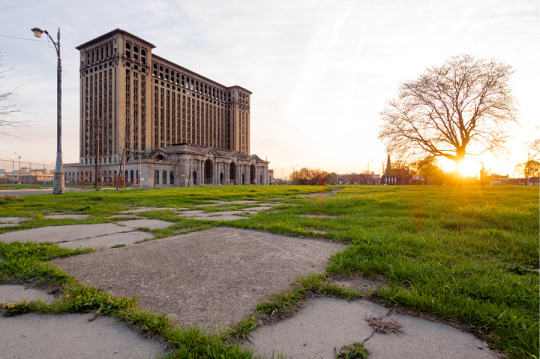
    Take, for example, billionaire Dan Gilbert and Detroit. Not everyone believes that Detroit will come back. In fact, I suspect there are probably more people who think it won’t come back, than people who think it will. Otherwise, it would already be back.

    But Gilbert is unquestionably long on Detroit (via Forbes):

    As you’ve likely heard, over the past four years Gilbert has become one of Detroit’s single-largest commercial landowners, renovating the city with the energy and impact of a modern-day Robert Moses, albeit bankrolled with his own money. He’s purchased and updated more than 60 properties downtown, at a total cost of $1.3 billion. He moved his own employees into many of them–12,000 in all, including 6,500 new hires–and cajoled other companies such as Chrysler, Microsoft and Twitter to follow.

    If/when Gilbert proves to be right about Detroit, then he will have been right about something that most people thought was wrong. And because of that, he will no doubt make a lot of money.

  • How ethical is the trailer park business?

    When I was in grad school at Penn, real estate mogul Sam Zell used to come in and talk to students about once or twice every year. He permanently endowed the Samuel Zell and Robert Lurie Real Estate Center at the school and so there was a strong connection.

    Because of Zell, a few of us developed a theory that the entertainment value of a talk was more or less correlated with net worth. In other words, the richer the speaker, the funnier the talk. Zell, for example, would often come in jeans, a baseball hat and a hawaiian-like shirt, and drop f-bombs all throughout his talks. You can do that sort of thing when you’re worth a few billion and you’re signing the checks.

    But beyond just being entertaining, Zell shared a lot of insights about the businesses he was in, getting into (Chicago Tribune) and getting out of (Equity Office Properties). Some of those businesses turned out to be a disaster (Chicago Tribune), but others (Equity Office Properties), made him look like an absolute genius.

    One business that he always liked to mention though, was the manufactured home business–also known as the trailer park business. And that’s because, as chairman of Equity LifeStyle Properties, Zell is the largest mobile-home landlord in the US. They control 140,000 sites across 32 states and in British Columbia, Canada.

    The reason Zell likes this business is, quite simply, because it makes a lot of money and it’s growing. There are an estimated 12 million Americans living in trailer parks. That’s probably why Warren Buffet also bought Clayton Homes–another manufactured home builder–for $1.7 billion in 2003.

    But it’s not just the big guys who like this business, it’s entrepreneurs at all levels. In fact, I was just reading this article from New York Times Magazine about a couple of entrepreneurs who actually setup a school called Mobile Home University. The objective is to train aspiring entrepreneurs on how to profit from poor people in America:

    “The bottom line is Americans as a group are getting poorer,” he told his students — and while that’s bad news for those living on the economic fringes, it also means opportunities for those willing to take advantage of the trend.

    Just how poor? Here are typical rents:

    The typical tenant who rents from Rolfe and Reynolds pays $250 or $300 a month in lot rent and another $200 or $300 if also renting a trailer. “The trailer park is people’s last choice,” Rolfe says, “and we recognize that.”

    Now, trailer parks are not the sort of thing that architects and planners typically like to talk about it. They’re not sexy. They’re not urban. But as the article says, these guys are providing the “dollar store” of housing and making a lot of money doing it (annual returns of approximately 25%).

    But is targeting people with rock bottom credit ratings and no other housing options an ethical business model? (The article also talks about 10% a year rent increases.) I’ve personally always found these ethical questions to be difficult to take a stance on and so, for this one, I’m going to put it out to the ATC community. What do you think?

  • What I see as the fundamentals of real estate investing

    Earlier this week my father sent me this article containing an excerpt of Warren Buffet’s upcoming shareholder letter. His annual letter—which started in 1965—is well known in the investment community. And in many ways, it’s like his own annual blog, started well before anybody knew what a blog was. His letters are personal, genuine and engaging—just like a good blog should be.

    But for me, what was really interesting about the letter is that it provided a number of lessons about investing in real estate. Lessons which, in my view, really represent the fundamentals of the business. The way I think about it is that there are really 2 ways in which to make money as a real estate investor over the long term. You can develop/reposition real estate and/or you can collect rent.

    Develop/Reposition

    If you’re developing or repositioning real estate, it means you’re doing something to increase the value of the property. It could be by rezoning, building new, or through an aggressive leasing strategy. It’s whatever you believe will unlock additional value. Once you’ve done this, you then either sell the property or you move onto the 2nd way of making money in real estate.

    Collect Rent

    By collecting rent, I really mean that you’re buying yield. This means you’re saying to yourself:

    I can buy this property for $1,000,000 and the net operating income on it is $100,000 (per year). So that means I’m buying at a 10% cap rate (or return). 

    Or maybe you’re saying:

    I can buy this property for $1,000,000, but the net operating income is only $25,000. However, the rents are well below market and I think I can easily get this thing up to a “10 cap.”

    Either way, you’re buying a stream of cash flows and you have an understanding of where that cash is going to come from.

    Speculate

    If on the other hand, you’re buying solely on the expectation that prices are destined to rise, you are—as Buffet points out in his letter—speculating. You’re not doing anything to create value and so you’re not developing. And if you’re counting on price growth to generate your investment returns, then you aren’t buying yield either.

    While many people have made large sums of money by speculating on real estate, I don’t consider myself capable of doing that in any sort of sustainable way. Hell, if Warren Buffet doesn’t think he can do that, why should I think I’m special.

    But some of you may disagree with this framework. If so, I’d love to hear from you in the comment section at the bottom of this post.