Daily insights for city builders, delivered every morning at 6 AM ET. I’m Brandon Donnelly — a Toronto-based real estate developer and founder of Globizen. I’ve been writing here since 2013.

Tag: wall street journal

  • Two-hour grocery delivery

    Today it was announced that Amazon is planning to launch its “Prime Now” service in Vancouver and Toronto this November and January, respectively. 

    The pilot program will offer two-hour deliveries for members and, according to the Wall Street Journal, will be be heavily focused on groceries. 

    It’s worth noting that most of Whole Foods’ stores in Canada (now owned by Amazon) are in and around Vancouver and Toronto. And that Amazon has already started lowering prices to make those stores more competitive.

    Right now a “Prime” membership in Canada costs CAD$79 per year. I’m not sure if the price will change at all for “Prime Now”, but let’s assume for the sake of argument that it won’t. 

    If this service was available to you today (or if you’re in a city that currently has it), would you (do you) use it? I would love to hear your thoughts in the comment section below.

    Two common objections around online grocery shopping are that many people want to touch and feel the goods before they buy and that perishable deliveries are a challenging thing to coordinate.

    I think I can work around those objections and would certainly try this today if it was available in Toronto. What about you?

  • From retail to logistics

    Over the past few weeks we’ve been talking about the future of the mall on this blog. It’s a topic that I’m very interested in.

    Yesterday the Wall Street Journal published an article talking about the trend of converting retail/shopping facilities to logistic centers. 

    Here’s an excerpt:

    “In Mesquite, Texas, FedEx Corp. next month will open a 340,000 square-foot distribution facility on what once was the site of the former Big Town Mall. Located along U.S. Highway 80 in Texas, the mall declined after newer malls were built nearby. It was demolished in 2006 and the land was later rezoned for industrial use.”

    It turns – and we’ve talked about this – that good retail locations are also good distribution locations. They are usually located close to humans and infrastructure.

    Here’s another example from the article:

    In North Randall, Ohio, Amazon.com Inc. is considering the site of the former Randall Park Mall as a fulfillment center, according to Port of Cleveland, a local government agency focused on spurring job creation and economic growth in Cuyahoga County. Amazon didn’t immediately respond to requests for comment.

    For a short time when it opened in 1976, Randall Park Mall was the largest shopping center in the world and had been “a thriving heartbeat” for the local economy, according to Mr. Davis. But the mall closed in 2009 as stores struggled with fewer shoppers.

    Assuming this trend continues and people continue to buy things online, one has to wonder about the placemaking that should or needs to happen in these areas.

  • I can’t spend unrealized gains

    image

    Earlier this week the Wall Street Journal published an article claiming that the celebrated venture capital firm Andreessen Horowitz was lagging behind its elite peers in terms of returns.

    The firm then responded with a well-written blog post explaining why this accusation is off the mark. Their response was simply that you can’t measure returns on “unrealized gains.” Until there is a liquidity event – that is, the company gets sold or goes public – it’s just paper returns. And what matters is cash. 

    As the post clearly states: “I can’t spend unrealized gains.”

    But beyond just a rebuttal, the blog post is a great primer on how the venture capital industry works. We talk a lot about the tech space on this blog, so I thought some of you might find it interesting. 

    One of the reasons I like to follow the VC space is that there are many similarities to real estate development. Not only in the way that the funds are structured, but also in the way that the gestation periods are incredibly long.

    The post talks about this as a “J curve.” In the early years of a fund, the returns are negative. Money is going out the door to invest in immature and risky startups. And it’s not until the harvesting period (7+ years later) that the realized gains start getting paid out to investors (LPs).

    It’s also interesting to note that the exit timing for companies – at least according to Andreessen Horowitz – seems to be increasing (10+ years). This is yet another similarity to real estate development where it seems to be getting harder and harder to build and deliver new supply.

  • Young, educated, and urban

    The Wall Street Journal recently published this article talking about how the young and educated are flocking to high-density urban areas all across the United States. Here’s a set of charts from the article:

    There are many people who will point out – probably rightly – that despite the “return to cities” that we are currently seeing, the world is still suburbanizing. But, it doesn’t appear to be suburbanizing in quite the same way as it did for prior generations. There’s also a socioeconomic shift taking place.

    As an example, and to drive home the point that it’s not just the expensive coastal cities that are seeing rising home prices, the WSJ article focuses quite a bit on Ohio City – a neighborhood in Cleveland. Here’s what has been happening:

    In the Ohio City neighborhood, the median income skyrocketed to $93,000 from $23,000 since 2006, according to Ohio City Inc., a local nonprofit development group. Median home values shot up 800% since 2000 to $270,000, according to Ohio City Inc. Median rental prices in downtown Cleveland as a whole jumped 47% from late 2010 to late 2015, according to the Center for Population Dynamics at Cleveland State University.

    These are pretty dramatic increases – though $270,000 feels cheap to someone from Toronto. Still, it speaks to a trend. You and I both know that Ohio City isn’t the only neighborhood seeing those sorts of numbers.

  • Project Sidewalk

    One of Alphabet’s subsidiaries is a company by the name of Sidewalk Labs. Some of you, I’m sure, have been following it. The goal of the company is to leverage technology in order to solve some of our biggest urban challenges.

    Initially, they were fairly under the radar, but more recently they’ve become a lot more public with their projects and their mission. Here is a snippet from a recent blog post written by their CEO, Daniel L. Doctoroff

    “The world is poised for a fourth urban-tech revolution — an age of connectivity capable of reshaping cities as much as the steam engine, electricity, and automobile have in the past. New technologies will help citizens and elected officials tackle those intractable urban challenges that Larry outlined last summer, but making sure this age imposes fewer social costs than those previous shifts is critical.”

    Earlier this week it was also announced that the company is likely to enter the real estate development business and construct a new city precinct in order to pilot some of their ideas and projects. The initiative is called Project Sidewalk. 

    Here is an excerpt from the Wall Street Journal:

    “According to people familiar with Sidewalk’s plans, the division of Alphabet is putting the final touches on a proposal to get into the business of developing giant new districts of housing, offices and retail within existing cities.

    The company would seek cities with large swaths of land they want redeveloped—likely economically struggling municipalities grappling with decay—perhaps through a bidding process, the people said. Sidewalk would partner with one or more of those cities to build up the districts, which are envisioned to hold tens of thousands of residents and employees, and to be heavily integrated with technology.”

    When I read this, I immediately thought of the Port Lands area in Toronto. Not because Toronto is decaying – far from it – but because it’s a massive 880 acre site that is both adjacent to downtown and entirely underutilized. I can’t wait to see this area transformed into a thriving waterfront community.

    In any event, if or when Project Sidewalk gets off the ground, it will be very interesting to see what a Google-backed real estate development company looks like.

  • Sprawling, but affordable

    The Wall Street Journal recently published an interesting article that ties in nicely with two of my recent posts. My post about North American population growth and my post about the San Francisco pro-development group known as BARF.

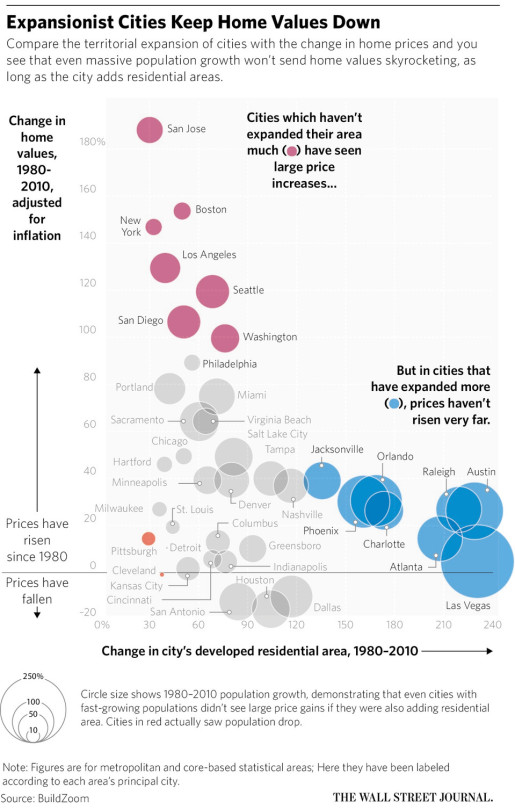
    The WSJ article is about the growing divide between affordable and expensive cities in the US. And the argument is that expansionist, or sprawling, cities are better at suppressing home values and maintaining affordability:

    “The developed residential area in Atlanta, for example, grew by 208% from 1980 to 2010 and real home values grew by 14%. In contrast, in the San Francisco-San Jose area, developed residential land grew by just 30%, while homes values grew by 188%.”

    Now, here’s a chart saying that same thing:

    The reality is that greenfield development (suburban sprawl) generally has far fewer barriers to development than urban infill development. So I’m not surprised to see cities like Las Vegas, Atlanta, and Phoenix clustered towards the bottom right.

    At the same time though, I’m obviously not convinced that sprawl is an optimal outcome. I think there are other costs not reflected in the chart above. So what’s the best solution here, assuming we want to build inclusive mixed-income cities?

  • America really is building very few condominiums

    On my way back from Philadelphia
    this past weekend I wrote a post called, The
    Philadelphia (real estate) story
    . It was about how opposite the market is
    in Philly compared to Toronto.

    After writing that post and
    because of a discussion in the comment section, I started thinking about condo
    vs. rental apartment development across the US. Because unlike cities such as
    Toronto and Vancouver, it struck me that – outside of maybe New York and Miami
    – most U.S. cities are really not building a lot of for sale condos. And if
    you’re from Toronto or Vancouver, I bet that feels odd to you.

    But what exactly is that number?

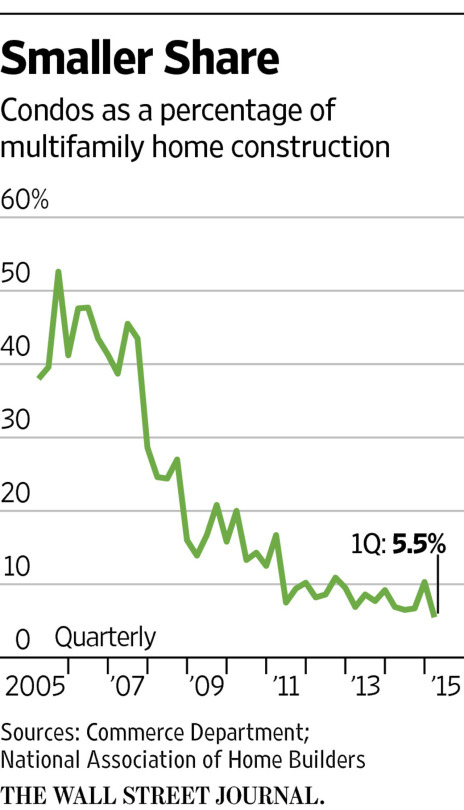
    As of the first quarter of 2015, condos as a percentage of all new
    multifamily (apartment) construction in the US was only 5.5%. That’s a tiny number and is down from
    over 50% before the Great Recession, which means most
    cities in the US really are building mostly rental. Last year the US built 264,000
    multifamily units across 11,000 buildings
    .

    So why is that happening?

    There appears to be a number of
    factors, according to a
    recent article in the Wall Street Journal
    .

    There’s a supply side
    constraint:

    Another obstacle cited by developers: construction loans. Matt
    Allen, chief
    operating officer of the Related Group, a developer based in Miami, said he can
    get a construction loan for roughly 75% of the cost of building an apartment
    complex. But lenders will cover only 50%, on average, of a condo complex’s cost
    because of the greater risk, he said.

    There’s a demand side
    constraint:

    As a result, the Federal Housing Administration, which
    backs mortgages made to low-wealth buyers, tightened its lending standards in a
    series of moves from 2008 to 2012. Under the new rules, in order for the FHA to
    insure mortgages in a given condo complex, at least half of the units must be
    owner-occupied and no more than half can be FHA-insured, among other
    requirements. For condo projects under development, at least 30% of units must
    be under contract for sale before the FHA will start backing mortgages there.
    Mortgage giants Fannie Mae and Freddie Mac tightened
    their standards as well.

    And there are macroeconomic
    factors:

    On the entry-level end, tepid job growth early in the
    recovery and the younger generation’s affinity for flexibility have fueled
    demand for rentals. Apartment rents are up nearly 16% since 2010, according to Reis Inc.

    Notwithstanding
    the above, could this be a post-recession policy pendulum that has swung
    too far in one direction?

  • Rise of rental

    image

    Last month Oxford Properties submitted a site plan application for the redevelopment of the rundown Cumberland Terrace in Toronto’s Yorkville neighborhood. If you’d like to browse the full application (including all the drawings), you can do that here.

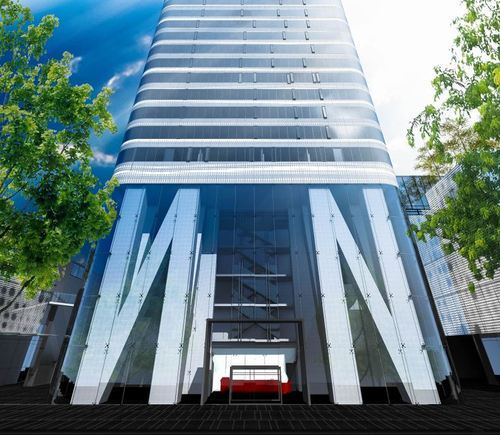
    The proposal is a departure from previous plans and now includes 3 buildings: a 4.5 storey building, a 2.5 storey building, and a midblock 54 storey residential tower (the lobby is shown above). There will be both retail and residential uses.

    For those of you familiar with the mall, it should go without saying that Cumberland Terrace is in desperate need of redevelopment. So I’m not going to talk about that today. Instead, I’d like to mention 2 other points that stood out to me about the application.

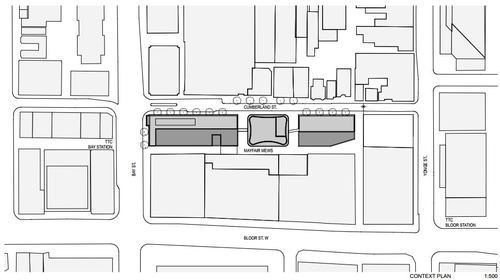
    The first is the 2 midblock connections on either side of the tower, running from Cumberland Street to Mayfair Mews in the rear (see below). Yorkville has a history of intimate laneways, and so it’s nice to see some of this being carried through in a new development. It also opens up the opportunity for an improved Mayfair Mews.

    image

    Secondly, it’s somewhat surprising to see that the 54 storey residential tower is being proposed as rental. Toronto doesn’t build a lot of purpose-built rental apartment buildings. There are some (from the likes of Morguard and Concert Properties), but we haven’t done it at scale for decades. And that’s largely because the demand for condos has been so great.

    But recently I’ve been noticing a renewed interest from the real estate community in multi-family rental assets. Cadillac Fairview also proposed a 65 storey rental building at the north west corner of Yonge Street & Queen Street last year – though they later withdrew their application.

    image

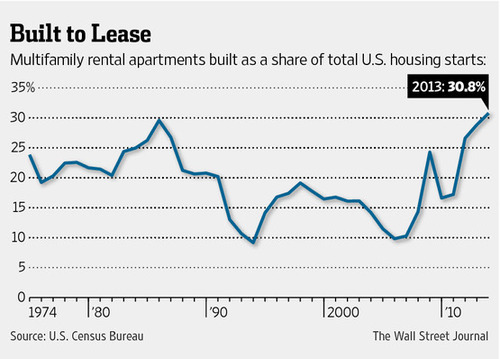
    In the US, rental apartments as a share of all new housing is also at record highs – over 30%. And that’s partly because credit remains tight (certainly compared to pre-2008) and economic growth has been tepid. But also because of demographic changes. People are having fewer children, later in life, and so many are putting off buying.

    So I think we’re going to see even more rental apartments being built in Toronto in the coming years.