
Daily insights for city builders, delivered every morning at 6 AM ET. I’m Brandon Donnelly — a Toronto-based real estate developer and founder of Globizen. I’ve been writing here since 2013.

Tag: wall street journal

  • What will be the new New York City?

    Peggy Noonan argues, in this recent WSJ article, that the world has changed forever. A human habit was broken during this pandemic and city life, including office life, will never be the same in New York City. She qualifies this by saying that some people will return to offices, potentially in significant numbers. (People like being around other people.) But that things will never be what they once were. We’ve learned that we can decentralize and still get work done.

    As many of you know, I am bullish on cities and I am bullish on offices. So I found myself disagreeing with many of her arguments. But Peggy does raise some valid concerns: How are cities going to pay for what just happened over the last 12 months? According to the Partnership for New York City, the city lost about 500,000 private-sector jobs since March 2020. About 300,000 residents from high-income neighborhoods also filed for a “change of the address” during this time period.

    Given that the top 5% in New York represent about 62% of the state’s income tax base, the movement of people to low-tax states (and warmer places) is something to watch. It’s also a trend that existed well before this pandemic.

    At the same time, I’m not necessarily convinced that (at least some of) these fleeing rich people aren’t coming back. I was speaking with a real estate agent over the weekend who is based in a popular US resort/recreation market and while he told me that, yes, he’s seeing a massive influx of people from expensive coastal markets, these people are largely choosing to rent. They want to take the lifestyle for a test drive and they are also waiting to see what happens with the world once city life returns.

    There will be real financial challenges coming out of this. But as I’ve said time and time before, cities are remarkably resilient. And as Jack Shafer argued in this recent article about “memorializing the pandemic,” humans tend to have short memories, especially when it comes to bad things. The Spanish Flu has been regarded by many as a forgotten pandemic. We moved on and the same will happen this time around.

  • Crossing the chasm in Austin

    I can’t open Twitter these days without seeing someone in the tech industry talking about moving or talking about someone who just moved to either Austin or Miami. “What’s the best neighborhood in Miami for startups? My friend just moved to Edgewater. Where did so-and-so move?”

    Here’s a recent article from the WSJ talking about how accelerated tech-fueled growth is straining Austin. And below is a set of charts (from the article) comparing home prices in Austin and San Francisco. (Reminder, the California-to-Texas migratory pattern recorded the highest number of “net movers” last year.)

    But in reading through the article, I am reminded that the challenges facing Austin are not entirely unique. Growing cities all around the world are being put in a position where they need to decide whether they want to remain car-oriented and relatively low-density, or if they want to make the shift toward more transit-oriented urbanism.

    It’s admittedly not easy, both politically and practically speaking. It’s hard to rewrite deeply entrenched built form. But Austin is naturally looking at what happened in San Francisco, where restrictions on new development are thought to be partially (largely?) responsible for the city’s unaffordable housing.

    According to the same WSJ article, voters in Austin turned down two previous transit proposals. One was in 2000 and the other was in 2014. There was concern over too much urbanization. There was concern it would induce more people to move to the city. And there was concern that it would threaten the city’s low-rise single-family homes.

    But this year a transit plan was approved that includes three new rail lines, one of which will tunnel through downtown. Provided that Austin can effectively pair this with more housing, more uses, and more density — which is generally what you need to make transit work — then it may be well on its way to crossing, if you will, the chasm of urbanity.

    Charts: WSJ

  • Delivering happiness

    I was both surprised and saddened to learn about the death of Tony Hsieh this weekend. Forty-six years old is far too young.

    Though best known as a pioneer of e-commerce (he was previously CEO of Zappos) and for his brilliant/wacky management ideas, Tony was also a city builder, particularly in Las Vegas.

    Here’s an excerpt from a recent WSJ article:

    In Las Vegas, Mr. Hsieh became beloved locally for investing $350 million into revitalizing part of the city’s downtown including real estate, restaurants, retail and a tech startup fund starting in 2012. His vision included the development Container Park, a quirky shopping and entertainment center where retailers operate in converted shipping containers. Visitors are greeted by a giant sculpture of a praying mantis that shoots fire.

    But perhaps more importantly, everything I have read this weekend about Tony describes him as a good human being with a great sense of humor and a commitment to “delivering happiness.”

    Here’s another excerpt from the same article:

    After Zappos had a rash of late deliveries, he sent an apology note to customers and provided a phone number for use by anyone who suffered “undue hardship.” As for those who were merely annoyed, he said, they were welcome to call Zappos and “ask whoever answers the phone to do something weird and embarrassing, like sing ‘I’m a Little Teacup.’”

    Happiness. I can’t think of anything better to be delivering to people in the world right now.

  • Wuhan as tourist destination

    Seeing people out at bars and at amusements parks in this WSJ video about Wuhan, China is a little odd given that in this part of the world we are decisively in our second wave. But that is what is happening. In fact, the title of the video is, “Wuhan, Former Pandemic Center, Emerges as Tourist Hot Spot.”

    Over a recent public holiday, the city saw nearly 19 million tourists — the most of any Chinese city. And while tourist revenues are still thought to be down by some 30%, Chinese people are seemingly feeling confident enough to get back out and do things.

    Based on what the WSJ is reporting, this seems to be supported by a few things. International travel isn’t happening, so it’s becoming a boon for local tourism, which is not that dissimilar from what’s happening in other countries. (Domestic air travel is rebounding faster than international travel when you look at flight volumes across major airlines.)

    At the same time, Wuhan implemented what sounds like some pretty extensive testing, which is in turn supported by a national healthcare platform that presumably makes contact tracing easier. These things seem to have given people the confidence to go out again. And I don’t doubt that the same will eventually happen in the rest of the world.

  • Extell Development to build $2 billion ski resort near Park City

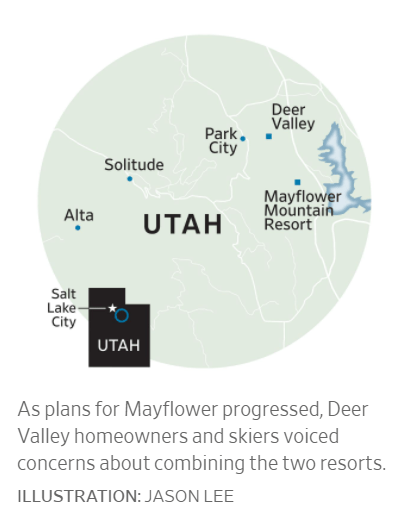
    New York-based Extell Development is, according to this recent WSJ article, in the midst of trying to build a $2 billion full-service ski and snowboard resort near Park City, Utah. It would be the first new resort in the United States in about four decades. These things are, clearly, difficult to get approved, and the fundamentals are, arguably, not all that great. In the early 1990s, the US had about 546 ski and snowboard resorts across the country. As of the 2018-2019 season that number had dropped to 476, according to the WSJ. People are skiing less than they used it, it would seem.

    To be a bit more precise on its location, the proposed resort, which is currently called Mayflower Mountain Resort, is to be located next to Deer Valley Resort. And there’s even a plan floating around to possibly merge the two resorts. That’s apparently what the county planners want. I’m not all that familiar with Deer Valley because they don’t allow my kind there (snowboarders). But it’s an exclusive resort with a country-club kind of feel (or so I’m told). So it shouldn’t come as a surprise that the proposed merger doesn’t seem to be getting a lot of traction with the patrons of Deer Valley.

    But here’s the interesting thing about the Mayflower site. It’s generally controlled (to what extent, I don’t exactly know) by an entity called The Military Installation Development Authority. And this entity has the power to do things like issue bonds and grant certain land-use approvals. This means that there may be an angle to streamline the approvals process (i.e. make this project actually feasible) and to leverage things like tax increment financing (TIF) in order to fund the project.

    Supposedly a new mountain resort has been on the books for this site for some 30 years. Could now finally be the time? If they allow my kind, you can count me in.

    Image: WSJ

  • Percentage of US mortgages in forbearance

    This recent WSJ article, which is largely about single-family home landlords in the United States, has some interesting charts about mortgaged homes. The following chart shows the percentage of US homes that are worth less than their debt (i.e. they’re underwater). Following the financial crisis, the figure was about a quarter of all mortgaged US homes, and it stayed that way until almost 2012. This percentage surprised me.

    The other chart that I’d like to share today shows the percentage of US mortgages in forbearance (i.e. people deferring payments). Not surprisingly, the percentage really increased in April, peaked in early summer, and has since started to seemingly decline. I say seemingly because who knows what this fall/winter will bring. As of September 6, the number was about 3.5 million home loans (or about 7.01%).

    The point of the WSJ article is that there are a segment of people who are house-rich, but cash-poor. They have equity that they have built up, but maybe not a lot of cash to weather a storm. That could force some to sell. And it could be a boon for the rental-home landlords, who have been, in many cases, betting on the the suburban rental market since the last recession.

  • Was NYC’s urban density really the problem?

    I posted this chart on Twitter last night. It’s from the WSJ showing new weekly confirmed COVID-19 cases in Florida, New York, and the U.S. as a whole. Now, the first thing I will say is that I relinquished my hopes of becoming an amateur epidemiologist back in April. I have no idea how this is all going to play out. But as an urbanist, it is interesting to note that back in April, many believed that New York City’s urban density was a real problem and the almost singular cause of its high number of cases (despite many other big and dense cities around the world doing much better). There was also a belief (or hope) that warmer temperatures might have a positive impact on transmission rates. That’s maybe why Florida was doing relatively better. But things have flipped. Cases in Florida are up and California just surpassed NY for the US state with the most number of cases. So who knows what will happen next. But what I do know is that wearing a mask isn’t a big deal (I have mine with me all the time) and that big urban centers will be just fine. City Observatory recently published apartment search data suggesting that dense cities have actually been getting more, rather than less, attention in the wake of COVID. That doesn’t surprise me.

  • City-to-city airline routes expected to decline by 20% this year

    Supposedly there are more than 14,000 airplanes parked around the world right now. And according to the latest numbers from IATA, this is expected to translate into an $84 billion loss for global commercial airlines in 2020. The industry is not expected to return to profitability until 2022. As a point of comparison, net profits were about $26.4 billion last year.

    Some more numbers from IATA:

    Here is something else from the Journal. The number of airline routes has doubled over the past two decades. That has included the number of city-to-city routes. IATA is predicting that by the end of this year we will see these urban routes decline by about 20% compared to last year. And who knows when they will return. Perhaps in 2022, along with profitability.

    The reason I point this out is because if you follow the work and writing of planner Joe Berridge, you will know that he often cites airports as being a key piece of infrastructure for global cities. At one point, having a deep harbor was everything you needed in order to bring in goods and people. But today a solid airport is paramount.

    Will the loss of this city-to-city connectivity have an impact on some cities?

  • Two tragedies

    A friend of mine called me out today for not using my online presence — both social media and this blog — to share my views on the horrible tragedies that are taking place right now in the United States and the world. She is right. And it is certainly something that I have been thinking about. But as I mulled it over in my head, it just didn’t feel right to glibly share a few social media posts and consider my contributions complete. For almost 7 years, this blog has been my public voice and this blog is where I figured it should show up when I was ready.

    My view is that there are really two tragedies taking place right now. The first started with the murder of George Floyd. It was truly awful, and it is symptomatic of some fundamental issues that remain in our society. I support the demonstrations that have ensued and I am pleased to see people and companies taking action. To give one example, Goldman Sachs today announced the creation of a $10 million fund for Racial Equity. If any of you know of any causes that should be supported or of any actions that you believe should be taken, I would encourage you to share them in the comment section below or to email them to me directly.

    The second tragedy is the looting that has followed tragedy number one. Whoever is doing it, I think it is counterproductive and I think it serves to obscure the systemic problems that we know need to be addressed. I was reading through this Journal article today about the impact that looting is having on small black-owned businesses in Philadelphia — a city that is near and dear to me. It makes me both sad and frustrated that these businesses are scrambling to post up “Black Owned” signs in their windows in an effort to be spared from the chaos.

    The article goes on to quantify the number of US small businesses in mostly black areas that have enough cash on hand to survive 14 days or more. Very few do. In fact, almost none of them do. The number for mostly black areas is only about 5.3%. This is compared to 70.4% for mostly white areas and 97.9% for mostly Asian areas. This is a scary statistic that only amplifies the severity of tragedy number two. This looting is delivering a second blow to small businesses that were already reeling on the ground from COVID-19.

    Tragedy number one and the push for racial equity and positive change is the focus here.

    Update: Minor edits were done to this post in an attempt to clarify its original intent.

  • The state of the restaurant industry

    People are starting to eat at restaurants again. Here is a recent chart from the WSJ showing seated diners at restaurants on the OpenTable network:

    OpenTable has been publishing this data since the beginning of the pandemic in something they call “the state of the restaurant industry.” All of their datasets from around the world can be downloaded here.

    Back in March, it was interesting to see this data, but most people basically just stopped eating out around the middle of the month. After that, in-person dining mostly flatlined. (This data wouldn’t capture takeout, delivery, and other activities not flowing through the OpenTable network.)

    At this point, we are now seeing geographies reopen in different ways. Germany, for example, is ahead of many other countries (at least on the OpenTable network). Note the spike (i.e. lower year-over-year decline) on May 21st. It was a national holiday.

    You can also drill down into individual cities:

    I think this is a pretty good indicator for how people are feeling, and so it could be useful to follow this data. Governments can reopen things, but people need to feel confident to go out and spend money. It looks like a number of people already feel that way.