Daily insights for city builders, delivered every morning at 6 AM ET. I’m Brandon Donnelly — a Toronto-based real estate developer and founder of Globizen. I’ve been writing here since 2013.

Tag: virtual reality

  • Will Apple Vision make our cities more lonely?

    Okay, so I haven’t tried it yet. But Apple Vision looks pretty awesome and the people who have tried it seem to be very impressed by it. The best article that I have read, so far, is this one here by Ben Thompson (of Stratechery). He gets into some of the tech details and explains why Apple is probably the only company in the world that could have created a device like this.

    For those of you who are interested, Apple Vision is still technically a VR device, even though it is being marketed as an augmented reality (AR) device that allows you to stay engaged with the world around you. This last part is true, but it is all done digitally through 12 cameras that capture the world around you and then display it back to you.

    So experientially, yes, it is an AR device; however, the tech behind it is actually just exceptional VR.

    But this is not the point of today’s post. The point I would like to make is one that Ben raises at the end of his article. After praising Apple Vision’s achievements, he goes on to argue that the arc of technology is one that is leading toward “ever more personal experiences.” In other words, it is increasingly about individual, rather than group, use cases.

    And this is one of the first things that I thought of when I watched the Vision Pro keynote. “Wow, this looks like a really cool way to watch and experience a movie. But how do I do that with my partner? I guess we both now need Vision Pros. And what about families with a bunch of kids? That is a lot of Vision Pros.”

    But maybe this doesn’t matter. Ben’s point is that it’s probably not an accident that this technology arc is happening at the same time as a larger societal shift away from family formation and toward more feelings of loneliness. Indeed, the number of single-person households has been steadily increasing in the US since the 1960s. The current figure sits at more than 1 in 4 households.

    So there is an obviously dystopian narrative that we could all tell ourselves here. It is one where everyone works from home, plugs into virtual workplaces, and then flips over to other, more exciting, virtual worlds when it’s time to unwind from the stresses of the former. And if you think about it, this isn’t that much of a stretch compared to what many of us do today.

    Whatever the case, in my mind, none of this is any reason to become bearish on cities. Humans will still be humans. And none of this tech is going to replace the feeling of enjoying a perfect pesto gnocchi in an impossibly narrow laneway in Milan, or drinking a caipirinha on the beaches of Rio de Janeiro while being surrounded by shockingly beautiful people.

    Or at least let’s hope so.

  • Self-expression and community move online

    The New Consumer, in collaboration with Coefficient Capital, just published its latest Consumer Trends report, which you can download for free over here (registration required). There’s a lot in the report to flip through, but I thought I would share these two slides:

    Generation Z and Millennials now make up ~40% of the US population and they are soon entering their prime consumer spending years. What’s noteworthy about these charts, but perhaps not surprising, is the extent in which self-expression and a sense of community have shifted from offline to online.

    Very few Boomers, at least according to this report, feel like themselves online. But nearly half of Gen Z feel most like themselves online. What it means to be part of a “community” has also shifted dramatically, with more if it happening online or at least partially online.

    All of this ties into what happened earlier in the week with Nike announcing the acquisition of RTFKT Studios. As I mentioned in this post, the so-called metaverse doesn’t necessarily have to mean VR goggles and living in video games. It can simply mean placing value on the parts of our lives that are now digital. The above two charts suggest that many are already doing this.

    Of course, what all of this means for our physical lives is an important question. Josh Stephens recently argued, over at Planetizen, that the metaverse is going to be really bad for cities. The more we focus on seductive virtual worlds, the less we will focus on our physical spaces. I get this logic.

    But again, I think it depends on how you define the metaverse. And I think VR headsets are a pretty narrow definition. I am both a lover of technology and a lover of cities. And throughout this pandemic I have been fairly consistent in writing about the resiliency of cities. Nothing in this post changes that for me.

  • Why construction productivity sucks and how it might be fixed

    We are living through an inflationary hard cost environment. In speaking with one of our cost consultants the other week, he was predicting that overall we could see another 9-10% increase next year here in the Toronto area. Now, who knows what will ultimately happen. But this is top of mind for everyone in the industry and it will continue to impact how and what we build.

    One of the challenges with construction — and this is will documented — is that unlike the manufacturing industry, which has seen sustained productivity improvements over the years, the construction industry has seen relatively little productivity growth over the last half century. In fact, you could argue that it’s been mostly negative in recent history.

    The obvious thought is why not just apply what we’ve been doing in manufacturing to construction. There is, of course, a long standing tradition of trying to do this, with varying degrees of success. But at the end of the day, building a house remains different than building something like a car.

    Probably the key difference is that every construction site has unique constraints and conditions and so the process is constantly changing. Whereas the innovations that Henry Ford pioneered were centered around interchangeable parts and a well-defined process that could be repeated millions of times to generate the exact same output.

    From what I can tell, there seems to be two ways in which we can think about improving productivity. One, we can try to be more Ford-like and drive standardization. This means more off-site factory construction and more standardization. This is the typical “pre-fab” approach and companies like R-Hauz, as well as many others, are already successfully doing this. The trade-off is less design flexibility.

    The second option has to do with better software and hardware. What if we had significantly better “digital twins” for our buildings such that we could see and experience it in 3D before it is physically built? I’m thinking strap on VR goggles and do a walkthrough with the team. This could allow us to pinpoint all of the issues before they actually happen on the job site.

    In parallel to this, what if we had far better on-site automation and robotics to then execute on the above digital twin? Think 3D printing concrete instead of using traditional forms. This is all happening and being worked on, but it doesn’t seem to be at a point where it is changing our industry. But it is exciting to think that it may one day.

    Photo by Di on Unsplash

  • Meatspace vs. metaverse — what is the best way to flex?

    With every passing year, the Matrix feels less and less like science fiction. With the continued rise of the metaverse — Zuckerberg is betting all of Facebook on it — we are increasingly living our lives between two worlds: one is offline and one is online. What this will ultimately mean (for us and for our cities) is of course up for debate. But what is clear is that the traditional trappings of real life have quickly made their way online into the metaverse. Arthur Hayes recently penned this fantastic article about the future of the world (it’s the metaverse) and the role of art (including NFT art). In it, he makes the argument that to “flex” is integral to the human experience. Here’s what he means by that:

    As social beings, the sole purpose of many activities and purchases is to publicly display how much energy you can waste. The nightclub economy is extremely a propos to this concept. Individuals walk into a dark room, listen to loud music (art), dance (a waste of energy akin to a mating call), and pay exorbitant amounts of money to drink liquid. Everyone gets dressed up real nice in articles of clothing that serve no useful purpose other than to demonstrate that the wearer spent a lot of money to display their social status to the rest of the clubbers present.

    People go to clubs to flex. In the words of the late Clayton Christensen, that is the “job” to be done.

    Why this matters is that many of us are now doing the same kind of things online. Buying a CryptoPunk (an OG NFT) for a large sum of money and posting it as your social media profile pic is a flex. Is this rational or irrational behaviour? Whatever your answer, it is akin to paying several hundred dollars for a t-shirt from some cool streetwear brand. The real job to be done is not that you desperately need a t-shirt to cover your upper torso. It is the signalling that goes along with owning something scarce and valuable. One of the things that is so special about NFT-permissioned stuff is that there’s now a simple way to prove and enforce all of these things: ownership, scarcity, and so on.

    What’s equally fascinating to me is how offline and online will end up interacting with each other. (Arthur refers to our offline world as the meatspace. I don’t know if he coined the term, but I’m going to rolling with it for the purposes of this post.) If people end up preferring to flex online instead of offline (and I’m sure many already do), what does that do to our meatspace(s)? And what does it do to our cities and how we build? I have no doubt that these questions are coming.

    Photo by Richard Horvath on Unsplash

  • Trying out the Oculus Rift virtual reality headset

    image

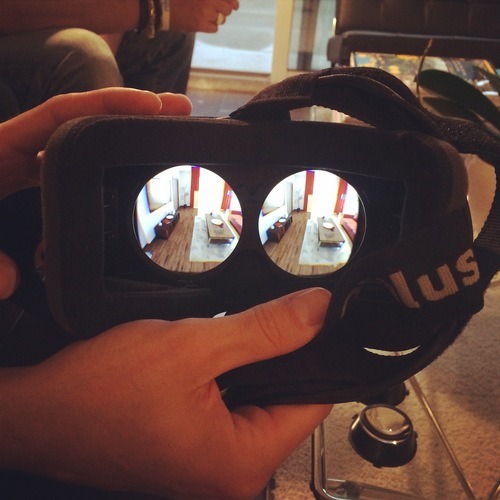
    This week on Architect This City is turning out to have a big focus on technology. And it’s not going to stop today, because this evening I had the chance to try the Oculus Rift virtual reality headset for the first time (many thanks to Dave Payne of Invent Dev for the demo). As a reminder, Oculus is the company that Facebook recently acquired for $2 billion.

    Now virtual reality certainly isn’t a new idea and lots of people have been promising – for a long time – that it was going to revolutionize the world. Which may be why I had somewhat low expectations going into this. But I have to say that I was blown away. Despite being a bit choppy (to get good visuals it ran at around 15 frames per second), I was shocked at how immersive the experience was.

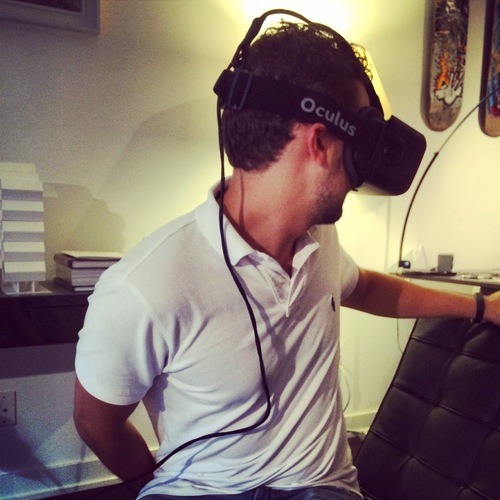
    Here’s a picture of Rick exploring the (virtual) space behind him:

    image

    It was actually really strange watching somebody move around as they explored another world. The demo that Dave showed us was of an apartment suite. You could walk around the living room. Turn around and see the front door. Walk up to the window and admire the view outside. It was incredible, but somewhat scary at the same time.

    Obviously there are ton of potential use cases for this. I’m imagining a buyer touring a condo suite and picking their finishes before it’s even built. I’m imagining an architect designing a building in 1:1 scale by waving their hands around in a virtual world. I’m imagining “traveling” to a beach to treat seasonal affective disorder. And the list goes on.

    This isn’t going to happen overnight. I actually got a bit nauseous because of how choppy the video got at times. But I can certainly see the potential. Virtual reality is coming. It’s clearly the future of gaming. And I’m sure it’ll get applied to many other areas of the economy. I guess that’s why Facebook bought these guys for $2 billion.

    If you have an interest or need in the 3D visualization space, I would encourage you to reach out to Dave at Invent Dev. He’s super passionate about the work that he’s doing and is looking to collaborate with more people in the design and real estate spaces. Thanks again Dave.