Daily insights for city builders, delivered every morning at 6 AM ET. I’m Brandon Donnelly — a Toronto-based real estate developer and founder of Globizen. I’ve been writing here since 2013.

Tag: venture capital

  • How Bitcoin could transform home buying

    Earlier today a friend of mine sent me this Fast Company article talking about bitcoin and the future of home buying. I’m really glad he did. Both because I wasn’t yet sure what I was going to write about today and because this is a topic that I’m deeply interested in.

    I recently heard Brad Burnham (venture capitalist at Union Square Ventures) say in a talk that if you’re thinking about Bitcoin just as a currency, then you’re thinking about it in the wrong way. If you take nothing else away from today’s post, I think you should remember that. Bitcoin, and the underlying block chain architecture, have the potential to be very transformative.

    The Fast Company article was written by Matt Weiss of IDEO (the powerhouse design and innovation firm). Here’s an introductory snippet:

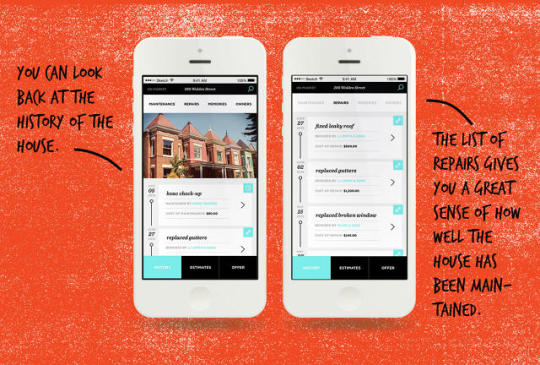
    Insert block chains: a relatively new and promising technology that could transform the way we digitally exchange value, similarly to how Internet protocols, like TCP/IP, transformed the way we exchanged information. For example, to transfer ownership of a home today, there are countless check of authenticity and intermediaries involved to insure the transfer is legitimate. By using a distributed database (a.k.a. “a block chain,” the same technology behind Bitcoin) to prove authenticity, we could legitimately transfer ownership immediately without the need of a middleman. In fact, when we think about block-chain technology and the industries it could disrupt, real estate tops the list. While Trulia, Redfin, Angie’s List and others have brought some transparency to the opaque world of home buying and home ownership, most of our experiences in this industry are fraught with incomplete, inaccurate, and asymmetric information.

    Following this, he goes on to talk about what it might be like – each step of the way – to buy a house using the block chain technology. There are even mockups of what the app could look like. I highly recommend you give it a read if you’re interested or involved in this space.

    The real estate industry hasn’t seen a lot of innovation. It remains an opaque market with lots of information asymmetries. I have no doubt that will one day change; it’s just a question of when. Perhaps it’ll be the block chain that makes that happen.

    Image: IDEO via Fast Company

  • Lisbon is the new Berlin

    Photograph Tramway à Lisbonne by yannick le goff on 500px

    Tramway à Lisbonne by yannick le goff on 500px

    This morning I stumbled upon a blog post by a Berlin-based venture capitalist (Ciarán O’Leary) talking about how Lisbon feels like the next Berlin. In other words, it feels like the next great European startup hub.

    Here’s his reasoning:

    • The tech scene is organic – it happened on its own, came out of nowhere. That is much more fun and sustainable than any kind of political or targeted economic strategy.
    • There are a ton of constraints (funding, local talent base, etc.) so entrepreneurs need to hustle to make things happen. Hustle is good.
    • Berlin was an economic void, Portugal had a massive economic crisis and Lisbon sure isn’t letting that crisis go to waste.
    • Entrepreneurship has the real chance to be a center stage act, not a side gig. It’s everywhere.
    • The city is very, very cool. You just want to be here.
    • You can have a great life on a startup salary.
    • Everyone speaks english; everyone is welcoming and open. That matters a lot when you want to attract international talent and funding.

    Of course, he’s not the only one calling Lisbon the next Berlin. The EU also named Lisbon “the most entrepreneurial region in Europe in 2015.” Isn’t it interesting what can grow out of economic crisis? See PIGS.

    I also don’t think it’s a coincidence that Monocle held its first ever Quality of Life Conference in Lisbon. It’s a testament to O’Leary’s point above that, “You just want to be here.”

    And while being “very, very cool” may not seem immediately relevant to creating a robust startup environment, it really is. It may be the most important point. It makes the city a magnet for talent. 

    Just the other day I was trying to explain Berlin to someone and I used a similar lexicon. I said: “It’s an unbelievably cool city. It bleeds hipness. You will love it.”

    If you’re a city, that’s a great thing to be.

  • Why brick-and-mortar stores should be scared of same hour delivery

    Venture capitalist Fred Wilson wrote a post on his blog today called, Same Day/Same Hour Delivery.

    The post is about why he believes that Walmart could get the “most disrupted by the Internet.” And it has to do with the rapid rise of same day and even same hour delivery from ecommerce companies. If you can order it online and receive it within an hour, why bother going to a brick-and-mortar store?

    His post reminded me of one I wrote towards the end of last year called, The threat to big box retailing. But since Fred is in the business of making bets on technology companies and he has accumulated a significant amount of wealth doing that, I thought you might like to also hear it from him.

  • “Great ideas are Obvious in retrospect.”

    Photograph San Francisco Sunset by Nathan Camarillo on 500px

    San Francisco Sunset by Nathan Camarillo on 500px

    The title of this post is a line from a Medium post that Biz Stone wrote back in August 2012. For those of you who might not know, Biz Stone is one of the cofounders of Twitter, as well as the cofounder of something called The Obvious Corporation.

    Obvious is a “company” that I’ve been following on and off for a number of years – I’m fascinated by the model and how it has evolved. It was founded back in 2006 by Biz Stone and Ev Williams (another Twitter cofounder) as a kind of “product lab” for new ideas. But since then it has gone through a number of iterations.

    Though I suspect that most people haven’t heard of Obvious, it was actually the parent company of Twitter before Twitter took off and became independent.

    But even more interesting is the fact that Twitter was actually a side project for a company called Odeo (a failed podcasting startup) that in turn was owned by Obvious. So specifically, Twitter started as a side project of one of the companies within a larger “product lab.” Nobody said innovation was straightforward.

    When Twitter eventually took off, their focus naturally shifted away from Obvious to it. They had a rocket ship of a company to build and run. 

    But in 2011, Ev and Biz, along with Jason Goldman (of Twitter), decided to “reboot Obvious.” The most notable outcome of this reboot has been the creation of writing platform Medium, which I believe still technically sits within Obvious. (Click here if you don’t know what Medium is.)

    Then in December of last year (2014), Ev Williams announced the third chapter of Obvious – now called Obvious Ventures – with this post called: It’s Obvious. Again. In short, they’re a venture capital firm with an approach that they call #worldpositive:

    We’re entrepreneurs. We’ve helped a lot of companies launch, grow, and generate great financial returns. A few of these companies also deliver positive social and environmental benefits with every dollar of revenue they earn. We want to fund and build more of those. That’s what we call #worldpositive venture capital.

    Already they’ve publicly announced investments in 10 companies, one of which I’ve written about before on Architect This City (Flux.io).

    I decided to tell this story today for 3 reasons.

    It shows you how non-linear innovation and careers can be. I love the idea of #worldpositive investing. And finally, because some of the startups that Obvious Ventures has invested in – such as Flux.io and Loup – are directly related to the future of cities.

  • 21 largest venture capital investments in Canada

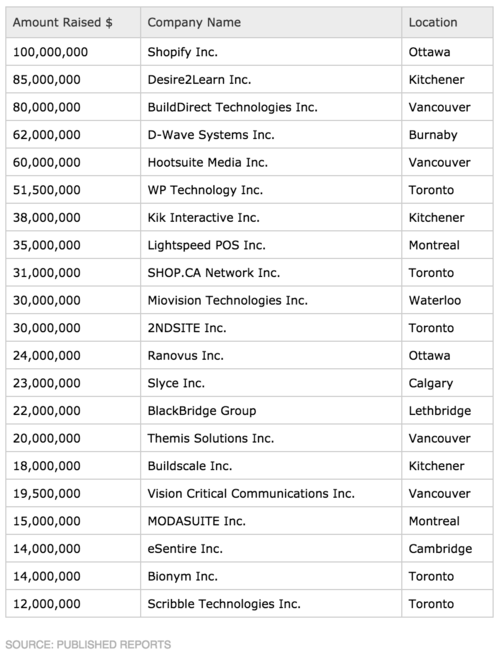
    The Globe and Mail published an interesting article this evening looking at the 21 largest venture capital investments in Canadian tech over the last 18 months. It’s called: Who needs Silicon Valley? Canadian startups scoring bigger deals.

    To put things into perspective, total venture dollars invested in Canada last year (2014) was around $1.9 billion. In the US, that number is estimated to be somewhere around $48 billion. So there’s a big spread here. But the Globe is arguing that there’s a shift towards medium-sized Canadian tech companies raising larger and larger rounds.

    Here are the top 21 largest venture capital investments made in Canada over the last 18 months:

    image

    At the same time, there’s also an attitude change that seems to be taking place. Confidence is growing. Here’s a quote from Mike McDerment of Freshbooks from the same article:

    “Our goal is to be an anchor tenant in Toronto. At Freshbooks, we want to build a global company that really contributes in some meaningful way to the city,” Mr. McDerment said. He touts the local schools and talent pool and downplays the Valley’s head start.

    “The money is shameless – it’ll just go wherever. It wants the opportunities,” Mr. McDerment said. “I don’t see why Toronto can’t beat Silicon Valley.”

    All of this is important because the medium-sized companies of today will hopefully become the large-sized companies of tomorrow. And that’s what you need to build a thriving startup hub. You need big successes. You need those companies going public and generating wealth for their employees and communities.

    Thankfully, that seems to be where we’re headed. The first company on the list above – Shopify – is already preparing for a dual US-Canada IPO.

  • Marginal cost = 0

    Earlier this week I wrote a post called: The pull from services to products. And in it I made mention of the fact that part of what’s driving this pull towards products is that the marginal cost of servicing additional users or customers is almost nothing in a world of internet services and products.

    Well the reality is that this phenomenon is driving a hell of a lot more. It could – and probably will – fundamentally change almost all aspects of the economy.

    I know that sounds like a pretty audacious statement, but if you watch the following 10 minute talk by Albert Wenger (Union Square Ventures) you might start to feel the same way. He outlines 5 changes being driven by the fact that in the digital world, marginal cost = 0. The impacts go well beyond tech, capturing sectors such as transportation and industrial real estate.

    [youtube https://www.youtube.com/watch?v=sVEtTzlqsoE?rel=0]

    If you can’t see the video, click here.

  • That’s a wrap

    Today is the last day of 2014.

    It felt like a frenetic year for me, and so I have to say that I’ve been really enjoying this holiday break. I needed the downtime. I needed the time to think and strategize. And I got all of that this holiday. (The only thing that would make this break even better would be some more snow on the mountains.)

    I’m super excited for the new year and what’s ahead, but before getting into that, I thought it would be worthwhile to look back at what happened in 2014.

    I was initially going to list out some of my thoughts, but then I figured that a better way would be to simply list out the most read Architect This City posts. That way it’s my (daily) thoughts, but curated according to what readers cared about most this past year.

    Click here for the top 15 most read Architect This City posts of 2014. I’ve listed them on a “topics” page that I plan to update every year.

    If you’re looking for some other 2014 themed reading material, I recommend also checking out the best #cityreads of 2014 by CityLab; the best articles of 2014 from ArchDaily; and what just happened? by venture capitalist Fred Wilson.

    Happy new year everyone! Thanks for reading. See you in 2015.

    Image: Family and friends lunch at Pizzeria Libretto, University

  • Pushing and pulling

    image

    Venture capitalist Chris Dixon recently published an interesting post called, Two eras of the internet: pull and push. In it, he describes two patterns that have emerged within the internet over the past decade and a half.

    Pull (2000s):

    Pull is when you are seeking information, usually an answer to a question. You want to know the closing time of a restaurant, the description of a hotel where you are thinking about staying, the details of an historical event you heard about, etc. You go to your computer and pull the information. The killer app for pulling information was Google.

    Push (2010s):

    Push is when you are using the internet in a more passive way and content comes to you. The killer app for push is social networks, the most popular being Facebook. Information is pushed from user to user via likes, shares, tweets, etc. People tend to push things they find funny, interesting, moving, outrageous, etc.

    Now let’s think about this for a second, because it’s a pretty significant change.

    Google’s mission is to organize the world’s information. And they have certainly made it easier for us to get the information we want. Instead of physically searching for something, you just type in a few keywords and it pops up. But, it still involves us deciding we want something and then pulling the information.

    What’s fascinating to me about push is the idea that content and information comes to you. And it’s one of the reasons that I’ve always found Foursquare more interesting than Yelp – even though Yelp is far more popular as a tool to help you find somewhere to eat, drink and so on.

    When I walk into a restaurant or bar now, oftentimes I’ll see a Foursquare notification popup on my phone showing me a tip that somebody has left: “Try the meatballs – they’re to die for”. I didn’t search for that. I didn’t ask for a recommendation. But Foursquare knew where I was and presented me with that information.

    Now, there are obviously potential downsides to constant interruption, but let’s focus here on the opportunities. How could these same principles to be applied to other industries such as, say, real estate?

    I think there’s a pull and push parallel.

    Today MLS operates in a way like a search engine for homes. You decide you might be interested in buying a home and so you go online and start pulling listings.

    Of course, the vast majority of people also work with a real estate agent. And in a way they’re kind of like your push. They get to know you, they figure out what you’re looking for, and then they push relevant listings and information to you.

    And maybe that’s why nobody has killed off real estate agents – despite the numerous attempts. Everybody has been focusing on new pull platforms (listing platforms) as opposed to a new push platform.

    Who knows.

    But I think it would be naive to think that these emerging push platforms won’t reach far beyond social media.

  • Taking a picture of the world, every day

    This morning I finished watching the rest of Steve Jurvetson’s Spark 2014 talk, which I shared with you all yesterday. And so I’ve got technology on the brain right now.

    I’ve said this many times before on ATC, but I truly believe that the pace in which technology is infiltrating “non-technology” companies is only going to increase. The video clip of Flux.io is a perfect example of that. After watching that demo yesterday, I immediately thought a handful of consultants that real estate developers use on projects that the Flux platform could replace.

    image

    So today I thought I would share another company that Steve talks about in yesterday’s video called Planet Labs. Planet Labs’ mission to image the entire world and make it universally accessible to people. But unlike Google and Microsoft – who already offer satellite photography – Planet Labs has figured out a cost effective way to do it on a daily basis.

    Because the problem with services like Google Maps and Bing is that they’re updated too infrequently. If I go to Google Maps right now, the building I live in doesn’t even exist in their aerial photography of Toronto – it’s still a parking lot. So there are limits to what you can do with this information.

    But once you increase the image frequency to daily, you create all sorts of new opportunities. You could track the number of cars in every parking lot in the world to measure retail activity (an example Steve gives in his talk). You could track changing water levels. You could track deforestation. You could track urbanization in China. And the list goes on. Here’s a blog post from Planet Labs that gives a few examples of the benefits of daily imaging.

    To return to my earlier point, consider the fact that every potential use case I’ve just outlined is in an industry that most of you wouldn’t consider to be tech. And yet Planet Labs is clearly a technology company. So the key insight here is really to focus less on the way things are done and classified today, and more on the way they could be – and likely will be – done in the future.

    Image: Planet Labs

  • How technology could completely change the real estate development industry

    If you’re involved in the built environment in any way, shape, or form – as a developer, architect, policy maker, and so on – I would highly recommend you watch the video below. My friend Candice Luck, who I went to Rotman with, sent it to me this morning with a link starting at the 24 minute mark. I haven’t yet watched the whole thing, but given how interesting this short section was, I plan to.

    The video is a talk by Steve Jurvetson, who is a venture capitalist with DFJ. He was one of the founding investors in Hotmail and currently sits on the board of companies like SpaceX and Tesla Motors. At the 24 minute mark he talks about a startup called Flux.io that hasn’t yet launched their product, but is working towards “reimagining building design”. They’re a spin-off from Google X and plan to officially launch in early 2015.

    Rather than try and describe the video here, I will just say that it’s an incredible example of how technology and digitization could completely change the real estate development industry. If you can’t see the video below, click here. The video starts at the Flux.io section.

    [youtube https://www.youtube.com/watch?v=IPgyb6euISs]