Daily insights for city builders, delivered every morning at 6 AM ET. I’m Brandon Donnelly — a Toronto-based real estate developer and founder of Globizen. I’ve been writing here since 2013.

Tag: venture capital

  • The benefits of sharing — what real estate could learn from tech

    One of the reasons I decided to start blogging was because I saw how open the tech community had become – with respect to sharing their ideas and experiences – and I thought that the same thing could and should be done in real estate, as well as in city building more broadly.

    But in many ways, the real estate industry is the antithesis of the tech industry. We are slow moving and secretive of our ideas. Now, some of this is driven by fundamental differences in terms of how these two sectors operate. It’s a lot easier to test and iterate on your ideas in tech than it is with actual bricks-and-mortar. But I still think about ways in which we, in real estate, could be pushing the envelope.

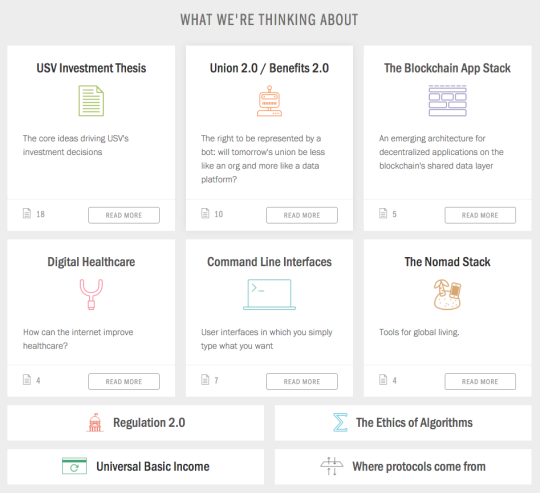
    As one example of what I’m talking about, take Union Square Ventures in New York. They call themselves a “thesis-driven venture capital firm”, which means they come up with a framework and core set of ideas, and then use those to drive their investment decisions.

    You would think that these frameworks and ideas would be pretty sensitive. I mean, they are the core drivers of their business. But their entire website is actually set up around sharing and collaborating – with the public – on these ideas. Here’s a screenshot:

    image

    Each topic is something they are “thinking about” and something they want to make an investment in (or already have). Fascinating.

    Many of you, I’m sure, would argue that there are risks to doing this. But there are also benefits, some of which are driven by collective intelligence. By sharing their ideas and hypotheses with the public, it helps to evolve their thinking. After all, their investment thesis is not a static thing. It grows over time.

    But in addition to this, it also makes it abundantly clear to their customers (entrepreneurs) what they believe in and what they look for. And I am sure this helps them with deal flow. More and more customers aren’t just “buying” a product, they are also “buying” a philosophical underpinning and belief system.

    Can you imagine a real estate firm doing something like this? I can. But it’s not happening yet, as far as I know.

  • Coworking, coliving, and an old architecture school project

    Coworking spaces are big business.

    One of the biggest of those companies is WeWork. As of last month (November 2015), the company had raised close to a billion dollars from investors like JPMorgan Chase, Harvard Management, and Benchmark Capital, and was valued at $10 billion. (Remember though, this is in the private not public markets.)

    If you’re unfamiliar with coworking spaces, check out this post from The Spaces. It’s a great demonstration of how beautiful these spaces can be.

    All of this is interesting because it speaks to the changing nature of work. There are a lot of people freelancing, participating in the “online gig economy” and working on new ideas. And in many of these cases, they don’t want or need traditional office space and/or they want the community that many of these coworking spaces afford – both offline and online.

    But it’s not just the office that is changing. It’s also potentially living spaces. Since 2014, WeWork has been talking about their new coliving concept, WeLive. The idea here is to combine smaller living spaces with larger common areas and create an overall live-work community. And they are not the only ones thinking about this.

    Below is a building section of what this might look. It’s from a Vornado Realty presentation. They are working with WeWork to deliver their new WeLive concept in Crystal City, Virginia.

    It’s so interesting to see this concept come to fruition. Back in 2008 when I was in architecture school, I worked with a classmate of mine and designed a modular coliving apartment building. It was called the Philly Flex Dwelling and it worked like this:

    The idea here was to start with standard floor plates and use a structural exoskeleton to minimize interior columns. This way you could insert whatever prefabricated modules you wanted and also re-purpose the structure should you want to change the building’s use in the future. 

    This is not that dissimilar from what was originally proposed for One Bloor West here in Toronto. Though the goal there was column-free retail spaces. 

    The yellow spaces are the shared common areas and the remaining spaces are the residential living “pods.” We also designed a “solar skin” that was perfectly tuned to the building’s orientation and location in Philadelphia. The idea here was to maximize winter sun (for heating) and minimize summer sun (to keep the building cool).

    That was a fun project to work on.

  • A guide to digital marketplaces

    Version One Ventures – which is an early-stage venture capital fund based in Vancouver – recently published a free handbook called, A Guide to Marketplaces.

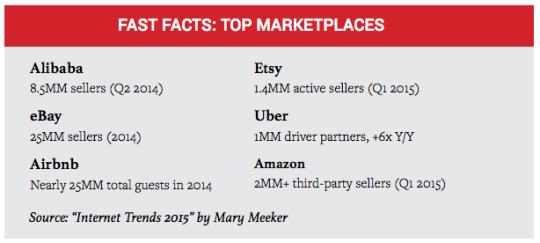
    Online marketplaces are really fascinating because they are perhaps broader in scope than you might initially think. For example, Uber is a marketplace. There’s a supply-side (drivers with cars) and a demand-side (people needing rides). Uber connects these two groups together and acts as a kind of digital middle person. Uber does not own any of the cars.

    This is an incredibly power business model and it can and is being applied in many different ways. Here are the top internet marketplaces (via the handbook):

    I have been interested in this space for years because I have been very curious as to why we haven’t seen more innovation when it comes to online real estate marketplaces. Yes, there are platforms like Zillow.com. But Zillow has not done to real estate what Uber is doing to urban mobility.

    My thinking is that it comes down to supply-side aggregation. Online marketplaces in general are hard to get started, which is why investors love them. They have defensibility. But real estate, in particular, is even harder to jumpstart compared to the incumbent models because of what I see as constraints on the supply-side.

    That’s why I am so excited about what BuzzBuzzHome.com is doing on the new construction side of the business. They are aggregating supply.

    If you’d like to download the guide to marketplaces in PDF, click here. It’s a great read and I’m glad that Boris and Angela took the time to assemble. Thank you 🙂

  • Technology is eating the world

    Large Gantry Crane on Sunset by Sasin Tipchai on 500px.com

    https://500px.com/embed.js

    Earlier today the comment section of an old post I wrote about UberX was revived with a discussion around technology and what it means for human capital.

    The concern expressed was that technology and machines are going to put us all out of a job. And it stemmed from a discussion around driverless cars. Clearly we are headed in that direction and so eventually we will no longer need to drive or have people drive us around. This means that something that was once a job will no longer exist.

    But I am not yet convinced that it will be as dire as some believe it will be – though it could very well necessitate some significant structural changes in the economy.

    Here are two things to consider:

    Marc Andreessen has written and tweeted a lot about the topic of “robots eat all jobs” and his argument is that this line of thinking often revolves around something called a lump-of-labor fallacy. This is the idea that there is a fixed amount of work to be done. And so when technology replaces humans, we are just making the labor pie smaller.

    But the reality appears much different. Human wants and desires increase and we find new ways to put people to work. One of the examples I’ve heard Marc give, that I really like, has to do with buildings. In the past, there used to be a guy whose only job was to shovel coal into a furnace. He physically heated the building. But eventually technology did away with that requirement and that job. Is that not progress? Or should we go back to that in order to put people to work?

    All this said, unemployment and job displacement are still serious issues for cities and countries. Which is why some people – including many capitalists – believe that minimum wages will not be enough going forward. We will also need to look at things like a “basic income guarantee” to redistribute wealth and ensure that, no matter what, everyone has a certain amount of money to live.

    At first blush, this doesn’t feel right. But I think it’s important to remain open minded and engage in discussion. Hopefully we can do a bit of that today in the comments below.

  • Is venture-based real estate development coming to the Bay Area?

    Golden Gate Bridge by Mariusz Blach on 500px.com

    https://500px.com/embed.js

    Chamath
    Palihapitiya
    is a Sri Lanka born, Canada educated, venture capitalist in
    Silicon Valley, who made a boatload of money as one of the early employees of
    Facebook. He now runs a VC firm called Social +
    Capital
     and owns part of the Golden State Warriors.

    The other
    night he was interviewed at a StrictlyVC event in San Francisco and I think
    that many of his comments would also be of real interest to the Architect This City
    community. He’s super passionate in interviews and always fun to listen to.

    Below is what
    he had to say about the San Francisco startup scene. It really speaks volumes
    about what people will put up with in order to live in an awesome place/city that they love. All of his responses below are from this
    TechCrunch article
    .

    “The city has to be doing more, around
    transportation, around housing… You have to get rid of the nimbyism and you
    need to quadruple, if not quintuple, the amount of housing. You need to tell
    that engineer from the University of Michigan that he can live here on a salary
    of $80,000.

    [In the meantime], we look at our startups, and
    the minute that they start to spend more than 15 percent of their burn – good
    money that we give them – on rent, a huge red flag goes up. When they, on a
    per-head-count basis, are spending so much, we start looking at the
    productivity of the technical team. And if it’s good but not great and they’re
    spending this insane amount of money [versus] a different team in Redwood City,
    we start to ask ourselves: “Are you so convinced that success is going to
    happen in this city at 1.5x the cost?”

    Because for every dollar that someone in
    Mountain View or Redwood City is raising, you [in San Francisco] have to raise
    one-and-a-half to two times that just to get to the same point. So you’re cutting
    your half life in half. To prove that you can take an Uber from some fuckin’
    shitty bar to another shitty bar? Like, I don’t understand.”

    And here he
    talks about the possibility of his venture firm also getting into the real
    estate development business. I couldn’t resist blogging about this.

    “We made a big
    decision with our last fund to build an organization that looks really
    different than a venture firm, and that organization is going to be this
    hybrid, bastard stepchild of Berkshire Hathaway and Blackstone and BlackRock.

    What I mean by this is
    that we want to have a large permanent capital base and we want to make really
    long, discontinuous bets on companies and sectors and trends.

    And one of the things
    we talked about was having a real estate fund …[because] we owe it to our
    companies to alleviate some of these problems when no one else is going to. If
    we went and built one million square feet somewhere of mixed use, where you
    work and live, and we rethink what it means to have a modular living environment
    for a millennial cohort that wants to work at companies and doesn’t necessarily
    have kids, we can do that in a way and give that back to our CEOs as a benefit
    of working with us.

    And you can probably
    make the economics work. Because we only really care about the equity of the
    company anyways. And the equity in the real estate will take care of itself if
    you take the 30-year view. So we’re at the point now where we’re like, wow, we
    should raise a few billion dollars and get into the real estate business and
    solve this problem systematically for our companies. And maybe in that, it
    becomes a blueprint for how others should do it. We’re just basically going to
    act as our own city-state and decide how to do it ourselves.”

    It’s
    interesting to think about what the economics might look like if your primary goal is
    simply to provide space to your portfolio companies (entrepreneurs) so that
    they get more (financial) runway and, therefore, have a greater chance of success. I’d love to see that pro forma.

  • Making alpha-bets

    GBike by Mohamed Yahya on 500px.com

    https://500px.com/embed.js

    On Monday, Google broke the internet when it announced that it was reorganizing itself into a holding company structure called Alphabet.

    That means that Google, Inc. will now become a subsidiary, along with many other companies, of Alphabet Inc. and all shares of Google will automatically convert into the same number of shares in Alphabet.

    This is huge, but also something that was likely inevitable given the passions of the founders. Apparently Larry Page has been thinking about this move for years.

    As it stands pre-Alphabet, Google (with its main internet products) is basically a cash cow funding all of Google’s other experiments. But this muddied the waters and made it difficult for investors to clearly see how much the main internet products were making and how much the founders were spending on self-driving cars, delivery drones (Project Wing), and other new ideas.

    Now everything will be separate.

    But what’s really exciting about the reorganization is that it sets the stage for Alphabet/Google – which is arguably already one of the most important companies in the world – to become even more impactful in a wide variety of industries and disciplines, some/many not traditionally associated with tech. Each wholly owned subsidiary will have their own CEO and the founders rightly believe, I think, that this overall structure will afford them more “management scale.”

    Within Google will remain search, advertising, maps, YouTube, and the Android mobile operating system. But already Alphabet is the parent company of the following other businesses:

    • Calico, an anti-aging life extension company
    • Sidewalk, a smart cities company whose mission is to improve life in cities
    • Nest, an “internet of things” company that makes connected devices for your home
    • Fiber, a company that offers super fast internet
    • Google Ventures (venture capital) & Google Capital (private equity)
    • Google X, which is the lab developing self-driving cars and delivery drones (Project Wing)

    If you can’t tell, I’m bullish on all of this. The approach really resonates with me and I can’t wait to see what Alphabet becomes. If you’d like to read the full and official blog post announcement, click here

    Cheers to trying new things and making big bets.

  • When everyone thinks you’re wrong

    Sunset by Paolo Mastrogiacomo on 500px.com

    https://500px.com/embed.js

    I was recently talking to my good friend Jeremiah Shamess about the current state of development land sales in Toronto (he does this for a living) and he said something to me that I found really interesting.

    He said that because the market is so competitive, you can really only win development sites in one of two ways. Either you’re willing to spend the most money or you see something and have a vision that nobody else sees.

    And it was this second piece that really stood out to me because it reminds me of one of my favorite investing frameworks.

    Warren Buffet is famous for saying that you should be fearful when others are greedy and you should be greedy when others are fearful. And what I’m about to talk about is really that same core philosophy.

    Here’s how venture capitalist Fred Wilson put it (reiterating something that Bill Gurley said):

    I saw Bill Gurley say that you can only make money by being right about something that most people think is wrong. His logic was that you can’t make money by being wrong. And you can’t make money by being right about something everyone else knows. So you have to be right about something that most people think is wrong. I really like that framework.

    But this doesn’t just apply to technology companies or stocks. It applies to city building, most industries, and probably most things in life if you think about it.

    If all you’re doing are things that everyone else is doing, then how can you expect to outperform? You’re going to revert to the mean.

    Take, for example, billionaire Dan Gilbert and Detroit. Not everyone believes that Detroit will come back. In fact, I suspect there are probably more people who think it won’t come back, than people who think it will. Otherwise, it would already be back.

    But Gilbert is unquestionably long on Detroit (via Forbes):

    As you’ve likely heard, over the past four years Gilbert has become one of Detroit’s single-largest commercial landowners, renovating the city with the energy and impact of a modern-day Robert Moses, albeit bankrolled with his own money. He’s purchased and updated more than 60 properties downtown, at a total cost of $1.3 billion. He moved his own employees into many of them–12,000 in all, including 6,500 new hires–and cajoled other companies such as Chrysler, Microsoft and Twitter to follow.

    If/when Gilbert proves to be right about Detroit, then he will have been right about something that most people thought was wrong. And because of that, he will no doubt make a lot of money.

  • Made in Toronto: 500px

    https://500px.com/embed.js

    If you’re a regular reader of Architect This City, you’ll know that I generally like to include at least one photo with every post. Sometimes I run out of time and I don’t always do that, but that is at least the intent.

    You might have also noticed that my go-to for stock photography is 500px. That is the case for a few reasons. 

    I find the photos to be of higher quality than any other service. I can easily “embed” them into my posts while giving appropriate credit to the author and linking back to 500px. The company was founded by a good friend of mine and snowboarding compadre. And the company is made in Toronto.

    That’s why it’s exciting to report that yesterday the company announced an additional $13M in funding (Series B). To date the company has raised $23M of outside funding, from some big names like Andreessen Horowitz. This is great for the everyone in the company, and I believe it’s great for this city.

    Why is that?

    Well, here’s a video from the New York Times’ Cities For Tomorrow conference, where Andrew Ross Sorkin and Fred Wilson talk about creating startup hubs. It’s about 20 minutes long and well worth a watch.

  • Enabling innovation by lowering the barriers to entry

    Yesterday afternoon Sam Altman of Y Combinator published a blog post talking about a new YC Fellowship program for even earlier stage companies. 

    For those of you who aren’t familiar with Y Combinator, they are a super successful funding platform for early stage startups. They are located in Mountain View, California.

    What’s unique about their approach is that they invest a relatively small amount of money ($120,000 for 7% of your company) in a relatively large number of companies. Their most recent cohort was around 85 companies and they do that twice a year.

    The rationale behind this approach is that it can be incredibly hard to predict which people and ideas will produce the next great company. Oftentimes the best ideas appear really shitty at first. (Here’s a post by one of the cofounders of Airbnb talking about the company’s early rejections.)

    So instead of putting all of their eggs in one basket, YC invests smaller amounts in more companies.

    But beyond this being beneficial to them, it’s also a model that I think helps to reduce the barriers to people starting a company. It gives more people the chance to prove that their company has the potential to be something great. 

    And that’s precisely what makes this new YC Fellow program/experiment so interesting to me.

    Instead of $120,000, YC fellows will receive $12,000 and they won’t have to move to the Bay Area (although it’ll be encouraged). They’ll still get mentorship and advice like the regular YC program, but it’ll be a kind of light version. 

    Though this is almost certainly just the beginning. Here’s how Sam ended his announcement post:

    “Someday if it works, we’d love to fund 1,000 companies per year like this.”

    Now all of a sudden that’s some scale.

    What’s exciting about this is that I believe our cities have the potential to be far more innovative than they are today. Every city is trying to be the next Silicon Valley, but every city is not the next Silicon Valley.

    I saw a great tweet the other day that went something like this (I wish I could remember who the author was):

    “Entrepreneurs aren’t risk takers. They’re just rich kids with big safety nets.”

    It’s a bit of a tongue-in-cheek generalization. But to unlock the full potential of our cities, we should be figuring out how to get everyone participating and building their ideas, not just those with a head start. 

    I think there are a lot of people around the world who could be doing great things, but they just haven’t been able to take that first step for one reason or another.

    Hopefully organizations like Y Combinator will be able to help them take it.

  • Why I write something every single day, even if it’s garbage

    I was out for brunch last weekend with a few close friends from high school. It’s a “monthly reunion” that happens nowhere close to every month. But the hope is certainly there.

    During brunch the topic of my blog came up. And one of my friends asked me how I got started and how the hell I keep up with one blog post every single day. (I get that second question all the time.)

    I’ve written about this before, but I think it’s worth revisiting.

    Earlier this week venture capitalist Fred Wilson wrote a post on his blog called The Blank Screen. And I really liked how he described the experience of writing a daily blog post:

    Sometimes this process produces great insights for me and possibly others. Sometimes it produces garbage. But I’ve come to realize that the daily post, and its quality or lack thereof, is not really the thing. It is the ritual, the practice, the frequency, the habit, and the discipline that matters most to me. And, I would suspect, the same is true of the readers and commenters who frequent this blog.

    Fred’s blog was a major source of inspiration for me. I saw him doing it. I saw the value he was getting out of it. And I wanted to do it too. So I did, almost 2 years ago. 

    But he also inspired me in another way.

    Venture capital and real estate development share many similarities in my mind, even down to the way that deals are often structured with preferred returns and promotes.

    But the interesting thing about venture capital is that it went from a largely closed and “ivory tower” kind of industry to now one where almost every venture capitalist blogs, tweets, and strives for greater transparency (when possible).

    I thought this was a fascinating shift and it made me think that the exact same thing was bound to happen in real estate development. So I am trying to make that happen. Hopefully this blog is helping.