Daily insights for city builders, delivered every morning at 6 AM ET. I’m Brandon Donnelly — a Toronto-based real estate developer and founder of Globizen. I’ve been writing here since 2013.

Tag: vancouver

  • Become a Sidewalk Toronto Fellow

    Sidewalk Toronto is currently looking for “12 smart, creative, and caring people who are interested in the future of Toronto’s waterfront and how we [Sidewalk Toronto] can responsibly incorporate technology to improve urban life.”

    Each Fellow will complete a 2-day orientation session in Toronto; 6 days in Amsterdam and Copenhagen; 5 days in New York City and Boston; 3 days in Vancouver; and then do a final 2-day working session back in Toronto before presenting their takeaways.

    This feels like a response to the criticism that Sidewalk Toronto wasn’t doing enough to listen to the community and that it simply wanted to build a tech-infused neighborhood that could serve us more ads – but it’s cool nonetheless. 

    If you’re between 19-24 years old and you live in Toronto, you can apply here. It sounds like a fun opportunity for young city builders. I know that I certainly would have been all over it when I was in that age bracket.

  • Cities are the destinations

    image

    Resonance Consulting out of Vancouver has a new report out: 2018 Future of Millennial Travel. You can download a free copy here. Resonance does great work and really gets content marketing.

    The first chapter immediately caught my attention, perhaps because it’s called, Cities are the Destinations. It talks about how big cities as a travel destination are a highly underreported tourism metric. Historically it’s been all about beach vacations and escaping.

    According to their survey, Millennials (aged 20 to 36 years old as of March 16, 2017) are almost as likely to travel to a major city (38%) as they are to travel to a beach resort (40%) in the next 24 months. (I wonder where the mountains fit in.)

    Also interesting is that this number increases when household earnings increase beyond $100,000. This subset of respondents is most likely to visit a major city on their next vacation (40%). It’s all about new experiences.

    I’m not an expert on travel and tourism, but Resonance is calling this a sea change and a likely indicator that, in the near future, big cities will become the dominant travel destination. Is your city ready?

    Photo by Nathan Ziemanski on Unsplash

  • 2017 was a record year for housing starts in Canada, but…

    According to Bloomberg (using data from CMHC), 2017 was a surprising record year for housing starts in Canada: 219,675 units. This is the most since 2007 and is up from 197,916 units in 2016.

    The explanation: job growth (nearly 400,000 new jobs) and population growth were both more robust than expected.

    Multiple unit project starts are also up significantly with 142,840 units starting in 2017. This is a 15% increase from the prior year. Of these units, 102,516 of them were “apartment-like homes.”

    But all of this is nationwide data. Look at what happened in Toronto and Vancouver:

    The increased activity mostly sidestepped land-constrained Toronto and Vancouver, the country’s two most expensive markets, but was robust in the suburbs and less pricey surrounding cities. Starts in Toronto fell 1 percent to 38,738 in 2017, while declining 6 percent in Vancouver to 26,204 units.

    This is not because of a lack of demand. It’s becoming systematically more difficult and more costly to build new housing in these two markets.

  • The Toronto and Vancouver housing markets

    CIBC World Markets recently published this report by Benjamin Tal talking about the Toronto and Vancouver housing markets. Here is an excerpt:

    “But when the fog
    clears it will become evident that the
    long-term trajectory of the market will
    show even tighter conditions. The supply
    issues facing centres such as Toronto and
    Vancouver will worsen and demand is
    routinely understated. Short of a significant
    change in housing policies and preferences,
    there is nothing in the pipeline to alleviate
    the pressure.”

    It’s a good read. Worth your time.

    One stat that stood out and directly relates to some of the topics that we frequently talk about on this blog is the shift in Toronto from low-rise to high-rise housing.

    In the report there’s a chart showing the “change in [housing unit] completions” in 2016 as compared to 2000. The switch from low-rise to high-rise is almost 1:1 in Toronto. In other words, we substituted high-rise housing for low-rise housing. 

    I think this speaks volumes about the fundamentals underpinning the Toronto condo/apartment market. We are continuing to build up because it is the future of housing in this city.

  • Superstar or bubble?

    “The term “bubble” refers to a substantial and sustained mispricing of an asset, the existence of which cannot be proved unless it bursts.” – UBS

    Last week UBS released its 2017 Global Real Estate Bubble Index. At the top of the list was none other than Toronto, followed by Stockholm, Munich, Vancouver and Sydney. And at the bottom of the list was Chicago – a city that UBS feels is undervalued.

    Here is the full list of index scores:
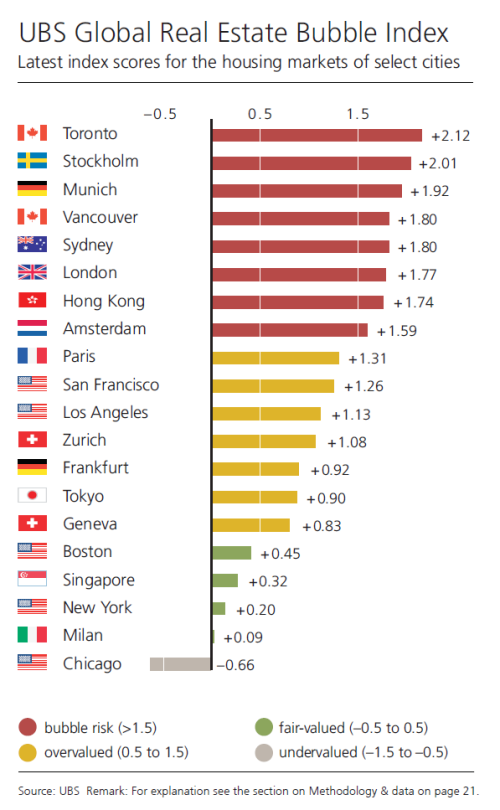
    image

    The UBS index is a weighted average of the following five sub-indices:

    1. Price-to-income
    2. Price-to-rent (fundamental valuation)
    3. Change in mortgage-to-GDP ratio
    4. Change in construction-to-GDP ratio (economic distortion)
    5. Relative price-city-to-country indicator

    If you look at their price-to-income benchmark in isolation, Toronto drops down to the middle of the pack along with Geneva and San Francisco. Hong Kong, London and Paris sit at the top with the most unaffordable housing. 

    Still, UBS credits “an overly loose monetary policy”, foreign demand, tight zoning, and rental market regulations for the eroding housing affordability in Toronto and Vancouver.

    One of the challenges, of course, is that the capital flowing into real estate is not all local – it’s also global. And many cities around the world are seeing high price-to-income multiples, perhaps because of that. 

    So exactly how much decoupling from local fundamentals should now be considered reasonable in our globalized world? And to what extent is this a result of “superstar economics?”

    Here’s an excerpt from the UBS report:

    The economics of Superstars explains why, in some professions, show business for instance, “small numbers of people earn enormous amounts of money and dominate the activities in which they engage.” By analogous reasoning, prices in the most attractive cities are expected to outperform average cities or rural areas in the long run. Hong Kong, London and San Francisco are exemplars of this theory.

    The intuition is that the national and global growth of high-wealth households creates continued excess demand for the best locations. So, as long as supply cannot increase rapidly, prices in the so-called “Superstar cities” are supposed to decouple from rents, incomes and the respective countrywide price level.

    I guess this is one of the reasons why bubbles are proven after the fact. If you would like to download a copy of the full UBS report, click here.


  • Is Trump good for Canada?

    Richard Florida and Joshua Gans just published an article in Politico called: Trump Is Making Canada Great Again. The overarching argument is that as the US closes its borders, Canada benefits. The best and brightest from around the world are coming here.

    This fall, international student applications at the University of Toronto were up 70% compared to last year. And numerous companies in Toronto are reporting “steady, double-digit increases” in the number of job applications from Americans.

    This is exactly what I was getting at when I made the pithy prediction that Amazon is going to choose Toronto for HQ2. It’s about access to human capital (though I acknowledge the political reality of selecting a city outside of the US). 

    Perhaps here or here might work for a location.

    Here is an excerpt from the Politico article that starts to speak to the importance of foreign-born workers in the US:

    As of 2013, foreign-born workers in STEM fields—science, technology engineering and math—accounted for nearly a fifth of workers with bachelor’s degrees in the United States, 40 percent of those with master’s degrees and more than half of those with Ph.D.s. In the San Jose metro area, consisting largely of Silicon Valley, immigrants comprise more than 55 percent of adults who hold advanced degrees.

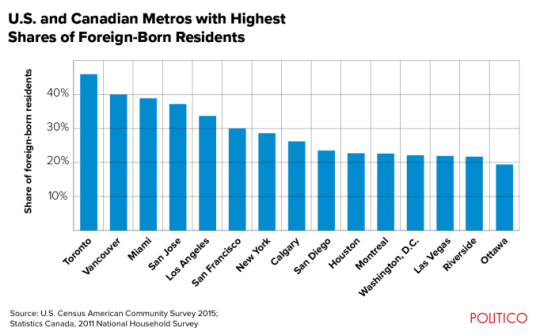
    Here is a chart showing the US and Canadian metros with the highest percentage of foreign-born residents:

    image

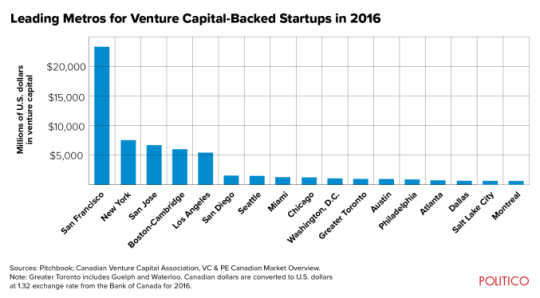
    And here is a chart showing which metro areas receive the most venture capital dollars (in millions of US dollars):

    image

    As to be expected, Toronto, Vancouver and Miami lead in terms of the percentage of foreign-born residents. Though, I would bet that Toronto’s foreign-born population is far more diverse than those of Vancouver and Miami.

    However, when you look at venture capital dollars invested, Toronto is nowhere near the top. Vancouver isn’t even on the list. And I suspect that some of you are surprised to see Miami sitting in between Chicago and Seattle (arguably a city that overperforms in tech relative to VC dollars invested). I was.

    Perhaps Trump will help with this by making Canada great again.

  • MONAD, Vancouver

    image

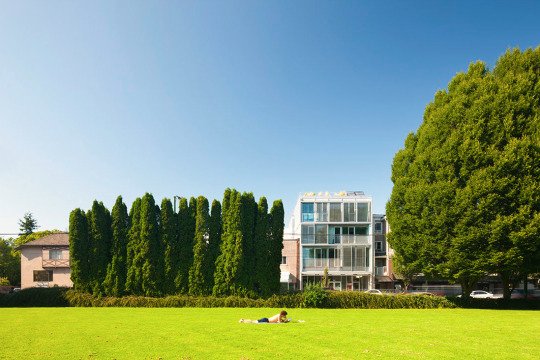
    Earlier today, Nithya Vijayakumar, of The Pembina Institute, pointed out the above housing project to me on Twitter through this 2013 Dwell article (worth a read).

    The project is called MONAD and it’s a 4-unit, 12,600 square foot prefabricated multi-storey building in Vancouver on West 4th Avenue. 

    The site itself is 33′ x 110′, which just so happens to be the same size as a typical single family lot in the city. However, this one sits on a main street.

    Completed in 2011 and designed by Lang Wilson Practice in Architecture Culture, the development was intended to be a pilot project and a rethink of urban living.

    There are real diseconomies when you develop at this scale, but if you make it high-end enough the math just may work. What a beauty.

    Above image from LWPAC. More photos here

  • Two-hour grocery delivery

    Today it was announced that Amazon is planning to launch its “Prime Now” service in Vancouver and Toronto this November and January, respectively. 

    The pilot program will offer two-hour deliveries for members and, according to the Wall Street Journal, will be be heavily focused on groceries. 

    It’s worth noting that most of Whole Foods’ stores in Canada (now owned by Amazon) are in and around Vancouver and Toronto. And that Amazon has already started lowering prices to make those stores more competitive.

    Right now a “Prime” membership in Canada costs CAD$79 per year. I’m not sure if the price will change at all for “Prime Now”, but let’s assume for the sake of argument that it won’t. 

    If this service was available to you today (or if you’re in a city that currently has it), would you (do you) use it? I would love to hear your thoughts in the comment section below.

    Two common objections around online grocery shopping are that many people want to touch and feel the goods before they buy and that perishable deliveries are a challenging thing to coordinate.

    I think I can work around those objections and would certainly try this today if it was available in Toronto. What about you?

  • Supply, not foreigners

    The chief economist at the Canada Mortgage and Housing Corporation (CMHC), Bob Dugan, recently published a piece in Macleans called: why the foreign buyers tax isn’t making Vancouver more affordable.

    Here’s an excerpt:

    One year after the implementation of the foreign buyers tax, monthly sales to foreign investors now hover around 4 per cent of all sales. But our latest Housing Market Assessment, released in July, still shows a red flag for Vancouver—with particular concern given to overvaluation and price acceleration. Average prices in Vancouver have rebounded to where they were before the tax’s implementation. In between, there was a marked drop, but it appears to have been temporary. In short, Vancouver is largely right back to where it was before the tax.

    He goes on to argue that while there are many factors affecting home prices, “supply is by far the chief factor.” This, of course, is a refrain you hear from everyone in the real estate business, so I’m not going to belabor the point.

    But I would like to point out some of the percentages. 

    Before the tax, foreign sales in Vancouver (to buyers who do not have a permanent address in Canada) were thought to sit at roughly 10%. Immediately following the tax, when everyone was trying to assess the impact, this dropped to ~0.9%. And now it’s back up to somewhere around 4%, according to the article.

    Arguably, there has been a slight reduction. Though who knows how accurate these percentages are. There is now a strong incentive to hide foreignness. 

    Regardless, CMHC doesn’t believe it’s working.

  • Seattle vs. Vancouver

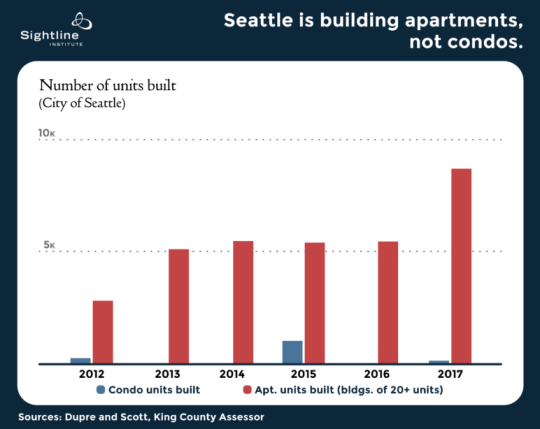
    A reader recently shared an article with me called: Why Seattle builds apartments, but Vancouver, BC, builds condos. Thanks for that.

    It’s a good summary of the differences between these two markets and why over the last five years less than 4% of all new residential units built in Seattle have been condos. The story is obviously very different in Vancouver.

    It’s also a good reminder that incentives matter. Capital has a funny way of flowing to where the returns are greatest.

    Chart: Sightline Institute