Daily insights for city builders, delivered every morning at 6 AM ET. I’m Brandon Donnelly — a Toronto-based real estate developer and founder of Globizen. I’ve been writing here since 2013.

Tag: vancouver

  • Prime property appreciation around the world

    Every year for the last decade, Knight Frank has published something called The Wealth Report. I’ve written about it before, but it’s basically a look at “prime property” and global wealth.

    As part of the report, they have something called the PIRI 100. It’s their “Prime International Residential Index”, which looks at luxury residential property prices around the world. They generally define “prime property” as being the top 5% of each market according to value.

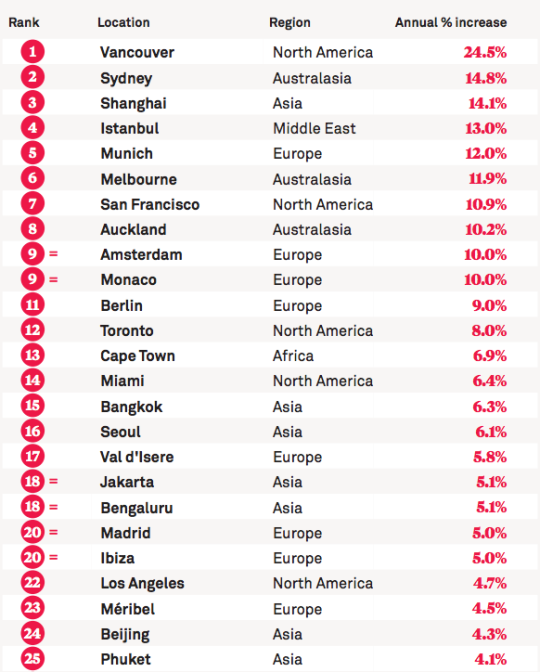
    This year, the top 25 locations in their PIRI 100 are as follows (for the most part, the data is up to December 2015):

    image

    Here in Canada, we like to talk about the insanity of the Vancouver and Toronto real estate markets. This list helps to put that into perspective. Even by global standards, Vancouver is at the top of the pack by quite a significant margin. 

    It’s worth noting that since this is a “prime property” index, it’s pretty safe to assume that the buyer profiles for these sorts of properties would have a significant international bias. So in a way, this list is really about global capital flows.

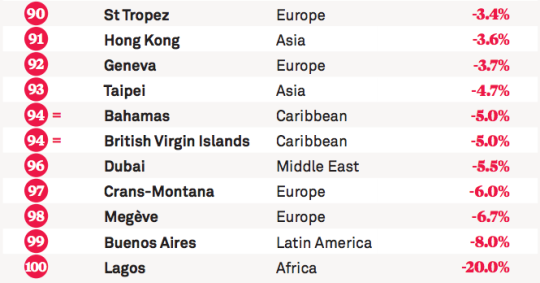
    Here are the bottom 10 locations on this year’s list:

    image

    If you’d like to see the full list, click here.

  • BARF is fighting for more housing in San Francisco

    A new YIMBY activist group is starting to gain meaningful traction in San Francisco. They were recently featured in the New York Times and they have managed to secure the financial backing of people like Jeremy Stoppelman – co-founder and CEO of Yelp. 

    (All excerpts in this post were taken from the NY Times.)

    image

    The group is called SF BARF, which stands for SF Bay Area Renters’ Federation. The group, however, supports new development of all kinds. So I think the name is more driven by the fact that the founder, Sonja Trauss, wanted the acronym to be BARF. It speaks to their shit disturbing approach:

    “Her group consists of a 500-person mailing list and a few dozen hard-core members — most of them young professionals who work in the technology industry — who speak out at government meetings and protest against the protesters who fight new development. While only two years old, Ms. Trauss’s Renters’ Federation has blazed onto the political scene with youth and bombast and by employing guerrilla tactics that others are too polite to try. In January, for instance, she hired a lawyer to go around suing suburbs for not building enough.”

    The impetus for all of this, of course, is San Francisco’s lack of affordability and severe housing shortage. Housing supply is decades behind the city’s population and job growth. 

    Most people are directing the blame at the tech community for bidding up housing. But there’s clearly growing recognition that housing supply matters.

    As a real estate developer, my industry obviously benefits from fewer barriers to building. So let’s get that out there:

    “Ms. Trauss’s cause, more or less, is to make life easier for real estate developers by rolling back zoning regulations and environmental rules. Her opponents are a generally older group of progressives who worry that an influx of corporate techies is turning a city that nurtured the Beat Generation into a gilded resort for the rich.”

    But let’s also be clear that I don’t believe we should be developing roughshod over our cities. New development should respond to what’s already there and give back. 

    At the same time, housing supply matters a great deal. A big part of the reason that cities like San Francisco, New York and Vancouver are so expensive is that they’re naturally supply-constrained markets. Geographically, they are either peninsulas or islands.

    When you overlay tight land use restrictions, fierce community opposition and/or foreign investment on top of this geography, it should come as no surprise to anyone that demand is outstripping supply. 

    New supply won’t solve every problem, but I do agree that it is an important part of the solution.

  • A breakdown of land use in Vancouver

    Last night when I was thumbing through Twitter before bed, I came across this blog post describing Vancouver’s land use types. The blog itself is called Mountain Doodles, but it’s not exactly clear who the author is. 

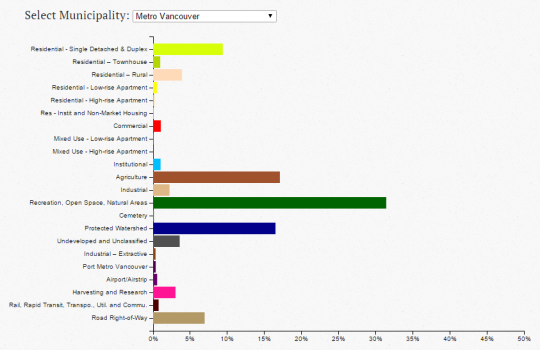
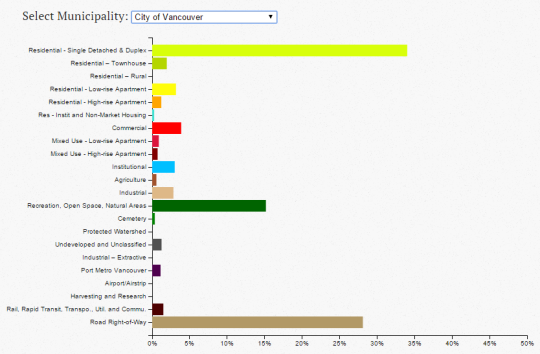
    In any event, what she/he did was analyze Vancouver’s land use dataset to come up with a series of charts that break down the percentage of each type: residential single detached, residential low-rise apartment, commercial, green space, and so on.

    Here’s what the chart looks like for Metro Vancouver:

    And here’s what it looks like for just the City of Vancouver, proper:

    When you look at the metro area, green / open space dominates. Although, the author states that, given the dataset, there could be a small overstatement of green space. There’s also the question of where the overall boundary was drawn.

    When you look at only the City of Vancouver, it’s land for residential housing (detached and duplex) and roads that dominate, with green / open space coming in a somewhat distant third.

    Of course, this does not speak to the intensity in which any of the above land might be used, such as the apartment lands (i.e., the third dimension). But from a two-dimensional perspective, you certainly get a sense of what we – for better or for worse – have chosen to privilege.

  • NO TOWER on Commercial Drive

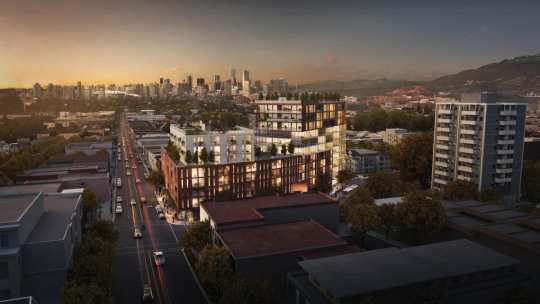
    For the past week or so I’ve been seeing the proposed Kettle Boffo Project in Vancouver make the rounds online. Here’s a rendering of the project, which is located at Commercial Drive and Venables Street:

    image

    The reason it has been making the rounds is that a community group called NO TOWER (written in all caps) has come out in fierce opposition of the 5 to 12-storey building. They have over 3,500 signatures.

    As an outsider looking in, this is surprising. The scale of the project seems appropriate. The height roughly matches the existing building shown above to the right. It may even be lower. And the project will provide somewhere around 30 social housing units, as well as additional space for the Kettle Friendship Society non-profit, who are currently on the site. (Note: An application to the city hasn’t yet been made.)

    What this has me thinking about is the push and pull between bottom-up and top-down planning. 

    When architect Bjarke Ingels talks about his Dryline project in New York, he likes to refer to it as the love child of Robert Moses (top-down planning) and Jane Jacobs (bottom-up planning). In the case of this project, it’s because it’s a large infrastructure project that they are trying to root into the local neighborhoods. Makes sense.

    But this same thinking could also apply to overall city building. Local communities rightly have their own wants. But at the same time, cities need to be thinking about the overall. The challenge is finding that right balance.

    I would be curious to hear your thoughts on the Kettle Boffo Project in the comment section below – especially if you’re from Vancouver.

  • A look at net migration by age group in Vancouver

    I’ve written quite a few posts about family formation and, more specifically, about where Millennials will move once they start having kids

    Many seem to believe that – despite the current Millennial love affair with urban centers – much of this cohort is destined to repeat the pattern of the previous generation. Meaning, once the kids come along, they’re headed to the suburbs in search of bigger and more affordable housing.

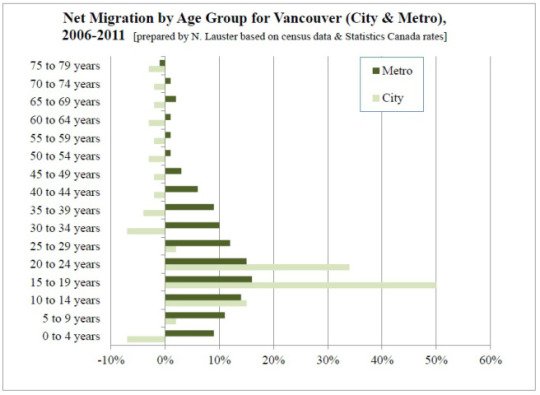
    If you look at the data, there’s a lot to support this prediction. Below is an interesting chart from Nathanael Lauster (Professor in Sociology at the University of British Columbia) that looks at net migration by age group for the City of Vancouver and the metro area.

    image

    What this chart shows is a flood of people in their late teens and early 20s migrating into the city (many of which are likely students), but then a fairly dramatic net loss of people leaving the city as they enter their 30s. The metro area, however, continues to grow – almost certainly because of people looking for more suitable family housing.

    But this data is from 2006-2011. We don’t yet have the 2016 census data. And I suspect that we will start to see an increase in the number of people opting to remain in the city across many different urban centers. 

    There are some very real economic pressures that successful cities today have to contend with. But I believe that the desire to remain in the city is there for a lot of young people.

  • Pocket two bedroom

    I recently started reading the blog of Michael Mortensen. Michael is a real estate developer and urban planner based in the UK. And if you like my blog, I think you’ll also like his.

    Last week he published a post talking about a UK development company called Pocket and a recent design competition that they organized called “Pocket two bedroom.”

    Historically the firm has been focused on well-designed and compact one bedroom apartments (38 square meters) that they deliver at a minimum 20% discount relative to typical market rate housing in London.

    But over time, they found that they had to turn people away because they were looking for larger – yet still affordable – two bedroom apartments. So the firm decided to figure out how to scale their model to larger units.

    To do this, they went out and asked 19 architects to come up with ideas for a two bedroom Pocket apartment. They then published all of the ideas online.

    Firstly, I applaud them for making their competition results public. Most real estate companies wouldn’t do this.

    Secondly, it’s interesting to take note of the recurring design themes, as they have on page 24-25 of their competition book. 

    Some of the themes include “deep thresholds” that blur private and communal spaces; “thick walls” that allow for storage and servicing; flexible spaces and fewer dedicated spaces; and dual entry apartments.

    This last item was particularly interesting to me. It’s a simple idea – two separate doors leading into one apartment – but it can allow for a number of flexible sharing scenarios. I am already imagining somebody creating an Airbnb rental out of their second bedroom.

    Housing is certainly undergoing a transformation.

  • A mapping of single family home prices in Vancouver

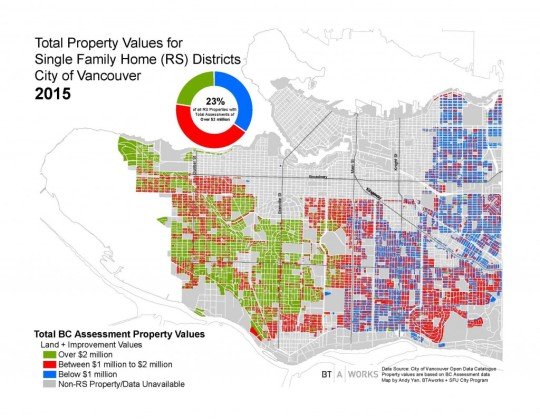
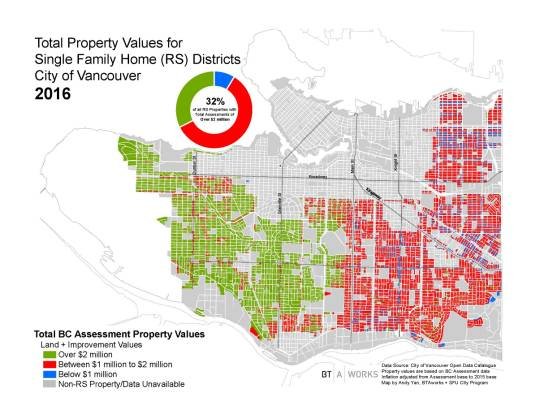
    Bing Thom Architects recently published a blog post looking at the property values of single family homes in Vancouver. The data was taken from the City of Vancouver Open Data Catalogue and is based on British Columbia Assessment data.

    The precise timing of the data is likely a bit off, but here’s how the city looked in 2015:

    23% of single family homes in the city had an assessed value over $2 million.

    A year later, this number increased 32% of all single family homes:

    It’s interesting to see how divided the city is along Main Street. But the big takeaway – thanks to BTA – is that $2 million seems to be the new $1 million.

  • 10 city building predictions for 2016

    Dawn by Adrian Popan on 500px.com

    https://500px.com/embed.js

    Few things are better than waking up in the mountains and seeing a notification on your phone that 9″ of fresh snow have fallen overnight, bringing the 48 hour snowfall total to 16″.

    This is what people in mountain towns live for. They ski in the morning and then head to work in the afternoon. I heard a number of people on the mountain today saying that they, “want to be in the office after lunch.” It’s a lifestyle thing.

    On that note, today I’d like to focus on 10 city building predictions for 2016. I’ve been assembling this list over the past few weeks and now that I have had my fill of Utah powder for the day, I’m dedicating the rest of the afternoon to writing.

    These are never easy to put together. But here are my thoughts:

    1. We will see increased migration to secondary cities – outside of the alpha global cities – which offer a higher quality of life, more affordable housing, and the ability to live a particular lifestyle. This includes cities like Austin (creative startup hub) and Denver (outdoor recreation).
    2. As more and more cities wake up to the importance of lifestyle in attracting top talent, I think we will see a lot of cities follow the lead of Amsterdam and create “night mayors” or some other equivalent. These cities will begin to see nightlife as a competitive urban advantage.
    3. Global cities will start experimenting with different land use and property tax reform strategies to try and deal with rising income inequality and eroding housing affordability.
    4. We will see a barbell of residential unit sizes. We’ll see more well-designed small units as a way to try and promote housing affordability and we’ll see larger urban infill units for families and baby boomers who want to live/remain in walkable urban communities.
    5. In line with above, I think we will see a further rethinking of urban spaces. Flexible spaces, unique program mixes, and a continued blurring of public/private spaces. One example of this is the trend towards small private spaces surrounded by generous public/communal spaces.
    6. The Toronto and Vancouver real estate markets will continue to chug along because of low interest rates, a weak Canadian dollar, and increased foreign investment. That said, I think we will see more restraint when it comes to over-the-top luxury product.
    7. We will finally see a disruptive technology product that starts to get people in the real estate industry thinking that change is on the way. This will not be a product that ports an offline experience online; it will a new way of thinking about the industry.
    8. This will be the year that cities stop fighting Uber (and other similar marketplaces). Cities (and lobbyists) will finally accept that this is a new reality and then work to figure out the best way to create policy around it. Edmonton, Alberta has already become the first Canadian city to regulate Uber.
    9. Road pricing will get the attention it deserves in North America. Things will start out slow, but we will finally get ourselves on a path which recognizes that we can’t build our way out of traffic congestion in most major cities.
    10. I will publish a book on becoming a real estate developer.

    Many city building trends and shifts seem to happen in a global way. But I think it’s worth noting that a lot of these predictions were likely written with my North American lens on, and in some cases my Toronto lens on.

    It’s not easy sitting down and thinking about what will happen in the future. But it’s a worthwhile exercise. It forces you to take a stance and then, when the future does come, you can see how well you did. I saw Fred Wilson do this on his blog and I thought it was a great idea.

    Now I would love to hear what you think about my predictions and what yours are for this year. Please let us know in the comment section below.

  • Additional thoughts on land prices

    Daniel Hertz over at City Observatory just published a post talking about why land costs are so important when it comes to home prices. More specifically though, his post is intended to refute a claim that multifamily housing is always going to be more expensive than single family housing.

    The key concept here – which is critical to understanding urban real estate economics – is that home values are essentially made up of two things: the land and the improvements (i.e. the building). 

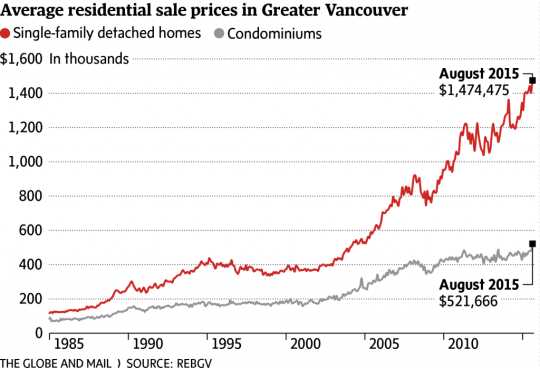
    When home prices rapidly appreciate, as has been the case in cities like Vancouver (see below) and Toronto, it’s not the building, but the land that’s really driving the price up. 

    And as you can see from the chart below (which Daniel shared in his post), it is possible for multifamily housing to be less expensive than single family housing. 

    image

    So why was someone arguing that multifamily housing is more expensive?

    Well if you look at just construction costs, then this is generally true. Single family housing is typically wood frame construction, whereas multifamily housing is usually reinforced concrete or some other material that allows you to build up. In these latter cases, the price per square foot to build is going to be higher.

    But Daniel’s argument is that when you build multifamily housing, you also begin to amortize the cost of the land over more housing units. So you begin to use land more efficiently and that offsets the higher construction costs.

    However, two thoughts come to mind.

    First, the value of a piece of land is entirely dependent on what you can build on it. And the more you can build on it, the more the land is worth. So as densities increase, so do land prices.

    Second, a big part of why condominiums are so much more affordable is that they’re smaller. In 2014, the average condo size in Metro Vancouver was estimated to be 840 square feet. I couldn’t find the average size of a detached house in the city, but let’s assume for a second that it’s 2,500 sf. 

    If that were the case, then a detached house, despite being more expensive overall, would still be cheaper on a per square foot basis. You would be paying less for every square foot of livable space. True that doesn’t make the house more affordable, but I think it’s a bit unfair to compare apples (small condo) to oranges (large house).

    So what I would really like to see is a graph of all-in low-rise and high-rise per square foot prices over time and for various cities. Because I would be curious to see at what point – if ever – they intersect.

  • How should cities manage their own awesomeness?

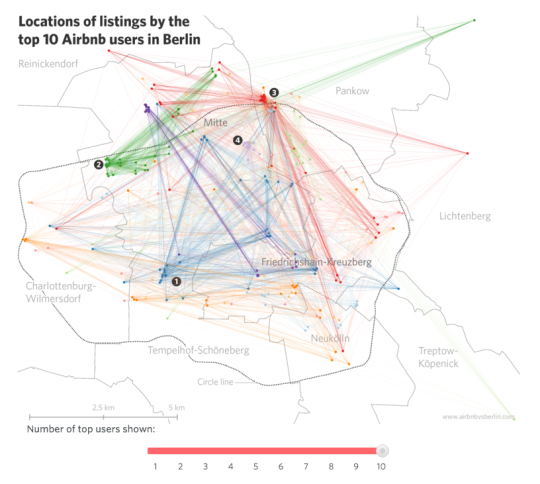
    Conor Maguire introduced me to an interesting site today called Airbnb vs. Berlin. The site does a deep dive into Berlin’s Airbnb market with the hope of answering the question: Is Airbnb contributing to a shortage in affordable housing?

    The site is very well done. It’s filled with lots of great market stats and diagrams such as this one here: 
    Of course, the impetus for a site like this is that cities all around the world, from San Francisco to Berlin, are grappling with rising home prices. If you happen to live in a successful, growing city, that’s probably what is happening.

    But when this happens, we seem to want to look for something or someone to blame. In San Francisco it’s the tech workers. They’re the ones driving up homes prices. In Vancouver, it’s the foreign Chinese buyers. And in Berlin, it’s those Airbnb users who are just out to make a profit. In all of these cases, we like to tell ourselves that if we could just get rid of “X”, everything would be much better. 

    But I think sometimes we forget that this is also the result of doing many things right.

    If Berlin wasn’t a brilliantly cool place to visit, then tourists wouldn’t come. And if tourists didn’t come, then Berlin wouldn’t have, by far, the largest Airbnb market in Germany. If Vancouver wasn’t one of the most enjoyable places in the world to live, you wouldn’t have the same attention from overseas buyers looking to snatch up properties. 

    So in a way, we should be asking ourselves: How do we, as a city, manage our own awesomeness?

    The other thing that Airbnb vs. Berlin reminded me of is the viewpoint that profits are some dirty little secret. I hear it all the time in the real estate development business. People will say: “That developer is just out to make money.” Of course she/he is! They operate a business. And like all for-profit businesses, one of the objectives – it may not be the only one – is to make money.

    I say all this not as a direct response to the website. They remained fairly neutral in their analysis. Instead, I raise it as an alternate viewpoint in the seemingly universal battle against “X.”

    In case you’re wondering about Berlin’s Airbnb market, the site estimates that there are roughly 11,701 Airbnb listings in the city out of a total of about 1.9 million flats. Of these listings, it is estimated that somewhere around 30% are by “professional users” who are only out to make a profit and are not participating in the “sharing economy” in its purest sense. That equates to about 0.18% of all Berlin flats.

    Based on this number, I’d say that Berlin’s cool factor probably has a lot more to do with the city’s rising rents than do the profit seeking Airbnb users.