Daily insights for city builders, delivered every morning at 6 AM ET. I’m Brandon Donnelly — a Toronto-based real estate developer and founder of Globizen. I’ve been writing here since 2013.

Tag: urbanism

  • 2 parents, 2 kids, and 1 cat in 1,000 square feet

    Yesterday a colleague at the office sent around this Globe and Mail article talking about a Vancouver family of 4 (plus one cat) who live in a 1,000 square foot loft near downtown that they purchased in 2003 for $269,900. There weren’t really any photos of the place, but the article makes it sound like they have 3 beds crammed into one room. (I wonder how the parents ever manage to have sex. There are better ways to lay out 1,000 sf.)

    In any event, the point of the article is that there’s a growing number of families who are clinging to the downtown lifestyle that they’ve grown accustomed to and are refusing to follow the path of a conventional suburban house – regardless of how tight their current quarters might be. It’s happening in Toronto (here’s an article from the Toronto Star and here’s a post I wrote) and it’s happening in New York:

    A recent New York Times article on a similar trend noted that the number of white professionals with one or more children living in one-bedroom condo units in that city had jumped by almost a third between 2000 to 2006. Prof. Andrew Beveridge, from Queens College of the City University of New York, said the pattern was showing up in other expensive American cities. In Toronto, the 2011 National Household Survey showed there are about 72,000 families living in 71,500 units in buildings with five or more storeys – undoubtedly many of them the new, tiny condos proliferating there.

    To some this might sound crazy. I mean, why would a dual income family–such as the one in Vancouver–subject themselves to a smaller space when they could easily afford a bigger place somewhere else? Isn’t that the dream – to have a big house?

    The answer is that these families are considering–in addition to the direct costs of a bigger place–both the indirect costs of living further away from the core (such as longer commute times) and the inevitable lifestyle changes that would happen should they move out from their downtown neighborhoods. The urban lifestyle is different.

    But what I find interesting about this phenomenon is that if this trend continues (and I think it will), we’re going to have a new generation of people in North America who grew up in apartments, condos, and lofts, and don’t have the same biases around single family houses and suburban living. To them, an apartment will be a perfectly normal place to raise a family.


  • The death of driving

    image

    Last night my father and I were walking to dinner and he commented to me that he thinks my generation will be a lot healthier than his–at least on average–given how much more my generation walks. I responded by reaffirming to him how little I drive these days and how much I enjoy that.

    Then today, I was watching this short clip of the The High Road with celebrity chef Mario Batali, where he interviews venture capitalist Fred Wilson. During their tour around New York City, Mario asks Fred what he thinks the future of transportation will be. Fred responds by saying that nobody will drive anymore. He then went on to say that the technology for driverless cars is already ready, but that we as a society just aren’t ready for it, yet.

    Finally, on my way home from wakeboarding today, I stumbled upon this Guardian Cities article talking about Helsinki’s ambitious plan to make owning a car pointless. By 2025, the goal is have a “point-to-point mobility on-demand system” that will integrate all forms of mobility into one booking and payment platform. Think everything from public transit to carpools to taxis. 

    As I read on, I then discovered that Helsinki is already offering on-demand public minibuses that allow people to specify their own routes on their smartphone. The system then aggregates all of the requests and establishes the most efficient route based on the immediate demand. Coincidentally enough, it’s quite similar to a use case I wrote about for driverless cars.

    All of this got me thinking that one day we’ll probably look back at that time when people used to drive their own vehicles around as some antiquated and hilarious moment from the past.

    Image: Observatoire

  • Further evidence that laneway housing is going to happen

    image

    Earlier this week Fast Company ran a piece talking about “the next big thing in urban planning” – backyard cottages. As the name suggests, backyard cottages are basically accessory dwellings built in the backyards of existing single family homes. And the idea is that they’ll provide new affordable housing options in competitive and supply constrained markets such as the Bay Area in California.

    While somewhat different than laneway housing–which you probably know I support here in Toronto–they do share many similarities. We’re talking about the intensification of our residential neighborhoods at the scale of the single family home. And the potential benefits go beyond just affordability. It would also make our communities more sustainable, more walkable, and more conducive to transit.

    But there are challenges. I don’t know about the Bay Area, but many municipalities don’t allow a “house behind a house” and many communities don’t want to see their neighborhood itensify. However, we are seeing companies, like New Avenue, emerge to help homeowners navigate the process of building a backyard cottage. This company in particular claims to have worked with over 90 homeowners. 

    So I think we’re going to see more, not less, of these types of housing solutions. Vancouver is already doing it. And so is Portland

    Now here’s a question for you. If you owned a house in a single family neighborhood, would you be fussed if your neighbor erected a backyard cottage or laneway house? I’d love to get your opinion. Let me know in the comment section below.

    Image: New Avenue

  • Architect This City is The Guardian Cities blog of the week

    image

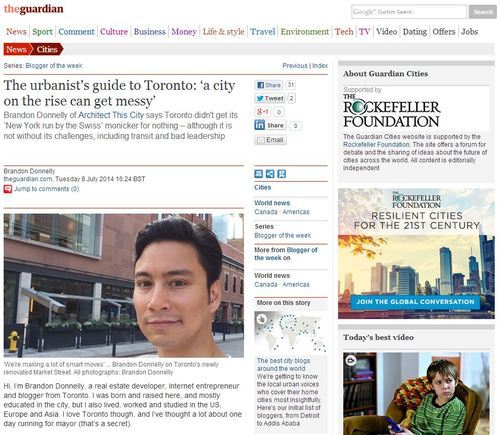
    ATC was featured in The Guardian Cities today as the city blog of the week. It’s a Q&A about Toronto and the idea is for it to be an “urbanist’s guide” to the city. They asked me to be playful and humorous in my responses, and so I tried to do just that.

    But my underlying message was that–despite being an awesome city–Toronto needs to get its act together with respect to mobility and transportation. I also recorded a video talking about this problem, which I believe will be released in the next week or so.

    A big thanks to The Guardian Cities for asking me to participate and to Athlyn Cathcart-Keays for continuing to be an avid supporter of Architect This City.

  • Stuck in condoland?

    Toronto Life recently published an interesting article called Stuck in Condoland. A lot of people have mentioned it to me, so there seems to be a lot of interest in the topic. It basically profiles the lives of a few young families who live downtown and are trying to raise young children in relatively small condos (think 700 square feet).

    I thought it was interesting because I like the idea of small and efficient living. The average post-war bungalow in Toronto was probably less than 1,000 square feet. And so this modern notion that you need a big house in order to properly raise a family is a relatively recent phenomenon. Although we’re a richer city today and that’s what happens when people become wealthier: they consume more.

    But the article also makes it seem that developers only want to build small condos and that larger condos and single-family homes just aren’t profitable enough. Thus the reason all these families are being forced to into tiny shoeboxes in the sky. But that’s not really true.

    Look, just like every other for-profit business on the planet, developers are concerned with making money. And so they will always look for ways to increase efficiency, drive down costs, and so on. But there are certain realities of the market that developers don’t have control over.

    First, developers aren’t building new single family homes in the city (at any sort of meaningful scale) because there’s no land to do so. And because the land use policies in place and the current thinking around how we can more sustainably build our cities for the future dictate that we should be building more intensely. In other words, building up. So it’s not a question of developers not wanting to build single family homes; it’s a question of not being able to.

    Second, trust me when I say that if the market wanted large 3 bedroom family units, developers would build them. Mandating them is a useless exercise if people don’t want them or are unable to afford them.

    The challenge we face is that a reinforced concrete condo tower is more expensive to build than a wood-framed single family house. So until land values get to a point where single family homes become the more expensive option (compared to condos), I don’t think we’ll see a huge rush towards 3+ bedroom suites.

    This is my hypothesis at least. Because when you buy house, you’re really buying two things: the house itself and the land. If the house itself (wood) is cheaper to build on a per square foot basis than a condo (concrete), then the variable that will make a difference is the land. And as people like to say: “buy land, they ain’t making any more of it.”

    So what I’m saying is that I just don’t think the situation is as simple as: “developers are bad, all they want to do is build tiny condos and make lots of money.” It’s more complicated than that. But I do believe the question of how families are going to live in the city is an important one.

  • A data-driven approach to city building

    Yesterday I wrote a post talking about the rise of community involvement in the city planning process and how many people feel that it’s undermining the expertise of trained city planners.

    My position is that community participation is only going to become more pronounced and that it’s likely a natural outcome given the internet and what we’re seeing with many other industries.

    So instead of lamenting, I think we as city builders need to figure out how to create better frameworks and processes for dealing with the changes that are currently underway.

    Because it’s not just community involvement that’s getting in the way of city building, it’s also politics. In too many cases we are allowing self interest to get in the way of rational city building.

    But what I was starting to get at yesterday is that as city building becomes more open and transparent, and we find new ways to collect and leverage decentralized data (traffic flows, public space usage, and so on), I think it’ll open up the possibility of a more data-driven approach to city building.

    Cities are complex systems and in the past we’ve made a lot of mistakes because our assumptions were incorrect. We assumed, for example, that building more highways would quickly solve congestion. It didn’t.

    But with more openness, more transparency, and more data at our disposal, I’m hopeful that we’ll discover countless ways to build better cities. And when that happens, I think we’ll find that the naysayers don’t have as much to say.

  • The death of planning expertise

    image

    Yesterday a friend of mine sent me this article written by a city planner talking about the death of planning expertise. The article talks specifically about the rise of “community participation” and how it has undermined the modern planning process. (I guess it’s not just architects who feel undermined.)

    …we have lost respect for “experts”—those who have knowledge and/or experience in a particular field—and have replaced it with a kind of “expertise egalitarianism” whereby everyone’s opinion is given equal weight. But it is not only that the layperson’s opinions are given equal weight, experts increasingly face outright hostility. Laypeople attack experts as being arrogant, elitist, and imposing, if not outright threatening, often because the expert insists he or she knows something the other does not. Even more ridiculous, rather than being viewed as helpful or even essential, expertise is viewed as harmful or even antithetical to community participation.

    But to be clear, the author is not arguing for technocratic rule. He simply believes that community input has reached a point where laypeople with only anecdotal evidence are given equal weight as planning experts, and that it’s miring the planning process and causing less than desirable outcomes.

    This topic is interesting to me for 2 reasons.

    First, it’s interesting because we’re basically talking about a form of decentralization, which, just so happens to be one of the macro trends being ushered in by technology and the internet. It used to be that we couldn’t decentralize. Communication costs were too high and the ability to share information in real time wasn’t possible.

    But today we can. So instead of, for example, only getting the news from one source (a newspaper, perhaps), we get it from millions of people on platforms like Twitter. We trust laypeople, just as much as we do “expert” reporters, to tell us and show us what’s happening in the world. Just yesterday I turned to Twitter to see what was happening with Toronto’s torrential rainfall (#TorontoStorm).

    And as a result of this trend, we’re seeing startups like Popularise that are, in some regards, trying to decentralize the planning process. The platform allows communities to decide what they want to see in their neighborhood and then share it. Think your neighborhood could use an organic grocery store? Great, you can spec that on Popularise.

    The second reason I find this topic interesting is because there’s a school of thought (let’s call it the “wisdom of crowds” school of thought, to name it after a book), which believes that in aggregation the opinions of many can actually be better than those of a few so-called experts.

    And in many ways I agree with this—though there are a number of prerequisites that need be met in order for this to hold true. For example, you can’t have groupthink taking place, which I think you could argue is what often happens with NIMBY movements.

    Nonetheless, there’s a shift taking place and it’s impacting not only the planning profession, but many others. In the end though, I don’t think it will make experts irrelevant. In fact, as industries continue to “open up” and as we harvest more and more data (that previously wasn’t available), I think we’ll all be surprised at how beneficial this ends up being. 

    Image: GSAPP

  • What the hell does gesamtkunstwerk mean?

    image

    I’m a big fan of Canadian developer Ian Gillespie and his firm Westbank. They are the developers behind projects like the Shangri-La Vancouver, the Shangri-La Toronto, the mixed-use Woodward’s complex, and the upcoming Vancouver House (shown above) designed by Danish architect Bjarke Ingels (who just so happens to be one of my favorite architects). I would easily count them as one of the preeminent city builders in the country today.

    In support of their commitment to city building (and as a way to offer the public a peek of Vancouver House), they recently staged an exhibition called Gesamtkunstwerk. I think this is great on so many levels. Not only was it probably a great sales tool, but it’s also introducing the public to a largely obscure and academic term, and showing off a deep commitment to design. Unless you studied art, architecture, or something like the philosophy of aesthetics, you probably haven’t come across this term before.

    Gesamtkunstwerk is a German word, which literally translates into a “total work of art.” It was introduced in the 19th century by an opera composer by the name of Richard Wagner, who felt that opera represented a total, or complete work of art. Later, the term was picked up by architects. Some interpreted it to mean that architects should be responsible for everything from the building itself to the furniture and everything else that goes inside of it. Everything was art.

    Westbank now wants to introduce the idea of gesamtkunstwerk into the real estate development business. They want to use it as a guiding philosophy for all of their projects. And what that means is that the building itself and its relationship to the greater city should be thought of as a “total work of art.” They seem to be reintroducing the term with an inherent city building tinge–one that I don’t think was ever there before. 

    What a great philosophy.

    Image: Westbank

  • How mobile apps are going to help us build better cities

    image

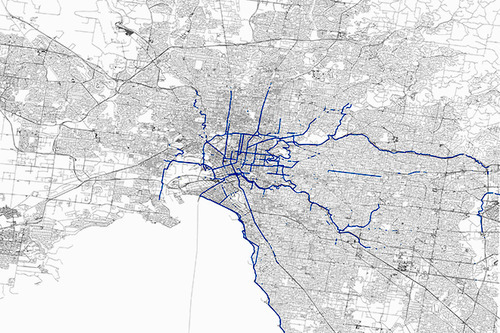
    Some of you might know that I’ve recently started using a mobile app called Strava. It’s a platform that allows you to track your runs and bike rides, as well as those of your friends. It tells you your speed, elevation changes, and it also maps your trips–among many other things. Here’s what my 50 km ‘Ride for Heart’ looks like from last Sunday.

    But what’s even more interesting is how cities are starting to use the data this app collects:

    For $20,000 a year, transportation planners and others can access Strava Metro, which provides an unprecedented look at where and how people are biking. It can tell them where they speed up and slow down, for example, or where they might stay in the street or ride on a crosswalk. That information can reveal where bike lanes or traffic calming measures would be useful, and if those already installed are effective.

    It’s a perfect example of how “tech” is infiltrating so many other sectors. Mobile technology and networks are generating huge amounts of data and it’s happening at an increasing rate. We’re gaining insights into the way people live that simply wasn’t possible before. Some of this information will inevitably be misused, but a lot of it will be used to improve the way we live our lives.

    I know that the City of Toronto also has its own proprietary cycling app and is hoping to collect similar sorts of data from it. But intuitively, I don’t think they’ll be able to compete with the scale of a platform like Strava. Though I certainly applaud the initiative.

    The information age is an exciting time.

    Image: Strava via Wired

  • Toronto mayoral candidate announces regional express line

    image

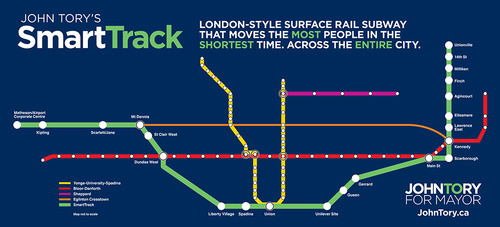
    Yesterday Toronto mayoral candidate, John Tory, proposed a transit line called SmartTrack. It’s part of his One Toronto transit plan. If you’re interested in watching the full 30 minute announcement, click here.

    As somebody who came out of the gate as a strong proponent of the “Yonge Relief Subway Line” (and as somebody I immediately supported for that reason), this proposal first hit me yesterday as a disappointment. Not because I don’t think we need a regional express rail network in the region (we do), but because I feel that he is backing away from that initial commitment and depriving the core of the transit infrastructure it needs.

    As soon as I found out about the plan, I immediately emailed one of my friends at Metrolinx. I told him I thought it was an “epic fail”. He pushed back and asked me to consider the merits of Tory’s plan. After having slept on it (and calmed down), I’m now prepared to talk about both the benefits of SmartTrack and why I was disappointed. 

    SmartTrack is basically a regional rail plan, intended to move people from the outer and inner suburbs to and from downtown using an integrated fare system. That is, riders will not have to pay a separate fare to transfer from subway to SmartTrack. 90% of the track needed for the plan is already existing, which means it will be cheaper and quicker to build compared to the full relief subway line. It will also bring employment centers such as Airport Corporate Centre in Mississauga into the transit network. For these reasons, the SmartTrack plan would certainly be beneficial for the region. 

    But, there’s a densities mismatch.

    If you look at the number of stops proposed in Scarborough and Markham, and compare it to the number of new stations proposed for downtown (1 – Spadina station) and the downtown shoulder neighborhoods (2 – Liberty Village and the Unilever site), the plan starts to look lopsided. SmartTrack would help residents of downtown get out to the suburbs, but it would do little to help them move in and around the core.

    If you look at the way Toronto is intensifying on a map, it looks like an upside down letter T. Density now hugs the waterfront and then follows our subway lines up north. I believe that the SmartTrack plan would help to relieve the pressures on those subway lines, but I don’t think it adequately addresses the bar of the T that now runs parallel to the lake.

    So while I do think that the Toronto region would be well served by regional express rail, I don’t think we can forget about the central part of the city. This shift in focus may have something to do with where Tory believes his voter base now sits, but let’s not forget that there’s a strong correlation between population density and transit ridership levels. 

    Now, let’s hear from you. What do you think of Tory’s One Toronto plan and SmartTrack proposal?