Daily insights for city builders, delivered every morning at 6 AM ET. I’m Brandon Donnelly — a Toronto-based real estate developer and founder of Globizen. I’ve been writing here since 2013.

Tag: urbanism

  • #donthave1million

    Tiny Park by David Brookfield on 500px.com

    https://500px.com/embed.js

    After I wrote this week’s post about Chinese homebuyers in Vancouver, I was surprised to learn about the racism debate that flared up in the city / on Twitter. I guess this really is a touchy subject. (See: #donthave1million)

    My reaction to the research was: Great to see someone (Andy Yan) putting in the time to try and better understand a market phenomenon. It’s painful how opaque real estate markets can be. Let’s get even more data so that we can make even better policy decisions. I didn’t read it as: let’s deliberately single out a race.

    Because the reality is that we all knew this was happening.

    Bloomberg recently published an interesting and related article that talks about China’s money exodus and how the Chinese logistically get their money out of the country. There are restrictions in place. 

    But first, here are two snippets from Bloomberg that describe the order of magnitude we’re talking about:

    This flood of cash is being felt around the world, driving up real estate prices in Sydney, New York, Hong Kong and Vancouver. The Chinese spent almost $30 billion on U.S. homes in the year ending last March, making them the biggest foreign buyers of real estate. Their average purchase price: about $832,000.

    In total, UBS Group estimated that $324 billion moved out last year. While this year’s numbers aren’t yet in, during the three weeks in August after China devalued its currency, Goldman Sachs calculated that another $200 billion may have left.

    Now here’s how it is being done:

    It works like this: Chinese come to Hong Kong and open a bank account. Then they go to a money-change shop, which provides a mainland bank account number for the customer to make a domestic transfer from his or her account inside China. As soon as that transaction is confirmed, typically in just two hours, the Hong Kong money changer then transfers the equivalent in Hong Kong or U.S. dollars or any other foreign currency into the client’s Hong Kong account. Technically, no money crosses the border – both transactions are completed by domestic transfers.

    And here’s a snippet that stood out for me because it shows how easy this has become:

    While the first exchange has to be set up face-to-face, customers can place future orders via instant-messaging services such as WhatsApp or WeChat, and money changers set no limit on how much money they can move.

    Given the scale and complexity of this issue – housing affordability – I have to believe that cities and policy makers would be far better off with more, rather than less, information. I hope we can work towards that.
  • Will parking spaces in cities become more, or less, valuable in the future?

    Parking Garage by Nuno Silva on 500px.com

    https://500px.com/embed.js

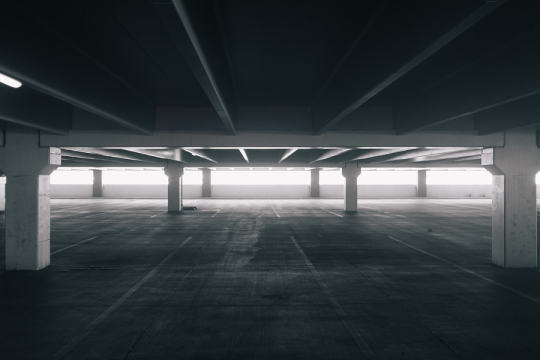
    Lately I’ve been having discussions around the future value of parking spaces in urban centers. So yesterday I tweeted out this poll:

    //platform.twitter.com/widgets.js

    The sample size is very small, but for what it’s worth, there are some/many people who believe that urban parking spaces will become more valuable in the future.

    This is a reasonable assumption. 

    Over the last couple of decades here in Toronto, I would guess that parking ratios for new multi-family developments have probably fallen by more than half. It used to be that you had to build 1 to 1.5 parking stalls for each unit and now we seem to be sitting somewhere close to 0.5. Although, there are also exceptions and some projects today are getting built with no parking.

    So given that the supply side of urban parking spaces seems to be getting constrained and many cities are actively trying to encourage other forms of mobility, it’s not unreasonable to believe that parking stalls will only become more valuable. That’s why a new underground spot in Toronto might cost you $60,000 today and why some spots in New York can even fetch a $1 million

    But this assumes that the demand for parking will remain more or less the same. What if it doesn’t stay the same? What if we were to experience a tipping point that rearranged urban mobility? What if the cost of driving became so high that people stopped driving at scale? In these scenarios, the demand side of the equation would change.

    If you’re a regular of this blog, you probably know what I’m going to say next. But already I can think of two innovations that would contribute to the above scenarios: Uber and driverless cars.

    Uber’s goal is to continually drive down the cost of transportation and eventually get you to no longer own a car. They know very clearly that the demand for transportation services is highly elastic and that the cheaper they get the more you will use them. And the way they get cheaper is by continually increasing the utilization rate of their drivers/cars. An idle driver/car is the enemy.

    Of course, the other way to drive down fares is to remove the driver all together. And once you’ve done that, there is, in theory, no reason that a car should ever sit idle – like they do today. (The utilization rate for my car is around 2%.) And if a car is never sitting idle, then why would you ever need to park it? Certainly you wouldn’t need to park it as often as you do today.

    All of this isn’t going to happen tomorrow, but I believe – despite the supply constraints – that we are going to end up with excess parking spaces in our cities. And that will mean that they are going to be perceived as less valuable than they are today. I also believe that it will eventually seem silly to drive your own car. 

    What do you think?

  • The impact of Chinese buyers on Vancouver’s single family home market

    I have a new favorite blog that I think you might all enjoy as well. It’s called BT | A | Works and it is the “architectural and urban research and development division” of Bing Thom Architects in Vancouver. 

    I think it’s it’s important to have people in a firm who are researching and experimenting with ideas beyond the day-to-day tasks of a job. So I was excited to discover their work this morning.

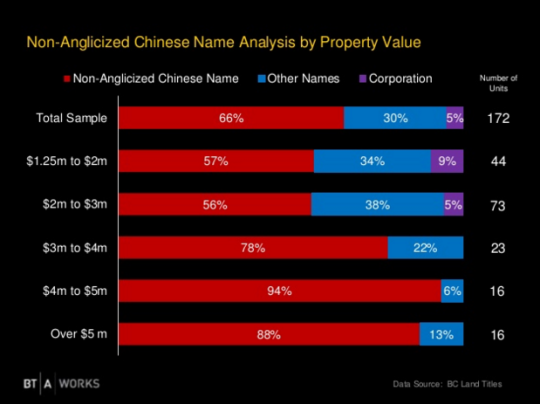
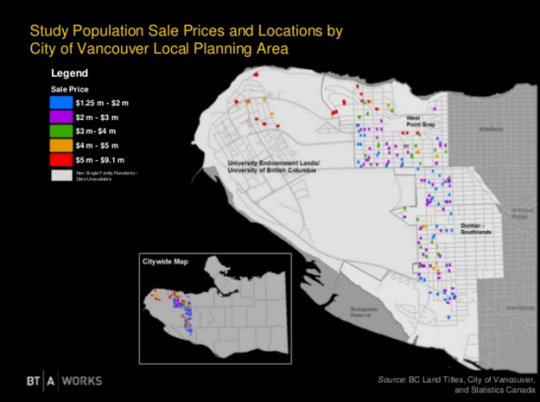
    Their most recent post is a look at ownership patterns of single family homes sold in 3 west end neighborhoods in Vancouver from September 2014 to February 2015 (a 6 month period). These are some of the most expensive areas in the city and, collectively, they found 172 properties sold with an aggregate value of around $520 million.

    Given the presence of foreign buyers in Vancouver’s real estate market, one of the things they then did was identify “non-anglicized Chinese names” on the title records. This means names like “Li Xian”, but not names like “Andrew Shui-Him Yan”, because the anglicized first name suggests that they are probably not a new immigrant or probably not living abroad.

    Here’s what they found:

    In total, 66% of the properties in the sample (172 properties) were associated with a non-anglicized Chinese name. And for properties over $5 million, the percentage jumps to 88%. The other interesting thing worth noting is that 23% of the registered owners declared their occupation as “homemaker/housewife.”

    I thought this would serve as an interesting follow-up to the post I wrote about a month ago called, Is Hongcouver better off than Vancouver? If you’d like to see the full BT | A | Works presentation, click here.

  • Los Angeles seeks Creative Catalyst

    Dance in the Temple of Light by Harun Mehmedinovic on 500px.com

    https://500px.com/embed.js

    We all know that city building is a multi-disciplinary endeavour. That’s why I was incredibly interested to learn about a new “Artist-in-Residence” program that Los Angeles is launching:

    The Honorable Mayor Eric Garcetti, is pleased to announce the first collaboration between two City of Los Angeles departments to place an artist in residence in a department to serve as a Creative Catalyst who will develop creative intervention strategies to achieve department specific goals. The Creative Catalyst Artist in Residence Program will serve as a model to stimulate creative thinking and innovative projects, while supporting Mayor Eric Garcetti’s Back to Basics priority outcomes: to make our city livable / sustainable, prosperous, safe, and well-run.

    Cities are complex organisms. And some of you might be wondering how artists can help city build. But this is about bringing different minds together, thinking across disciplines and, hopefully, leveraging design thinking to solve urban problems. And LA is not the only city to try this approach.

    In my view, it’s not that dissimilar from the trend around “Designer-in-Residence” programs at venture capital firms and startup incubators. Cities, businesses, and many other organizations are recognizing that the way artists and designers think can be of tremendous value.

    So if you’re an artist who lives and/or works in LA, this might be something worth considering. You have until this Friday, November 6th, 2015 to apply.

  • How we perceive commuting

    CHENNAI, INDIA-FEBRUARY 10: Street of Indian city 10, 2013 in Ch by sergemi on 500px.com

    https://500px.com/embed.js

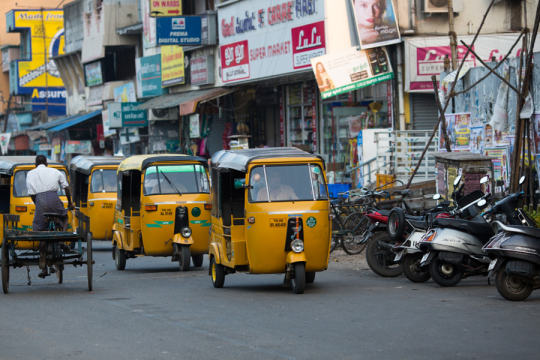
    Wharton real estate professor, Mariaflavia Harari, recently published a paper that looks at the relationship between urban geometry (specifically compactness) and inner city commuting efficiency across 450 cities in India.

    Consistent with previous research done in this space, she finds that people generally prefer compact cities and that they are willing to pay a premium for it. It increases overall welfare. Here’s an excerpt from her paper:

    “My findings are broadly consistent with compact city shape being a consumption
    amenity. All else being equal, more compact cities grow faster. There is also evidence that
    consumers are paying a premium for living in more compact cities, in terms of lower wages and,
    possibly, higher housing rents.”

    So her recommendations for the Indian cities she analyzed was that they should relax land use restrictions to allow for more vertical / compact development and that they should focus on improving urban transport in order to offset some of the negatives externalities associated with sprawl. This is no different than the approach that many cities in the developing world are adopting or looking to adopt.

    One of things that really stood out for me in her paper though is the way people perceive commuting:

    “The loss associated with non-compact
    shape appears to be substantial: a one-standard deviation deterioration in city shape, corresponding
    to a 720 meter increase in the average within-city round-trip, entails a welfare loss
    equivalent to a 5% decrease in income. This is considerably larger than the direct monetary and
    opportunity cost associated to lengthier commutes. Less compact cities also appear to attract
    fewer low-income immigrants, as captured by the share of slum dwellers.”

    What this is saying is that we tend to overvalue the negatives of commuting, beyond the direct costs of gas, insurance, car payments, our time, and so on. We hate it so much that we also want to be compensated for the mental anguish. Here is that same idea said differently:

    The estimated welfare loss from longer commutes appears to be large, relative to the immediate
    time and monetary costs of commuting. This is consistent with the interpretation that
    commuting is perceived as a particularly burdensome activity. The behavioral literature has
    come to similar conclusions, albeit in the context of developed countries. Stutzer and Frey
    (2008) find a large and robust negative relation between commuting time and subjective wellbeing,
    using German data. They estimate that individuals commuting 23 minutes one way
    would have to earn 19 percent more per month, on average, in order to be fully compensated.

    So I guess I’m not the only one who thinks commuting and driving sucks.

  • Somewhereness

    For over 10 years I have been a big
    supporter and proponent of Ontario wines. It’s almost the only kind of wine I
    buy. When I go to a restaurant I will always look to see what wines they have
    from Ontario, because I would much rather support a local winemaker.

    This past weekend I was in Prince Edward County visiting Norman Hardie. They are one of my
    favorite wineries in Ontario and if you haven’t yet tried their wines, I would
    encourage you to give them a go. They also have a great wood pizza oven if you
    decide to visit them in person.

    One of the things I appreciate about Norman Hardie’s wines –
    besides obviously the wines themselves, though the two aren’t mutually exclusive – is his philosophy behind the wines.
    Here’s a snippet from the website:

    I’ve chosen Southern
    Ontario to grow and vinify cool climate varietals, because I truly feel that
    these soils are unlike any other in the New World. As the worldwide market
    grows, the majority of wines available to us have been carefully manufactured to
    fit a flavour profile as opposed to smell and taste like the region they came
    from. I strongly believe in the importance of crafting wines that tastes of the
    place they came from. The French know this notion as “terroir”. Matt Kramer
    (Wine Spectator) calls it “Somewhereness”.

    I like this approach because I feel exactly the same way
    about architecture and cities. Who wants a city that looks and feels like every
    other city in the world? That’s boring, bland, and banal (couldn’t resist the
    alliteration).

    In my opinion, the best buildings respond to their local
    context and the best cities create a unique sense of place. They create
    somewhereness.  

  • How to encourage traffic congestion in your city

    City
    Observatory recently republished their
    commentary
    on a report (released earlier this year) called Who Pays
    for Roads
    . I missed their original post, so this is new to me.

    The report
    and commentary are all about the mispricing of roads/driving and the fallacy
    that “user fees” (gas taxes, tolls, and so on) are enough to completely cover
    the costs associated with driving.

    I have been
    a vocal supporter of road pricing and/or congestion charges here in Toronto, and
    so I’d like to share two pieces from their commentary.

    The first
    is this paragraph, which talks about how mispricing leads to demand issues
    (i.e. traffic congestion):  

    The conventional
    wisdom of road finance is that we have a shortfall of revenue: we “need” more
    money to pay for maintenance and repair and for new construction. But the huge
    subsidy to car use has another equally important implication: because user fees
    are set too low, and because, in essence, we are paying people to drive more,
    we have excess demand for the road system. If we priced the use of our roads to
    recover even the cost of maintenance, driving would be noticeably more
    expensive, and people would have much stronger incentives to drive less, and to
    use other forms of transportation, like transit and cycling. The fact that user
    fees are too low not only means that there isn’t enough revenue, but that there
    is too much demand. One value of user fees would be that they would discourage
    excessive use of the roads, lessen wear and tear, and in many cases obviate the
    need for costly new capacity.

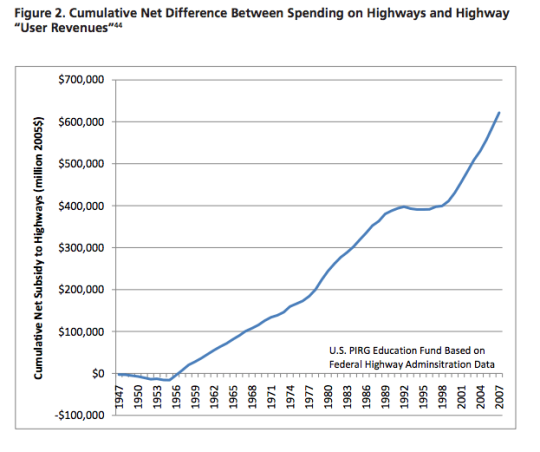
    And the second is this chart, which shows the cumulative net
    subsidy to highways in the US from the late 1940’s:

    image

    The point of all this is that when you subsidize something
    it’s because you’d like to see more, not less of it. So why then are we even surprised by the crippling traffic that plagues our
    cities? We are doing a lot to encourage exactly that.

  • Make Way for Laneway

    I was speaking with a friend this morning and he told me that he had a Pavlovian association between me and laneways. That made me happy. 

    If you’re a regular reader of this blog, you’ve heard me go on and on about the great potential of laneways and laneway housing (accessory dwelling units) in Toronto, as well as in other cities around the world.

    So I won’t do that today. Instead, I’m going to link to a report that was just released by the Pembina Institute called Make Way for Laneway: Providing more housing options for the Greater Toronto Area.

    The report is obviously about Toronto, but there’s no reason that the lessons and ideas won’t also apply to your city. So I would encourage you to give it a read.

    For those of you who have emailed me about my own laneway house, the project is still on hold. And it will likely remain that way until the city becomes a bit more accepting of this housing typology. Hopefully that will happen soon.

  • The London Crossrail

    On Thursday afternoon the mayor of Toronto, John Tory, was in London meeting with their mayor, Boris Johnston, and talking about Toronto-London business relations, the economy, and transit.

    Here is the tweet:

    //platform.twitter.com/widgets.js

    On the topic of transit, the big item to see and discuss was The Crossrail. For those of you who might not be familiar with it, here are a few bullet points from their website:

    Crossrail is Europe’s largest construction project – work started in May 2009 and there are currently over 10,000 people working across over 40 construction sites.

    The Crossrail route will run over 100km from Reading and Heathrow in the west, through new tunnels under central London to Shenfield and Abbey Wood in the east.

    Crossrail will transform rail transport in London and the south east, increasing central London rail capacity by 10%, supporting regeneration and cutting journey times across the city.

    Crossrail will bring an extra 1.5 million people to within 45 minutes of central London and will link London’s key employment, leisure and business districts – Heathrow, West End, the City, Docklands – enabling further economic development.

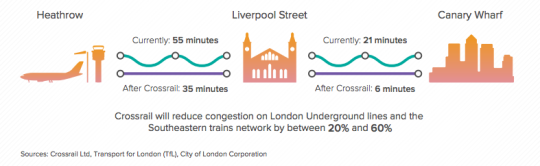
    And below is a neat diagram that I found in this City of London report. I think it does a good job summarizing some of the spatial impacts of The Crossrail.

    image

    In the past I’ve been negative about John Tory’s SmartTrack proposal, which is clearly inspired by The London Crossrail. I had my reasons for that. But I want to be clear that I am not in any way negative on Regional Express Rail as a mobility solution.

    Toronto would benefit greatly from RER and Metrolinx is working diligently to deliver it to the region. I can’t wait for that to happen so I can drive even less than I already do.

  • The contradiction in American housing policy

    I really like this post by Daniel Hertz talking about the inherent tension in American housing policy.

    Here’s his conclusion:

    We are, in conclusion, profoundly conflicted as a nation when it comes to housing: we want it to be affordable, but we also want its prices to rise fast enough to be valuable as a financial investment. That’s a contradiction we need to acknowledge if our housing policy debate—and, ultimately, our housing policy—is going to be coherent and constructive.

    Of course, this situation isn’t unique to the US. Though the US does have homeownership subsidies – such as the mortgage interest tax deduction – that other similar countries, like Canada, do not have.

    Still, I feel a similar kind of contradiction here. We worry about excess supply and housing bubbles when the reality is that both of these things are desirable outcomes if, and only if, the primary objective is to maintain housing affordability.

    But I don’t think that is the primary objective in practice. At least in this part of the world, I think we worry first and foremost about making sure that home prices continue to go up and that wealth is being built. Then, we worry about providing affordable housing for those that are unable to participate.

    I’m not making a judgement call on whether or not that’s a good or bad thing. It just strikes me that this tension, and there certainly is a tension, is not an equal one.