Daily insights for city builders, delivered every morning at 6 AM ET. I’m Brandon Donnelly — a Toronto-based real estate developer and founder of Globizen. I’ve been writing here since 2013.

Tag: urbanism

  • Rentberry brings open bidding to rental market in San Francisco

    A new startup out of San Francisco, called Rentberry, has just launched, allowing tenants to openly bid on rentals in the city. Think of it like a rental auction. Landlord lists property. And then tenants compete for it by submitting offers. 

    Not surprisingly – especially since we’re talking about San Francisco – there’s concern that this will do nothing but drive up the city’s already high rents.

    But I think the key detail is that the platform will make public the total number of applicants. As a tenant, it’ll even tell you how your credit score compares to those of the other bidders (presumably, so you can gauge how aggressive you might need to be on your bid).

    The real estate industry is rife with information asymmetries. So anything that improves transparency is something that catches my attention. If you’ve ever bought or rented a place in a competitive market, you know that one of the worst things you can hear from the broker is: “We have another offer.” (Even worse: “We have 12 other offers.”)

    It’s frustrating because it now means you’re competing. But even more frustrating is the fact that you have no way of assessing whether or not that statement is fact or fiction. Yes, I realize that there’s a code of ethics that’s supposed be followed, but you and I both know that games are played all the time.

    In fact, I think someone could easily make a full career out of just trying to correct the information asymmetries inherent in the real estate industry. Who knows what sort of impact they might be having on the market. So I’m excited to see how things pan out for Rentberry.

  • The birthplace of techno

    Detroit has been called the birthplace of techno. Beginning in the early 1980s – when the city was well in decline – the Detroit techno sound started to emerge, thanks to musicians such as Juan Atkins, Derrick May, and Kevin Saunderson. 

    Chicago had house music. And Detroit had techno music – among, of course, many other musical genres. But what I find fascinating about Detroit techno, in particular, was how it really reflected the ethos of post-industrial Detroit. It was high-tech. It was about machines. And it was obsessed with the future.

    Below is a clip from a 1996 French documentary called Universal Techno. Even if you’re not into electronic music, I think you should at least watch the segment starting at 1:40. I love how Derrick May talks about Detroit, and what should be this balance between the past and the future. It really reflects my own views on city building.

    [youtube https://www.youtube.com/watch?v=RSX_r0u3uzE?rel=0&w=420&h=315]

    If you can’t see the video, click here.

    I’m thinking about Detroit and its music because I’m headed there during Memorial Day weekend for the annual Movement Electronic Music Festival. It has been about 2 years since I was last in Detroit and so I’m excited to see the city in full swing.

  • What’s in a word? A lot.

    image

    One of the things I try to be aware of is the language that I use to describe things. Because the words and conventions we use can impact how we perceive things and they can also reinforce certain inherent biases. (I have a good friend who is an expert on this topic, so he has heightened my awareness.)

    For instance, I find that we tend to equate home and house. In other words, we’ll use the descriptors detached house and detached home interchangeably. And when we say that someone is a homeowner, it can sometimes, or often, mean that they have purchased a house.

    The same does not seem to be true for apartments and condominiums. Rarely do I hear people say that they live in an apartment home or a condominium home. It’s just an apartment or condo.

    This is meaningful because the emotionally charged word is home. It signifies a subjective (and usually comforting) experience, whereas the word house, I would argue, represents a building typology. And so by conflating the two, I often feel that we’re promoting a cultural bias that privileges houses as the ideal building typology. A true home is a house.

    The other word that I often think about in my business is unit. When we talk about multi-family buildings we often – and I’m definitely guilty of this – refer to each suite as a unit. We’ll say things like: “This is a 200 unit building and the unit mix is as follows…”

    Again, I am absolutely guilty of this. But at the same time, I often think about how this word, unit, is probably the furthest thing away from a home. Who wants to live in a unit? That doesn’t sound very pleasant. In fact, it sounds clinical. People want to live in a home. Now that’s a word with positive psychological associations.

    And so by reducing each home to a unit, I think it could be making us lose sight of the fact that each suite will eventually be lived in by someone who will then make it their home. Yes they can be considered a customer who are paying for a product (a great place to live), but I don’t think that should take anything away from its homeyness. 

    I live in a condominium and it is my home. What about you?

    Image: Flickr

  • What it takes to unlock infeasible development land (and some thoughts on parking)

    image

    One of the questions that came up after my recent post about land pricing was: what is it going to take to develop underutilized land on the outskirts of city centers?

    So today I thought I would talk about a new development project that was also discussed at the Land & Development conference I recently attended. I think will begin to answer this question.

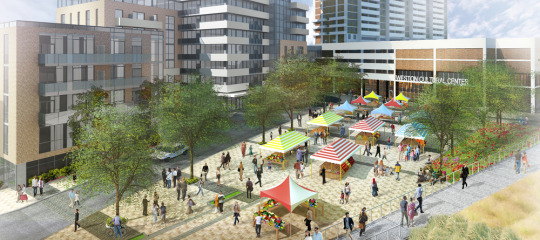
    The project today is known as the Rockport Weston Community Hub & Rental Building. And it’s going to include a community cultural hub, 26 live/work artist spaces, and 300 rental apartments. 

    It’s located in the Weston neighborhood of Toronto, which is designated as a “Neighborhood Improvement Area.” These are lower-income areas that the city considers to be “at-risk.”

    Given this, rents are naturally lower here than in other parts of the city, which means that it’s basically infeasible to develop here. There has been no large scale development in this community since the 1970s!

    To put some numbers to this, the developer said they were projecting rents somewhere around “two and a quarter.” So let’s assume for a second that the average apartment rents will be $2.25 per square foot. 

    At this rate, it means that a 600 square foot one-bedroom apartment will have a face rent of $1,350 per month. This may seem fairly high, but it almost certainly wouldn’t be enough to get a project like this off the ground under normal market conditions. At least, that’s the case here in Toronto with current cost structures.

    So what had to happen was a fairly complicated public-private partnership, which you can read all about here. But at a high level, there seems to have been 3 main economic factors that allowed this project to move forward:

    1) The developer was able to acquire the land for cents on the dollar. As I said in this post, land is expensive. So this helps a lot.

    2) The developer was able to make use of extra parking in an adjacent building. Assuming that underground parking could cost around $50,000 per stall, this is a huge cost savings.

    3) Lastly, the project is benefiting from the public invest made in the airport rail link that now quickly connects this site to both Pearson International and downtown Toronto.

    The moral of the story is that infeasible sites require some sort of subsidy or top up to make them work. Or, there needs to be an exceptional circumstance. Because if the rents aren’t there, nobody is going to build. It’s as simple as that.

    That said, here’s one idea…

    This discussion reminds me of a post I wrote a while back called, The hypocrisy of parking minimums. Frankly, I don’t understand why a city like Toronto still has parking minimums. If anything, we should have parking maximums.

    Underground parking is a huge cost that has to get carried by purchasers and renters in a new building. For example, let’s assume that 300 apartment suites would require 180 parking stalls (ratio = 0.6). Assuming $50,000 per stall, that’s a $9 million cost.

    So the second takeaway is that it’s probably time we took a good hard look at how we think about and plan for parking in our cities. Especially since the entire mobility space is being quickly disrupted.

    Image: Rockport

  • Towards a walletless society, almost

    image

    Today I am one step closer to not only going cashless, but also going walletless.

    This is going to be old news for those of you in the U.S., but yesterday, all 5 of Canada’s big banks signed on to Apple Pay. Before yesterday, you had to have an American Express credit card – which I do not have – to use Apple Pay in Canada. Now you can use a debit and/or credit card from these institutions.

    What’s great about Apple Pay is that it can be used anywhere that contactless, or tap, payments are currently accepted. And since this is pretty commonplace in Canada – more so than in the U.S. I think – Apple Pay can, at least in theory, be used almost anywhere.

    Being the early adopter and geek that I am, I went out for lunch today determined to test out Apple Pay. As I pulled out my phone to pay for lunch, the guy told me: “That’s not going to work. Other people have tried before.” But I tried anyway and, boom, it worked like magic. The transaction amount popped right up on my screen.

    I am pretty excited about this for a couple of reasons. 

    Firstly, it’s more secure. Apple Pay works in tandem with the iPhone fingerprint scanner. So even if I were to lose my phone, nobody would be able to charge anything to it. That’s not the case with a lost wallet. Anyone can tap a credit card to buy something.

    Secondly, Apple is working on allowing reward cards to be stored in its Wallet app. I am terrible about remembering to collect rewards and use gift cards, so anything that consolidates and simplifies is a positive in my view.

    Thirdly, I like to go to the gym and go cycling with just my phone and headphones. I don’t like carrying around my wallet. I’m always afraid that I might lose it or someone might steal it from a locker. So I try and leave it at home. Now I can do that and still pay for stuff – assuming my battery will last that long.

    Of course, it’ll be awhile until we can all really go walletless. I’m not aware of any significant push to digitize government IDs. But it will happen. (Does that mean there will be no more fake IDs for underage drinking?)

    As this transition happens, I can’t help but think of all the small businesses that only accept/use cash and probably hide some of their earnings. I suspect it’s going to be a lot harder to do that in the future.

    I’m also thinking about how transit agencies are going to have to quickly get onboard with this technology. Here in Ontario, we’re still rolling out a card-based payment system. And cards are about to disappear; perhaps sooner than most people think.

    Image: Apple

  • It sold for what?

    Today I spent the day at the Land & Development conference here in Toronto. If there was one running theme throughout the day, it was: “Holy shit, I can’t believe that X piece of land sold for $Y million. How will they (the developer) ever make the numbers work?”

    Outside of the real estate development community, there’s often the perception that developers are building everywhere and that there’s lots of land left in cities, like Toronto. When you see all the cranes in the skyline, it naturally seems like we’re building a lot. Things seem easy.

    But the reality is that it’s extremely difficult to find “land” in markets like Toronto and Vancouver. And by “land”, I mean properties that can be feasibly acquired/assembled, entitled, developed, and then brought to market. The way the speakers today spoke about land it’s as if it were a rare precious commodity.

    I say all this, not to complain about how tough things are, but simply to shed light on the process. A developer’s job is to take a piece of property and figure out a way to create additional value. But to do that, they need to find a suitable piece of real estate. “Land” is an input.

    This has implications for consumers, because inputs turn into outputs. And if one of the inputs is becoming scarcer, then it’s pretty safe to assume that the outputs, such as new housing, are also becoming scarcer.

  • Enemies of the High Line

    Despite not being the first example of infrastructural adaptive reuse, the High Line in New York has certainly kickstarted an urban trend. Cities all around the world now want their own “version of the High Line.”

    Philly is working on a new “rail park.” I toured the space last summer and it’s very similar to the High Line in terms of existing infrastructure. Rome and Toronto are both working on “under” spaces, which are beneath an old viaduct and elevated expressway, respectively. And the list goes on.

    But I think it’s worth remembering just how contentious the High Line was before it was built. For some people it was just an eyesore and a public safety hazard. Here’s a excerpt from a New York Times article dated 2002:

    “This is a terrific win for us,” said Michael Lefkowitz, a lawyer for Edison Properties, one of 19 businesses that own land beneath the High Line.

    Janel Patterson, a spokeswoman for the city’s Economic Development Corporation, said an agreement to share the $11 million cost of dismantling the High Line was being circulated among the property owners and the rail bed’s owner, CSX, of Richmond, Va. “It’s about eliminating a public safety hazard,” Ms. Patterson said, “but it’s also about enabling the city to move forward and better develop the area.”

    It’s also worth mentioning that former Mayor Giuliani supposedly favored demolition of the High Line. Former Mayor Bloomberg, however, did not:

    …Mr. Bloomberg said: "Today, on the West Side of Manhattan, we have an opportunity to create a great new public promenade on top of an out-of-use elevated rail viaduct called the High Line. This would provide much-needed green space for residents and visitors, and it would attract new businesses and residents, strengthening our economy. We know it can work … . I look forward to working with Friends of the High Line and other interested parties to develop a feasible reuse scenario.”

    The challenge with these sorts of things – that is, new ideas – is that we live in a world of proof and precedents. We want to see that it has been successfully done before, because, otherwise, we might be wrong. So now that New York has shown what is possible, it has cleared the way for other cities.

    Rethinking old infrastructure is a sound urban strategy. But we also shouldn’t forget that it’s less valuable to be right about something that every other city already believes to be true. The real value is created when you’re right about something that most other cities don’t yet believe.

  • Is Toronto a world-class city?

    image

    Earlier this week I was on a panel discussion called Building Toronto Tomorrow. One of the questions was about whether or not Toronto is world-class city. It elicited a good discussion, so I thought I would talk about that today on the blog.

    Shamez Virani, President of CentreCourt Developments, responded by saying that he thinks Toronto is the greatest city in the world and that he wishes more people would just accept how incredible this city is. I agreed with him.

    I also responded by saying that I hate this question. I think it reeks of insecurity and I think it’s a bit of a red herring. It distracts from more direct and meaningful questions – questions such as our livability and our position as a global city.

    Because the reality is that Toronto is one of the most livable cities in the world and, in my view, we are the only true global city in Canada. We are an important node in the global economy for the flow of goods, people (we’re particularly good at this), capital, and now information. There’s a lot to be proud of.

    But that’s not to say that we’re perfect. Everyone knows we need better transit. And to name a few others (non-exhaustive list), I also think we need to:

    • Get a move on road pricing.
    • Loosen up our archaic alcohol laws and start using nightlife as a competitive advantage for attracting talent.
    • Acknowledge through our governance structures that cities are what drive today’s information economy.
    • Stop thinking about the Canadian/Toronto value proposition as being about cost savings. That is, buy this from us because our currency is weaker than yours. This is anti-innovation and there are much better ways to create sustainable value. (Innovation is still a weak spot.)
    • Focus on developing an information economy that leverages the unique talent and knowledge base of Toronto. For example, I think we’re in a great position for real estate + tech innovation.
    • Do everything we can to encourage big tech IPOs in this city. They are critical to developing the ecosystem.

    There’s a saying in Silicon Valley that you “make what you measure.” It means that whatever you decide to focus your attention on, is invariably what you end up making – regardless of whether or not you happen to be focusing on the right metric.

    In the context of Toronto, I think we’d be better served if we focused on and quantified our position in the global economy, as opposed to chasing some idea of “world-class.” The latter will grow as the former grows.

    I also think that this needs to be balanced against our livability. Sometimes there’s a tension. But there are cities – the best example is perhaps Tokyo – who have managed to pair a high quality of life with one of the strongest positions in the global economy.

    Is there anything else you think we should be doing? We can talk about it in the comments below.

    Image: Building T.O Toronto (BuzzBuzzHome Event)

  • De Rotterdam…

    image

    “Manhattanism is the one urbanistic ideology that has fed, from its conception, on the splendors and miseries of the metropolitan condition – hyper-density – without once losing faith in it as the basis for a desirable modern culture. Manhattan’s architecture is a paradigm for the exploitation of congestion.” 

    Rem Koolhaas, Delirious New York, 1978

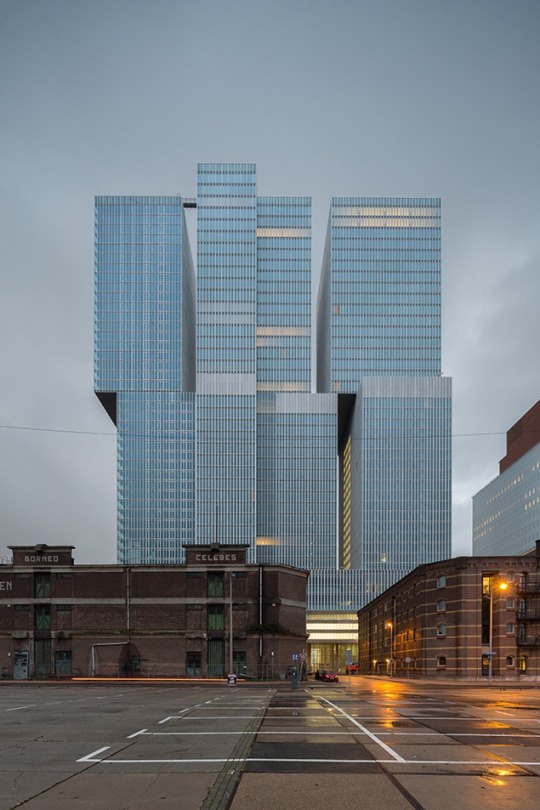
    Image: De Rotterdam by photographer Ossip Van Duivenbode via The Architectural Review

  • Happy 100th Birthday, Jane Jacobs

    “We came to Toronto,” she says, “because it’s a place where you can work, it’s a place where you can live well, it’s a place where there is hope.” –Jane Jacobs (1971)

    It was my birthday this week (May 2nd). But it was also the birthday of someone far more noteworthy. This past May 4th marks what would have been Jane Jacob’s 100th birthday. (She passed in Toronto in 2006.)

    In commemoration of this, Toronto Life published a photographic essay, along with a short piece by Joe Berridge. Joe is a partner at the urban design and planning firm Urban Strategies. He’s also a great storyteller.

    Here’s an excerpt:

    Jane didn’t do nice—Toronto’s default emotional setting. She was cantankerous and argumentative: once you got on the wrong side of her, that was that. About 20 years ago, when I was working as an urban planner, we were on a panel together at Boston College. I was making some remarks about city planning she clearly thought rubbish—and she just interrupted me. “Joe, Joe, Joe,” she said (her squawky Scranton, Pennsylvania, accent made it sound like “jaw, jaw, jaw”). “You’re tacking nansense.” The audience agreed. After I spoke, an incomprehensible social science professor took the stage. Jane wasn’t fond of academics—she didn’t think they knew much—but to make matters worse, he kept addressing her as Professor Jacobs. “Staap calling me prafessa,” she barked. “I barely graduated high school.” He and I both slunk offstage in shame, clutching our notes.

    Jacobs was certainly a force to be reckoned with. Without a doubt, she left her mark on this city, as well as others, like New York. And I believe that she is part of the reason why – almost 50 years after she first moved to Toronto – we remain a city where you can work, live well, and where there is hope. I like that simple characterization.

    If you’d like to read/see the full piece by Toronto Life, click here.