Daily insights for city builders, delivered every morning at 6 AM ET. I’m Brandon Donnelly — a Toronto-based real estate developer and founder of Globizen. I’ve been writing here since 2013.

Tag: urbanism

  • 133 Wai Yip Street, Hong Kong

    Dutch architecture firm MVRDV recently converted an old industrial building in Hong Kong into new office space. The overall project size is roughly 200,000 sf. What’s unique about the project is the obsessive focus on transparency and glass.

    Here’s what the interior looks like:
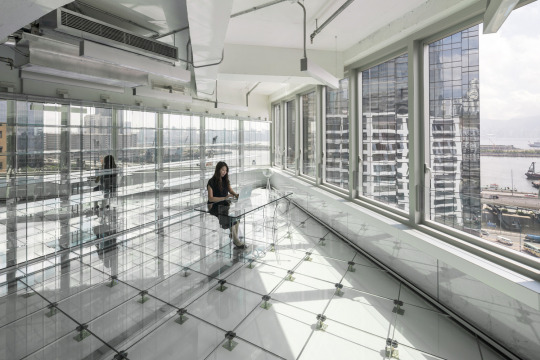
    And here’s how the architect has described the project:

    “We are moving into a transparent society, businesses are becoming more open with the public, and people care more about what goes on behind closed doors. In that way, a clear workspace leaves nothing questionable, nothing hidden; it generates trust.” Tells MVRDV co-founder Winy Maas, “But also it is an opportunity for the building to become a reminder of the industrial history of the neighbourhood, monumentalised in a casing of glass.”

    I have written quite a bit about how I believe we are shifting towards a more transparent world – perhaps even a radically transparent world. And so it’s interesting to see an architect pick up on this broader theme and translate it into physical space.

    The floor is transparent. The partitions are transparent. The furniture is transparent. And you can clearly discern the interfaces between old and new.

    Good architecture, at least in my opinion, should reflect what is happening in our broader society. That’s why I believe that studying the history of art and architecture is really like studying the history of the world.

    For more photos of the project, click here.

    Image by Ossip van Duivenbode via MVRDV

  • Event: Community Consultation for Mirvish Village

    image

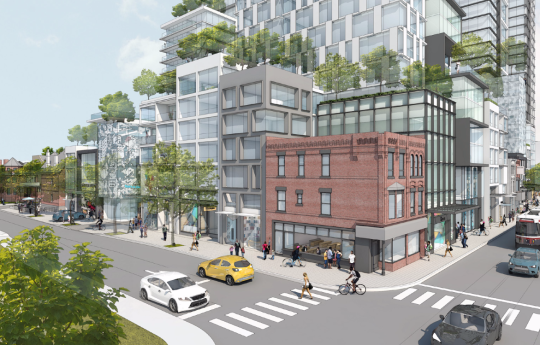
    One June 13, 2016 from 6:30 to 9:00 pm, the City of Toronto will be hosting a community consultation meeting for the proposed redevelopment of Honest Ed’s / Mirvish Village

    The meeting will be held at the Bickford Centre Auditorium at 777 Bloor Street West (across from Christie Pits Park).

    The purpose of the meeting is to present Westbank’s revised development proposal, which was submitted to the city last month. Their first proposal was submitted last summer (July 2015). 

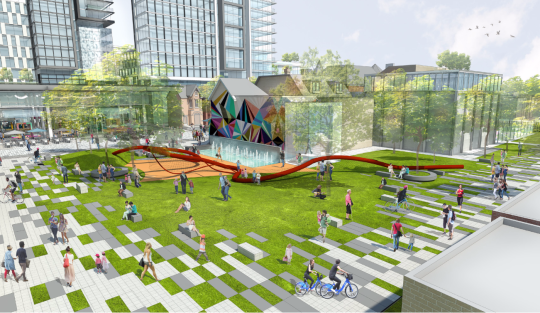
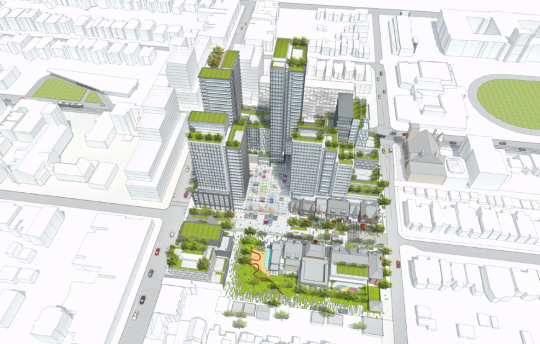
    Some of the key changes include a new on-site public park, the retention of additional heritage buildings (now 21 in total), more pedestrian porosity, and the retention of Honest Ed’s alley in its current location.

    I consider Westbank to be one of the most thoughtful developers in the city and so I’m pretty excited to see this one evolve. I’m planning to attend the community meeting and maybe I’ll see you there.

    Below are a couple of other renderings to give you a taste.

    imageimageimage

  • More thoughts on inclusionary zoning

    Alan Ehrenhalt recently published a balanced piece in Governing that largely reflects my own views on inclusionary zoning. It’s called: Why Affordable Housing Is So Hard To Build.

    His argument is that there are lots of cities trying to build more affordable housing, but that most strategies have not yet proven to be all that successful.

    I’ve written a few posts on inclusionary zoning. The most recent is this one. And though I believe that a mix of incomes is a critical component of good city building, I am having a hard time believing that inclusionary zoning is the silver bullet that will get us there. Admittedly, it sounds like a great idea. But how does that translate into reality?

    Here’s a snippet from Alan’s article (shout out to Daniel Hertz of City Observatory who seems to get cited in almost every article I read these days):

    Just about every city that has tried an inclusionary zoning law in recent years has had a similar experience. In some cases, the results have been much worse. According to BAE, Chicago’s inclusion law produced $19 million in 11 years, but only 760 affordable units. Thirteen years of inclusionary zoning in Seattle brought the city $31.6 million in fees and a grand total of 56 units. As the urbanist Daniel Hertz wrote recently, inclusionary zoning has been “more powerful as a symbol than as a way of helping people.”

    Of course, the devil is in the details. Many inclusionary zoning policies allow cash in lieu of actual housing:

    San Francisco actually has had an inclusionary zoning law since 2002, and it has been a flop. It mandates a 12 percent affordable set-aside, but allows developers to escape the mandate by paying a fee to the city. As in Arlington, this is what they have done. A study by the research firm BAE Urban Economics found in 2014 that after 12 years the San Francisco law had brought in $58.8 million in developers’ fees and had generated 1,560 units. That’s better than nothing, but it’s a drop in the bucket for a city facing an affordability problem in virtually every neighborhood.

    All this said, I’m still not so sure that it’s as simple as eradicating the cash in lieu option and forcing mandatary inclusionary zoning. As Alan rightly points out in his article, if we set the bar too high, then all of a sudden it starts making some market rate housing infeasible to build. 

    And if this ends up lowering the overall supply of new housing, then we could be hurting affordability while at the same time trying to mandate more of it. Does that make sense? Clearly this is not as simple as it may seem.

    I get the appeal for cash poor cities. It sounds like free affordable housing. But I’m always suspect of “free” lunches. In any event, I think we can all agree that this is an important discussion to be having.

  • Towards car-free living

    Right now, there’s an apartment building in San Francisco that is trying to encourage car-free living by offering residents a $100 per month credit that can be used for Uber and/or for public transit. Prospective residents can even get a $20 credit to go check out the community. (The program is a partnership with Uber.)

    The reason this leasing strategy caught my attention is because we’re at a point where city builders are now trying to recalibrate themselves to this new emerging world. 

    When I was at the Land & Development conference earlier this month, one developer brought up this exact point. He more or less asked: If you’re starting development on a new building today and you’re expecting approvals in 2 or so years and completion in another 3 or 4 years, what do you think the state of cars/driving will be at that point? Should you really be building all that underground parking?

    These are great question. And they highlight one of the challenges of development. It takes a long time to bring new supply to the market and a lot can change during that time period. My sense is that we are pretty clearly seeing downward pressure on driving and car ownership.

    That said, this isn’t the case in every city or in all parts of a particular city. I just got back from a trip to a Detroit where it’s pretty hard to imagine the city being oriented around anything but the car. But in cities like San Francisco and Toronto, car-free living is already a reality for many people and so we need to respond to that.

    How do you see yourself driving, or not driving, in the next 5 to 10 years?

  • The answer to San Francisco’s housing affordability problem

    Blogger and programmer Eric Fischer has an excellent post up on his site where he looks at: “Employment, construction, and the cost of San Francisco apartments.” It’s worth a good solid read.

    What he did was dig deep into whatever data he could find – the data goes back to the beginning of the 20th century in some cases – to try and figure out a solution to San Francisco’s housing affordability problem.

    Many (including myself) have argued that, at least part of the solution, is to build more, not less, housing. However, others, such as Tim Redmond of 48 Hills, have argued that building more market-rate housing would simply exacerbate the current situation.

    In Eric’s analysis, he looked at everything from median rents and new housing units constructed (above graph) to annual wage growth and income inequality. I particularly liked his summary of the city’s various building booms. 

    In the end, here’s the conclusion that he came to:

    “In the long run, San Francisco’s CPI-adjusted average income is growing by 1.72% per year, and the number of employed people is growing by 0.326% per year, which together (if you believe the first model) will raise CPI-adjusted housing costs by 3.8% per year. Therefore, if price stability is the goal, the city and its citizens should try to increase the housing supply by an average of 1.5% per year (which is about 3.75 times the general rate since 1975, and with the current inventory would mean 5700 units per year). If visual stability is the goal instead, prices will probably continue to rise uncontrollably.”

    By visual stability, he is referring to maintaining the current urban fabric of San Francisco just the way it is. In other words, he is making the link between preservation and affordability in a prosperous and growing city.

    Intuitively, this makes sense to me. It’s unrealistic to think that you can maintaining some level of housing affordability without allowing supply to increase alongside demand.

    At the same time, I do not believe that preservation needs to equate to no changes whatsoever. Urban preservation, to me, should be about dutifully respecting the past while still looking firmly towards the future. And that’s how I believe successful should be approaching this problem.

  • Should Switzerland adopt an unconditional basic income guarantee?

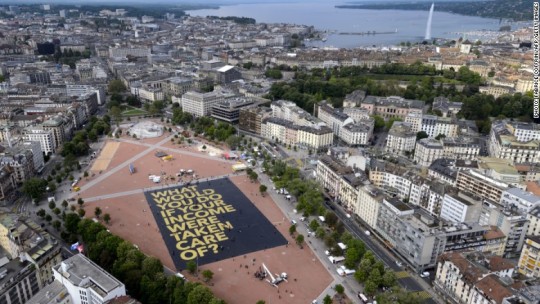
    On June 5, 2016, Switzerland will become the first country to hold a national referendum on the introduction of an Unconditional Basic Income. The proposal is essentially an income guarantee that would ensure everyone in the country is paid a minimum after-tax amount of 2,500 Swiss francs per month.

    The idea is that this would replace various other social programs. But unlike traditional welfare, people would be allowed to work. If you happened to be making less than 2,500 Swiss francs per month, then you would simply get topped up to ensure you hit this minimum income level.

    Supporters believe that a dramatic rethink of income redistribution is needed in our current information economy where income inequality is rising and productivity gains don’t seem to be getting applied evenly. 

    There is also an argument that a basic income guarantee could encourage more entrepreneurship. If we didn’t need to work, would more of us start a company and/or pursue our passions?

    Personally, I’m not sure about an income guarantee. It’s difficult to predict the broader impacts. But it’s worth exploring and many people – are various ends of the political spectrum – are doing just that. (Additional reading material can be found here, here, and here.)

    I haven’t made up my mind on this topic, so I would be curious to hear your thoughts in the comments below.

    Image: CNN Money

  • The Storefront Index

    The folks over at City Observatory have recently developed something called The Storefront Index

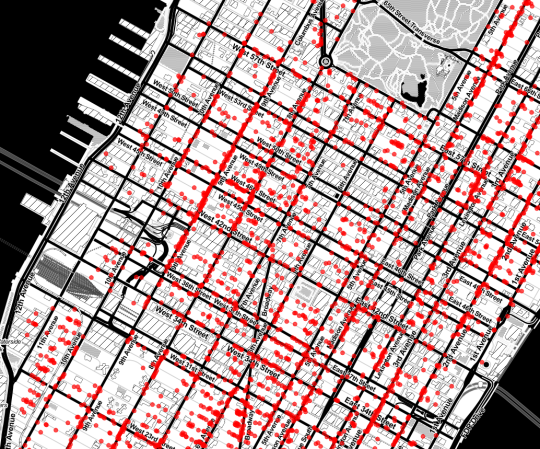
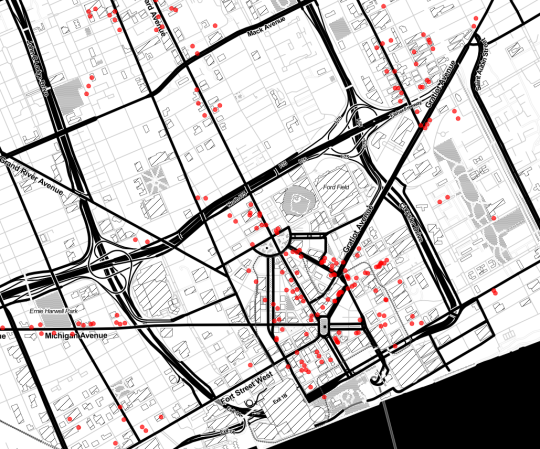
    It is a mapping of “clustered” consumer-facing storefront businesses across the 51 largest cities in the United States and within a 3-mile radius of their CBD. (Their definition of cluster is that the business is located within 100m of another business.)

    At the top of this list is New York (no surprise here) with 9,905 storefronts and at the bottom of this list is Detroit (probably no surprise here either) with 411 storefronts. On average, they found that the “typical” city has about 900 storefronts within this 3-mile radius.

    Here’s a screenshot of New York:

    image

    And here’s a screenshot of Detroit:

    image

    They should be at the same scale.

    If you’d like to read their Storefront Index Report, you can do that here. And if you’d like to explore their interactive maps, you can do that here. City Observatory has made all of this available as a free tool for city builders – which is really great to see. (You can even download their shapefiles if you’re into that sort of thing.)

  • Towards decentralized city building

    One of the
    most profound shifts taking place today – because of new technologies – is
    that of decentralization. I’ve written about this before, but I keep coming
    back to it because I find it so fascinating.

    It’s
    happening to varying degrees, but as a general trend, I believe it is leading
    to better data (less information asymmetries), more efficient markets, and the
    removal of many middle people. In the past, some intermediaries were necessary in
    order to act as proxies for portions of the market. But I believe that is
    changing.

    So what’s
    an example of this? Bitcoin. Bitcoin is an example of decentralization because
    no one entity controls it. It operates through a decentralized public ledger.
    And because of this, it has the potential to be highly disruptive to the way we
    think about currencies today.

    Put another
    way, I see decentralization as a way to leverage the wisdom of crowds. I am
    convinced that large groups of people can be incredibly intelligent when they’re
    allowed to contribute in the right ways. And I think this could solve many
    different problems, from the infighting we see within cities to broader market phenomena.

    As another example,
    there’s something new in the venture capital space called DAO – which stands
    for Decentralized
    Autonomous Organization
    . Essentially it’s a decentralized VC platform based
    off of a Bitcoin derivative currency.

    But perhaps
    the most noteworthy and relevant feature is that it allows its large pool of
    investors to anonymously vote on which investments to pursue. This is in
    contrast to a more centralized approach where an investment committee would
    meet behind closed doors in a big boardroom and make a decision. This would be the
    more typical approach.

    If you’re
    not in the tech space, the above may not seem all that exciting to you. But I
    see many parallels between venture capital and real estate development, which is
    one of the reasons I follow the space. So I can’t help but wonder what this
    trend could ultimately mean for real estate, design, and other city building industries.

    I can
    certainly imagine a world where the forces that shape our cities are more
    collective and decentralized in nature. It’s already starting to happen through crowdsourcing, social media, ridesharing, and other online platforms.

  • In support of a super-metro

    I just got home from a couple of coffee meetings, an afternoon bike ride and an impromptu basketball shootaround. Toronto is a different place in the summer. And it feels great to be biking everywhere.

    But Toronto is more than just Toronto. Toronto is at the center of a much larger urban agglomeration. And our continued success is going to partially hinge on our ability to work together in a coordinated way.

    Greg Spencer of the Martin Prosperity Institute recently published an interesting article called: Is it time to create a super-Metro? Here’s what it’s about:

    Our research at the Martin Prosperity Institute shows that economic competition is now primarily between cities rather than countries. To be successful in this environment, Toronto and its neighbours need to find a way to erase local divisions and solve their problems together. 

    Toronto is a wildly successful city, world-class in many respects. When our current institutional arrangements were forged, no one predicted the level of growth the region is experiencing. Status quo local government arrangements cannot adequately deliver the level of co-operation and collaboration needed to cope and plan for the future.

    Greg believes that the answer is a new regional authority that could give “democratic legitimacy to the very important decisions being made for the benefit of the wider region.” 

    I’m not going to comment on how all of this should be executed, but I fully agree that we need to think and act as one consolidated urban entity.

    Cities are the economic driver of the new global economy, but many (most?) of our governance structures do not properly reflect that reality. And the risk is that we are allowing arbitrary municipal boundaries and lack of coordination to hinder our ability to compete globally.

    This goes for Toronto and it goes for every other city region around the world.

  • Barcelona’s new superblocks

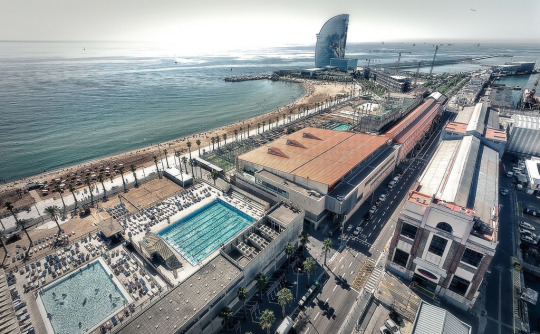
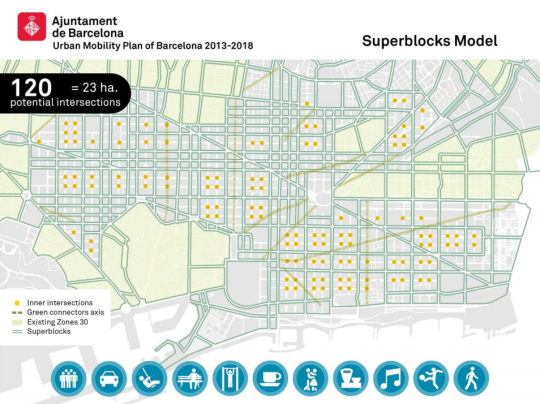
    Barcelona is in the midst of dramatically rethinking its urban fabric to address issues around urban mobility and climate change. Initially laid out in this 2014 Urban Mobility Plan for Barcelona, the city is now implementing something it calls superilles (or superblocks in English).

    Here’s what it looks like:

    The idea is to concentrate transit and vehicular traffic onto the edge of these new superblocks and then convert the interiors into livable spaces for pedestrians and cyclists. Here’s a description from the Agència d’Ecologia Urbana de Barcelona:

    “Superblocks are made up of a grid of basic roads forming a polygon, some 400 by 400 meters, with both interior and exterior components. The interior (intervía) is closed to motorized vehicles and above ground parking, and gives preference to pedestrian traffic in the public space. Though the inner streets are generally reserved for pedestrians, they can be used by residential traffic, services, emergency vehicles, and loading/unloading vehicles under special circumstances. The perimeter, or exterior, of Superblocks is where motorized traffic circulates, and makes up the basic roads.”

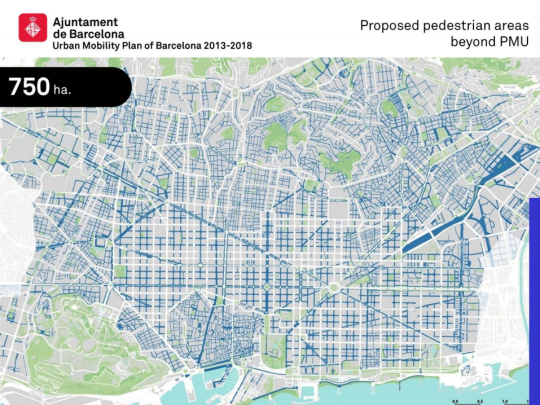
    The result is going to be an absolutely radical shift in the amount of public space given to drivers, pedestrians, and cyclists. When their 2014 report was issued, it was estimated that 73% of public space was allocated to cars (versus pedestrians). This plan will completely flip that ratio. With the superblock model, it is estimated that 77% of public space will now be allocated to pedestrians.

    Here’s what that is expected to look like…

    Before:

    After:

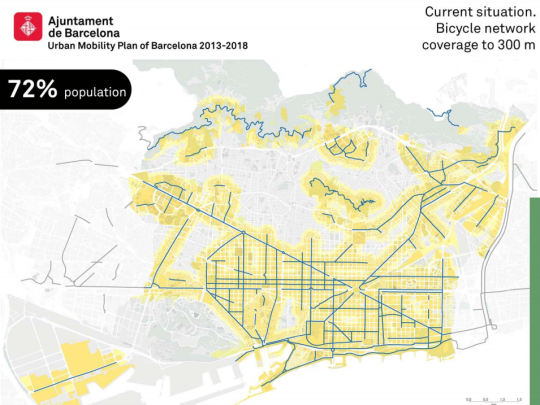
    There are also plans to expand the bicycle network to roughly 95% of the city’s population.

    Before:

    After:

    If any of you are from Barcelona, I would love to hear a local perspective on this mobility plan. Were and are there cries of a war on the car?

    Images: Top image from Tom Walk (Flickr); Maps from Urban Mobility Plan of Barcelona 2013-2018