Daily insights for city builders, delivered every morning at 6 AM ET. I’m Brandon Donnelly — a Toronto-based real estate developer and founder of Globizen. I’ve been writing here since 2013.

Tag: urbanism

  • How will self-driving vehicles change our cities and our habits?

    Last night
    I had a dream that I was driving around in a snowstorm and, for whatever
    reason, my tires had almost no tread on them. So I was all over the road.
    Strange. I have no idea what this means, if anything at all.

    But it did
    remind me that I can absolutely imagine a time when the thought of driving your
    own car (outside of it being maybe a hobby) will seem positively archaic. I
    mean, think about how messy our current system is. Roads are a chaotic and
    oftentimes dangerous place.

    The more
    interesting question for me though is: how will self-driving vehicles change
    our cities, our habits, and so on? In Elon Musk’s recently published Master
    Plan (Part Deux)
    he outlines 4 main goals for Tesla:

    1. Create stunning solar roofs with
      seamlessly integrated battery storage
    2. Expand the electric vehicle product
      line to address all major segments
    3. Develop a self-driving capability
      that is 10X safer than manual via massive fleet learning
    4. Enable your car to make money for
      you when you aren’t using it

    Let’s think
    about what these could mean.

    One
    translates into decentralized energy generation and storage. Now all of a
    sudden the cars on our roads will be roaming around our cities collecting and
    storing energy, eventually returning home at the end of the day to power our homes.
    I can already imagine fleets of sun worshipping cars chasing the light as it
    moves across our cities.

    Two is recognition
    that self-driving vehicles are going to have a meaningful impact on traditional
    public transit. (Elon reveals that Tesla is working on high passenger-density
    urban transport.)

    Three
    addresses the chaotic current state and the massive potential of networked
    cars.

    Four is particularly
    interesting to me. I wonder to what extent this income will simply subsidize
    car ownership or if it could actually transform cars into an investment (rather
    than purely an expense). Will people end up buying self-driving vehicles in the
    same way that people buy real estate for yield?

    Furthermore,
    how does this notion of a shared vehicle pool now completely change the way we
    think about parking requirements. For instance, today we think about parking in
    terms of individual usage. This tenant requires/wants X amount of parking. All
    2-bedroom apartments require Y amount of parking.

    But if we’re
    now all sharing our vehicles, parking requirements would then be based on some
    broader and collective demand curve. Parking would become less individualistic
    and instead become more of a yard where self-driving vehicles come to store
    themselves when not in use.

    Once again,
    we reach a point where utilization rates go up for each vehicle and overall
    parking demand goes down. Good thing we’re getting rid of parking minimums.

    What else could
    you see happening?
  • The master plan

    I’m going through and dissecting Elon Musk’s second “Master Plan” this morning. 

    I love how he drops earth-shattering news in such a casual and honest way. Two days ago he tweeted that he was planning to pull an all-nighter to complete the “master product plan.” And then yesterday, he outlined his vision in a simple – and at times personal – blog post for how Tesla is going to change the world. It all feels very genuine.

    //platform.twitter.com/widgets.js

    There are so many interesting snippets from the master plan, that I’m simply going to quote them all here. There’s lots to think about and discuss.

    A reminder of the broader vision:

    The point of all this was, and remains, accelerating the advent of sustainable energy, so that we can imagine far into the future and life is still good. That’s what “sustainable” means. It’s not some silly, hippy thing – it matters for everyone.

    By definition, we must at some point achieve a sustainable energy economy or we will run out of fossil fuels to burn and civilization will collapse. Given that we must get off fossil fuels anyway and that virtually all scientists agree that dramatically increasing atmospheric and oceanic carbon levels is insane, the faster we achieve sustainability, the better.

    The solar roof and other electric vehicles that Tesla has in the pipeline:

    Create a smoothly integrated and beautiful solar-roof-with-battery product that just works, empowering the individual as their own utility, and then scale that throughout the world. One ordering experience, one installation, one service contact, one phone app.

    In addition to consumer vehicles, there are two other types of electric vehicle needed: heavy-duty trucks and high passenger-density urban transport. Both are in the early stages of development at Tesla and should be ready for unveiling next year.

    Thoughts on self-driving vehicles:

    Even once the software is highly refined and far better than the average human driver, there will still be a significant time gap, varying widely by jurisdiction, before true self-driving is approved by regulators. We expect that worldwide regulatory approval will require something on the order of 6 billion miles (10 billion km). Current fleet learning is happening at just over 3 million miles (5 million km) per day.

    The most important reason is that, when used correctly, it is already significantly safer than a person driving by themselves and it would therefore be morally reprehensible to delay release simply for fear of bad press or some mercantile calculation of legal liability.

    Once we get to the point where Autopilot is approximately 10 times safer than the US vehicle average, the beta label will be removed.

    Why an even lower cost vehicle (compared to the Model 3) may never be necessary:

    You will also be able to add your car to the Tesla shared fleet just by tapping a button on the Tesla phone app and have it generate income for you while you’re at work or on vacation, significantly offsetting and at times potentially exceeding the monthly loan or lease cost. This dramatically lowers the true cost of ownership to the point where almost anyone could own a Tesla. Since most cars are only in use by their owner for 5% to 10% of the day, the fundamental economic utility of a true self-driving car is likely to be several times that of a car which is not.

    And finally, Uber has a new competitor (that, to me, is a good thing):

    In cities where demand exceeds the supply of customer-owned cars, Tesla will operate its own fleet, ensuring you can always hail a ride from us no matter where you are.

    I’ll provide my thoughts on all of the above in a subsequent post. I’m out of writing time for today.

  • Within-city house price gradients

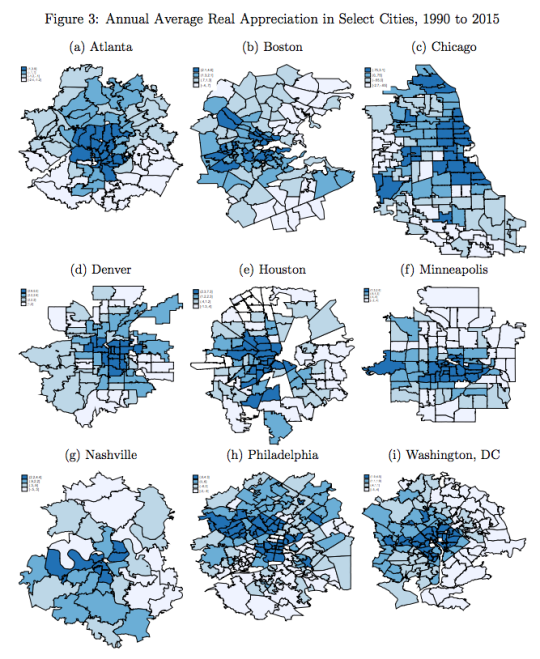
    The Federal Housing Finance Agency recently published a working paper where they looked at within-city house price gradients for a selection of US cities over a 40 year period. The goal of the study was to address what they call a “persistent blind spot” in local house price measurements.

    Here is their diagram showing annual average real appreciation from 1990 to 2015 for 9 US cities: 

    The darker areas indicate more appreciation. They are generally clustered around each city’s CBD.

    And here is an excerpt from the paper’s conclusion:

    “In an area with a highly elastic housing supply, a permanent housing demand shock is first capitalized into prices, but over time as quantities adjust, prices return to pre-shock levels (see Glaeser, Gyourko, Morales,
    and Nathanson, 2014). In contrast, near the CBD, where buildable sites are less available and regulation is presumably more onerous, a permanent demand shock can outpace supply responses, leading to permanent price increases.

    What stood out for me was this last sentence. It’s a reminder of the perfect storm that many cities now find themselves in.

    When everyone wanted to live in the suburbs, it was fairly easy to just build more homes. Supply was relatively elastic. And this kept prices in check.

    However, the same is not true for city centers. Supply is relatively inelastic, meaning it’s much harder to build more homes when demand increases. And demand has been increasing.

    So what we have today is a situation where many central cities are operating with basically a perpetual supply deficit. Hence the the comment about “permanent price increases.”

    I don’t want to oversimplify the situation, the potential solutions, and/or the well-documented mistakes, but there was arguably a middle class price benefit to mass produced sprawl.

    What should we be doing today to address housing affordability concerns?

  • What I’m doing next

    image

    A number of you have asked if I’m moving to New York. I can see why that was inferred from some of my posts, but that was actually not my intention. I am not moving to New York. (Sorry New York friends. I’ll visit soon.)

    Toronto is home base. I hope it’s clear how much I love this city. Sure, I’m a big fan of New York and Miami and Vancouver and Berlin and Tokyo and Jackson (to name some of the places I have on my phone’s weather app), but I made a deliberate choice to station myself here.

    Because unlike some of the other industries I write about on this blog, city building is hyper local. What I do involves the built environment. And that doesn’t generally happen via a laptop on a beach in Bali (at least not for extended periods of time).

    It happens by being on the ground, interfacing with local communities, meeting face-to-face with the city, and poring over drawings with smart people who know far more about their respective disciplines than I ever will. It is a collaborative and local effort. It’s about getting into the details.

    And so to be successful in this business, I think it helps to find a home and take long bets. I’m not saying that I will never work on projects in other cities (I have and I would), but I am saying that I’m not moving to New York right now and that home remains Toronto.

    On that note, here’s what I have to tell you. Later this year I’ll be joining Slate Asset Management as VP of Development.

    A bit about Slate:

    Slate is one of the most active acquirers, owners, and managers of real estate in Canada right now. Founded in 2005 by two brothers (Blair and Brady), Slate has over $3 billion of assets under management across over 16 million square feet and over 130 properties.

    All of this is done through four main investment vehicles: 

    1) The first is Slate Advisors. It acts on behalf of and alongside private institutional investors — such as Greystone.

    2) The second is Slate Office REIT (TSE:SOT.UN). It is a pure play Canadian office REIT focused on downtown and suburban properties all across the country.

    3) The third is Slate Retail REIT (TSX:SRT.U). It is a pure play REIT entirely focused on grocery-anchored U.S. retail properties. (Remember how many times I’ve written on this blog about how grocery has one of the lowest online shopping penetrations?)

    4) And the fourth: Slate is also starting a grocery-anchored retail platform in Germany. It is similar to #3, except that it’s in Germany.

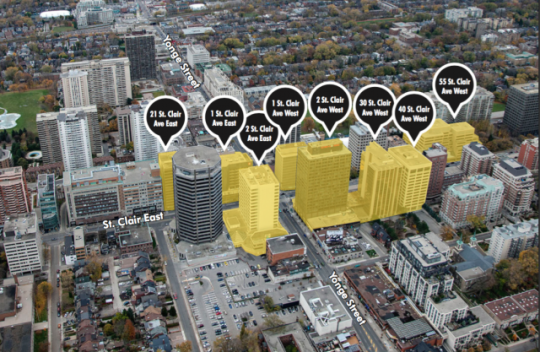
    Most recently, Slate has been in the news because of the position it has taken at Yonge + St Clair in midtown Toronto — a perfect example of “finding a home and taking long bets.” Slate, in partnership with Greystone, owns all 4 corners of the intersection and about 60% of the properties along the St. Clair corridor.

    Here’s a diagram of those Slate buildings:

    image

    In case you didn’t put two and two together, the 8-storey mural I wrote about two weeks ago is going up (right now) on the side of a Slate building (1 St Clair Avenue West — shown above). The British street artist known as Phlegm is doing it.

    Up until today, the focus of Slate has largely been on acquiring undervalued / overlooked real estate and creating value through re-leasing and overall repositioning. That will certainly continue. But given what I do, I am sure you can posit what’s also next.

    I’m genuinely excited to be joining such a talented group of real estate professionals. As I mentioned last week, I wasn’t in the market for anything new. I was heads down working on cool projects. But life happens. And Slate quickly demonstrated to me that the incredible success they have seen to date is precisely because of how progressive, nimble, and entrepreneurial they are.

    On that note, I have “one more thing” to share today.

    In parallel to all of this, and with the support of Slate, I am also starting a boutique city building company called Globizen. The name is derived from Global + Citizen.

    The objective is to build a company that embodies everything I write about on this blog. I want it to be lifestyle and design-driven. I want it to leverage technology to improve the way that cities and the building industry operate. And I want it to function as a vertically integrated real state + design firm, focused on sustainable urban infill development. Think of it as city building by and for the responsible global citizen.

    It’s still early days, but the thinking is that this new platform could compliment the larger Slate platform in some way. It’s too early to say how exactly, but everyone is open to having those discussions. And that’s what matters at this stage.

    I am going to end with a quote. It’s by Partner and Co-Founder, Blair Welch:

    “On all of our deals we have had people say ‘can’t’ to us. They say ‘Can’t be done, can’t do that, can’t raise money, etcetera.’ At Slate, we don’t do ‘can’t’ well.”

    I like that a lot. So here’s to finding a home, taking long bets, and not saying can’t. Onward my friends. 

  • Urban pet peeve: copycatting

    One of my biggest pet peeves is when cities copy things from other cities. 

    Let me give you an example. Whenever I see one of those red double decker tourist buses roaming around Toronto, I always look to see if it’s the type that has London signage and destinations plastered all over it. And when it is, I cringe. (I saw one earlier today.)

    Why would anyone design a tourist bus that makes you feel like you’re half in another city? I don’t get it. The whole reason people are getting on that bus is because they’ve come to visit this city. It should make you feel like you’re here and nowhere else. It should feel locally authentic.

    To be clear, I’m not saying that we shouldn’t be learning from other cities and building on top of other’s great ideas. That’s precisely what we should all be doing. I’m talking about kitschy copies with little additional thought put into them. And I can think of many examples beyond just tourist buses.

    Am I just being pedantic?

    What about you? Any urban pet peeves?

  • How sexy is your city?

    I recently penned an article for Building Magazine called How Sexy Is Your City? The subtitle is: The next generation of talent will require cities to take a next generation approach to city building.

    I know that we’re all hitting our limit in terms of people talking about millennials, so I’d like to reassure you that – excluding the actual article tag – the word “millennial” only shows up twice in the piece. 

    I also don’t write long-form articles very often. I’ve had people suggest that I do that periodically on this blog, but I find the time commitment to be exponentially greater than for the short, glib pieces I usually write here. 😉

    So if you can bear two more instances of the word “millennial” and you’ve been looking for something longer, you are in luck. Also, if you’d like to subscribe to Building, you can do that here.

    Image: Doublespace Photography via Building

  • We’re eliminating parking minimums

    I’ve been writing about the hypocrisy of parking minimums for years now. Some posts here, here, and here

    To me, it doesn’t make sense to try and promote more sustainable forms of urban mobility while at the same time mandating a minimum number of parking stalls in every new development. 

    Do you want people driving or not driving? Pick one.

    That’s why I was happy to see the following action item in the province of Ontario’s five year plan to transition to a low-carbon economy and fight climate change (thank you Ken Wilcox for bringing it to my attention):

    image

    I haven’t gone through the entire action plan and so this post is not a commentary on that. It is, however, a commentary on subsection 1.4. I believe it is the right thing to do and I’m stoked to see it in the plan.

  • Real estate company? No, a lifestyle brand.

    This past weekend a rooftop restaurant, pool, and entertainment venue called LAVELLE opened upon atop 629 King Street West here in Toronto. It’s on the rooftop of a condo by Freed Developments, that for some reason is no longer called the Thompson Residences.

    Here’s a sampling of their Instagram to paint you a picture:

    imageimageimageimage

    I mention this not because I went, but because I think it’s interesting to see how Peter Freed is evolving his company and brand. He is best known as a real estate developer. But what he wants to do and what he is doing is turning Freed Developments into a “vertically and horizontally integrated progressive lifestyle company.”

    According to this recent press release, LAVELLE is the first venture of Trademark Hospitality Inc., which itself is “a branch of Freed Hospitality.” This is him selling not just selling a place to live, but selling a particular lifestyle and a certain community – and then taking an active and ongoing role in the programming of it.

    The other example that comes to mind is that of Equinox Fitness. I’m sure you all know this company, but what you may not know is that it’s owned by a real estate development firm called Related. The New York-based company acquired them in 2005 (closed in 2006) for about half a billion dollars. 

    Here’s why they did it (excerpt from this press release):

    Related and Equinox have historically shared similar visions. Both companies are known for their commitment to lifestyle, service, innovation and design, and have a passionate following amongst dedicated upscale consumers. The companies’ respective customers have similar demographic and psychographic profiles and both foster fiercely loyal clientele who are passionate about their brands.

    Related has redefined the residential marketplace, created the benchmark for sophisticated urban living and has been committed to quality fitness facilities in its buildings since the mid-eighties. Since its inception 15 years ago, Equinox has been widely recognized for being an industry innovator and for delivering an unparalleled fitness experience.

    Both companies will enjoy a number of key strategic opportunities from the partnership. Related will secure a well known brand as a quality anchor tenant for key current and future developments. This will also help Related to enhance the quality of its amenities and facilities available to residents.

    So this is not a new thing. In both of these cases, the goal is to create a brand and identity centered around a precise lifestyle. I mean, Related even mentions “psychographic profiles” in their news release. They know who their audience is, just as Freed does.

    Another way of looking at this is how it ties into what I see as a broader shift away from just development to more city building. It’s not just about throwing up a building and then moving on. It’s about trying to foster a certain kind of community and lifestyle. We may not all agree on what that community should be, but overall I think it’s an exciting direction for cities.

    If you’re taking a similar approach in your business (or even if you’re not), I would love to hear from you in the comments below.

  • One lease for the world

    image

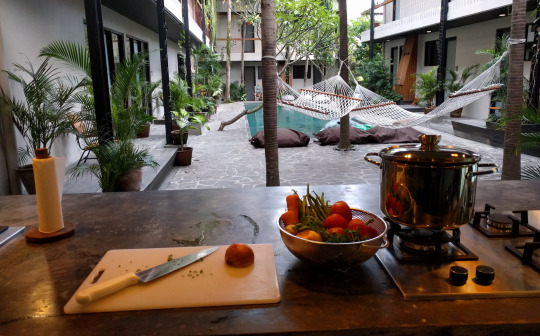
    If you’re looking for more evidence that the way we live and work is changing, then check out a new startup called Roam. They describe themselves as an international network of communal spaces. So far, they have locations in Ubud (Bali), Miami, and Madrid. Buenos Aires and London are coming soon.

    The way it works is that you start by signing a lease for either a week or a month. You get a private room and bathroom, but everything else, from the co-working spaces to the kitchens, are shared amongst the community. Like other co-working and co-living environments, the community they build is critical.

    However, what really differentiates Roam is that you can sign one lease and then live all over the world, freely traveling across their properties. All of the locations are offered up at the same price and you can stay for as long as you’d like.

    In my line of work, I don’t have the flexibility of living like a global nomad. But today, there are many people who can. And I also know that there are many people who would prefer to live like this. It’s liberating in so many ways.

    My friend and I actually had a similar idea to this back in University and we spent some time working on it. At the time, and this was over a decade ago, we felt that there was a segment of people who increasingly wanted to live like global citizens. I still believe that to be true and, clearly, so do others.

    To date, Roam has raised $3.4 million in funding.

    Image: Ubud kitchen via Roam

  • Global street artist paints 8-storey mural in midtown Toronto

    This morning

    (Friday, July 8th)

    at 11AM eastern time, the global street artist Phlegm will start work on a giant 8-storey mural at the corner of Yonge + St. Clair in midtown Toronto. It’s going up on the west elevation of 1 St. Clair West.

    Here’s what it will look like when it’s complete:

    image

    The piece is intended to be experienced at two different scales. From afar, you read it as a human figure embracing itself. (See it?) Once you get closer, you are then drawn into an intricate interpretation of the Toronto landscape – both built and natural.

    Embedded within are depictions of the Royal Ontario Museum (including Daniel Libeskind’s Crystal), the SkyDome (yes, the SkyDome), the St. Lawrence Market (my hood), the CN Tower (obligatory), as well as other landmarks in the city. It’s going to be awesome.

    The project is a STEPS Initiative and it is being supported by the City of Toronto, Slate Asset Management, CBRE, CIBC, and a few others. They have also setup a great website with a live webcam, so that you can follow along as the artist works.

    At the time of writing this post, nothing yet has happened. But by the time it reaches you (email subscribers) it should be well underway. The hashtag for all of this is #PHLEGMPAINTS

    Big things are starting to happen at Yonge + St. Clair.