Daily insights for city builders, delivered every morning at 6 AM ET. I’m Brandon Donnelly — a Toronto-based real estate developer and founder of Globizen. I’ve been writing here since 2013.

Tag: urbanism

  • 70 years of LA

    The New Yorker recently published an interesting split-screen video tour of the same streets in downtown LA in the 1940s and today. 

    They have done a great job pairing up the same views and also panning in such a way that the middle divider seems to magically transport you 70 years.

    Here it is:

    [youtube https://www.youtube.com/watch?v=WIHfmisMLOY?rel=0&w=560&h=315]

    If you can’t see the video above, click here.

    In some cases (okay, many cases), I couldn’t help but feel like 1940s LA was far more urban and engaging. What did you think?

  • Rail Deck Park – will it happen?

    Everybody
    in Toronto is talking about one thing right now.

    This:

    image

    When I got into the office this morning, someone asked what I thought about Rail Deck Park and whether or not I thought it would happen.

    When I went for lunch this afternoon, someone asked what I thought about Rail Deck Park and whether or not I thought it would happen.

    And
    I’m fully expecting that somebody else will ask me these same questions before the day is done.

    For those of you who haven’t been following or aren’t from Toronto, it is a 21-acre park that is proposed to be built by decking over the rail corridor that runs from Bathurst Street in the west to the Rogers Centre in the east. See top image.

    Of course, the reason everyone is asking me these questions is because it’s a wonderful idea and everyone wants it to happen. But we’re all thinking the same thing: will it and who is going to pay for it?

    Here are my thoughts.

    Section 42 of the Ontario Planning Act stipulates that cities may ask developers for either land or cash in order to create new parkland. 

    To give you an example of how significant this can be, Spacing reported that 1 Bloor East alone – which is a single tower under construction right now – contributed $10 million into the city’s parkland reserves.

    Zooming out, between 2011 and 2014 alone, developers paid almost $300 million in park levies across
    the city
    . It’s worth noting that most of the funds collected
    were from development projects in the core of the city. During this same time period, wards 20, 27, and 28 alone produced over $140 million.

    Here is a chart from a Spacing investigation published last year that corresponds to the above stats:

    image

    The problem with all of this is that it’s becoming increasingly difficult to actually deploy this capital. I mean, think about how difficult it is to buy a single family home or find a development site in this city. Now go out and try and find a piece of land in which to build a park. And do it as a cash-starved public entity that can’t engage in a bidding war.

    As of September 30, 2013, the city’s uncommitted parkland reserve fund balance was $234,995,348. This includes Parkland Acquisition, Parkland Development, Alternative Parkland Dedication, and Other Reserve Funds. If anyone has a more recent figure, please share it in the comments below.

    Also, the irony of this situation is that the neighborhoods producing all of the
    parkland funds (i.e. downtown) are precisely the areas where it’s exceptionally difficult to actually create new parks. So what I think is happening is that Mayor Tory and the rest of the city see Rail Deck Park as a perfect opportunity to turn this reserve fund money into a meaningful urban park in the core of the city.

    We
    don’t yet know how much this park will cost and I don’t know what’s sitting in the reserve funds today. But this is my read on the situation. I doubt the reserve funds will be able to pay for it all, but that shouldn’t be a deal breaker. It’s worth getting creative and fighting for something as significant as Rail Deck Park. 

    This
    is an opportunity to reinforce Toronto’s status as one of the most liveable global cities in the world. This is an opportunity I believe we are going to take.


  • 3 thoughts from Rem Koolhaas

    Earlier this year, architect Rem Koolhaas of OMA spoke with Mohsen Mostafavi (dean of the Harvard Graduate School of Design) to close out the 2016 AIA convention

    I still remember my first architectural theory class where the professor told us all that Koolhaas was the most important living architect of our time. And today, if you think about all of the stars that have grown out from his firm – such as Bjarke Ingels and Joshua Prince-Ramus – it is certainly a defensible argument.

    Koolhaas is generally very critical of globalization and the market economy when it comes to creating good architecture. His view is that “pure profit motives” are leading to cities that are basically not designed.

    This is a fairly common belief within architectural circles, which is why many celebrated names would rather work on a museum over a residential condo project. The latter is too motivated by profit. It’s not architecturally interesting.

    I, on the other hand, have always believed in working within the confines of the market to try and promote great architecture and city building. I’m not saying that the market is perfect, but profitability is a constraint that every industry deals with. Architecture is no exception.

    That said, there are other things that I agree with Koolhaas on. Below are 3 verbatim highlights taken from a Fast Company article summarizing his talk with Mostafavi: 

    Communication needs an overhaul.

    “Architecture has a serious problem today in that people who are not alike don’t communicate. I’m actually more interested in communicating with people I disagree with than people I agree with.”

    "To have a certain virtuosity of interpretation of every phenomenon is crucial. We’re working in a world where so many different cultures are operating at the same time, each with their own value system. If you want to be relevant, you need to be open to an enormous multiplicity of values, interpretations, and readings. The old-fashioned Western ‘this is’ ‘that is’ is no longer tenable. We need to be intellectual and rigorous, but at the same time relativist.”

    Architecture’s greatest value in the future might not even be architecture.

    “Architecture and the language of architecture—platform, blueprint, structure—became almost the preferred language for indicating a lot of phenomenon that we’re facing from Silicon Valley. They took over our metaphors, and it made me think that regardless of our speed, which is too slow for Silicon Valley, we can perhaps think of the modern world maybe not always in the form of buildings but in the form of knowledge or organization and structure and society that we can offer and provide.”

    Preservation is a path forward.

    "We’ve tried to discover domains and areas in architecture which are not a simple vulgar multiplication of uninspired global projects. Recently, we have looked at preservation. The beautiful thing about preservation is you begin with something that already exists and therefore is already local. By definition, a preservation project is an homage to earlier cultures and mentalities to which you can add a new dimension, a new function, a new beauty or appeal. Almost every impulse signals that globalization needs rethinking or adjustment.”

  • Journeys by walking

    Arup, the global consulting firm, has an interesting publication out called Cities Alive: Towards a walking world. The report highlights 50 benefits of walking and then 40 actions that city leaders can take today to transform their cities. The entire study was informed by examining 80 international case studies.

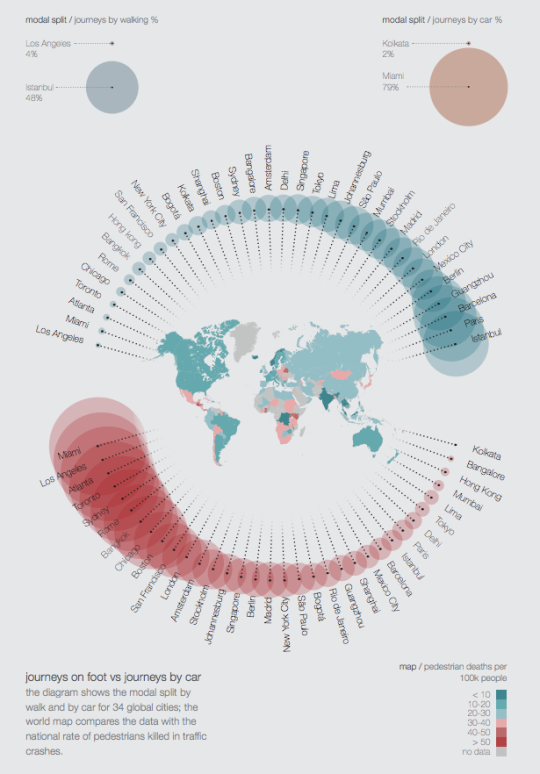
    As I was going through the report, the following diagram caught my attention. It compares journeys on foot vs. journeys by car for a collection of global cities.

    The turquoise circles represent % of journeys by walking. On the left is Los Angeles at 4%. And on the right is Istanbul at 48%.

    The red circles represent % of journeys by car. On the left is Miami at 79% (with Los Angeles right beside it). And on the right is Kolkata at 2%.

    The map in the middle of the circles represents pedestrians killed in traffic crashes per 100,000 people.

    I’m not sure where the data was drawn from, but it’s not all that surprising to see a few North American cities clustered towards the left (less walking; more driving). Still, I wonder how “journey” is defined.

    To view the full report, click here. Arup also produces a lot of other great content that you can download for free, here.

  • Slot-based intersections

    If you don’t follow the work of MIT’s Senseable City Lab, I highly recommend that you start. 

    Earlier this year, researchers from the Massachusetts Institute of Technology, the Swiss Institute of Technology, and the Italian National Research Council developed something that they call “slot-based intersections.” In a world where cars have sensors and drive themselves, it is intended as a more efficient alternative to traditional intersections. Goodbye traffic lights.

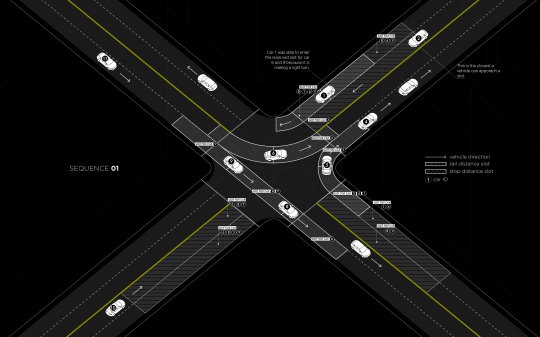
    Much like air-traffic control, the way the system works is by assigning individualized time slots to each car for when they may enter an intersection. For example, in the diagram below (Sequence 01) the car approaching from the bottom left (#10) has a “stop distance slot” in front of it reserved for 3 of the cars that are currently in the intersection. The two that are traveling perpendicular to it and the car currently turning left into the same lane as #10 (on the other side of the intersection). The car in the midst of turning right (#5) is exempt because there’s no possibility of collision. 

    image

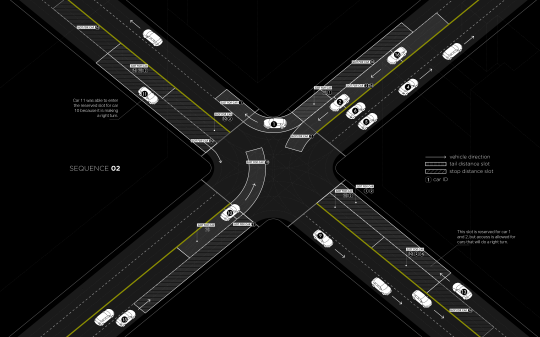
    In Sequence 02 (below) you can see that car #10 is now turning left, which means it has its own time slot in the intersection. Other approaching cars now have a “stop distance slot” dependent on car #10.

    image

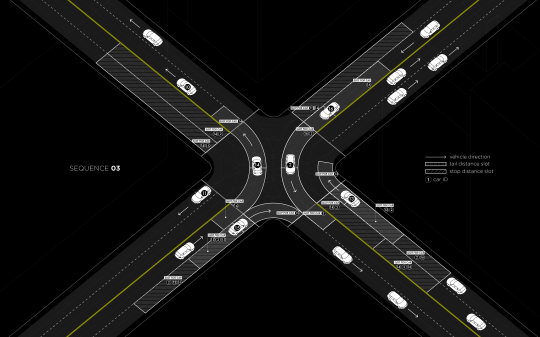
    In all cases, cars making a right turn are able to move freely, provided they will not interfere with any other cars.

    image

    The researchers estimate that real-time slot allocation might double the number of vehicles that a traditional traffic-light intersection can handle today and, in some cases, it might completely eliminate stop and go traffic.

    Often when I write about self-driving vehicles I hear people tell me that cars are still cars. It doesn’t matter whether they are self-driving or not. The same inefficiencies apply. They are not the solution to urban gridlock. Elon Musk was also criticized (following his Master Plan) for not properly understanding urban geography.

    But self-driving cars will create new efficiencies. I am not saying that they are a silver bullet, but I am saying that they will help a great deal. I don’t think that anyone truly understands the extent of these efficiencies, but there are a myriad of possibilities. This Senseable City Lab project is a perfect example.

    What I am grappling with right now is the relationship between self-driving vehicles and traditional forms of public transit. Until we get a handle on the efficiencies and overall impact, it’s hard to ascertain how these different forms of mobility will work together. My gut tells me that the lines are bound to get blurry and that self-driving “cars” will feel less and less like the cars we know today.

    Below is a video that was published along with the research. If you can’t see it, click here.

    [youtube https://www.youtube.com/watch?v=4CZc3erc_l4?rel=0&w=560&h=315]

  • For the love of compactness

    I’m in Provincetown, Cape Cod right now. One of the things that is great about this town is the scale of it. It’s compact and many of the streets feel like laneways or alleys (I’m obsessed, I know). It’s all about pedestrians here. Even the main drag, Commercial Street, is effectively a pedestrian street – though it’s not technically closed to cars most of the time.

    There’s something liberating about being able to get where you need to go by walking or biking or skateboarding. And all of those things are done here. I enjoy the inherent efficiency that compactness brings. That’s why I was excited to learn this morning about the following proposal at 24 Mercer Street in Toronto (via Urban Toronto):

    image

    It’s a 12 unit, 17 storey building on a 195 square metre lot. The proposed FSI is 16.8. And it will have zero parking. I would be incredibly curious to know what the construction costs will be and how the overall project pencils out. But regardless, it’s exciting to see someone trying to make use of such a tight site. I would love to see more of this in Toronto and I am certain we will.

    What do you think about projects like this? Some of you may call this “poor planning,” but I see the efficient use of resources.

  • Low cost energy efficient homes perched atop of surface parking

    A regular of this blog recently suggested (in the comments) that I take a look at the London-based design firm ZED Factory. ZED stands for Zero Energy Development.

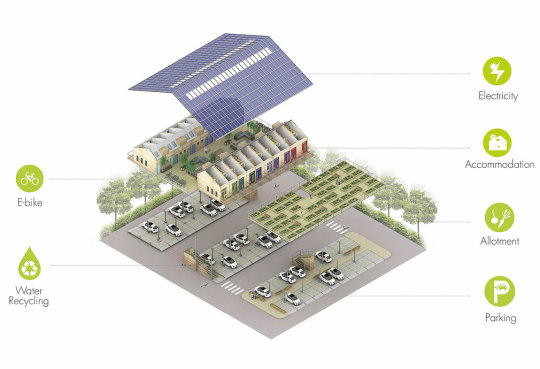
    The first project that caught my attention was ZED Pod. ZED Pod is a small, low cost energy efficient modular home that is designed to sit atop of surface parking lots. In other words, it’s a way to repurpose under-utilized surface parking without compromising existing parking ratios. All you really need are the air rights. And since the “land” is cheaper, the homes can be cheaper. They can also be easily relocated if the parking lot were to get developed in the future (though they are designed as permanent structures).

    image

    In some ways, there is something perverse about the way that driving and parking have such a profound impact on the urban landscape. Even when it’s buried underground and hidden from sight, the structural column grid needed to layout efficient parking will often carry up through the building impacting suite layouts. We’ll even restrict housing supply when parking requirements can’t be met. Should it be parking or people who come first?

    But cars aren’t going away. And ZED Pod is a clever way of dealing with an existing urban condition – however suboptimal it may be. I found the concept interesting and I thought you all might as well.

    Image: ZED Factory

  • Hello Boston

    image

    I arrived in Boston early this morning. It has been about a decade since I was last here.

    I took the subway in from the airport, which is typically what I like to do when I visit a city. It’s such a great way to get a feel for a place. And in the case of Boston, Logan Airport is only a few stops away from downtown.

    image

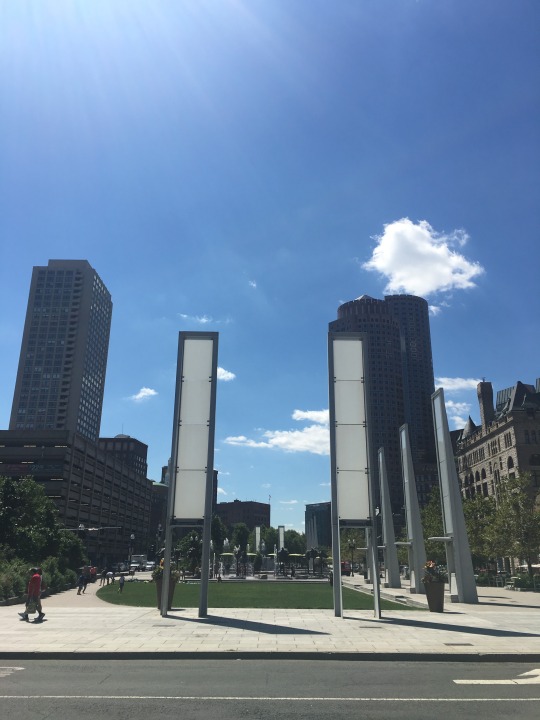
    As soon as I got in, I walked over to see the Rose Fitzgerald Kennedy Greenway (above image). It’s a linear park that was made possible by burying the city’s elevated waterfront expressway – the infamous “Big Dig.”

    image

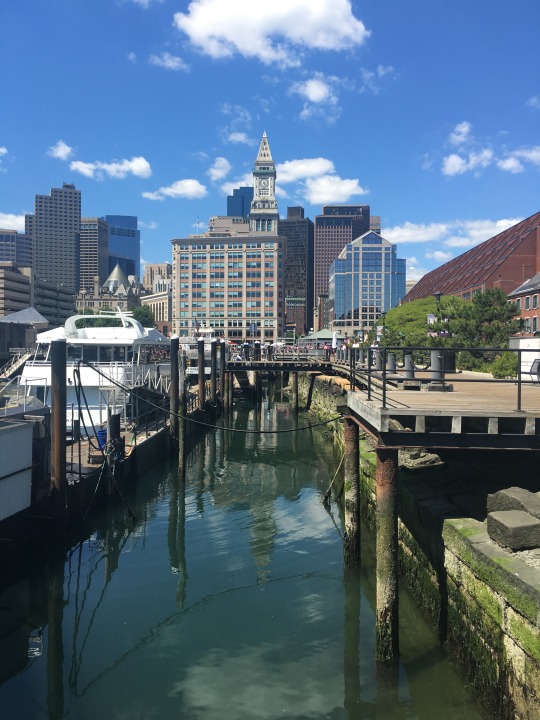
    I recognize that it was a lavishly expense infrastructure project that went many times over budget, but walking across the greenway to get to the water was rather pleasant. Will Toronto’s The Bentway achieve a similar result at a fraction of the cost?

    image

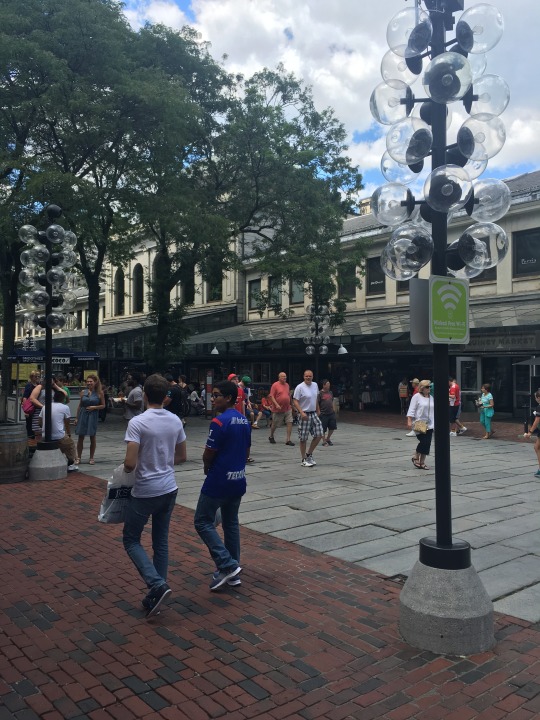
    With that out of the way, I went for a lobster roll. It had to happen. I then walked around Faneuil Hall and Quincy Market (above image). It felt a bit touristy, but what a remarkable pedestrian-only area

    image

    And now I’m on a boat heading over to Provincetown (Cape Cod) for a wedding. I’m writing this blog post over a spotty wifi connection, so out of fear that I may spontaneously lose it, I am going to end here. See you all tomorrow.

  • Climate change gridlock

    I spent this morning reading an article called: How climate change is rapidly taking the planet apart. Here is an excerpt from the introduction: 

    “According to Naomi Oreskes, a great number of climate change scientists (she interviewed most of the top 200 climate change scientists in the US) suffer from some sort of mood imbalance or mild or serious depression. It is easy to understand why: we see the climate change taking the planet apart right in front of our eyes. We also clearly see, right in front of us, what urgently needs to done to stave off global disaster on an unprecedented scale. We need carbon taxes and the reconversion of industry and energy towards zero CO2 emissions systems. This route is without any doubt technically and economically feasible, but politically it seems to be permanently locked. If we do not unlock it, the future looks bleak, not to say hopeless, for humankind.”

    It’s clearly not a positive article. But it is an important read. We know we need to immediately and drastically reduce CO2 emissions (for all the reasons explained in the article), but we simply aren’t doing that.

    Part of the problem, I think, is that it’s easy to lull ourselves into complacency. We read about it and we notice the erratic weather patterns, but for the most part the status quo isn’t all that bad for most of us. Life just goes on.

    There’s evidence that revenue-neutral carbon pricing could actually increase productivity levels. It would force innovation. But it doesn’t yet appear to be 10x better than what we have today – which is often what you need to get people to accept change.

    So instead we hold largely ineffectual climate change conferences, which allow us to tell ourselves that we are, in fact, doing something. But I don’t think we’re being bold enough. And that’s too bad.

  • Monocle’s Top 25 Liveable Cities — 2016 Edition

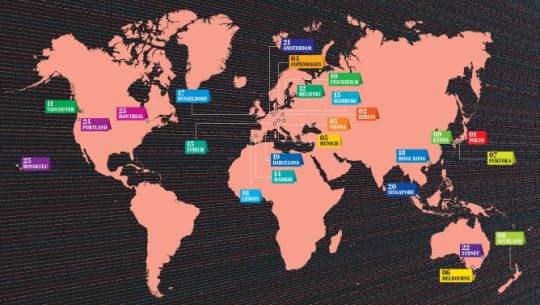
    Monocle’s annual survey of the top 25 most liveable cities in the world was just released. It’s now in its 10th year. I found it in my inbox this morning and it was a good reminder that it was about time I renewed my subscription. I’ve been a regular reader of Monocle since 2007, but I let my membership lapse last year.

    Of course, any sort of list like this is going to be subjective. It all depends on the methodology you use. Still, their annual survey is an interesting way to see what each city is up to and where the tides are going. This year Monocle put extra weighting on each city’s nightlife. If you’re not a subscriber, here’s a short video you can watch. It will give you a rundown of all the cities. (I was happy to see Montréal creep onto the list. Incredible city.)

    This focus on the night is something that I’ve been writing about a lot both on this blog and elsewhere. It’s an idea that’s picking up momentum around the world as an economic development strategy. But for whatever reason, uptake seems to be slower here in North America.

    I like how architect Anna Dietzsch puts it in this video. She says that Rio may have the beaches, but Sao Paulo (where she’s based) has the night. That’s exactly how cities should be thinking about this opportunity. It used to be that cities thrived almost entirely because of location, waterways, transport, and other natural features (example: Buffalo). But increasingly, it’s becoming about things like nightlife.

    Vancouver may have the mountains, but Toronto has…

    Image: Monocle