Daily insights for city builders, delivered every morning at 6 AM ET. I’m Brandon Donnelly — a Toronto-based real estate developer and founder of Globizen. I’ve been writing here since 2013.

Tag: urban strategies

  • Introducing 100 Lombard

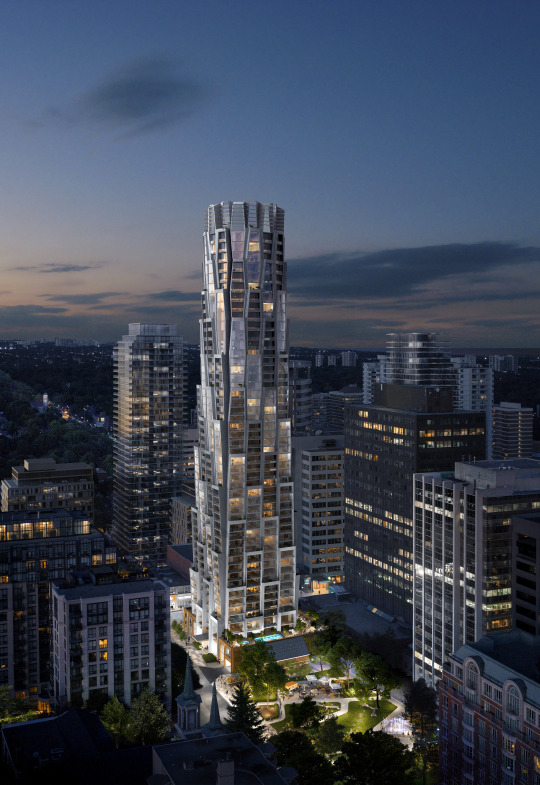
    Earlier this week, Slate Asset Management and Forum Asset Management submitted a new development proposal for 100 Lombard Street in downtown Toronto.

    At the time of writing this post, the applications (zoning by-law amendment and site plan control) hadn’t yet hit the city’s website. So here’s some information about the project, including its big moves:

    • This is the first mixed-use residential project in Toronto designed by the Office for Metropolitan Architecture (OMA). The proposal includes residential, office, and retail spaces.
    • Architecture by OMA and WZMH Architects. Heritage by ERA Architects. Landscape and public realm by Claude Cormier + Associés. Planning by Urban Strategies. Structure by Stephenson Engineering.
    • The principal architectural idea is to create a vertical urban village through a series of “urban rooms” interspersed throughout the tower. These spaces would serve as amenities for the building and house a variety of different functions. See above rendering.
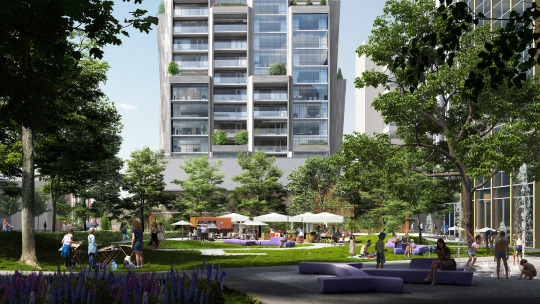
    • The proposal introduces three important public realm moves: (1) a new public plaza that pays homage to the site’s former neighbor to the east — Second City; (2) a new mid-block pedestrian connection running north-south from Richmond Street East to Lombard Street; and (3) an outdoor public art gallery featuring oversized art tableaus.
    • The site currently houses one designated heritage building (86 Lombard Street), and the design contemplates relocating and fully retaining this building on the eastern edge of the site. Once you see the drawings, you’ll fully understand why this was the most logical move.

    The entire project team is very excited to get this proposal out and into the world. And we hope that you will see it as being representative of our ongoing and lasting commitment to elevating architecture, sustainability, culture, and city building in Toronto.

  • City-to-city airline routes expected to decline by 20% this year

    Supposedly there are more than 14,000 airplanes parked around the world right now. And according to the latest numbers from IATA, this is expected to translate into an $84 billion loss for global commercial airlines in 2020. The industry is not expected to return to profitability until 2022. As a point of comparison, net profits were about $26.4 billion last year.

    Some more numbers from IATA:

    Here is something else from the Journal. The number of airline routes has doubled over the past two decades. That has included the number of city-to-city routes. IATA is predicting that by the end of this year we will see these urban routes decline by about 20% compared to last year. And who knows when they will return. Perhaps in 2022, along with profitability.

    The reason I point this out is because if you follow the work and writing of planner Joe Berridge, you will know that he often cites airports as being a key piece of infrastructure for global cities. At one point, having a deep harbor was everything you needed in order to bring in goods and people. But today a solid airport is paramount.

    Will the loss of this city-to-city connectivity have an impact on some cities?

  • The capital of the future: Shanghai

    Joe Berridge’s recent opinion piece in the Globe and Mail makes the case for why Shanghai is destined to become “the capital of future.” Brash city building, massive scale, and entrepreneurial hustle are among some of the reasons why he believes the city is on a path to global supremacy. And similar to other great capitals, it has benefited from a strategic geographic position on an important waterway — in this case the Yangtze River.

    By way of comparison, Toronto is said to be the fastest growing urban region in both North America and Europe right now. We add somewhere around 125,000 people each year. Shanghai, on the other hand, is adding between 700,000 and 800,000 people each year — much of it from internal migration. The city currently has a population of around 24 million people and it is expected to grow to somewhere between 35 and 45 million people by 2050. (Figures from the Globe.)

    Notwithstanding all of our successes as a global city region, as I was reading Berridge’s piece I couldn’t help but come back to this comparison. Shanghai opened its first subway line in 1993. Today it has one of the most extensive networks in the world; whereas, it would probably take Toronto this long to figure out if that first line should be light rail or a below-grade subway. And we haven’t even gotten to the number of stops yet.

    But that’s one of the differences between top-down and bottom-up city building: speed.

    Photo by Denys Nevozhai on Unsplash

  • The perfect city

    “This book is a love story of cities. It is so well observed — the places, the people, the history and what the future holds. Joe tells a very personal and beautifully written story direct from the front line. An absolute must read for everyone who cares about, and wants to understand, what makes cities and their citizens tick.” 

    – Dame Alison Nimmo, Chief Executive of the Crown Estate

    Joe Berridge, of Urban Strategies, has a new book coming out called, Perfect City: An Urban Fixer’s Global Search for Magic in the Modern Metropolis. Perfect may be the enemy of good (as they say), but Joe argues that all great cities have moments of perfection that we can learn from.

    I just preordered a copy. If you’re interested, you can do the same here.

  • More on One Delisle and the block

    image

    Now that things have quieted down from last night, I would like to say that we are thrilled by the response to One Delisle and the broader ideas for the block. There was a lot of positivity last night at the open house and today the project team received countless emails and messages from people telling us that they are excited and/or looking forward to working with us over the coming years. Many were from the local community.

    image

    Following yesterday’s Globe and Mail piece by Alex Bozikovic, One Delisle was also covered in Urban Toronto (read the comments), designboom (they’re allergic to capital letters), ArchDaily, Canadian Architect, Dezeen, The Architect’s Newspaper, and probably other places that I am missing. The comments have been interesting to read and there seems to be a fatigue around boring glass boxes. This project team does not want to do that.

    Though the project has been making the rounds, there are two images that I don’t think have been widely shared and so I would like to do that today (below). Both were presented at last night’s open house. And they are intended to show the relationship between One Delisle and Delisle Park, which is proposed to be revitalized and expanded by ~50% as part of the project’s block and enhanced public realm strategy. Credit to ADHOC Studio for these renderings.

    imageimage

    In fact, it is important to keep in mind that while a lot of attention is being paid to the architecture of the building, there’s a broader city building strategy that is attached and integral to it:

    • Revitalize and expand Delisle Park by 50%
    • Add residential uses to a block of office buildings
    • Reduce the number of vehicular access points across the block from 5 to 3 in order to improve traffic flows in the area
    • Create below-grade vehicular connections across the block to consolidate and legitimize access/loading and once again improve traffic flows in the area 
    • Significantly widen the sidewalk along Yonge Street to eliminate existing pedestrian pinch point
    • Significantly widen the sidewalk along Delisle Avenue to strengthen connection to Delisle Park
    • Introduce pedestrian laneway with art canopy to connect St. Clair Avenue West back to Delisle Park
    • Create a unified and consistent public realm across the block and provide retail animation along its edges
    • Retain Art Deco facade along Yonge Street
    • Target the 2nd tier of the Toronto Green Standard (voluntary sustainability target)
    • Continue to explore the feasibility of district energy solutions across the block to take advantage of the different energy demand curves for office, retail, and residential uses

    Once again, a big thanks to the ~300 people who came out last night – in the rain – to engage with the project team. And a big thanks to the full project team who worked tirelessly to prepare for this week’s community open house. But as was said on Thursday night, in many ways this is really just the beginning. To stay informed about the project and to provide your feedback to the team, stay tuned to yongedelisle.ca.

    Photos: Khristel Studios

  • An open house with Jeanne Gang

    image

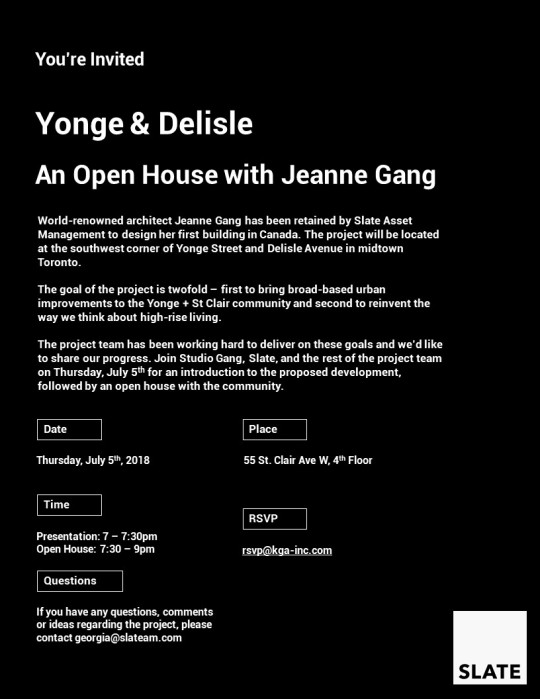
    On Thursday, July 5th, Slate Asset Management, Studio Gang, and the rest of the project team will be hosting a community open house where we will introduce designs for a new block plan and mixed-use building at Yonge + St. Clair. This will be Studio Gang’s first project in Canada. We’re pretty excited.

    It’s important to note that while the proposed design has been influenced by some of the early discussions we had with city staff and the local Councillor, we are still very much at the beginning of this process. Which is why alongside this community open house, we are also launching yongedelisle.ca.

    This will be our “neighbourhood engagement” website as we go through the planning process. You’ll find updates from the project team as they become available, and you’ll also have a direct way to get in touch. We’re also testing out this interactive page where you can vote on the city building principles that matter most to you.

    So hopefully we’ll see you on Thursday, July 5th. Invite details above. Please RSVP, here, if you can. But if you forget to do that, don’t worry, you can still just show up. For more on Jeanne Gang, click here.

  • Big, bold, and global

    I love the way that urban planner Joe Berridge thinks about Toronto and city building. He is constantly considering our position on the global stage and urging us to fight for a top position by executing on real and meaningful projects. 

    Here is a recent article from the Toronto Star which lists some of those projects. They include everything from a new convention center to creating a fourth university (in addition to the University of Toronto, York, and Ryerson).

    Here’s a snippet:

    We could get “lost in domesticity — very nice, but that’s not enough,” he says, drawing on his experience leading urban renewal projects around the world.

    Toronto’s social cohesion is enough to attract 125,000 new people each year to the region. But they won’t stay if we can’t employ them and provide opportunities. And that requires global thinking.

    Berridge says it is the city’s “moral obligation” to use its taxing power, its wealth, its status as Canada’s only global city and the historical advantages of public education, public health and public services to propel Toronto into super city status.

    Cities will often talk in nebulous terms about being “world class.” That isn’t all that helpful. Let’s be specific and also acknowledge that great things cost money. Are we a top tourist destination? Are we a top convention destination? Are we attracting the smartest people in the world with the best schools? Do we have the best transit and health care systems in the world?

    Toronto is a great city and so it’s perhaps easy to become complacent. But past performance is not an indicator of future outcomes. We need to think in global terms. We need to keep in mind that this is an international competition. And every day all of us step onto that field.

    Thank you Joe for constantly reminding us of that.

  • Merry Christmas from post-tribe Toronto

    Belfast Christmas Market by Peter Holloway on 500px.com

    https://500px.com/embed.js

    Merry Christmas and/or happy whatever you happen to celebrate around this time of year.

    Hopefully things have slowed down for you all and you’re relaxing with family and friends either at home or somewhere on vacation. I’ll be doing that here in Toronto and making pancakes for breakfast, because that’s what I like to do on Christmas morning.

    If you’re in the market for some long form reading material while you relax, I recommend you check out an article in The Walrus called, After the Troubles. It’s by Toronto-based planner Joe Berridge – who is a partner at Urban Strategies – and it’s the story behind his team’s Belfast City Centre Regeneration Strategy and Investment Plan.

    It’s a fascinating and entertaining read, and there are lots of comparisons between Toronto and Belfast. Here’s a little taste:

    “IT WOULD BE HARD to conceive of two cities more different than Belfast and Toronto. One old world, one new; one grand, one utilitarian; one barely ticking over, one growing like topsy. And of course, one tribal, the other the epitome of post-tribe. Belfast is 96 percent white—forget about Catholic-Protestant, that’s the critical urban statistic. And yet it’s important to remember that Toronto itself was once the largest Orange town in the world. (Wikipedia asserts that every mayor of Toronto since its founding was an Orangeman until Nathan Philips, a wonderful Jewish mayor, was elected in 1954.) Even the current mayor, John Tory, draws his name from a bunch of brigands and royalist cattle thieves in the Irish backcountry.”

    I spent a bit of time in Belfast when I was working in Dublin (2007) and so it was particularly interesting for me to read about his assessment of the city. Like Berridge, I found the city eerily empty during off-peak times. But it’s an architecturally rich city and a fascinating city for urbanists because of all that has happened.

    Though now we are talking about “after the troubles.” Things are progressing. And that strikes me as a positive thought while I make my pancakes on Christmas morning.

  • 7 ideas and lessons for global cities

    Today I had the pleasure of attending a really great talk by Joe Berridge (partner at the planning firm Urban Strategies) that was all about how Toronto can best maintain its position as a globally competitive city. 

    He went through 7 ideas/lessons. Though they were specifically aimed at Toronto, most of them could be applied to any city that’s concerned about its position on the global stage. They are:

    1. Invest in infrastructure, such as transit, airports, and so on. Sustainable funding and proper governance are critical. Transit planning in Toronto has become far too political and it’s crippling our city.
    2. Embrace Uber and get them using our Presto card so that it becomes a legitimate part of the city’s public transit network. Every city in the world is battling with Uber. Toronto has the opportunity to take a leadership position.
    3. Build a new convention centre and invest more in tourism and economic development. Berridge’s suggestion was something big at Ontario Place/Exhibition Place.
    4. Build new Universities to fuel the knowledge economy. See New York’s Cornell Tech campus as an example.
    5. Invest in infrastructure and institutions that turn research and development into businesses. Platforms like MaRS.
    6. Start thinking big. This was specifically geared towards Toronto, as his argument was that we do a lot of the small things right, but we’re missing out on the really big opportunities.
    7. Create Suburban Enterprise Zones to help drive employment outside of the core and along new transit corridors.

    Alongside these ideas and lessons, there was a fascinating sub-argument. And that is that Toronto is really an accidental global city. In other words, we didn’t set out to become a top 10 global city and one of the fastest growing cities in the developed world.

    But by getting a lot of things right – such as a high quality of life – and through a bit of luck – such as Montreal shooting itself in the foot – we somehow became one. But we absolutely shouldn’t take that for granted. There’s lots of work to be done.