
Daily insights for city builders, delivered every morning at 6 AM ET. I’m Brandon Donnelly — a Toronto-based real estate developer and founder of Globizen. I’ve been writing here since 2013.

Tag: urban renewal

  • The role of the private sector in city building

    image

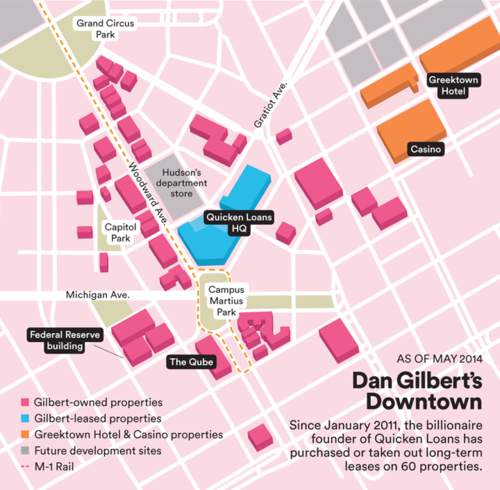
    The New York Times published an interesting and popular article last Friday called The Post-Post-Apocalyptic Detroit. It of course talks all about the efforts of billionaire Dan Gilbert, but it also talks about the initiatives of many small and local entrepreneurs who are doing their part to help revive the city – while at the same time making a profit.

    One thing that I found interesting about the article is the extent to which the private sector has taken over the responsibilities of the public sector. With only 35,000 of the city’s 88,000 streetlights actually working, the city simply doesn’t have the money to pay its bills. When I visited the city last fall, I was told that the city couldn’t even afford batteries for its parking meters. 

    So the private sector has stepped up. 

    In downtown, Dan Gilbert pays for his own security force to patrol the area 24 hours a day both on the ground and through 300 surveillance cameras. And in the Jefferson East corridor, John Stroh III – of the Stroh Brewery Company – is paying for 3,500 hours of private security in order to help transform the area into a walkable retail strip.

    It’s a model that relies on the funding and vision of rich people to catalyze change. And it strikes me as a quintessentially American way of going about it. In Canada, I’m not so sure it would be approached in quite the same way, which I think is both good and bad. I think in Canada there would be more government involvement.

    If the rich people are there and willing to step up (like they are right now in Detroit), then I would assume the capital would be deployed more efficiently and that change would happen more quickly. But if the rich people aren’t willing to step up, then nothing happens and the place declines.

    That might be an oversimplification, but I think there are differences.

    To end, I’m going to leave you with this Bloomberg video about Steve Case’s (former AOL founder) “Rise of the Rest” road trip to Detroit. If you can’t see the video below, click here.

    [youtube https://www.youtube.com/watch?v=_RUG0H4VThM?rel=0]

  • New ideas need old buildings

    In reading a recent Financial Times article called, Are creative people the key to city regeneration?, I was reminded of a famous line from the late urbanist Jane Jacobs: “New ideas need old buildings.” What she meant by that is the following:

    Cities need old buildings so badly it is probably impossible for vigorous streets and districts to grow without them…. for really new ideas of any kind—no matter how ultimately profitable or otherwise successful some of them might prove to be—there is no leeway for such chancy trial, error and experimentation in the high-overhead economy of new construction. Old ideas can sometimes use new buildings. New ideas must use old buildings.

    And what she was effectively getting at is that we live in a world obsessed with historical data and precedence. To use the words of business thinker Roger Martin: “The enemy of innovation is the phrase ‘prove it.’” Because, if it’s never been done before, how can you prove it? You can certainly imagine it. But you can’t prove it.

    If you’re in the business of building buildings, convincing your lender to give you the money to build something that’s never been done before, is an almost impossible sell. That’s not the way it works. Which is why Jane Jacobs famously said that “new ideas need old buildings.”

    We’ve seen this story play out in countless cities around the world. The creatives move into an scuzzy neighborhood, make it cool and then investment follows. The neighborhood has been proven. But for this cycle to continue, we need a continuous stock of derelict buildings and undesirable neighborhoods, or at least areas that offer the same kind of affordability and flexibility to creative entrepreneurs.

    Often these circumstances have been the result of failure. The proven ideas that got the buildings built in the first place became no longer relevant. And so the buildings were left to expire. But in many global cities, these kinds of areas are an endangered specifies. However, it’s in our best interest to make sure that we don’t lose our creativity alongside them.

  • Civic leaders, here’s why people need to love your city

    I was planning to write about something else today, but then I saw Fred Wilson’s post on revitalizing urban cores and I had to switch topics, because I think he makes a great point about turning around declining cities:

    I’ve been asked by civic leaders from places like Newark, Cleveland, Buffalo, and a number of other upstate NYC cities that have suffered a similar fate how they can do the same thing. They all talk about tax incentives, connecting with local research universities, and providing startup capital. And I tell them that they are focusing on the wrong thing.

    You have to lead with lifestyle. If you can’t make your city a place where the young mobile talent leaving college or grad school wants to go to start their career, meet someone, and build a life, all that other stuff doesn’t matter.

    It’s exactly the same point I made in my post entrepreneurship as economic development strategy. You can throw as much money as you’d like at startups, but if young people don’t want to live in your city then you have a serious problem.

    Fred goes on to talk about Tony Hsieh’s (founder of Zappos) initiatives in downtown Las Vegas:

    When Tony moved Zappos from the suburbs to the former City Hall in downtown Vegas a few years ago, he decided to invest $350mm in a massive urban revitalization project. He set aside $200mm to purchase land at bargain prices and the other $150mm to invest in three areas, arts and culture, small businesses (restaurants, cafes, bars, markets, boutiques, etc), and tech startups. $50mm is going into each area.

    It’s an example of leading with lifestyle, urbanism and city building, rather than purely economics. And I think it’s the way to go. But to be clear, I’m not suggesting that the focus should be on large capital projects, such as stadiums and infrastructure. I’m not convinced those are the most effective catalysts. There’s no silver bullet here.

    Instead, I think the answer is in building, from the ground up, a real sense of community and place. People need to love your city. That’s easier said than done though.

  • Risk-oblivious, risk-aware and risk-adverse

    image

    Yesterday when I was researching for this post on Lean Urbanism, I came across a really interesting way of describing and classifying the groups typically involved in the emergence of a new neighborhood.

    It came from New Urbanist Andres Duany, who explained the process, here, using 3 groups of people: those that are risk-oblivious; those that are risk-aware; and those that are risk-adverse

    Risk-oblivious are people like the artist, who go into a crappy neighborhood and magically make it hip. They’re the ones that give the neighborhood its character. They’re the first catalyst.

    Risk-aware are people like real estate developers. They know risks exist, but they believe they can manage it, as well as profit from taking it on. They take the neighborhood to the next level.

    And finally, risk-adverse are the boring people who only come to a neighborhood once it’s absolutely clear that it’s a safe investment. Duany typecasts this group as the “dentist from New Jersey.” There’s much less value creation at this stage.

    Most of you have probably heard of this cycle of urban renewal, but I thought it was really interesting to frame it in terms of risk tolerance.

  • New urban planning buzzword: Lean Urbanism

    The term “lean” is well known in technology and startup circles. Thanks to people like Eric Ries and Steve Blank, it’s become all about starting up lean and not investing a lot of time and money before you’ve really tested your business assumptions in the marketplace.

    But keeping it lean isn’t unique to just tech companies. Its origins are actually in manufacturing—mostly from Toyota’s celebrated production system. Lately though, it has been starting to make its way into cities with a new buzzword called “Lean Urbanism.”

    Championed by New Urbanist Andres Duany—who is actually in the midst of writing a book on the topic—the methodology seems to be gaining awareness in cities spanning from Detroit to San Diego. Here’s an article that a friend of mine (currently working in San Diego) sent me yesterday on the topic.

    At first, the article gave me the impression that the movement was all about building as-of-right. That is, build what’s allowed and stop asking for special discretionary permissions, which is often how real estate development works.

    But then I started to do a bit more research.

    And it turns out that Lean Urbanism is about something much deeper. It’s about empowering incremental urban growth:

    “Lean Urbanism…focuses on revitalizing cities by finding ways for people to participate in community-building — specifically, by enabling everyday people to get things done.”

    What Lean Urbanism hopes to do is create tools and techniques that will help local communities avoid and workaround overly onerous regulations. It’s about removing the barriers to entry—whether that be a business permit or a building permit—so that more people can participate in shaping their own community.

    What I like about it is that it’s building upon the renewal cycle that has traditionally always powered cities. It hopes to empower the proverbial artist that moves into a neighborhood like New York’s Soho and magically makes it cool—then spurring an onslaught of investment.

    And so while the buzzword might be new, it’s a renewal cycle we’ve seen before. But, if it works, maybe not with so much frequency.

  • Why I’m planning a trip to Detroit

    I’m planning a trip to Detroit this month.

    Some of you might be wondering why on earth I would do that, but I’m actually super excited. Why? Because I’m fascinated by the city. Detroit is such a dramatic example of how the fortunes of a city can change. I think some people forget what places like New York City and South Beach were like in the 1980s.

    But more importantly, I’m interested in the future of Detroit and the opportunities that might lie ahead. In many ways, the city feels like a clean slate. It’s a city that’s trying to completely rebuild and reinvent itself. And there’s a lot of smart (and rich) people, like billionaire Dan Gilbert, putting their weight behind its renewal. Through his company Bedrock, he has quickly become one the largest private landlords in the cityI also have a good friend who’s working in Detroit on strategies for the Midtown area. He’ll be my “tour guide” during the trip.

    It’s easy to get wrapped up in media headlines and so I want to see what’s happening first hand on the ground. Detroit has a long history of entrepreneurialism and so the eternal optimist in me wants to believe that it can come back.

    One of its big challenges, however, is education. As Harvard economist Ed Glaeser put it in his book, the Triumph of the City, one of the greatest things about the Detroit of yesterday was its ability to create a lot of high paying jobs for people with little education. Now the city has to deal with that legacy and few jobs.

    I’ll have more to say after my trip but, in the interim, what are your thoughts on Detroit? Can it come back? Will it ever be the economic powerhouse that it once was?