Daily insights for city builders, delivered every morning at 6 AM ET. I’m Brandon Donnelly — a Toronto-based real estate developer and founder of Globizen. I’ve been writing here since 2013.
Lyon is located at the confluence of two rivers: the Saône and the Rhône. And where these two rivers physically merge in the south is a neighborhood called La Confluence:
A former industrial area and urban renewal project since 1999, La Confluence is now home to world-class architecture, a broad mix of uses, and a club called Le Sucre.
The most important piece of architecture is probably the Musée des Confluences, which was designed by the Austrian firm Coop Himmeb(l)au. It is situated at the very southern tip of La Confluence.
And at the very south end of the museum is this column:
It feels like the exact right place for a column like this.
This might seem like a fairly benign tweet by Clive Doucet, a former Ottawa City Councillor. I mean, Paris is wonderful. It is livable, walkable, and my favorite city in the world after Toronto. But as I have argued many times before on the blog, there is a tendency to look at Paris’ uniform mid-rise buildings and then incorrectly try and translate it over to a North American (or other) context with opinions that we should simply cap building heights. Because if only we were to do that, then we would be left with our own version of beautiful Paris.
This is false. And you should immediately call bullshit on anyone who suggests this might be the case. It ignores most of what Napoleon III and Haussmann did to Paris in the 19th century, and instead just cherry picks height so that it can be exported back home to oppose tall buildings. If we really and truly want Paris, then it is important to be reminded that, among many other things, the Paris we all love today is the result of:
The annexation of eleven surrounding communities (in order to form the city’s current boundaries)
Mass urban renewal, involving the displacement of some 350,000 people (according to some estimates at the time)
Nearly two decades of large-scale disruptive construction
The demolition of hundreds of old dilapidated buildings (some of which may have even been in a Heritage Conservation District — bad planning joke)
The cutting through of nearly 80 kilometers of new avenues all across the city
The building of high-density courtyard buildings and blocks
As you might suspect, Parisians at the time were upset with this kind of large-scale change. The now famous Impressionist painters lamented the new monotony of Paris’ regular mid-rise blocks. Where had the unique and quirky Paris of past gone? It was, of course, being systematically erased in the name of modernization and urban renewal, which by the way, included a new and important water and sanitation network. What Napoleon III and Haussmann did was transform Paris from a crumbling medieval city into a modern metropolis.
I am not suggesting that any of this is bad and shouldn’t have happened. Today, Paris is deeply loved the world over. But what I am suggesting is that if we truly want to create our own version of Paris, then we are going to need to be realistic with ourselves on what it is going to take to get there. It will require nothing short of massive change.
If we want Paris and Paris-like densities (despite what Clive posits in his tweet, Paris is not the densest city in the world), we are going to need to be fully prepared to rip up and rethink our entire approach to zoning. Taller buildings are partially (largely?) a result of our cultural obsession with single-family houses. We restrict supply, codify low-densities, and then wonder why the remaining areas need to be so tall. We then grasp at out-of-context examples in order to justify our own selfish interests.
If Paris is really what we want, then we must be prepared for everything that comes along with its pretty mid-rise buildings. Are you ready?
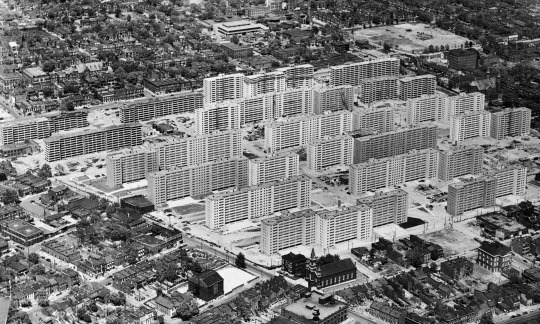
In 1956, a large 57 acre urban renewal project was completed in St. Louis. It consisted of 33 apartment buildings, each 11 storeys tall. The entire complex was known as Pruitt-Igoe.
Early residents seemed to really like the buildings. The first tenant, Frankie Mae Raglin, called it the “nicest place she’d ever had.”
But 16 years later in 1972, the first 3 buildings within Pruitt-Igoe were demolished. And in 1977, architectural historian Charles Jencks proclaimed that the day Pruitt-Igoe was demolished was the day that modern architecture had officially died.
The modernist dream had failed. Architecture had failed us. Segregated “towers in a park” was not the way to socially engineer away poverty and slums from our cities.
This is the narrative that we have told ourselves, not only in St. Louis, but in cities all around the world.
But was it really all architecture’s fault?
Stuyvesant Town in New York (80 acres) shares many of the same architectural ideals that Pruitt-Igoe embodied and it seems to be holding up just fine. The same could be said for Lafayette Park in Detroit (46 acres), which is probably more telling given what the city witnessed in the years following 1956 – the year Lafayette Park was completed.
So the reality is far more complex.
Between 1950 and 1970, St. Louis lost about 30% of its population. Coming on the end, Pruitt-Igoe had a vacancy rate of 88%. Racial tensions were also surging. Here’s how the American Institute of Architects put it back in 2012:
Pruitt-Igoe was built during a tumultuous time in U.S. race relations in a city with an intense history of racial segregation. Pruitt and Igoe were designed as separate, racially segregated projects: Pruitt for African-American residents, Igoe for whites. As the towers were going up, the Supreme Court’s Brown v. Board of Education decision banned segregation. Faced with the possibility of living next to African-American neighbors in an integrated Pruitt-Igoe, white residents moved out en masse, exacerbating Pruitt-Igoe’s vacancy problems.
So while most cities rightfully would’t dare build in the spirit of Pruitt-Igoe today, this was not a strictly architectural problem. There is always an underlying social, political, and economic environment. And unfortunately architecture, alone, cannot solve everything.
If you’re interested in this topic, I recommend you check out a paper by Katharine G. Bristol called, The Pruitt-Igoe Myth.
Buy real estate. It always goes up. That’s the mantra, right?
Few things in life are that black and white.
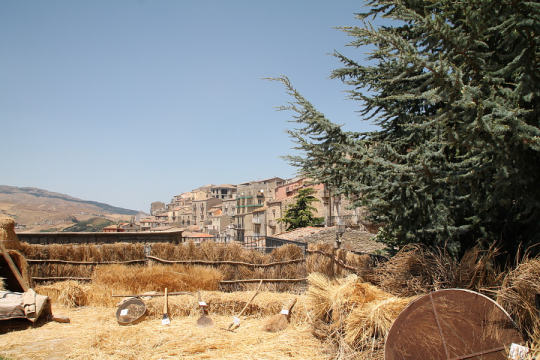
A small town in Sicily called Gangi is in the midst of a novel urban renewal experiment. They are giving away houses for free to people who will agree to renovate them within a 4 year time period.
As Architect This City continues to grow in readership, I’m starting to get pitched more and more. People email me with something they want promoted and they try and convince me to write about it. Everybody is looking for distribution. I get it.
I have no qualms about people and companies reaching out. In fact, I welcome the suggestions. But the vast majority of these “pitches” don’t make it onto ATC.
When it comes to these sorts of things, I have two simple rules: (1) I have to like it myself. If I don’t think what you’re pitching is interesting or cool, I’m not going to write about it – even if you’re offering up money. (2) I need to be able to be transparent about it. More on this second point in the coming weeks.
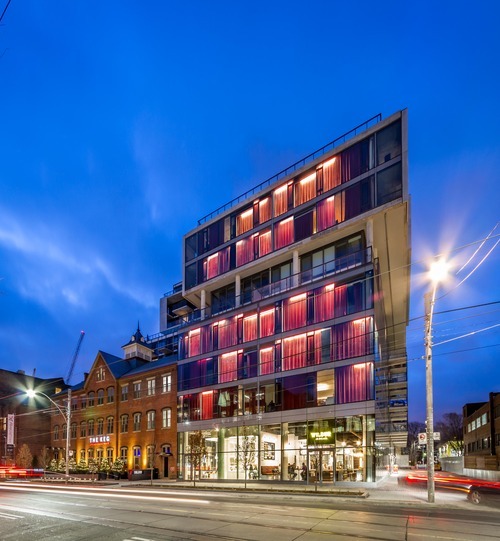
Recently I was asked to do a post about the Fashion House Condos in Toronto’s King West neighborhood.
Here’s why I decided to do it:
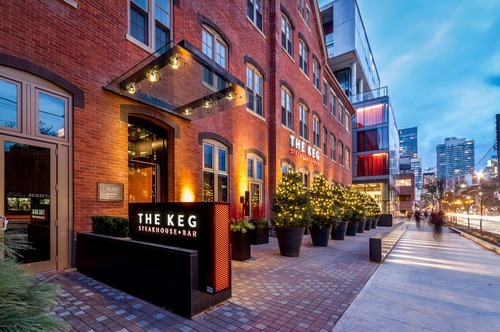
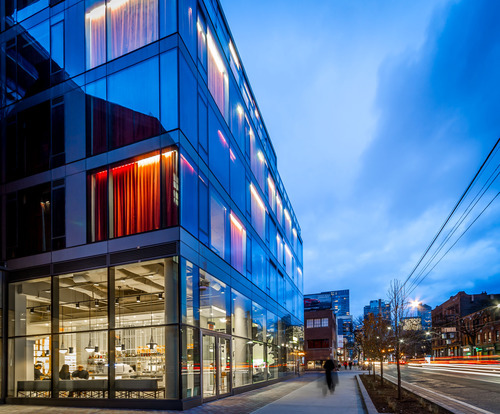
I like that the existing Silverplate heritage building was preserved and integrated into the base of the condo. It’s now tenanted to The Keg, which has gone into the base of a number of new condo buildings in the city. They’re a successful chain.
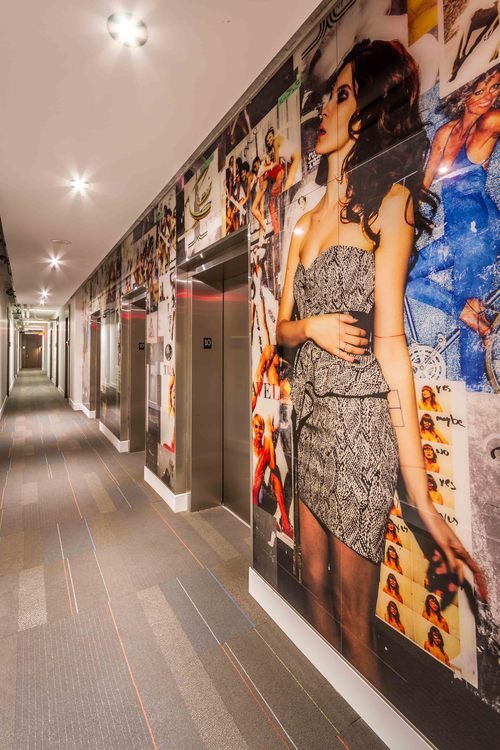
Each elevator lobby within the building has a unique mural designed by a different fashion designer – most of which are Canadian. The whole Fashion House theme is meant to speak to the area’s history as Toronto’s Garment District.
Many of the residential suites have red curtains (which are white on the interior). They form a “common element” and have to stay in the condo. It gives the building a dramatic and unique feel, though it means you have to be a fan of curtains.
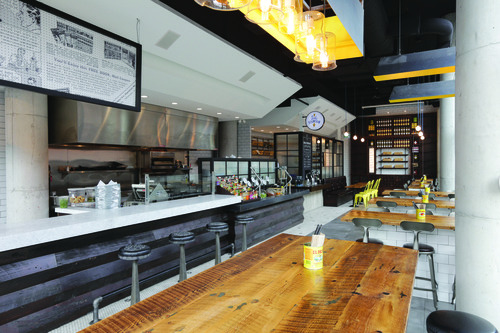
My good friend designed the Mexican restaurant at the base of the building (Wilbur Mexicana). His firm is called Reflect Architecture.
The article talks about some of the things that the Rust Belt is doing to revitalize their cities and the lessons that many cities in Ontario – which are facing similar fates – could learn from. It’s worth a read.
I’m not going to summarize his article, other than to say that some of the key points were around tax increment financing, tax incentives, University connections, a DIY/entrepreneurial culture, and the American tradition of philanthropy – which Radwanski points out is probably the least imitable for Canada.
And it’s this last point that I would like to focus on first. The US has a deep history of people getting rich and then giving back – certainly more so than in Canada in my opinion.
If you think about the resurgence of cities such as Detroit, you’d be hard pressed not to think of people like Dan Gilbert. He has become the poster boy for Detroit’s resurgence by moving his companies to downtown and buying up most of the office buildings. If and when Detroit comes back (I think it’s a when), Gilbert will easily be one of the biggest beneficiaries.
Now, you could argue that this is made possible because of greater income inequality, but there’s something to be said about powerful individuals acting on intrinsic passion. Gilbert is investing in Detroit because he personally wants to see his home city come back. And that’s hard to replace.
The second point I would like to focus on has to do with this snippet:
With oil’s current slide, Canada really can’t afford for it to remain a drag – and in fact there is some expectation that Ontario will instead reclaim its old role as the leader of Canada’s economic growth. Its premier, Kathleen Wynne, recently expressed optimism that plummeting oil prices and a sinking dollar will prove a boon to manufacturing. “I don’t wish for low oil prices and a low dollar for Alberta,” she said earlier this month. “But at the same time, we want our manufacturing sector to rebound. So if that [low oil price] helps, then that’s a good thing.”
I don’t know what context this was said in, but I continue to feel strongly that we cannot rely on low oil prices and a low Canadian dollar for Ontario’s competitiveness. That is a terrible business model, and an unsustainable one. We need to figure out ways to create value and grow the economy without relying on currency differentials and other macroeconomic factors. Radwanski is right to point that out in his article.
So let’s hope we don’t let any short term benefits go to our head. There’s lots of exciting work to be done.
It was built to correct what had become a major slum on the east side of downtown Toronto. And like many cities around the world, this type of built form was viewed as the solution. Urban slums were crowded and dirty. Density was bad. The solution was to spread people out and surround them with green space.
But that didn’t work out so well. Regent Park failed. So today we are once again starting again. Phase by phase, the old is being demolished and the new is being built. However, unlike the last time, I think this time it’ll be for the better.
But there’s something very ironic about this story.
Before Regent Park became Regent Park, it was called something else: Cabbagetown. That neighborhood of course still exists in Toronto – it’s adjacent to Regent Park – but it’s now a bit smaller having given up a portion of its land to the first iteration of Regent Park.
Today, what remains of Cabbagetown has become an affluent and desirable inner city neighborhood with, allegedly, the largest stock of Victorian housing in North America. But of course it wasn’t always that way. At the time that Regent Park was being conceived, Cabbagetown was a slum. And that’s why we built Regent Park version 1.0. It was the solution for this entire section of the city.
The photo at the top of this post is the southeast corner of Gerrard Street East and Parliament Street. The building at the corner is the Hotel Gerrard. The photo is from 1919, which means it’s a photo of Regent Park when it was still called Cabbagetown. It’s part of what we demolished to make way for the new.
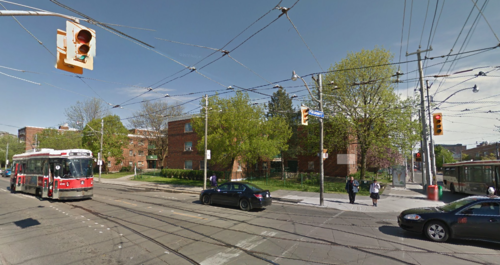
In 2013, that same corner looked like this:
What’s ironic about all of this, is that the area we spared from grandiose urban renewal plans actually became the richest part. And where we intervened is where things got screwed up. So much so that we’re now starting entirely from scratch, again. All of this just makes wonder whether Cabbagetown, in its entirety, would have ultimately taken care of itself had we just left it alone.
But what’s in the past is in the past.
So to end on a positive note, I’d like to share a short video that somebody recently shared with me called Spectrum of Hope. It was co-directed by 7 young artists from the neighborhood who are calling it “a piece for Regent Park, by Regent Park.”
I think it’s a great example of the positive momentum developing in this neighborhood. I hope you’ll give it a watch and then share it around. Click here if you can’t see the video above.
After yesterday’s post on Belval in Luxembourg, I started thinking more about authenticity. I ended the post by talking about some of the industrial elements – blast furnaces and so on – that will be preserved in the neighborhood and argued that those types of things are great for creating a sense of place. But I also said that it’s always better when those things are authentic.
But what does it mean to be authentic? What if some savvy developer created new blast furnaces and inserted them into their new neighborhood in order to simulate the feel of an old industrial steelworks? Would that change how you felt about the space and area?
Another example is Intrawest’s ski resorts. Intrawest is quite famous for creating attractive ski villages that give you the impression of being in some old European mountain village. They include a mix of uses and many people visit them even if they don’t intend to ski. But does it matter that it’s not really an old European ski town or that many of them look the same?
Clearly, in both of these examples, one is more “authentic” than the other. But all that really changes is the story. In one case, you get to tell yourself, and others, about an old steel mill that used to be where you now have your Scandinavian desk and Retina display MacBook. And in the other case, all you get is a simulacra or imitation of some blast furnace thing.
While this may seem immaterial to some, I don’t think it is. I’m not saying that customers always demand 100% authenticity. We don’t. But let’s not forget how much we all love a great story.
Early this morning, before the sun even came up here in Toronto, I had a video conference call with a sharp and talented entrepreneur in Luxembourg. His name is Fräntz Miccoli and he’s working on an interesting startup called KonnectR.
The idea is to create a platform to connect with new people at any point in time and wherever you might happen to be. It may sound like a “hook-up” app, but that’s not the intent. He came about the idea while traveling and looking for other smart and engaging people to hang out with.
When we started the video conference call this morning, I showed him my window so that he could see the sun just starting to rise. He then showed me his coworking space, which made it seem like he is working out of an old industrial steel mill. Turns out, he is.
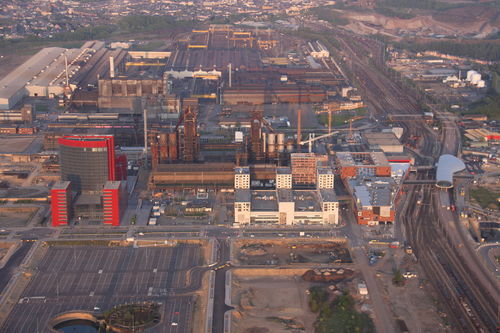
The area of Luxembourg he’s working out of is called Belval, which is a neighborhood in the west end of the country’s second largest city, Esch-sur-Alzette. The neighborhood used to consist of the largest steelworks in the country. But with the decline of steel production in Luxembourg, the area fell into decline. Today, it’s being reborn as a 21st century mixed-use community.
The developer behind the project is called Agora. And the site – equal to about 120 soccer fields – will house everything from residences and offices to shopping and cultural institutions. The University of Luxembourg has also centralized their campus in the new neighborhood. Having institutions “anchor” a community is becoming quite common for urban renewal programs. Here in Toronto, we did a similar thing with George Brown College along the waterfront.
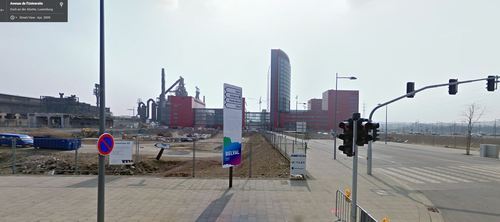
To give you a better sense of the transformation taking place in Belval, here’s a streetview photo from 2009:
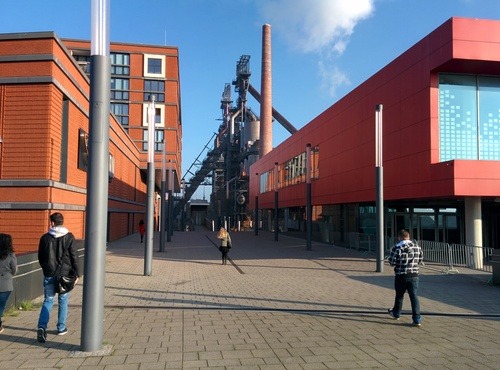
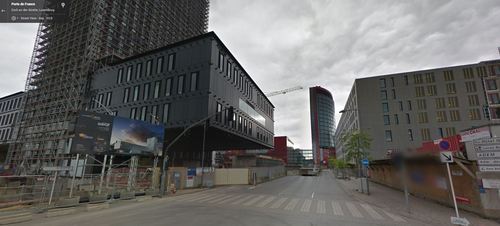
Here’s another one from the same intersection in 2013 (notice the same tower in the background):
I’m always fascinated by urban renewal projects of this scale because it so clearly speaks to the evolutionary nature of cities. Industries die. Businesses disappear. And new uses need to be found. In this case, the area has gone from steel production to tech startups. That’s not surprising.
But at the same time, I think it’s important that we don’t completely erase the past. Here, I think it’s great that they’re preserving some of the blast furnaces and other industrial structures. It gives the area character and a sense of place – which is oftentimes hard to manufacture and always better when it’s authentic.
Yesterday morning I went for a swim at the new Regent Park Aquatic Centre. I used to swim regularly when I was in grad school in the US, but it fell off when I moved back to Toronto and there wasn’t a convenient place for me to walk to. Having to drive to a gym or to a pool can really cut hurt how often you’re able to go.
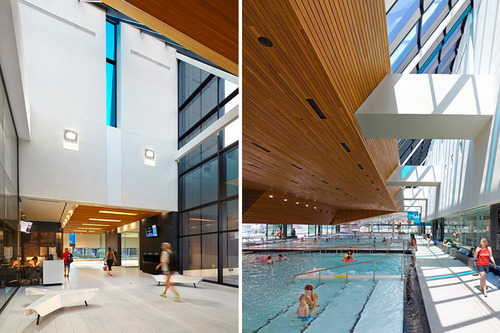
In any case, the pool was fantastic. On the west side of it are glass sliding doors that face the park. And since yesterday was such a beautiful day, they were all open while everyone was swimming lanes. The wooden ceiling also gives the space a nice, warm feel.
The biggest surprise for me though was the universal change rooms. I had never been in a co-ed change room before – or one that was completely open and visible to the pool (there are small private rooms so you can actually change). For families, it makes a lot of sense. Everyone can go in together and it’s easy to watch your kids in the pool from within the change room.
After my swim, I rode my bike around Regent Park and tweeted this out:
What’s happening in Regent Park is incredibly exciting. To me, it feels like a return to the fundamentals of city building. They’ve reconnected the old street grid – which had previously been removed to create the old “towers in a park” scheme – and they’re clearly working towards a proper urban neighborhood with retail at grade and buildings pushed right up against the street.
A big measure of success, though, will be how animated the streets become and how well the retail does. Because all of that isn’t quite there yet. But we’re on our way. And already I feel like we’re about to forget what the old Regent Park used to be like. Toronto may have lived with that neighborhood for over 60 years, but future generations will barely know it existed.