Daily insights for city builders, delivered every morning at 6 AM ET. I’m Brandon Donnelly — a Toronto-based real estate developer and founder of Globizen. I’ve been writing here since 2013.

Tag: university of toronto

  • Where the world’s billionaires live

    The Martin Prosperity Institute here in Toronto recently published an interesting report called The Geography of the Global Super-Rich.

    What they did was use the Forbes 2015 Billionaire List to chart billionaires and billionaire wealth by location and by industry. They also looked at the wealth gap in each location and whether the wealth was self-made or inherited.

    A correlation analysis was also done to see what key variables – such as population, density, economic output, global city standing, VC investment, and so on – were positively correlated with a greater concentration of super rich people.

    There are 1,826 billionaires across the world according to Forbes. The researchers were able to match 99% of them to a specific metro area / primary residence.

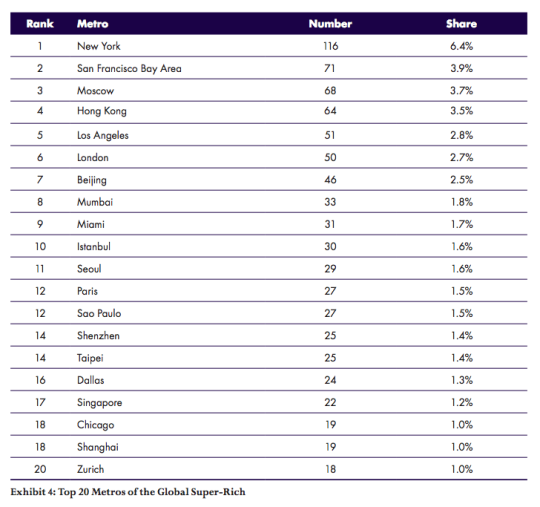
    Here are the top 20 metro areas in terms of the number of billionaires:
    image

    Look at Miami at #9. 

    I suspect that this may surprise some of you. But Miami has grown into a significant global city. As one of my friends from Miami likes to tell me: “The best thing about Miami is that it’s a Latin American city that’s so close to the United States.”

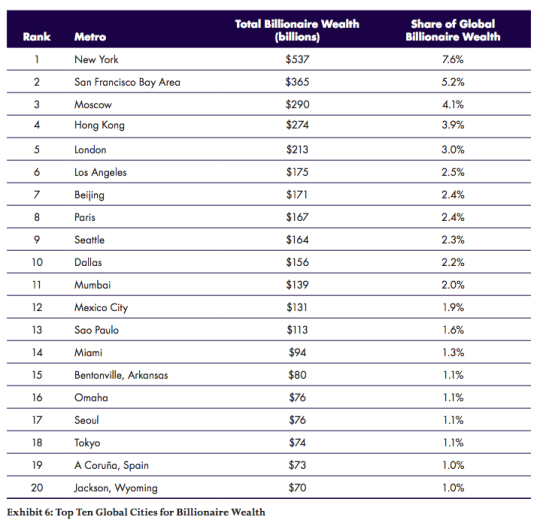
    Here are the top 20 metro areas in terms of total billionaire wealth: 
    image

    A bunch of changes on this list because of extremely wealthly people and families in places like Bentonville (Arkansas) and Omaha.

    One of the conclusions of the report is that the size of the city generally matters:

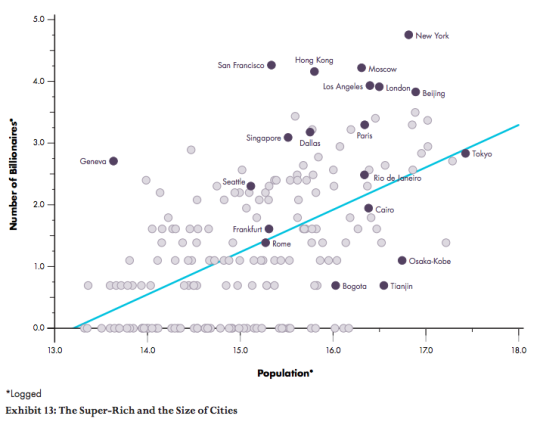
    “The geography of the super-rich is a function of larger cities. Both the number of billionaires and their net worth are positively associated with the population of global cities, with correlations of 0.56 for the number of billionaires and 0.44 to their net worth.”

    Here is a chart comparing population to the number of billionaires:
    image

    Cities such as New York, Moscow, and Hong kong, which sit far above the blue line, have more billionaires than their population size would predict.

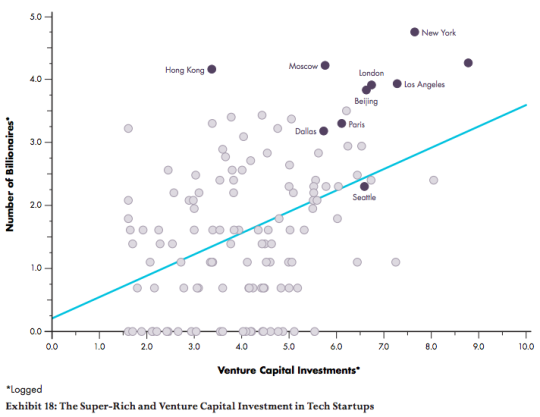
    Here is a similar chart comparing venture capital investment to the number of billionaires:
    image

    Once again, there is a positive association.

    Finally, here are a two charts that show which industries have produced the most billionaires:
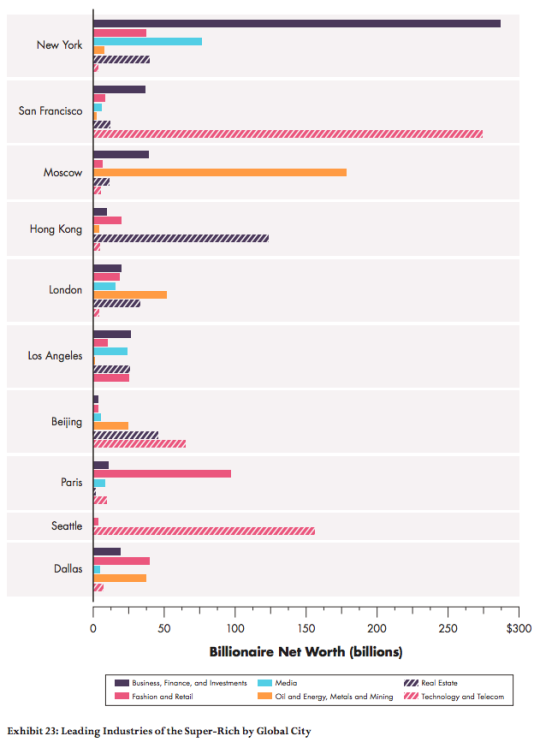
    imageimage

    If you’re interested in this study, you can download the full report here. All of the charts were sourced from the report.
  • Moving to the big city

    When I was 18 years old, I
    moved from the suburbs of Toronto to Waterloo, Ontario, which is about an hour
    west of the city.

    I largely did this for two reasons.

    Firstly, I had started
    visiting friends at both Wilfrid Laurier University and the University of
    Waterloo while I was in high school, and I thought that I wanted
    that kind of University town experience.

    Secondly,
    I started University as a Computer Science student and I figured that Waterloo
    was a pretty good place to study that. Research In Motion (later renamed to
    Blackberry) was an important company at the time and interesting things were happening.

    Though
    to be clear, I was a student at Laurier and not at the University of Waterloo – the better of the two schools for Computer Science – because I didn’t have
    the grades for the latter.

    But a
    funny thing ended up happening. I hated living in Waterloo. I felt so out of
    place. So much so that I spent every weekend back in Toronto visiting my
    friends who had instead decided to go to the University of Toronto.

    And I
    remember vividly how I felt during those weekends. I would stand in my friend’s
    apartments – most of which had dens and solariums that were hacked into
    bedrooms so that they could afford to live there – and I would look across the skyline and
    think to myself: why the hell do I not live here?

    So I
    transferred to the University of Toronto. And that solved that.

    The
    reason I bring up this story today is that I was reminded of it while reading a recent CityLab article by Richard Florida called, The
    Self-Confident City
    .

    The three
    main arguments in the article are:

    (1) Where
    we choose to live has a massive impact on our life outcomes.

    (2) Self-confident
    people – according to a recent study – seem to be drawn to big cities.

    (3)
    Self-confidence can also be a self-fulfilling prophecy
    for people in big cities.

    Now,
    I don’t know if it was really self-confidence and youthful hubris that told me I needed to live in a bigger city than Waterloo. (It was probably part of it.) All I know is that I
    wanted to live in a super dynamic place that felt bigger than me. I wanted to
    feel like I was a small fish in a big pond trying to make some sort of
    meaningful dent.

    That
    was true for me when I was 18. And it remains true for me today at 32.

  • Everything you ever wanted to know about automated vehicles

    Last fall, David Ticoll (who is a research fellow at the Munk School of Global Affairs at the University of Toronto) published a thorough discussion paper called Driving Changes: Automated Vehicles in Toronto

    If you’re interested in driverless cars, and I know that a lot of you are, then it’s definitely worth a weekend read. It’s fairly long. He gets into the various automation levels, the transition period, the implications for policy makers, the benefits, and so on.

    Here’s a quick snippet on the topic of benefits:

    “This report provides bottom-up analysis based on Toronto-specific data. The result is a conservative estimate that were AVs to be at a 90% adoption rate in Toronto today, the result would be annual savings of $6 billion, or 4% of the City’s $150 billion gross
    domestic product. This includes $1.2 billion from reduced collisions, $2.7 billion out of congestion costs, $1.6 billion from insurance, and $0.5 billion from parking fees and fines. AVs will provide other quantifiable social and economic benefits that range from fewer deaths and hospitalizations thanks to lower particle emissions, to productivity gains in many business sectors.”

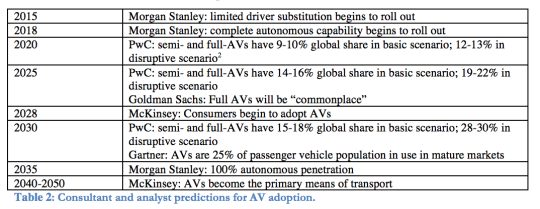
    But of course there’s the question of: when will this happen? Below is a chart from the paper that was assembled using various consultant/analyst predictions. Based on this, we’re still over a decade away from the consumer adoption of automated vehicles.

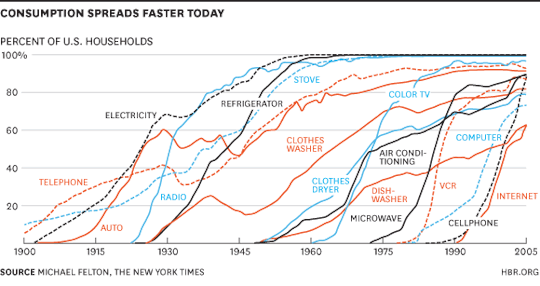
    However, these are just estimates and history has shown us that the adoption rate for new technologies has been increasing over time. Below is a chart by Michael Felton, which is also from the paper, that shows this phenomenon. Take a look at the telephone in comparison to the internet.

    Maybe I’m being overly optimistic (it wouldn’t be the first time), but consumer-facing driverless cars, at least to me, feel pretty close to the horizon.

  • School of Real Estate

    I’ve been getting a lot of (email) questions lately about what to study in order to become a real estate developer. So I thought I would reblog this post that talks about exactly that. I wrote it over a year ago and I almost forgot it existed.

    At the same time, I’m reminded of something: I think these questions really speak to the fact that there’s a significant opportunity (particularly in Canada) in terms of real estate development education. 

    Oftentimes when I get these questions, I end up recommending the Master of Science in Real Estate Development (MSRED) at ColumbiaMIT, and USC. Why don’t we have something similar (and better) in Canada? We are falling behind.

    I have raised this with some Universities here in Toronto, but the response I got was that they felt the real estate courses being offered as part of their existing MBA programs were more than sufficient. I think we can do a lot better.

    One professor suggested that I line up a big donor and work with them to spearhead the creation of the (Insert Donor Name Here) School of Real Estate. I think that’s a great idea, but not something I have the capacity for right now.

    Hopefully somebody else out there is of the same mind.

    Post Update: 3 days ago the Schulich School of Business (York University) announced a one-year full time Master of Real Estate and Infrastructure (MREI) program – the first of its kind in Canada. 

    This is great news. 

    Now I would love to see the University of Toronto and Ryerson University (as well as others) step up and leverage their respective architecture schools. Schulich is already out of the gate on this one.

  • British stock brick

    On Tuesday night architect Jamie Fobert spoke at the Daniels Faculty at the University of Toronto. Fobert’s practice is based in London, but he is a graduate of the Daniels Faculty well before it was called that.

    I unfortunately wasn’t able to attend, but I did get on to looking at his work. And I want to share two of his projects that stood out for me. Both are in London.

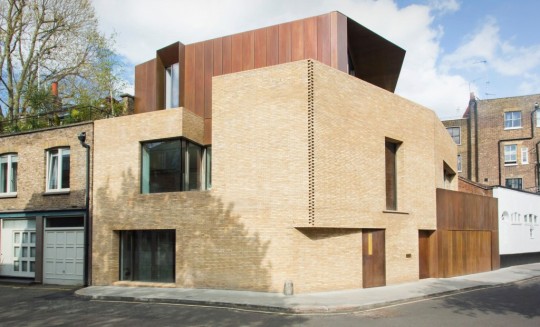
    The first is the Luker House:

    imageimage

    And the second is the Levring House:

    imageimage

    What I love is how subtle the detailing is in both projects. The Luker House uses a “British stock brick” to mimic its context. But at the same time, it is applied in such a minimal way that the project feels entirely contemporary.

    You can see that same philosophy in the Levring House, which was built to complete an historic mews house.

    Finding the right balance between old and new is not always easy. But I like how Jamie Fobert has done it with these two London homes.

  • The unfinished city

    https://500px.com/embed.js

    Earlier this week I attended a talk at the University of Toronto called Data Innovation and City Governance. It was by Mark Kleinman who is from London, but is now a Visiting Scholar at the Munk School of Global Affairs.

    The topics covered would have been familiar to anyone who is a regular reader of this blog (the power of open data, the knowledge economy, etc…), so I’m not going to repeat it all here. But I did want to touch on one of his impressions of Toronto, which is that this is a city that is “never finished.”

    What does that mean?

    The opposite of a city that is never finished would be a city like Paris that feels a bit like a monument that is now done and shouldn’t be touched anymore. It’s a city that almost feels too precious to intervene in. This is obviously not the case for all of Paris, but I think you get the point.

    Toronto, on the other hand, is a city that is constantly building, changing, and renewing itself. There are often layers upon layers of new interventions being applied, which gives you the impression that the city will never be done. It’s constantly in flux.

    Some of you may not appreciate this kind of “messy” urbanism, but I think it gives cities a kind of entrepreneurial resiliency (resiliency is a hot topic right now in urbanist circles). Cities are an ecological system. And the most resilient ecological systems in the world are the ones that are able to adapt to constant change.

    So in my view I look at this as a feature, not a bug. The only constant is change.

  • Why Toronto-Waterloo needs all-day two-way urban rail service

    image

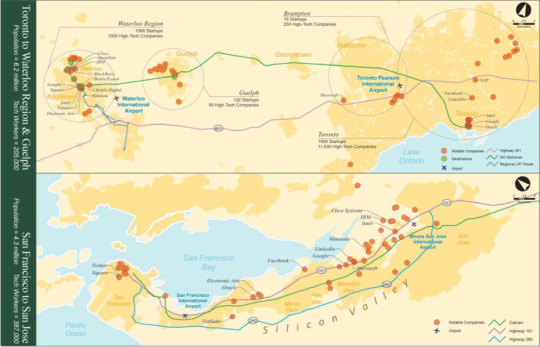
    This morning I stumbled upon an interesting Medium article talking about the need for an all-day two-way urban rail service between Toronto and Waterloo. 

    The argument is that along this corridor sits a technology ecosystem that is second in size only to San Francisco-Silicon Valley and that current connectivity levels represent a missed opportunity of epic proportions. Presently this rail service will feed you into Toronto during the morning rush hour and take you back out in the evening rush hour. But that’s it.

    According to this report prepared by the City of Kitchener (which is beside Waterloo), efficient train service would stitch together an ecosystem of approximately 12,800 technology companies, 2,800 startups, and 205,000 technology employees. It would also connect 6 universities and 4 colleges, many of which are ranked top in the world.

    There’s an argument here that this is exactly the sort of thing that governments should be doing to encourage innovation and entrepreneurship. Rather than trying to be heavily involved in actual startups, they should be creating an environment that maximizes output and then getting out of the way. 

    I think this makes a lot of sense. Don’t you?

    Image: The Innovation Express

  • The most segregated cities in North America

    The Martin Prosperity Institute here in Toronto just released a new research study called Segregated City: The Geography of Economic Segregation in America’s Metros

    The report looks at the physical sorting and separation of advantaged and disadvantaged groups within cities. And it did so across 70,000+ Census tracts in the US and in terms of 3 different dimensions: income, education, and occupation.

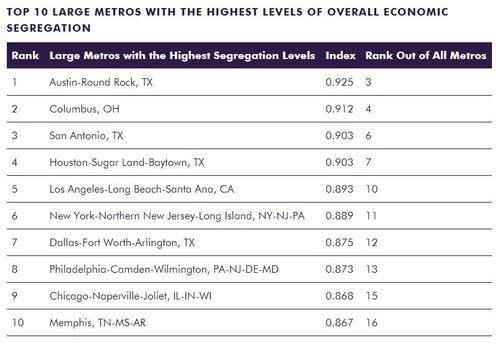
    Here are the most segregated “large metros” in the US:

    image

    Table Source: MPI

    And here are some of their broader findings – taken verbatim from page 9 of the study (click here for the full report):

    Economic segregation is positively associated with population size and density. It is also positively correlated to two other sets of factors that follow from metro size and density: how people commute to work and the breakdown of liberal versus conservative voters.

    Economic segregation tends to be more intensive in high-tech, knowledge-based metros. It is positively correlated with high-tech industry, the creative class share of the workforce, and the share of college grads. In addition, it is associated with two key indicators of diversity, the share of the population that is gay or foreign-born, which tend to coincide with larger, denser and more knowledge-based metros.

    Economic segregation is connected to the overall affluence of metros, with positive correlations to average metro wages, income, and economic output per capita.

    Race factors in as well. Economic segregation is positively associated with the share of population that is black, Latino, or Asian, and negatively associated with the share that is white.

    Economic segregation is associated with income inequality and even more so than with wage inequality. Its effects appear to compound those of economic inequality and may well be more socially and economically deleterious than inequality alone.

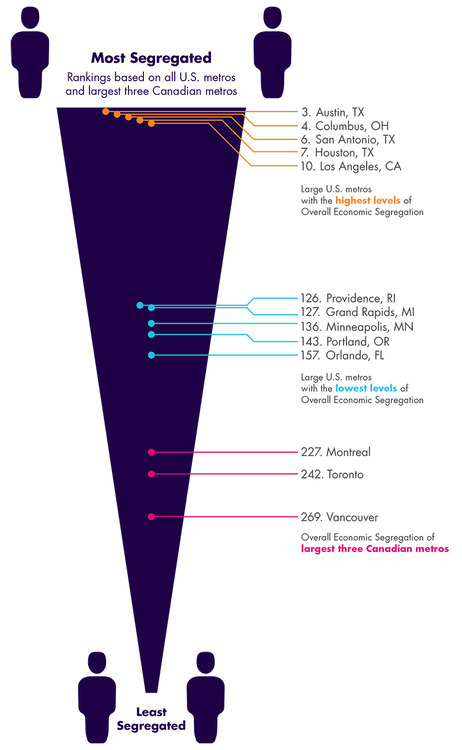
    The research team also looked at how Canada’s 3 largest metros – Toronto, Montreal, and Vancouver – compare to those in the US in terms of segregation. 

    The finding was that Canadian cities are overall less segregated than US cities, but that it should still be considered an area of concern. The most segregated of Canada’s 3 largest metros was found to be Montreal.

    image

    Image Source: MPI

    My view is that our economy is going through a profound shift right now. We’re transitioning from the industrial age to the information age. And in its wake, we’re seeing a number of disruptions, one of which appears to be rising inequality and segregation. 

    That’s not to say that I think this transition is a bad thing (I don’t think it is), but I do think we should be carefully considering and designing our future.

  • A look at One Spadina Crescent

    image

    One of the projects that I’m most excited about here in Toronto is the renovation and addition to One Spadina Crescent. The building sits in the middle of a roundabout along Spadina Avenue and occupies what is easily one of the most ceremonial positions in the city.

    But for as long as I can remember, the building hasn’t been living up to its full potential. So much so that in the 1960s it was going to be demolished in order to make way for the proposed Spadina Expressway. That would have been an absolute tragedy. Thankfully, our friend Jane Jacobs stopped that one.

    Today, exciting things are happening at One Spadina Crescent. The Daniels Faculty of Architecture, Landscape, and Design at the University of Toronto is in the midst of renovating and expanding the building, and will eventually relocate there from its current location on College Street.

    When it’s all said and done, One Spadina Crescent will look something like this (via Daniels).

    From the south:

    image

    From the west:

    image

    From the north:

    image

    What’s most exciting to me about this project are the following 3 things:

    First, it’s an opportunity to connect One Spadina Crescent to the surrounding urban fabric. Today, it feels very much like an island in the middle of the street. 

    Second, it’s a wonderful example of the new layering on top of the old, which is something that I believe we should aspire to do in our cities. The University of Toronto has become quite good at doing that on campus.

    And finally, the intent is for this building and site to include a number of research centers and public facing functions devoted to architecture, design, and city building. And so One Spadina could become quite the hub in the city. That’s exciting.

    If you’d like to take a look inside the building (pre-renovation), check out these great photos by Peter MacCallum. The picture at the top of this post is his.

  • The unmet demand for real estate education in Canada

    image

    I continue to be amazed by the unmet demand for real estate (development) education here in Canada.

    Following yesterday’s post on the real estate development process, I received a few emails from readers asking about the best university programs (MBA, MRED, etc.) and the best approaches for becoming a developer.

    I also had a good conversation on Twitter, which covered off some details that I had left out from my post (for simplicity) and which resulted in me suggesting that a real estate development school needs to be started here in Toronto:

    //platform.twitter.com/widgets.js

    //platform.twitter.com/widgets.js

    Now, part of the reason things are the way that they are, I think, is because the real estate industry has been historically dominated by private rich families. People didn’t go to school to learn how to be developers. They learned by doing and that was then passed down to the next generation. All it took was chutzpah.

    But as the real estate industry continues to institutionalize and become run by pension funds and large publicly traded companies, I think the point of entry will also become increasingly institutionalized. And that’s where dedicated real estate programs will continue to come in. 

    I’ve spoken to a few people at the Rotman School – where I did my MBA – and there doesn’t seem to be a huge interest in a dedicated program such as a Master of Real Estate Development (they already offer real estate courses). It’s more of a “longer term” strategy. 

    But I think that’s a mistake.

    I’m confident there’s strong demand from the student side, so hopefully a wealthy donor will step forward to help make this happen. The University of Toronto has both a great business school and a great architecture school. That feels like a great recipe for a first-in-kind joint degree offering.

    Image: Urban Learning (via Flickr)