Daily insights for city builders, delivered every morning at 6 AM ET. I’m Brandon Donnelly — a Toronto-based real estate developer and founder of Globizen. I’ve been writing here since 2013.

Tag: united states

  • 5 city builders who read Architect This City

    image

    A few weeks ago I wrote about showcasing the Architect This City community. The idea was that there are lots of interesting and talented people who subscribe to this blog, but that there’s no scalable way for me to connect with everyone.

    So I wanted to provide an opportunity for you to share a bit about yourself on this blog. I could selfishly learn more about the kinds of people who read ATC; you and/or your company could benefit from a bit of exposure; and you all could get the opportunity to connect with one another.

    I didn’t get quite as many responses as I thought I would — which is partially why it has taken me so long to write this post — but I did get a lot of positive feedback on the idea. So I’m excited to share 5 of the people and companies that did respond.

    Darren Davis @ Auckland Transport (Auckland, New Zealand)

    Proudly car-free Principal Public Transport Planner, and arch transit nerd, at Auckland Transport. Auckland Transport is in the midst of the biggest redesign of the city’s public transport system since the introduction of electric trams in 1902. We are taking a once-in-a-generation opportunity to reimagine public transport by going back to first principles, in an exercise inspired by Human Transit and strongly influenced by its author, Jarrett Walker. 

    Travis Goodhand @ Entuitive (Calgary, Canada)

    We are a consulting engineering practise — structural, building envelope, restoration, and special projects & renovations — bringing together engineering and intuition to enhance building performance. Entuitive is creative, collaborative, and advanced.

    Taya Cook, Development Director @ Urban Capital (Toronto, Canada)

    We develop forward thinking condominiums with a focus on urban location, fantastic design and superior customer experience. I work there. Really B, do you need more reasons for awesomeness?

    Sara Parratt-halbert @ South Yorkshire Forest Partnership (Sheffield, UK)

    Currently managing a Europe-wide €4m ERDF funded project, ‘Stimulating Enterprising Environments for Development and Sustainability’ (SEEDS).  SEEDS is working with 8 partners across 6 countries towards establishing acceptance of the temporary use of abandoned places and spaces as an integral part of longer term planning.

    Cynthia Mykytyshyn @ Urbanspace Gallery (Toronto, Canada)

    Urbanspace Gallery is a unique venue, dedicated to diverse exhibitions and events that explore how cities work and how we might improve them. Our purpose is to present issues related to community, public space, housing, transportation, planning, governance, and sustainability (among others) in order to further the discussion about our own city and others around the world, while fostering a space of learning and reflection.

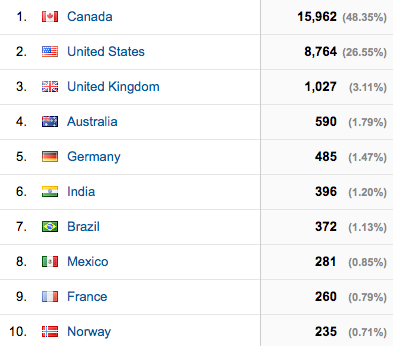
    Most of the people who responded were from Toronto and Canada. And that’s not surprising given how local a lot of my content is. Half of the ATC reader base is currently from Canada.
    image

    But I did also get emails from many other places all around the world. It always amazes me to see where people are reading from. My only wish is that I could learn more from them (you). So drop me a line. I hope to do another community profile sometime soon.

    Many thanks to everyone who responded!

    Image: How Does Your Neighbourhood Grow? (Urbanspace Gallery)

  • The middle class myth — a conversation with Marc Andreessen

    New York Magazine recently published a really great conversation between Marc Andreessen and Kevin Rose. Marc cofounded Netscape way back when, and now runs a venture capital firm.

    In addition to technology, the conversation touches on a bunch of different topics such as why it’s beneficial to be an optimist and why change can be difficult for people to accept.

    But they also hit on a number of broader economic shifts, such as the replacement of labor by machines, and the rise and decline of industrial production in the US. Here’s a snippet on that latter point:

    You’ve described the middle class of the 20th century as a myth.

    There are two middle classes. There’s the historical middle class—which is the bourgeoisie—starting in the, like, 1600s. This was the businesspeople and the traders, the merchants, the butcher, the baker, the general-store manager, the guy who was going off to China to go get silk and bring it back. Businesspeople.

    But in the 1940s something really significant happened, which is we bombed the rest of the industrialized world. And so the industrial base of Germany was obliterated. Japan was reduced to rubble. The rest of Continental Europe was bombed. England was bombed. The industrial base of the world was bombed. The one major industrial country that wasn’t bombed was the United States. So the United States became the monopoly producer of industrial goods.

    The army bombed the American middle class into existence?

    It was an accident of history. We had a window of opportunity which we took full advantage of. We had this window from basically 1945 to 1966, 1968, in which we were basically running unopposed. In that window, all kinds of wonderful things happened. One of the things that happened was the rise of this new idea of the middle class, which there was no historical precedent for, which was college-level wages for high-school-level education. As long as there’s no competition, it’s all well and good. The minute the Japanese show up, the minute the Germans show up, it just all falls apart.

    Click here for the full conversation. It’s an interesting read.

  • How does your city address its streets — literally?

    image

    Depending on where you live, street numbering may not be something you’ve given a lot of thought to. In Canada, and in many other places in the world, the convention is usually to start on one end of the street and count up – with even numbers on one side and odd numbers on the other.

    In many cities in the US, they’re even more rational. The streets themselves are numbered and the addresses indicate location. For example in Philadelphia, where I used to live, if you were going to let’s say 1750 Walnut Street, you would know that it’s between the cross streets of 17th Street and 18th Street. It’s a kind of hyper-rational approach, which lets you know precisely the number of blocks you need to go to get to your destination.

    But not all countries and cities are this rational.

    According to this Economist article – which a friend of mine forwarded me over the weekend – Costa Rica actually had no street numbering system until about 2012. Which means that directions were all based on landmarks: “100 metres south of the McDonald’s.” It seems almost hard to believe. But I guess that’s why ¼ of all mail was getting lost.

    Of course, there are also lots of variations in between these two extremes.

    Japan numbers its buildings, but they’re often clustered together in blocks and have no particular order or logic to them. Brasilia (Brazil) also assigns numbers based on sectors, quadrants, and blocks. And in Ireland, where I also used to live, they actually never adopted postal/zip codes. They’re one of the few developed countries in the world not to do that – though it’s coming next year.

    If your city or country has a unique numbering system or you’ve come across one in your travels, I would love to hear from you in the comment section below.

    There are obviously practical reasons to adopt an easy to understand numbering system. People need to be able to figure out where they’re going. But I would also imagine that there are spatial implications to the way you number and the way you organize your city.

    Image: Flickr

  • Rise of rental

    image

    Last month Oxford Properties submitted a site plan application for the redevelopment of the rundown Cumberland Terrace in Toronto’s Yorkville neighborhood. If you’d like to browse the full application (including all the drawings), you can do that here.

    The proposal is a departure from previous plans and now includes 3 buildings: a 4.5 storey building, a 2.5 storey building, and a midblock 54 storey residential tower (the lobby is shown above). There will be both retail and residential uses.

    For those of you familiar with the mall, it should go without saying that Cumberland Terrace is in desperate need of redevelopment. So I’m not going to talk about that today. Instead, I’d like to mention 2 other points that stood out to me about the application.

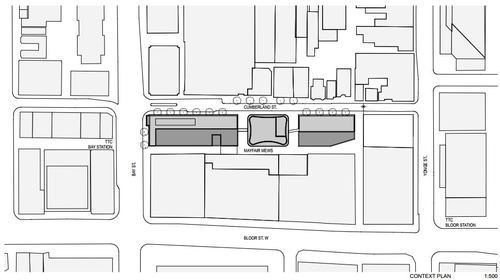
    The first is the 2 midblock connections on either side of the tower, running from Cumberland Street to Mayfair Mews in the rear (see below). Yorkville has a history of intimate laneways, and so it’s nice to see some of this being carried through in a new development. It also opens up the opportunity for an improved Mayfair Mews.

    image

    Secondly, it’s somewhat surprising to see that the 54 storey residential tower is being proposed as rental. Toronto doesn’t build a lot of purpose-built rental apartment buildings. There are some (from the likes of Morguard and Concert Properties), but we haven’t done it at scale for decades. And that’s largely because the demand for condos has been so great.

    But recently I’ve been noticing a renewed interest from the real estate community in multi-family rental assets. Cadillac Fairview also proposed a 65 storey rental building at the north west corner of Yonge Street & Queen Street last year – though they later withdrew their application.

    image

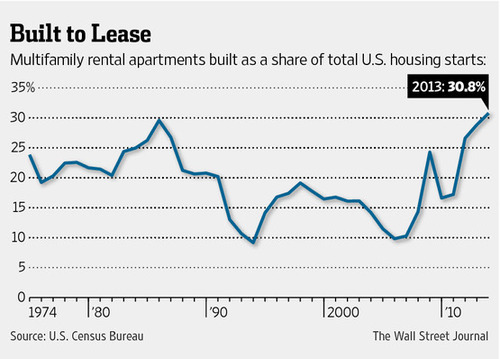
    In the US, rental apartments as a share of all new housing is also at record highs – over 30%. And that’s partly because credit remains tight (certainly compared to pre-2008) and economic growth has been tepid. But also because of demographic changes. People are having fewer children, later in life, and so many are putting off buying.

    So I think we’re going to see even more rental apartments being built in Toronto in the coming years.

  • A century of homeownership and renting in England and Wales

    This morning while I was reading about gentrification in Berlin, I clicked through to an interesting overview of homeownership and renting in England and Wales over the last century. Here’s a video. If you can’t see it below, click here.

    [youtube https://www.youtube.com/watch?v=LDnGryGJ1ZA]

    The video starts in 1918, where the vast majority of households (77%) rented. As of 2011, this number has reversed. 64% of households in England and Wales now own their home.

    If you compare this housing trend to what happened in the United States and Canada, you’ll see a similarity. Although, the US was ahead in terms of promoting homeownership. They reached 50% ownership somewhere in the mid 1940s, whereas England and Wales didn’t reach this number until around 1971.

    image

    All of this is an interesting reminder that our obsession with homeownership is a relatively new one. But it’s also not a universal one. The homeownership rate in Berlin is 15.6%, and it’s only 49.5% in London. People in big cities tend to rent more.

  • Why the homeownership rate is higher in Mexico than in the US

    If you check out the “What I read” page that I recently added to Architect This City, you might notice a blog by Charlie Gardner called the Old Urbanist. I discovered it a few months ago (when he added ATC to his blog roll) and it’s good stuff.

    Last week he posted this interesting piece comparing homeownership rates and house sizes in both Mexico and the US. His finding is that there’s a fundamental mismatch in America in terms of the size of housing and the size of households. One and two person households now represent more than half of the market, and are on the rise, and yet 40% of houses in the US have 3 bedrooms.

    Because of this mismatch, he’s arguing that households are being poorly served by the US housing market and that it’s driving down homeownership levels. It currently sits around 65%, which is a drop from over 69% during the mid 2000s. Contrast this to Mexico, where there’s a greater number of one and two person households and the homeownership rate is 80%! Oh, and where only 6% of homes are financed using a mortgage.

    So what the Old Urbanist is suggesting is that we need to embrace smaller homes. He doesn’t explicitly say it, but he mentions the opportunity to redevelop laneways and alleys, which many of you will know I fully agree with. It’s a great post and I suggest you have a read if this topic interests you.

  • Housing tenure in Europe

    Yesterday I came across an incredibly fascinating chart from Eurostat, analyzing housing tenure (in 2011) across Europe. Here it is:

    image

    And here’s what I found interesting.

    Working from left to right, there seems to be a clear difference between Eastern and Western Europe in terms of the amount of leverage they use to buy homes. If you look at Romania, not only does over 90% of the population own a home, but they also don’t seem to have any outstanding mortgage or housing loan. That means they’re buying their homes in cash.

    By the time you get to the United Kingdom, you start to see numbers that are comparable to Canada and the United States. The percentage of owner occupied homes is sitting at or below 70% and the majority of them have a mortgage or loan.

    But as a whole, Western Europe seems much more likely to rent than Eastern Europe. And in the case of Switzerland, more people rent than own. Why is that? This seems odd given its economic strength. But the same could be said for Germany and Austria, which also show relatively low ownership rates. Here’s one possible explanation.

    Finally, I found it interesting that in Denmark, the Netherlands, and Sweden, there’s virtually no such thing as subsidized rental housing. If you rent, you’re paying market rate (at least according to this chart). I wonder if this has something to do with there being less income inequality.

    If anyone has any insights on some of these points, I’d love to hear from you in the comment section below.