Daily insights for city builders, delivered every morning at 6 AM ET. I’m Brandon Donnelly — a Toronto-based real estate developer and founder of Globizen. I’ve been writing here since 2013.

Tag: union station

  • Railway architecture and design

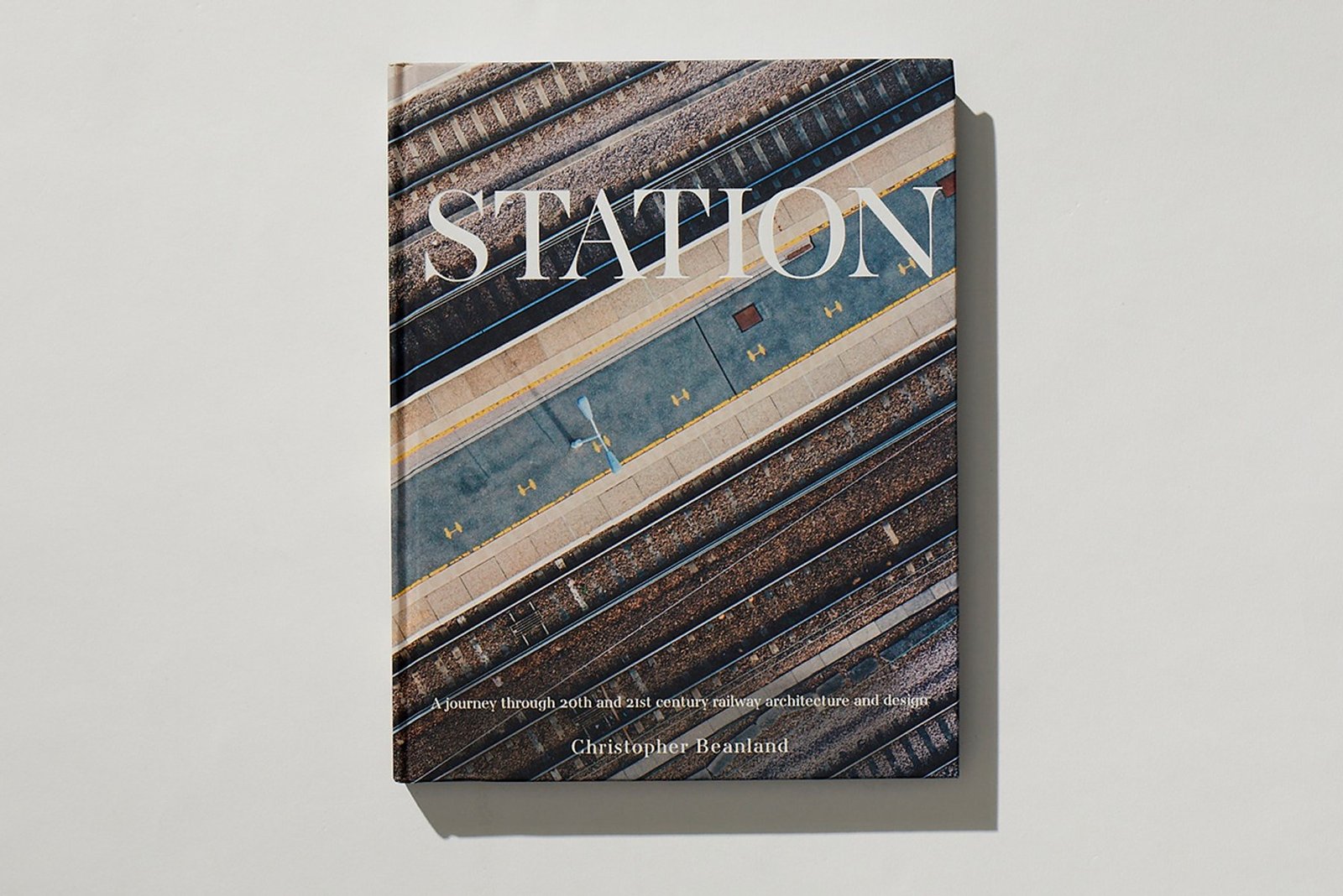
    I would rather take a train to the office than drive. And given reasonable options, I would rather take a train than get on a plane. I like trains. So by default, it means that I’m interested in Christopher Beanland’s new book, Station. In it, he profiles some of the best railway architecture from the 20th and 21st centuries. Places like Union Station in Los Angeles, Hauptbanhof in Berlin, and Byappanahalli in Bengaluru. But as cool as these places are on their own, I think it’s important to keep in mind that trains exist as part of a network. And like all transport, they promote time-space convergence. This is part of what makes these spaces so interesting — they’re like a portal to somewhere else.

  • The West Toronto Railpath needs to be extended to Union Station

    Following my recent post about cycling to the office, Richard Witt of BDP Quadrangle suggested that I do a post on the West Toronto Railpath and use the little influence that I have to try and encourage further expansion. I thought this was a reasonable idea and so here I am writing about it today.

    For those of you who may not be familiar, the WTR is a multi-use trail that can be used for “human-powered activities” such as biking, running, or unicycling. And as the name suggests, the path runs on an old rail line on the west side of Toronto. Here is the current route map (we’re talking about the dark orange line):

    And here’s what it looks like today:

    It’s an incredible amenity and piece of infrastructure on the west side of Toronto, but it’s probably also a little underrated. I think of part of this has to do with it being somewhat hidden. And I think another part of this has to do with it being too short.

    Right now the WTR runs from Cariboo Ave in the north — which is around the corner from Junction House — down to Dundas Street West & Sterling Road in the south. But according to the City of Toronto, an expansion phase has already been funded and construction will start next year. This will take its southern terminus down to Queen Street & Sudbury Street:

    All of this is, of course, excellent news. But you and I both know that the WTR needs to be further extended to Union Station, then up north, and probably elsewhere too. So I am here today to advocate for that to happen. If we can find a few billion hanging around to rebuild the Gardiner East (ugh), then surely we can scrape together a few more million for this.

    Images: Friends of West Toronto Railpath

  • Metrolinx to further optimize the Union Pearson Express train

    It was announced this week that Metrolinx will be making changes to the popular UPX train service that connects Union Station to Toronto’s Pearson International Airport. This is an interesting transit story. And as someone who will be moving to the Junction (adjacent to one of the stops along the way), I have a vested interest in this announcement.

    The UPX started out as a high-priced boutique train service to the airport. A one-way fare was $27.50 per person (without a PRESTO card). This was too much and I argued that here on the blog. If you looked at the math and compared it to the alternatives, such as taking an UberX, most people were not going to take this train.

    The fares were ultimately dropped — by a lot — and the service then took off not only as a link to Pearson but as an inner-city commuter service. I now sometimes call it the Union-Junction Express, because the actual train ride from Union to Bloor St (at Dundas West) is about 7 minutes once you’re on the train.

    The announcement this week merely solidifies the train’s evolution from high-priced boutique service (which didn’t work) to airport/commuter service (which is really working). The trains are expected to run more frequently now, some of which will continue to make the same stops as today and some of which will stop in new locations along the line.

    As transit-advocate Cameron MacLeod said in the Globe and Mail yesterday, “there’s both good and bad news here.” The good news is more frequent service. Even quicker trips in some instances. And better integration with the broader GO train network. The bad news is the award-winning UPX station at Union will no longer be needed. The service is expected to move to a new platform.

    Photo by Sean Thoman on Unsplash

  • Golden hour cranes

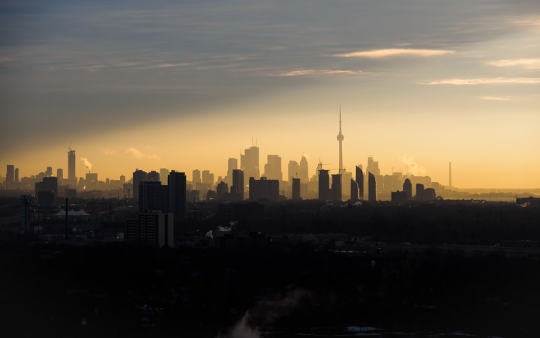
    I was out this past Saturday evening with my Fujifilm X-T3. I usually always have it on me when I’m traveling, but less so when I’m at home. It can be harder to be a “tourist” in your own city because things don’t stand out in the same way. And oftentimes it is that novelty which sparks the desire to take a photo. But that’s no excuse. So here are two photos that I took right before sunset from CityPlace, Toronto. The cranes you see in the first picture (mostly) belong to The Well.

  • Microsoft Canada moving to CIBC Square

    image

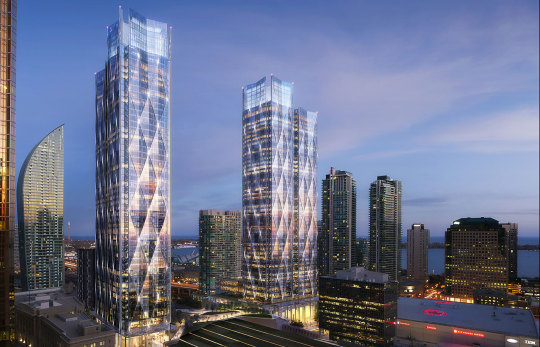
    Today, Microsoft announced that it will be moving its Canadian headquarters from Mississauga to the new CIBC Square development that is currently under construction in downtown Toronto (and rendered above). 

    According to RENX, Microsoft will occupy 132,000 square feet across 4 floors in the first tower. Occupancy is scheduled for September 2020.

    I love this project. The design architect is WilkinsonEyre. And there’s going to be an elevated one-acre park spanning the rail corridor between the project’s two towers.

    But it’s also noteworthy because it is an example of a major suburban tenant deciding to relocate to a transit-oriented urban environment. (I have a post on this somewhere.) 

    Image: WilkinsonEyre

  • Let’s fix the UPX train, together

    I am a big fan of the UP Express train that runs from downtown Toronto to Pearson Airport. 

    I love the station architecture, the branding and identity, the trains themselves (with wifi), and the local retailers they house at Union. I also happen to live a stone’s throw away from the downtown station. So I can go from door to bum in seat within 10 minutes.

    But despite all this, it has become clear that something needs to be done to fix the UPX train. Just last weekend a friend of mine and fellow urbanist, who was visiting Toronto from Vancouver, sent me a text message saying: “This UPX train is really nice, but why is it so expensive?”

    Indeed, that seems to be the general consensus. Here is the opening paragraph from a recent Globe Editorial article:

    Toronto’s high-end airport express train is a failure. A city that urgently needs better transit has been saddled with a deluxe boutique rail service that cost $456-million to build and runs nearly empty, 19 ½ hours a day.

    So today I thought we could collectively brainstorm some ideas for how Metrolinx – the public agency that operates the train – should address this issue.

    I’ll start by sharing my thoughts as a rider and then, hopefully, you all will share yours in the comment section below. I know that there are people from Metrolinx who subscribe to this blog, so I am sure your feedback will get through to them.

    My thoughts are twofold. Like many others, I think the pricing is off. But at the same time, I think there should be a focus on enhancing the value proposition of the service.

    Bur first, let’s talk about price.

    At the time of writing this, a one-way trip from Union Station to Pearson Airport on the UPX is $27.50. If you happen to have a PRESTO card, it’s $19.

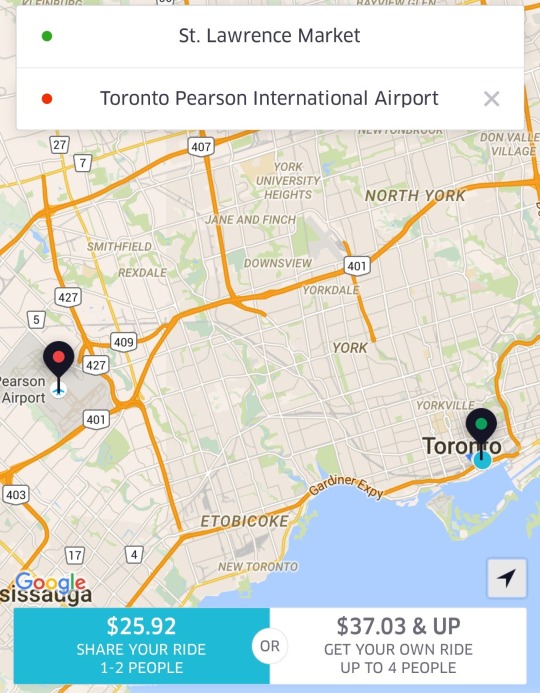
    The alternative for many is probably a taxi. So let’s also look at some Uber fare estimates. For someone like me leaving the St. Lawrence Market area, I’m looking at $25.92 with UberPOOL (meaning I’m sharing the car with 1-2 other people) or $37.03 if I insist on riding solo.

    image

    Against the non-PRESTO fare, UberPOOL is a cheaper option and it’s door-to-door service. Against the PRESTO fare, UPX is potentially $6.92 cheaper. But if you’re someone who has to take the subway to the UPX station, then it’s only $3.67 cheaper (add $3.25 for the subway) and it’s not door-to-door service. So for the vast majority of people, I suspect that UberPOOL would win out in this particular scenario.

    If you happen to be traveling with someone, then UberPOOL and UberX are probably going to be cheaper no matter how you slice it. And again, you’re getting door-to-door service. So I think the consensus is right: fares need to come down.

    But I don’t think Metrolinx should be solely focused on price. They should also be thinking about ways to create additional values for riders. 

    One of my favorite travel experiences is that of Hong Kong’s airport train. There, they have airline check-in counters in the city so you can collect your boarding pass and check your baggage up to a day before your actual flight. This is a huge value add because it means you can check out of your hotel, liberate yourself of your luggage, and spend the day in the city before leaving on the train to catch your flight. You can’t do that with an Uber. And lugging bags around a busy city, sucks.

    My point with all of this is simply that you can’t expect people to pay more or roughly the same, if they are not getting additional value. And right now, the train isn’t door-to-door and taxis are. (Though, the train has a travel time advantage during peak times.) So you either make it cheaper or you create additional value. Or, you do some combination of the two, which is where my head is at.

    What are your thoughts? Please respond in the comments below so all the feedback is public. Thanks.

  • Interview with Brad Keast of Osmington

    image

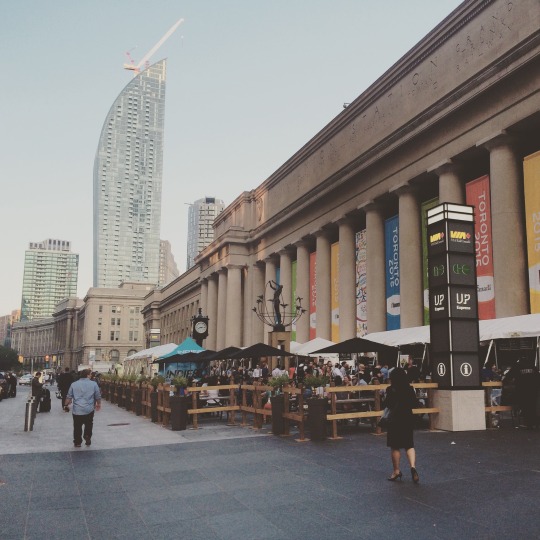
    Given yesterday’s post about Times Square in New York, the timing is perfect to talk about the revitalization of Union Station here in Toronto, its new public spaces, and the programming that’s now happening in and around the station.

    Perhaps the most noticeable is something called Front Street Foods @ Union Summer, which is an outdoor food market set up along Front Street. It’s on this summer from July 6th to September 27th, 2015. 

    However, Front Street Foods is only one part – the food part – of a larger events and programming strategy known as Union Summer. I recently had a quick chat with Brad Keast of Osmington, who is involved in a lot of what’s happening right now at Union Station.

    I found it interesting to learn about how organic the process was. And I thought you all might find it interesting as well.

    ————————————–

    Tell us a little bit about you and your company’s involvement with Union Station. 

    I’ve been with Osmington for over 4 years now and Union Station is a major focus of my waking life. 

    The company won a public RFP with the City of Toronto in 2009 to be the City’s retail partner in the redevelopment. What this means is that while the City owns the building and is doing base building construction, we are overseeing all the retail, advertising, and special events and programming. We are finding all the tenants, doing a bit of overshell work and then turning it over for fit-up.  

    We think the real special part of the project comes in through the special events and programming. We really want to make the station a destination in itself and you’re starting to see that with some of the programming we’ve done this year, be it a contemporary art event like Villa Toronto or something more community-focused like Union Summer – the current animation of the area in front of the station.

    How did the idea for Union Summer come about? 

    This really was a collaborative internal effort. We started by thinking ‘hey, let’s put a bunch of tables and chairs on the new plaza in front of the station and see what happens.’ Then we added in the idea of food. We knew it had to be accessible but didn’t want traditional food trucks, rather something less mobile but still not permanent. 

    That’s when we reached out to Toronto Market Company and they started rounding up the vendors. Then we layered on entertainment – daily music be it live or DJs, as well as a movie night with the Toronto International Film Festival (TIFF). We even have some kids programming on the weekends. Then we worked with the Farmers’ Market being displaced from Nathan Phillips Square due to Pan Am this year to have them here on Wednesdays.

    What was involved in making Union Summer a reality? What was the biggest surprise and/or hurdle that needed to be overcome? 

    There was a tremendous amount of coordination needed. First we weren’t sure when the construction was even going to be finished, all that was certain was it would be before Pan Am started. 

    Then the infrastructure required for the event itself was an exercise in creativity – power, water, and grey water disposal in particular. There was a lot of meetings with City officials for things like building permits, fire code, council approval to apply for a liquor permit, and health and food safety measures. Operationally things like loading in, coordinating with the installation of the Pan Am banners between the columns, interim furniture when our original order didn’t make it onto a ship in Antwerp, and then the first week was so busy that some vendors started losing staff because they were burnt out. 

    Like all things with this project we have to be mindful that this is an operating train station. In fact it’s the busiest building in the country with over 250,000 people per day passing through so we can’t impede those operations. We’ve done our best and have learned some lessons along the way and the reception has been overwhelming. 

    One of the best things about having that many entrepreneurs in close proximity is that some vendors have been pairing up to try experiments. Frozen custard-stuffed churro?

    Toronto is getting much better at designing and programming its public spaces. Given your experience with Union Summer, is there something the city could and should be doing to encourage more of these kinds of urban activations?

    Well, first of all, our contacts at the City, in particular Denise Gendron and Scott Barrett in Real Estate Services have been incredibly supportive of our efforts and we couldn’t have done it without them. If I could make one recommendation it would be to build in the supportive infrastructure for services. Of course that’s only beneficial if there is someone to take charge of the space and program it appropriately. It’s not a part time job.

    What’s next for Union Station?

    Right now the focus is on getting the first retailers open on GO’s new York Concourse. On the programming side we will host art for Nuit Blanche (October 3rd, 2015). That promises to be exciting. And then opening November 30th, 2015 is the Holiday Market. It was a huge success last year so we’re bringing it back for 3 weeks this time.

  • 10 reasons to visit Toronto right now

    https://500px.com/embed.js

    Next weekend a good friend of mine from architecture school will be visiting Toronto from Philadelphia. And I’m really excited to show him the city. (Next month it’s my turn to go to Philadelphia.)

    He’s a fellow city geek. He hasn’t been to Toronto in a number of years. And I haven’t seen him since our trip to Detroit 2 years ago.

    For those of us living and working in Toronto, there’s a lot to celebrate. Sure the Gardiner Expressway East decision didn’t go as I – as well as many other urbanists, including our Chief City Planner – had hoped. But there’s no shortage of other things to brag about.

    So here are 10 reasons to visit Toronto right now:

    1. We’ve created an entirely new business district south of Union Station called South Core. Now the region’s primary mobility hub is in the middle of the country’s most important business district, as opposed to on the edge of it. It’s a better use of infrastructure.

    2. We now have a dedicated train (the Union Pearson Express) that takes you from the country’s busiest airport directly to downtown in 25 minutes. You’ll find local retailers at the stations and a brand created by the brain behind Monocle Magazine. You can even use a smart card to ride it and our local transit system.

    3. We didn’t shut down Uber. Instead our mayor wants to create new policy that will allow these services to coexist with conventional taxi services. We don’t yet know how this will turn out, but I believe it’s a step in the right direction. It’s Toronto taking a leadership approach to innovation as opposed to trying to stomp it out.

    4. We are about to host the largest sporting event in Canadian history. The 17th Pan American Games will have double the number of athletes competing as the 2010 Winter Olympics in Vancouver.

    5. We created an entire neighborhood from scratch in order to house all of these athletes (Canary District). And I think it’s destined to become one of Toronto’s great neighborhoods. I’m saving my first visit for next weekend, so expect a follow-up post on this.

    6. We are dramatically rethinking this city’s public realm. From the plaza out front of Union Station to the new Queens Quay Boulevard along the waterfront, we are prioritizing people and creating more complete streets. It has given Toronto an entirely new urban feel.

    7. We are slowly starting to embrace our forgotten laneways and alleys through the help of organizations like The Laneway Project. And this is going to eventually lead to a further rethink of our pubic spaces and urban fabric.

    8. We continue to be one of the fastest growing cities in the world (certainly in the developed world). As a result, we are building some really exciting buildings by some of the top architects in the world. This includes everyone from Norman Foster to Frank Gehry.

    9. According to a recent report coming out of the Martin Prosperity Institute, Canada is one of the most creative and globally competitive countries in the world, as well as the most open to “ethnic and religious minorities and gay and lesbian people.”

    10. The ATC community is in the process of identifying a new, quintessentially Toronto food dish. But since we have every type of imaginable cuisine here, we’re struggling to pick just one. When you visit, you can help us identify the best and most Toronto dish.

    So there’s a lot to be excited about. I for one can’t wait for us to host the Pan Am Games, starting tomorrow. It’s a chance to show off this great city. 

    So if you’re also in town next weekend and want to geek out about cities, drop me a line.

  • Toronto’s Bloor-Danforth subway corridor is a land use crime scene

    image

    Yesterday after my post on leveraging LRT, I stumbled upon an interesting and timely article written by Richard Joy, who is the Executive Director of the Urban Land Institute (Toronto).

    The article talks about some of the transit-oriented development that we’ve seen at various nodes along Toronto’s Yonge subway corridor (St. Clair, Eglinton, Sheppard, and so on). But it goes on to argue that these are exceptions to the rule. For the most part, we’ve missed the boat:

    The tragic history of our massive capital investments into transit infrastructure is massive under-development.

    Indeed, the Bloor-Danforth subway corridor is a land use crime scene.

    His main argument is that until we expand the supply of transit-oriented land (through increased intensification), we will continue to undersupply the kinds of walkable and transit-oriented neighborhoods that many, if not most, people actually prefer. And that, out of necessity, will force people into their cars. Because affordability trumps location preference.

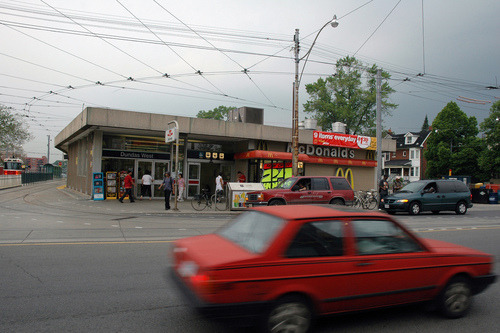
    As one example, he talks about the intersection of Bloor Street and Dundas Street in the west end of the city. Next to Union Station, this is probably the best connected mobility hub in the region. You have the Bloor-Danforth subway line, a streetcar line, and a GO regional rail line which all feed into it. Next year it’ll also become a stop for the new express train to Pearson airport.

    And yet the city has a history of opposing intensification in this location, including the old Giraffe Condominiums proposed by TAS. Does that make sense to you?

    Image: Flickr

  • Taxis just got 40% cheaper in Toronto

    UberX officially launched in Toronto today. Which means that Toronto’s taxi and limousine industry is about to get a lot more grouchy. For those of you who may not be familiar, uberX is Uber’s low-cost car service. Just like the regular version, you hail a car using your mobile phone. But this option will cost you 40% less than a regular taxi!

    Here are sample rates from the Financial District to Yonge & Eglinton (midtown):

    And from the Financial District to Pearson International Airport:

    image

    This is pretty exciting. Because as much as I think it’s great to use Hailo or Uber to hail and then pay for a car, the big problem in my mind has always been that cabs in Toronto are just far too expensive. The meter starts at $4.25 and shoots up faster than you can take a selfie in the backseat.

    But obviously there’s an entrenched industry here that is not going to be happy about a startup eating into their fares. So I wouldn’t be surprised if we see a lot more backlash here in Toronto – as has been the case in many other cities. However I don’t think that’s a viable long term solution for the incumbents.

    Uber is thought to be worth $18.2 billion right now. It’s probably not going to go away.

    So instead of protesting and trying to ban it, we should be figuring out how to adjust to this changing reality. For the incumbents, this might mean lowering fares or figuring out a better way to differentiate themselves. A 40% discount is a pretty compelling value proposition. For me personally, I don’t know why I would ever pay more for a regular taxi, unless there was no other option.

    On a side note, it’s worth pointing out that an uberX trip from downtown to Pearson is estimated to cost around $33 – roughly the same as what some people think the Union Pearson Express train will cost. That’s further evidence that charging a lot and targeting business travelers may not be the best strategy.