Daily insights for city builders, delivered every morning at 6 AM ET. I’m Brandon Donnelly — a Toronto-based real estate developer and founder of Globizen. I’ve been writing here since 2013.

Tag: uk

  • Making city planning cool again

    image

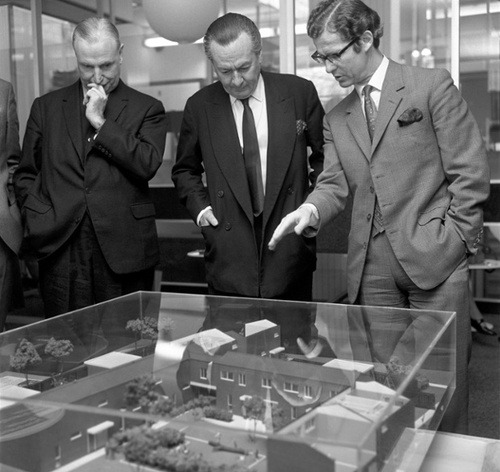
    This morning my friend Mackenzie Keast – who is famous and was on the radio in Toronto today talking about The Laneway Project – sent me an interesting article from the Guardian talking about the marginalization and growing irrelevance of city planners. It’s called: For the sake of our cities, it’s time to make town planning cool again.

    The gist of the article is as follows:

    While the cult of the star architect has soared over the decades and property developers have displaced bankers as the new super-rich, the figure of the local town planner has become comic shorthand for a certain kind of faceless, under-whelming dullard.

    But what really stood out for me are the following two things. First, that people are genuinely interested in cities. I would say that it’s almost trendy to be into cities these days.

    Urbanism may have displaced cultural theory as the favoured subject of the academic hipster, but talented young men and women rarely consider becoming town planners.

    And second, that we’ve made it difficult for these same interested people to participate in the planning process.

    Planners have become simultaneously under-respected and over-professionalised. Their training and practice too often leaves them able to communicate effectively only with other planners and professionals, working in an abstract language that alienates them from people. People are occasionally allowed into the professional planner’s world, but in highly mediated terms dictated by the profession.

    This stands out for me because I think that architecture is in a somewhat similar position. I often joke that the more architecture training someone has, the more likely they’re going to like buildings that the rest of the world doesn’t. It all becomes quite insular – just like the Guardian is arguing with respect to planning.

    And that may in fact be the reason for the marginalization of both planners and architects (minus the few starchitects that have a distinct brand and can command a premium). If the general public doesn’t like what you do or understand how you create value, why should they care?

    I’ve written before about the future of the architecture profession, as well as the reasons for why I decided to never practice architecture. So I won’t repeat it all here.

    But I will say that it had nothing to do with me not loving architecture. Because I do and always will. Instead, it was about recognizing that professions are not set in stone. Just like pretty much everything else in this world, they can and will be reinvented.

    Image: The Guardian / PA
  • Architect This City is The Guardian Cities blog of the week

    image

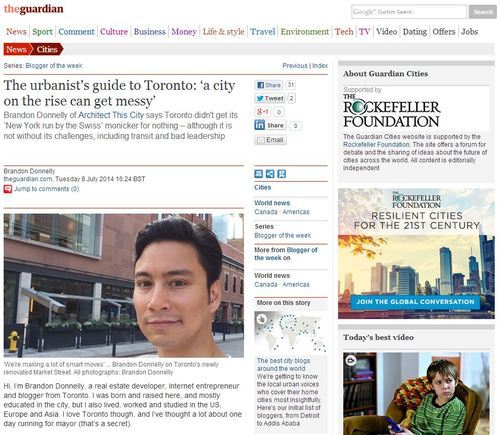
    ATC was featured in The Guardian Cities today as the city blog of the week. It’s a Q&A about Toronto and the idea is for it to be an “urbanist’s guide” to the city. They asked me to be playful and humorous in my responses, and so I tried to do just that.

    But my underlying message was that–despite being an awesome city–Toronto needs to get its act together with respect to mobility and transportation. I also recorded a video talking about this problem, which I believe will be released in the next week or so.

    A big thanks to The Guardian Cities for asking me to participate and to Athlyn Cathcart-Keays for continuing to be an avid supporter of Architect This City.

  • The super-linear relationship between human interactions and city size

    image

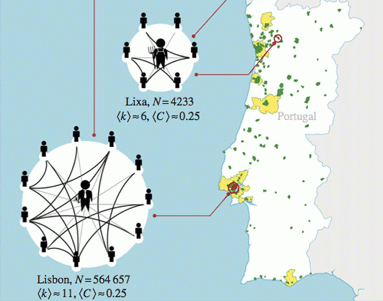
    The MIT Senseable City Lab recently teamed up with a few other research groups to investigate the relationship between human interactions and city size. If you happen to be a member of the Journal of the Royal Society Interface, you can download the full report here. But in true ATC fashion, I’m going to give you the Coles Notes version here.

    What the study did was look at billions of anonymized mobile phone data in both Portugal and the UK in order to determine how our real life social networks change with city size. And what they found is a pretty consistent relationship:

    [T]his study reveals a fundamental pattern: our social connections scale with city size. The larger the town you live in, the more people you call and the more calls you make. The scaling of this relation is “super-linear,” which means that on average, if you double the size of a town, the sum of phone contacts in the city will more than double – in a mathematically predictable way.

    What’s interesting about this finding is that it starts to explain how cities–and the clustering of people–can act as fertile ground for the exchange of ideas and knowledge. The bigger the city the more people you probably know.

    But what I’m curious about (I don’t have the report) is if there’s some kind of upper limit. Presumably this “super-linear” relationship tapers off after a certain city size, because there has got to be limits to the number of people we can maintain productive relationships with.

    According to British anthropologist Robin Dunbar, that number was 150 people.

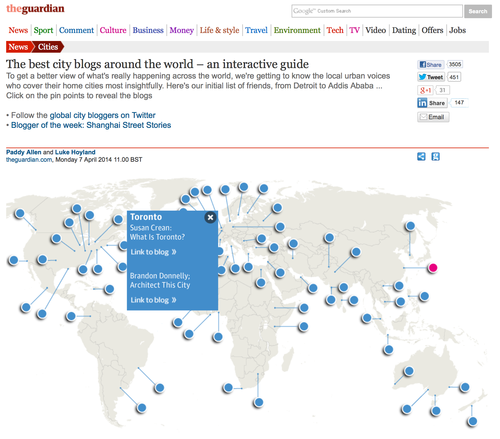
  • The best city blogs around the world

    This morning I’m super excited to announce that Architect This City has just been listed by the Guardian Cities UK as one of ’The best city blogs around the world.’

    There are some great and well known blogs on the list, including The Happy City by Charles Montgomery (Vancouver) and Humans of New York by Brandon Stanton–which went on to become a #1 NYT bestselling book. So it feels good for my fledgling ATC blog to be included.

    A big thanks to the editor of the Urban Times for encouraging the folks over at the Guardian to include it and thanks to everyone who reads ATC. Happy Monday.

  • In the U.K. the average home is only 915 square feet. In the U.S. the average new single-family home is 2,480 square feet.

    Businessweek