Daily insights for city builders, delivered every morning at 6 AM ET. I’m Brandon Donnelly — a Toronto-based real estate developer and founder of Globizen. I’ve been writing here since 2013.
I know I know this, but this is still an alarming chart:
This is saying that, as of 2016, over 36% of Americans were considered to be obese. In Canada, the number was just under 30%. And in the UK, it was just under 28%, which is the highest rate in Europe.
We often talk about the health benefits of living in a walkable community. And there’s lots of research to back up that this is in fact the case: obesity rates tend to be inversely correlated with higher prevalences of active transportation (walking, cycling, and so on).
An increased reliance on cheap, ultra-processed food, which accounts for 57 per cent of what Britons eat according to a 2019 study conducted by researchers at the University of São Paulo, suggests that the health crisis is unlikely to change anytime soon without intervention, argue campaigners.
It can be hard to eat healthy, especially if you don’t have a lot of money and you live a busy life. But in my view, we need to change the course of this graph. And two very good places to start looking would be (1) our built environment and (2) the Japanese diet.
Actually, now that I think of it, Japanese cities would be a good place to look as well.
Last week the Prime Minister of the UK, Rishi Sunak, announced a number of initiatives designed to support drivers. The slogan is “slamming the brakes on anti-motorist measures” and you can find more information about it, over here.
Naturally this is sparking the usual debate about driving vs. all the other forms of mobility. But it also seems to be part of some sort of broader political strategy intended to distance his party from things like environmental sustainability, net zero targets, and 15-minute city design.
If you’re looking for a way to process the above announcement, this recent FT article by John Burn-Murdoch is an excellent place to start. Firstly, the UK (outside of London) is generally poorly served by public transport. This is an important thing to know. By the below measure — percentage of large cities that have trams, a metro, or urban light rail — it is even worse than the US:
In fact, one way to think about and measure mobility in the UK is to think in terms of the following geographic categories: there’s US cities, European cities (including London), and then there’s the rest of the UK. In the case of US cities, they have very clearly optimized around road infrastructure. Meaning, the vast majority of people don’t take transit to work, but the area (km2) you can cover by car (in 30 mins) is high.
Look at Houston and Dallas on the left side of this graph:
On the other hand, European cities (again, including London) have optimized in the opposite direction. A lot more people walk, cycle, and take transit to work. In the case of cities like London, Paris, Barcelona, Bilbao, Prague, and others, the number is greater than 60%! However, they’re sucky places to drive, as I learned this past summer. The area you can cover by car within 30 mins, is relatively low (bottom right of the above graph).
The challenge for British cities (excluding London), is that they seem to be right in the middle (burgundy dots above). Poor public transport (low percentage of trips to work). And poor road infrastructure (limited area accessible by car within 30 mins). So it is perhaps no surprise that Sunak is honing in on this issue. London is not representative of Britain. And based on the above data, the majority of people living in British cities are almost certainly mobility frustrated.
Of course, to correct this issue you have two options. You can move toward the left (in the above chart) and optimize for road infrastructure. Or you can move to the right and optimize for public transport and other forms of mobility. Based on last week’s announcement, Sunak has chosen the left.
There is, of course, part of me that admires what King Charles III has been trying to do in Poundbury (a small master-planned community on the outskirts of Dorchester, England). It is a community that has deliberately rejected the modern suburban in favor of traditional main-street urbanism. It is denser than you’d expect. It has a mix of uses. And it has been generally designed around people, rather than the car.
To live here is to live under Charles’s rules (it is not clear whether William intends to be more flexible). Currently, Poundbury residents are embroiled in a debate about windows: The Duchy says that only wooden sash windows are permitted. Many residents would like to replace theirs with vinyl or fibreglass windows, which are easier to maintain and, crucially, more energy-efficient – and Poundbury is theoretically a ecologically advanced town. So far, the Duchy is not willing to budge.
The last thing I want in my life is someone telling me what kind of windows I can install and what kind of architectural styles are suitable. Messy and organic urbanism suits me just fine.
The UK has something called the National Model Design Code. The purpose of this national code is to provide guidance to local authorities and communities on the production of policies that promote successful design. More specifically, it is intended to help people determine what “good quality design looks like in their area.”
So as part of this, the code wades into subjective things like beauty, attractiveness, and distinctiveness (see above chart). This is an interesting discussion — and a topic in this recent Monocle radio episode — because, at the end of the day, is there really such a thing as universal beauty? Can we all agree on what the most beautifully designed places in the world are?
At the same time, and architect Félicie Krikler points this out in the Monocle episode, there are countless examples of ugly places that are still wildly successful by all other urban measures. Is that okay or should they also be beautiful? And if budgets are tight (they always are), is it better to be a beautiful building or to be a more affordable one? Uh oh.
There is also a temporal consideration. Sometimes the things that were once thought to be ugly are now actually thought to be quite beautiful. Beauty can take time, and places sometimes take time to settle in and find their best uses. This is something that I have written about a few times before on the blog.
All of this being said, I believe wholeheartedly in the importance of beautiful places. And I don’t think we talk enough about it. Too often we get hung up on esoteric planning stuff, even though so many of the places that we love would never meet these same tests. However subjective as it may be, more beauty is rarely a bad thing.
Chrysler announced last week that it will become an all-electric vehicle company by 2028. This is a pretty big deal and, as I understand it, a first for the legacy US automakers. At this point, it now feels difficult to argue that this shift isn’t going to happen. Though I remember lots of people in the past asserting that the masses would never ever switch over to electric.
I guess that’s the status quo bias at work. Because if you flip the script and assume that the status quo is already electric (that is, we all come home after work, plug in our cars, and charge them up at low rates), it would be pretty hard to argue for a switch to gasoline-powered cars. Here, try this new thing. It’ll cost you more to fill up and you get to pollute the environment more. But hey, it sounds cool when you do a cold start.
In the UK last month (December 2021), 41% of new car registrations were electric or some kind of plug-in electric hybrid. That is up from 29% for the same period in 2020 (see above). Pure EVs also make up about 2/3 of these registrations and look to be picking up momentum. That’s certainly what I would expect to see when we revisit these numbers next year. The century of gasoline vehicles is coming to an end and it’s going to happen well inside of this decade.
When I was buying a new car back in 2018, I wanted to buy an electric vehicle. I don’t have a charging station in my parking garage, but I would have gotten one. The problem is that I couldn’t find the kind of car that I wanted in an electric version. And the ones that were available were pretty expensive. That has changed and is no longer the case. If I were buying today, it would certainly be an EV. The car would also have to change colors at the push of a button.
The Kowloon Walled City was once one of the most densely populated precincts in the world. And by some measures, it was. Prior to its demolition in 1993, the Walled City was believed to house some 50,000 people — mostly informally — and was known for problems of prostitution, gambling, and drug usage.
But despite these problems, the Walled City is the kind of urban settlement that fascinates architects, planners, and other city builders. This is partially because it wasn’t centrally planned. There is no individual architect or specific team responsible for its design.
It was, instead, a kind of self-organizing system — both from a built form standpoint and from, I’m sure, a socioeconomic standpoint. And so it is fascinating to see what results when you let that happen on its own.
Here are a series of cross-sections of the Walled City that were meticulously drawn prior to its demolition. They obviously aren’t new, but it is the first time I am seeing them. It is interesting to see everything from mahjong parlors to strip clubs stacked on top of one another in such a confined space.
A team of researchers at UCL recently surveyed 2,500 households across the UK to see how the design of their homes and neighborhoods has impacted their experience during lockdown (May to June 2020).
Perhaps most notably, the report, called Home Comforts, found that people living in housing built in the last 10 years were more likely to feel uncomfortable during lockdown (1 in 5), compared to those living in homes built before 1919 (1 in 7).
On top of this, people living in Victorian era housing were more likely to say that their neighborhoods were meeting their everyday needs, which seems to translate into convenient access to basic amenities (5 to 10 minute walk).
So what does this tell us?
That people want more ornament and clearly defined Zoom-friendly rooms? That the Victorians were better at city and community building? Or maybe that Londoners living in low-rise pre-1919 housing are generally well-established and have the ability to afford more conveniences? It’s likely a bunch of different things.
There’s no denying that the way we build our homes and our neighborhoods has, for better or for worse, changed over the last 100 years. But let’s not forget that it’s easy to romanticize the past and the things we used to do. I’m sure it wasn’t puppy dogs and ice cream for all of the Victorians.
In this January 2018 report from the Fraser Institute, they pegged the average population density of Paris to be about 21,067 inhabitants per square kilometer (2014 population year). It is the second densest city in their report after Hong Kong, but the densest in Europe. By comparison, Vancouver sits at around 5,493 inhabitants per square kilometer (2016 population year).
Now, these are of course city averages. Some neighborhoods will be higher and some will be lower. According to a January 2018 study by Alasdair Rae — who is a works in the Department of Urban Studies and Planning at the University of Sheffield — these are the most densely populated square kilometers across Europe (or at least within the 39 countries that he looked at).
Paris, once again, comes in near the top with a peak density somewhere around 52,218 inhabitants per 1km square. The square in question is in the neighborhood of Goutte D’Or. And the only square within the study to come in denser is one from the L’Hospitalet de Llobegrat in Greater Barcelona (53,119 inhabitants per square kilometer).
Now let’s take a look at how these sorts of densities actually manifest themselves. Below is an aerial capture from Google Maps showing a section of Goutte D’Or in Paris. The buildings are all pretty much 7 storeys (mid-rise), but the blocks are mostly filled in. Lots of interior courtyard apartments. This is one way to get to over 50,000 people per square kilometer.
Returning to Vancouver as a point of comparison, below is an aerial capture from downtown Vancouver at exactly the same scale as the Paris capture. I couldn’t find a density map of downtown, but it’s probably safe to assume that it’s greater than 5,493 and a lot less than 52,218 residents per square kilometer.
What you see here is typical Vancouverism. Lots of slender point towers, careful tower positioning and spacing, and generally low podiums. It is a perfect demonstration that height and density do not necessarily correlate. It is possible to have low buildings and high density, which is something that Europe obviously does very well.
But here’s the important question: In which of these two examples would you rather live? Please leave a comment below.
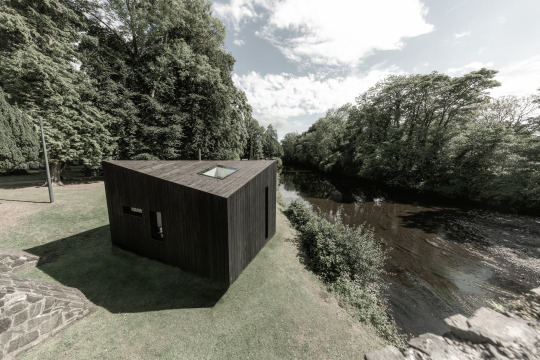
Johnathon Little (husband) and Zoe Little (wife) recently launched a new housing concept out of the UK called Koto, which is supposedly Finnish for “cozy at home.”
(Before Koto, Johnathon worked for Snohetta in Oslo.)
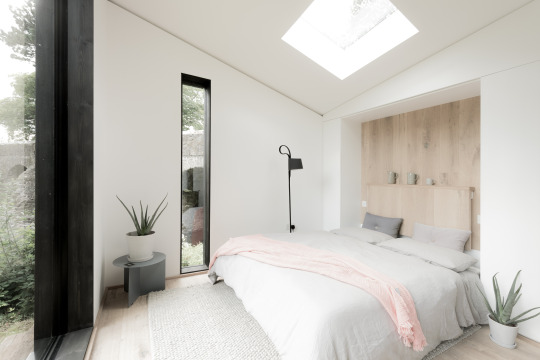
The goal of the company is to create beautiful, small, and prefabricated houses and cabins that allow people to connect with nature.
It is inspired by the Nordic concept Friluftsliv. The literal translation is “open air living” but, more specifically, it is about the benefits of nature on our mental and personal wellbeing.
Their small cabin has a footprint of 15 square meters and their large cabin has a footprint of 40 square meters. Base prices run from about £33,500 to £63,500. A bathroom is optional.
The most obvious use case for me is that of a bunkie. For more on Koto, check out their website and Instagram.
A condo developer friend of mine once told me something along the lines of this: “Brandon, I have generally learned over the years that if I like something, it probably means the general public [our purchasers] isn’t going to like it. And that’s because if I like it, there’s probably something unique or quirky about it.”
When he told me this it made perfect sense to me, because there’s a well documented taste divide that seems to exist between architects and design-types and non-architects and non-design-types (whatever this latter categorization means).
A few years ago The Architects’ Journal published an article referencing a 1987 study that took a group of students – some architecture students and some non-architecture students – and asked them to rate the attractiveness of a series of photos containing both unfamiliar people and buildings.
What they discovered was that most people had similar views on the attractiveness of the people. I guess hotness is somewhat universal. But when it came to the buildings, the viewpoints were completely opposite. The architecture students’ favorite buildings were what everyone else disliked the most.
The conclusion in the article: “Professionals are, empirically, the very worst judges available of what people want or like in the built environment.”