Daily insights for city builders, delivered every morning at 6 AM ET. I’m Brandon Donnelly — a Toronto-based real estate developer and founder of Globizen. I’ve been writing here since 2013.

Tag: $uber

  • Tech Tuesday: Uber testing out “Smart Routes” in San Francisco

    Uber is currently testing out something called “Smart Routes” in San Francisco.

    Basically it works similar to UberPOOL (where you carpool with strangers to bring the cost down), except that your pickup location (and trip?) is confined to a specific route. 

    This means less detours and more rides for drivers, as well as even cheaper fares for passengers. But just like public transit, you’ll likely have to walk a few minutes to get to the closest route. 

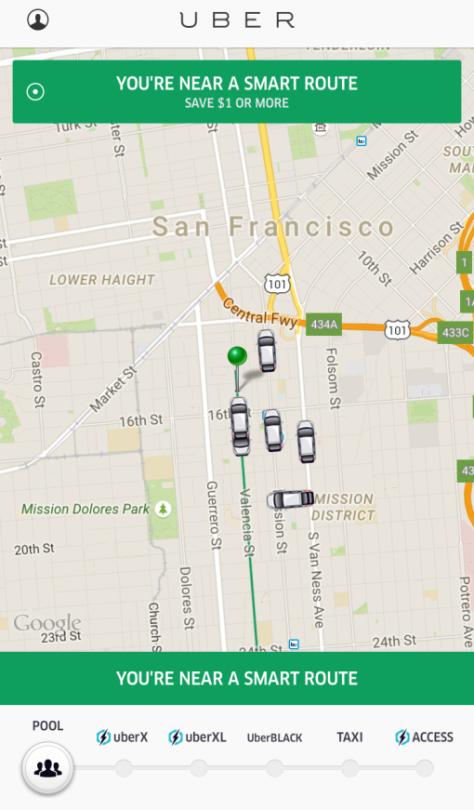
    Here’s a screenshot of what that looks like (via TechCrunch):

    The green line is the “Smart Route.” So all you have to do is select a pickup location somewhere along that green line, and you’ll save a bit a money. Currently it’s “$1 or more” off your fare, but who knows what it might be when this feature actually rolls out.

    This is fascinating to me because it’s starting to look and feel a lot like a conventional bus route. But in this case, the routes can change and new routes can be easily created as demand changes. 

    So it’s not just taxis that need to be thinking about Uber. It’s public transit authorities as well.

  • The taxi cartel

    https://500px.com/embed.js

    Early this morning Peter Cheney of the Globe and Mail published an article called: How Uber is ending the dirty dealings behind Toronto’s cab business.

    And I highly recommend you read it. He’s been investigating this industry for decades.

    Though the article is specific to Toronto, I know that there are middle people and archaic policies governing the taxi industries in many other cities around the world.

    Here it revolves around taxi licenses issued by the city (known as “plates”), which are expensive and almost impossible to get. Last year the average price of a plate was $118,235 (2014).

    The way it works is that people – typically non-drivers – buy/inherit/get these plates and then charge rent on them to drivers who want to use them. The result is a taxi cartel:

    In fact, Toronto’s taxi plate system is anything but free enterprise. Instead, it is based on the artificial restriction of a natural market, and the granting of licences to a fixed number of participants. Even those who paid top dollar for a plate used to enjoy an annual return of more than 12 per cent. And for those who inherited plates, the return was manna from heaven.

    So it shouldn’t come as a surprise that the taxi industry is grouchy about companies like Uber. But the cost structure of the incumbents is going to need to change if they want to stay in business.

    Jeff Bezos of Amazon is famous for saying, “Your margin is my opportunity.” And that’s exactly what is happening here. A bloated legacy cost structure is being quickly supplanted by better/cheaper.

  • The evolving gig economy

    This morning venture capitalist Fred Wilson wrote a post on his blog talking about the gig economy and Hillary Clinton’s economic speech last night. 

    Here’s a snippet from Clinton’s talk:

    Meanwhile, many Americans are making extra money renting out a small room, designing websites, selling products they design themselves at home, or even driving their own car. This on-demand, or so-called gig economy is creating exciting economies and unleashing innovation.

    But it is also raising hard questions about work-place protections and what a good job will look like in the future.

    So, all of these trends are real and none, none is going away. But they do not determine our destiny. The choices we make as a nation matter. And the choices we make in the years ahead will set the stage for what American life in the middle class and our economy will be like in this century.

    The headlines this morning are making it seem like Hillary Clinton is taking direct aim at companies like Uber. But the transcript suggests that she’s being far more balanced than that: these new companies are creating exciting opportunities, and they are not going away, but there are still things to figure out.

    That’s basically how I feel.

    Take, for example, Airbnb. I think Airbnb is a great idea and company. A lot of my friends use it both as consumers and as suppliers of space.

    But for many (most?) condos in Toronto, owners are strictly prohibited from renting out their units on leases that are less than six months. It’s a direct ban on short-term leasing and it’s written into the Condo Corporation’s Declaration.

    And there’s good reason for that. Who wants to buy a condo only to find out that next door is being operated as a nightly hotel? Most people would even prefer that their neighbor is an owner rather than a renter.

    That doesn’t mean I believe Airbnb should not exist. I think we’ll likely end up getting more transparent about how buildings (and portion of buildings) are operating, as opposed to it being a shadow economy. And that could help.

    If you have any ideas for how companies like Airbnb might be better integrated into urban life, I would love to hear from you in the comment section below.

  • 10 reasons to visit Toronto right now

    https://500px.com/embed.js

    Next weekend a good friend of mine from architecture school will be visiting Toronto from Philadelphia. And I’m really excited to show him the city. (Next month it’s my turn to go to Philadelphia.)

    He’s a fellow city geek. He hasn’t been to Toronto in a number of years. And I haven’t seen him since our trip to Detroit 2 years ago.

    For those of us living and working in Toronto, there’s a lot to celebrate. Sure the Gardiner Expressway East decision didn’t go as I – as well as many other urbanists, including our Chief City Planner – had hoped. But there’s no shortage of other things to brag about.

    So here are 10 reasons to visit Toronto right now:

    1. We’ve created an entirely new business district south of Union Station called South Core. Now the region’s primary mobility hub is in the middle of the country’s most important business district, as opposed to on the edge of it. It’s a better use of infrastructure.

    2. We now have a dedicated train (the Union Pearson Express) that takes you from the country’s busiest airport directly to downtown in 25 minutes. You’ll find local retailers at the stations and a brand created by the brain behind Monocle Magazine. You can even use a smart card to ride it and our local transit system.

    3. We didn’t shut down Uber. Instead our mayor wants to create new policy that will allow these services to coexist with conventional taxi services. We don’t yet know how this will turn out, but I believe it’s a step in the right direction. It’s Toronto taking a leadership approach to innovation as opposed to trying to stomp it out.

    4. We are about to host the largest sporting event in Canadian history. The 17th Pan American Games will have double the number of athletes competing as the 2010 Winter Olympics in Vancouver.

    5. We created an entire neighborhood from scratch in order to house all of these athletes (Canary District). And I think it’s destined to become one of Toronto’s great neighborhoods. I’m saving my first visit for next weekend, so expect a follow-up post on this.

    6. We are dramatically rethinking this city’s public realm. From the plaza out front of Union Station to the new Queens Quay Boulevard along the waterfront, we are prioritizing people and creating more complete streets. It has given Toronto an entirely new urban feel.

    7. We are slowly starting to embrace our forgotten laneways and alleys through the help of organizations like The Laneway Project. And this is going to eventually lead to a further rethink of our pubic spaces and urban fabric.

    8. We continue to be one of the fastest growing cities in the world (certainly in the developed world). As a result, we are building some really exciting buildings by some of the top architects in the world. This includes everyone from Norman Foster to Frank Gehry.

    9. According to a recent report coming out of the Martin Prosperity Institute, Canada is one of the most creative and globally competitive countries in the world, as well as the most open to “ethnic and religious minorities and gay and lesbian people.”

    10. The ATC community is in the process of identifying a new, quintessentially Toronto food dish. But since we have every type of imaginable cuisine here, we’re struggling to pick just one. When you visit, you can help us identify the best and most Toronto dish.

    So there’s a lot to be excited about. I for one can’t wait for us to host the Pan Am Games, starting tomorrow. It’s a chance to show off this great city. 

    So if you’re also in town next weekend and want to geek out about cities, drop me a line.

  • 7 ideas and lessons for global cities

    Today I had the pleasure of attending a really great talk by Joe Berridge (partner at the planning firm Urban Strategies) that was all about how Toronto can best maintain its position as a globally competitive city. 

    He went through 7 ideas/lessons. Though they were specifically aimed at Toronto, most of them could be applied to any city that’s concerned about its position on the global stage. They are:

    1. Invest in infrastructure, such as transit, airports, and so on. Sustainable funding and proper governance are critical. Transit planning in Toronto has become far too political and it’s crippling our city.
    2. Embrace Uber and get them using our Presto card so that it becomes a legitimate part of the city’s public transit network. Every city in the world is battling with Uber. Toronto has the opportunity to take a leadership position.
    3. Build a new convention centre and invest more in tourism and economic development. Berridge’s suggestion was something big at Ontario Place/Exhibition Place.
    4. Build new Universities to fuel the knowledge economy. See New York’s Cornell Tech campus as an example.
    5. Invest in infrastructure and institutions that turn research and development into businesses. Platforms like MaRS.
    6. Start thinking big. This was specifically geared towards Toronto, as his argument was that we do a lot of the small things right, but we’re missing out on the really big opportunities.
    7. Create Suburban Enterprise Zones to help drive employment outside of the core and along new transit corridors.

    Alongside these ideas and lessons, there was a fascinating sub-argument. And that is that Toronto is really an accidental global city. In other words, we didn’t set out to become a top 10 global city and one of the fastest growing cities in the developed world.

    But by getting a lot of things right – such as a high quality of life – and through a bit of luck – such as Montreal shooting itself in the foot – we somehow became one. But we absolutely shouldn’t take that for granted. There’s lots of work to be done.

  • Imagining the way things could be

    Photograph Old in new by Andrew Johnston on 500px

    Old in new by Andrew Johnston on 500px

    I was out for lunch with a colleague of mine yesterday afternoon and he said to me: “Brandon, I’m really surprised that you’re so interested in technology. It just seems so different compared to real estate and architecture.”

    And I’ve certainly heard that exact same comment from a number of people before. But I don’t see it that way and here are a few reasons why.

    The common thread for me between architecture, real estate development, and technology is that in all of these cases it is about imagining the way things could be in the future and then creating it. It’s about change. It’s about growth. It’s about creation. And I consider myself a builder in practically every sense of the word.

    At the same time, each of these disciplines is about creating engaging spaces for people. Architects and real estate developers do it in the physical world, but many technology products strive to do exactly the same thing in the online world.

    In fact, a couple of years ago I was fascinated to learn that Facebook has and continues to draw inspiration from many of the same books and philosophies that architects, planners, and developers rely on when it comes to creating engaging communities. The medium might be different, but it’s still about people.

    Finally, as I’ve said many times before here on Architect This City, I think that the distinction between tech and non-tech companies and industries is quickly evaporating. Is Airbnb a tech company or a hospitality company? Is Uber a tech company or a taxi company? Pretty soon we’ll be saying that about many other industries.

    Maybe it’s because I’ve always been interested in wading through the overlaps between disciplines, but this is just the way I see it.

  • “Project Snowball” cracks down on UberX drivers in Toronto

    https://500px.com/embed.js

    This afternoon I saw on Twitter that Toronto Police are now starting to crackdown on UberX drivers in the city. The investigation is called “Project Snowball” and they have already charged at least 11 people. The fines are anywhere from $200 to $20,000.

    My response on Twitter was the following:

    I get that Uber is a highly disruptive company. I’ve written about it many times before. But at the end of the day, this is not just about Uber. This is about a larger shift in the economy.

    The buzz term is “sharing economy.” But one of the ways I like to think about it is like so: Facebook doesn’t produce any of its own content, and yet you could define it as a media company. Airbnb doesn’t own any rooms, and yet it is disrupting hotels. Uber doesn’t own any cars or plates, and yet it is disrupting the taxi industry.

    What’s happening is that the internet and mobile phones are allowing for peer-to-peer connectivity and more decentralized forms of marketplace supply.

    What does that mean?

    It means that instead of having a fleet of cars or a centralized hotel building, anyone with an extra car or an extra room (and an internet connection) can plug themselves into the market. And that represents an entirely different cost structure for businesses.

    It’s worth noting that prior to Uber, Travis Kalanick founded a peer-to-peer music sharing company called Scour (1998). Its closest equivalent would have been Napster. Remember Napster? This is not a new trend.

    That said, I still think we’re at the early stages of this shift. I predict that many other industries will see disruptors similar to Airbnb and Uber. And so when I look at it in this context, I have a hard time believing that fining UberX drivers is the most enlightened way forward.

    I believe we should instead be taking a leadership position and trying to figure out how to adapt our rules and regulations to this changing economy. Toronto is not alone in this battle. But we could certainly be the one to lead the way out.

  • How Uber is driving down the cost of transportation

    A few days ago, Bill Gurley – who is an investor in Uber – wrote a really fascinating blog post called, Uber’s New BHAG (Big Hairy Audacious Goal): UberPool. Bill doesn’t update his blog very often, but when he does it’s incredible stuff.

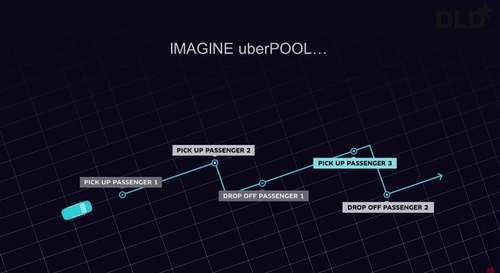
    I’ve touched on UberPool briefly before. But basically it’s a true “ride sharing” service where people with overlapping routes can easily share the same car – much like people do today informally. The obvious advantage of this is cost. It’s cheaper to share.

    image

    What’s most fascinating about this service though is how it fits into Uber’s larger mission to drive transportation costs down. And there’s a specific reason for that (via Bill Gurley):

    When Uber launched its low-cost UberX offering in the summer of 2012, the company quickly realized that the demand for its transportation services is HIGHLY elastic. As the company achieved lower and lower per-ride price points, the demand for rides increased dramatically. A lower price point delivered a much better value proposition to the consumer, yet still remained a great business decision due to the remarkable increase in demand.

    So what Uber quickly figured out was that if they could increase the utilization rate for drivers (the time actually spent with passengers), they could charge consumers lower prices while at the same time maintaining driver salaries. Prices went down, but volume went up.

    One way to do that is to obviously decrease driver downtime by improving liquidity on the marketplace. But another way is to simply increase the number of passengers being transported at one time. Hence the creation of UberPool.

    But it doesn’t stop there.

    Because of all the transportation data that Uber now has (the company has a data group called the “math department”), they can fairly accurately predict what a price cut will do to their ridership levels. This allows them to “forward invest” their capital in new services – such as UberPool – before they even have the revenue from the anticipated increase in ridership.

    So what does this all mean?

    It means that Uber is going to get cheaper and cheaper and cheaper. Uber is trying to get to what they call “The Perpetual Ride”, which basically means that drivers will always have customers (100% utilization). That’s quite a goal, but it would mean the absolute lowest prices for consumers (barring any other changes to their cost structure). 

    Dirt cheap transportation is a pretty compelling value proposition, which is why I continue to believe that cities should be hard at work trying to figure out how to harness this transportation shift.

    If you’re interested in this topic, I would encourage you to give Bill Gurley’s blog post a read.

  • Marginal cost = 0

    Earlier this week I wrote a post called: The pull from services to products. And in it I made mention of the fact that part of what’s driving this pull towards products is that the marginal cost of servicing additional users or customers is almost nothing in a world of internet services and products.

    Well the reality is that this phenomenon is driving a hell of a lot more. It could – and probably will – fundamentally change almost all aspects of the economy.

    I know that sounds like a pretty audacious statement, but if you watch the following 10 minute talk by Albert Wenger (Union Square Ventures) you might start to feel the same way. He outlines 5 changes being driven by the fact that in the digital world, marginal cost = 0. The impacts go well beyond tech, capturing sectors such as transportation and industrial real estate.

    [youtube https://www.youtube.com/watch?v=sVEtTzlqsoE?rel=0]

    If you can’t see the video, click here.

  • Engaging with the sharing economy

    image

    Last week I wrote (yet another) post about Uber where I argued that leading cities will be the ones that engage with the sharing/rental economy (as opposed to try and outright ban it) and that Uber is going to continue to impact current beliefs around vehicle ownership.

    As to be expected, some people agreed with me and some people didn’t:

    //platform.twitter.com/widgets.js

    But I also discovered following that post that there are groups, and hopefully cities, who are working to adapt to the changing realities brought about by disruptive innovation.

    One of those groups is The National League of Cities – which I truthfully don’t know that much about. But they have created something called “The Sharing Economy Advisory Network.”

    “Cities across the country have been struggling to respond to the rapid emergence of the Sharing Economy,” said Clarence Anthony, National League of Cities executive director. He continued, “Cities are looking for ways to update and improve their current regulatory framework to ensure that regulations like safety and health protect residents, while at the same time supporting the growth of new businesses. It is imperative for cities to learn how this industry operates and discover ways to engage in order to support these new modes of doing business and to create jobs.”

    It sounds like the right kind of initiative and I wish them lots of success. I hope it’s effective and I hope that Toronto will look at how it too can properly manage these economic changes. This is going to take both the private and public sectors working together.

    Image: Sidecar