
Daily insights for city builders, delivered every morning at 6 AM ET. I’m Brandon Donnelly — a Toronto-based real estate developer and founder of Globizen. I’ve been writing here since 2013.

Tag: trump

  • This is not right

    I have largely avoided commenting on politics and Trump on this blog, but at this stage it is almost impossible to do that.

    Donations are starting to pile up for the American Civil Liberties Union (ACLU) as the tech community, and many others, begin to respond to Friday’s executive orders. Lyft announced a $1 million contribution to the non-profit group.

    Today, venture capitalist Fred Wilson wrote: Make America Hate Again. And yesterday, his business partner Albert Wenger wrote: Misleading the World on Immigration.

    At 6 AM this morning, Richard Florida started a tweet storm where he argued that “Trump’s immigration insanity” will fundamentally threaten the core of America’s innovation hegemony. 

    (He also argued that Canada, and more specifically Toronto, serve to “gain substantially”, as there will no doubt be a doubling down on tolerance to attract the best talent from around the world.)

    The Canadian tech community penned an open letter to reinforce the message that, here in Canada, diversity is our strength. This echoes similar messages from Prime Minister Justin Trudeau and Mayor John Tory.

    Mass protests have broken out at US airports (links to photos) spanning San Francisco to New York. 

    And I am seeing folks from Toronto offer up their homes (publicly on Twitter) to anyone who might be stranded at Pearson International Airport as a result of the orders. Many have even tweeted out their phone numbers.

    Everywhere I look this weekend I am seeing these sorts of messages. So while I could remain quiet, that doesn’t feel right. And that’s because what is happening is not right.
  • Trump

    Many of us are living in a bubble.

    Since Donald Trump won the election less than 24 hours ago, it feels like everything has already been said. It’s been non-stop. My social feeds have been filled with everything from frustration and anger to Canadians offering marriage to the highest bidders. (Obviously tongue-in-cheek?)

    I didn’t think Trump would win the election, but he did. I also didn’t think Brexit would happen, but it did.

    Part of the reason I thought this is because nobody seemed to be supporting Trump. My friend graph was virtually 100% Clinton (and vehemently opposed to Trump). The media I consume – Globe and Mail, New York Times, Twitter feed (interest graph), and so on – was virtually 100% Clinton. And the polls told us that would be the outcome.

    But what I just described is – now quite obviously – a filtered view of the world. I was thinking within my own little bubble and I was wrong. The number of biases at work here are numerous.

    Firstly, it has been well documented that we prefer to associate with people that are most similar to ourselves. It gives us comfort when someone shares the same religious views, sports-team loyalty, education level, socioeconomic status, and so on. And you see this in cities. We cluster in so many different ways.

    Secondly, we often privilege information that reinforces our own view of the world (see confirmation bias). We believe what we want to believe. Here is an excerpt from an op-ed in the New York Times this morning that stood out for me

    (see, I’m again reading the same media):

    “The silence in this great city, a stronghold of Clinton and the Democratic Party, is revealing: The elites of the East and West coasts, betraying a dangerous arrogance, were dismissive and ignorant to the last of the heartland anger feeding Trump’s rise.

    This is the revenge of Middle America, above all of a white working-class America troubled by changing social and cultural mores — not every American loves choose-your-gender bathrooms — and by the shifting demographics that will make minorities the majority by midcentury.”

    Thirdly – but probably not lastly – I wouldn’t be surprised if we saw the social desirability bias play out here. It is possible that many people simply did not want to openly admit that they were supporting Trump. And they perhaps responded that way in the polls. But privately, when it came time to vote, they went with what resonated most.

    I say all this simply to suggest that now is not the time to get angry. Now is the time to open our eyes and pay attention to our rapidly changing world. Globalization and technology are transforming what we know and it is not benefiting everyone equally – far from it. Trump overwhelmingly won the support of white people without college degrees; people who are feeling left behind.

    This divide is real.

  • Introducing YOO Architecture

    Back in 2006 when I was fresh out of architecture school and looking for work, I knocked on the door of a design company based in London with my polished resume in hand. I was sleeping on a friend’s couch at the time and the company seemed like a perfect fit for me – so I went for it.

    There’s no happy ending to this story though – because I didn’t get past the front door that day – but there’s never any harm in trying. As my friend told me the morning I went: fortune favors the bold.

    The firm I visited that day is called YOO.

    They call themselves “a residential and hotel design company”, but their model is actually more unique than that. Founded in 1999 by John Hitchcox (a property developer) and Philippe Starck (a rockstar designer), the firm partners with local real estate developers around the world and creates value through design, branding, and marketing expertise – as well as through celebrity names like Philippe Starck and Jade Jagger.

    They did one project in Toronto with local developer Peter Freed called 75 Portland.

    What makes their model interesting is that, unlike the real estate developers they partner with, they’re not assuming the same level of risk (unless, of course, they co-invest). They get paid (well) for the design services and marketing expertise they provide, as well as the brand equity that they bring.

    This is similar to what Donald Trump does with some (most?) of his developments now. Want the Trump name on your building? Pay $X. Want Philippe Starck at your condo sales launch? Pay $Y.

    When I was in architecture school, I used to wonder why we didn’t talk about the importance of branding and marketing. I thought we should. Which is probably why I ended up in business school afterwards.

    I think there’s a lot of potential in overlaps and hybrid business models, which is why I was excited to learn today that YOO has just launched a new architectural practice called YOO Architecture.

    You can read more about it here.

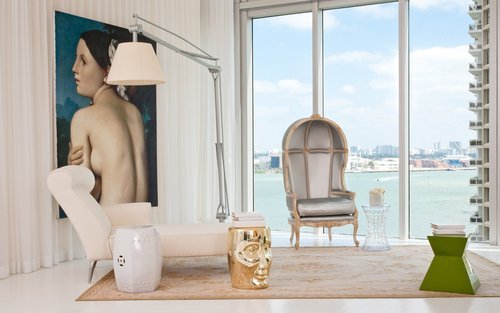
    Image: Icon Brickell, Miami via YOO

  • Trump Vancouver