Daily insights for city builders, delivered every morning at 6 AM ET. I’m Brandon Donnelly — a Toronto-based real estate developer and founder of Globizen. I’ve been writing here since 2013.

Tag: trump

  • The growth of branded residences

    A branded residence is, as the name suggests, a residential building with a known branded attached to it. Historically, these have tended to be hotel brands. But it really just needs to be any brand that people know, care about, and will pay a premium for. So it could also be a fashion brand, a car brand, or whatever else.

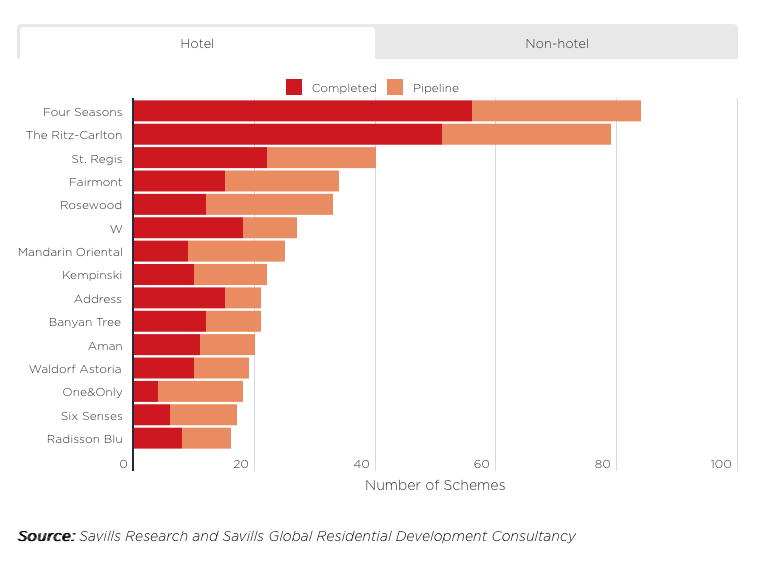
    This is a growing segment of the residential market. According to UK-based Savills, there were only 15 or so of these “schemes” in the 1990s (the UK uses scheme in lieu of project, which always sounds conniving to me), but by the end of this decade they expect the pipeline of branded residences to exceed over 1,200.

    I would also argue that projects designed by celebrated architects and/or designers are a form of branded residence. And this is not being captured in Savills’ number above.

    Whatever your definition, today, the branded residence capital of the world seems to be Dubai, which feels right. And the biggest brands, by what appears to be a long shot, are Four Seasons and Ritz-Carlton (hotel side), and YOO and Trump (non-hotel side). Here are the full rankings from Savills:
    This is an interesting part of the real estate business for a few reasons. One, it makes sense. A New Balance shoe that gets co-branded with Aimé Leon Dore unlocks additional value for both sides. ALD has a brand that certain people care about. So, of course the same would be true of real estate paired with the right brand.

    Two, it’s a growing market, and I think this is aided by the fact that development is an intensely local business — so it can be hard to grow a globally-significant brand on your own. Sometimes you just need to borrow someone else’s.

    And three, it’s usually a less risky approach to getting your name on buildings. Branded residences typically operate on a licensing model, which means developers pay for the right to use the brand. The brand may also capture some of the upside in the form of a percentage of sales. That’s less risky than putting up your own money.

  • Does every real estate developer really do this?

    I am not a lawyer. Nothing I write on this blog should be construed as legal advice. In fact, it is highly questionable whether anything I write here should be construed as any sort of advice. Still, Trump’s fraud trial is an interesting one for us to discuss. The case, as I crudely understand it, accuses him of “inflating his net worth to dupe banks” and “issuing false financial statements every year between 2011 and 2021.” And possibly some other things, too.

    Now there are some people who are saying that there’s nothing actually wrong with the way Trump conducts his real estate practice. Kevin O’Leary, for instance, was just on CNN saying, “every real estate developer everywhere does this.” His position was that if you’re going to fault Trump, then you need to go after every developer out there. Here’s the video interview where he says this:

    Let’s break this down. Kevin is right in that people who own real estate ordinarily want it to be worth as much as possible. This is true for individual homeowners and it’s true for large real estate companies. And there are various reasons for this. One reason is that it maximizes your debt proceeds. For example, if you buy a building for $100 and the banks are willing to give you a loan based on a LTV (loan-to-value) of 70%, then you will get $70 in debt proceeds and you will need to put in $30 of your own cash equity.

    However, if you buy a building for $100 and it ends up being worth ~$143, then this same 70% LTV will result in $100 of debt proceeds. This means that you won’t need to put in any of your own cash and that, for all intents and purposes, you just got a building for “free.” By most metrics, this would be considered a good real estate deal. (Of course, you could also buy a building for $100 and have it be worth only $50. And this would be much less fun than getting free real estate.)

    One important question, though, is how does the building end up “being worth $143?” Well, one scenario could be that you just bought really well. It was an off-market transaction (i.e. it wasn’t formally listed), the seller was highly motivated, and so you negotiated a below-market purchase price. You then went out and hired a reputable third-party appraiser who did a bunch of rigorous research and issued you a report that said, “your building is worth $143.” And this would be perfectly fine.

    But one can also imagine ways in which someone could lie and do nefarious things to try and convince people that their building is worth $143, even if it clearly isn’t. Now, at the end of the day, I don’t know the facts of this case. So I can’t comment directly. But I did want to use this as an opportunity to add some nuance to Kevin’s claim that “every real estate developer everywhere does this.” Ultimately, that depends on what “this” is. Are we talking about doing customary things to maximize value creation? Or are we talking about fraud?

  • Biden revokes Trump’s executive order encouraging classical architecture

    This week it was announced that US president Joe Biden has revoked a number of Presidential Actions, one of which is Executive Order 13967 — Promoting Beautiful Federal Civic Architecture.

    Signed on December 18, 2020 by former president Trump, the order, which I wrote about last February, encouraged the use of “classical and traditional architecture” for all federal buildings.

    Part of the argument was that too many buildings are being made for only architects to appreciate. This includes, you know, modern architecture and styles like brutalism.

    Well that order has been revoked and that means that “beautiful” federal civic architecture is now free to be anything it wants. Look to the past, look to today, and/or look to the future.

    This is the way things should be.

  • Counties won by Biden generated 70% of America’s GDP in 2018

    Here is an interesting look at the economic geography of the recent US election. Similar to what they did for the last presidential election, Brookings has just analyzed each candidate’s aggregate share of US GDP broken down by the counties that they won. That’s what the above diagram represents. The blue and red tiles are showing the relative size of each county’s economy.

    In 2016, Clinton won 472 counties with nearly 66 million votes. These counties accounted for about 64% of US GDP at the time. Trump, on the other hand, won 2,584 counties with nearly 63 million votes. But these counties represented only about 36% of US GDP. (Note that Trump won the election with fewer total votes. This is the electoral college at work.)

    When Brookings published the above findings, votes were still outstanding for 11 counties. Most of them low-output. Still, Biden has won 477 counties with well over 75 million votes. These Democratic counties now account for about 70% of overall US GDP. Virtually every big economy county went to Biden in this last election. Los Angeles, New York City, Chicago, and so on.

    This is a big deal because it shows the great economic divide that exists in the US, as well as in many (most?) other countries around the world. This is the urban vs. rural divide. Places with very different economic bases and, therefore, very different sets of priorities.

    Diagram: Brookings

  • The Trump family real estate empire

    He is tall, lean and blond, with dazzling white teeth, and he looks ever so much like Robert Redford. He rides around town in a chauffeured silver Cadillac with his initials, DJT, on the plates. He dates slinky fashion models, belongs to the most elegant clubs and, at only 30 years of age, estimates that he is worth “more than $200 million.” 

    Judy Klemesrud, New York Times, 1976

    Last week the New York Times published a special investigation looking at the Trump family’s real estate empire and the suspect tax schemes that they allegedly employed over the years to preserve, grow, and pass it down. 

    According to the Times, all of which has been rebuked by a lawyer for the president, Donald Trump received at least $413 million in today’s dollars from the family empire. 

    I just finished reading the investigation in its entirety. It’s a long one. But if you’re interested, you can do the same here. If you’d prefer the Coles Notes version (Cliff Notes for you Americans), have a scroll through the headlines in this article instead.

  • Winner take all, or most, economy

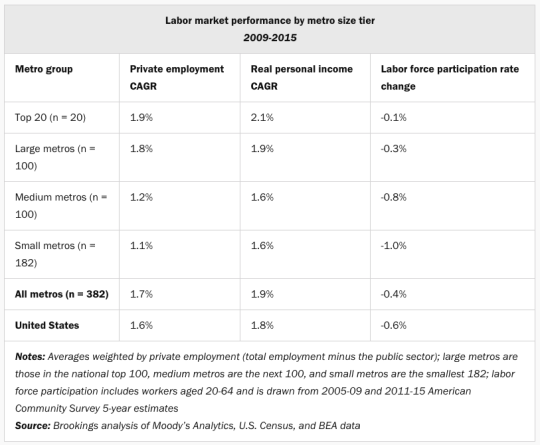
    The world is increasingly spiky. Inequality is growing and it is increasingly geographic in nature. We know that people tend to make more money in urban areas compared to rural areas – even when they possess the exact same level of education. The returns to being smart and educated are simply greater in cities.

    But they also depend on the size of the city. Mark Muro and Jacob Whiton of Brookings recently published data looking at labor market performance – by metro size – from 2009-2015 (right after the financial crisis). What they found is that larger metropolitan areas simply performed better than smaller ones.

    image

    In summary:

    City size matters because it’s a major influence on city prosperity and adaptability as well as local worker fortunes. Bigger cities are more productive. They are more innovative. They draw better-educated workers by offering higher wages.

    The situation is even more pronounced across the pond. According to the New York Times (quote from Richard Florida), a third of Britain’s gross domestic product comes from London alone.

    What is far less clear is what should be done to address the decline of some of the smaller cities in America – cities that are stagnating and feeling left behind. But perhaps the first step is acknowledging what has happened and what remains feasible in today’s global economy.

    Here is another quote from the above NY Times article:

    Mr. Trump’s promise to relieve the pain by reviving the coal and steel industries, by keeping immigrants out of the country and by raising barriers against manufactured imports is only a rhetorical balm to satisfy an angry base seeking to reclaim a prosperous past that is no longer available.

    That rhetorical balm.

  • How to make money with low-risk licensing deals

    image

    This morning the Toronto Star published a detailed autopsy of the failed Trump International Hotel and Tower Toronto. It outlines the players, the investors, and what supposedly went wrong. Of course, the headline is all about how Trump managed to make money from the deal – through his well-publicized licensing business – even though the project went bankrupt.

    At the beginning of this year, the Washington Post reported that Trump’s name had been licensed and linked to over 50 properties and that these contracts have earned him at least USD$59 million in revenue. Outside of the US and Canada, the Trump Organization has (or had) deals in Brazil, Turkey, Azerbaijan, India, Indonesia, the UAE, and so on.

    There would have been more money to be made in the actual development of these properties, but the beauty of these licensing deals – for Trump – is that they are “low-effort, low-risk, high-reward.” In fact, this past summer it was reported that the breakup fee at Trump Toronto – the fee to exit all contracts with the Trump Organization – was at least $6 million (guessing that’s in USD).

    This story is not unique to Toronto. And so I have got to believe that there’s major brand dilution happening here. Does the Trump name really bring credibility to projects in some markets? How sustainable is this licensing business? 

    The only other thing that I would add to the Toronto Star article is that the hybrid condo-hotel model has proven to be difficult in this city. It’s perfectly fine to have residential condos and a hotel in one tower. There are lots of successful examples of those. But when the condo units can be put into a hotel pool (and there’s an IRR expectation on the part of individual owners), many seem to have been disappointed.

    Part of the challenge with this model here in Toronto is that the condo-hotel units typically end up with a commercial property tax rate, which, in this city, is much higher than the residential rate. This can suppress values.

    Photo by NeONBRAND on Unsplash

  • How Trump’s tax plan would impact the mortgage interest deduction

    image

    In the US you can reduce your taxable income by deducting the mortgage interest you pay toward your principal residence. You can’t do this in Canada, at least not on the property where you live.

    However, there are limitations. It is capped at loans up to $500,000 or up to $1M if you’re married and you file jointly. On the other end of the spectrum, you also need a loan big enough such that an itemized deduction will save you more money than the standard deduction.

    Not surprisingly, the MID is popular among homeowners. And from a public policy standpoint, one of its selling features is that it’s supposed to stimulate homeownership. But many have argued that it doesn’t actually do this – it unequally benefits people with larger mortgages. (Canada has a higher homeownership rate than the US.)

    Right now it looks like you need to buying a home worth at least $305,000 in order for the mortgage interest deduction to make economic sense for you. Again, if your loan isn’t big enough, you’re simply going to opt for the standard deduction. 

    In 2015, about 22% of all US taxpayers opted to take advantage of the MID. According to Zillow, only about 29% of all homes in the US are valuable enough for the MID to actually make sense. Though in some cities, like San Francisco, it’s pretty much all of the homes. Of course.

    Zillow also recently looked at what the recent tax reforms put forward by the Trump Administration would mean for the MID and the real estate market

    One of proposed changes is a doubling of the standard deduction. What this means, based on Zillow’s math, is that you would need to be buying a home worth at least $801,000 today for the MID to make sense. This also means that the deduction would now only benefit about 5% of all homes in the US.

    This would seem to only exacerbate the criticism that the MID does not in fact stimulate homeownership in the segment of the market that needs it the most. But perhaps this is the only politically palatable way of removing it – gradually.

    Photo by Erol Ahmed on Unsplash

  • Is Trump good for Canada?

    Richard Florida and Joshua Gans just published an article in Politico called: Trump Is Making Canada Great Again. The overarching argument is that as the US closes its borders, Canada benefits. The best and brightest from around the world are coming here.

    This fall, international student applications at the University of Toronto were up 70% compared to last year. And numerous companies in Toronto are reporting “steady, double-digit increases” in the number of job applications from Americans.

    This is exactly what I was getting at when I made the pithy prediction that Amazon is going to choose Toronto for HQ2. It’s about access to human capital (though I acknowledge the political reality of selecting a city outside of the US). 

    Perhaps here or here might work for a location.

    Here is an excerpt from the Politico article that starts to speak to the importance of foreign-born workers in the US:

    As of 2013, foreign-born workers in STEM fields—science, technology engineering and math—accounted for nearly a fifth of workers with bachelor’s degrees in the United States, 40 percent of those with master’s degrees and more than half of those with Ph.D.s. In the San Jose metro area, consisting largely of Silicon Valley, immigrants comprise more than 55 percent of adults who hold advanced degrees.

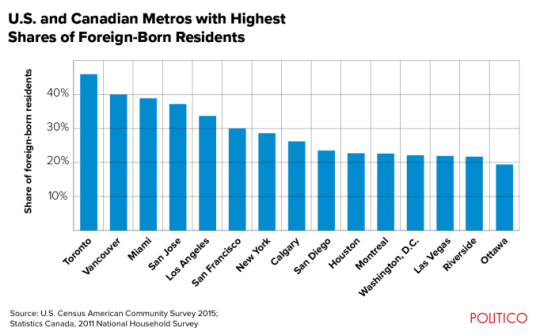
    Here is a chart showing the US and Canadian metros with the highest percentage of foreign-born residents:

    image

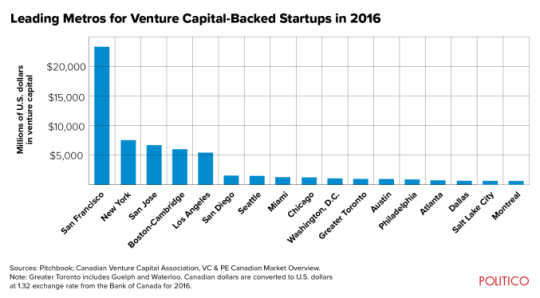
    And here is a chart showing which metro areas receive the most venture capital dollars (in millions of US dollars):

    image

    As to be expected, Toronto, Vancouver and Miami lead in terms of the percentage of foreign-born residents. Though, I would bet that Toronto’s foreign-born population is far more diverse than those of Vancouver and Miami.

    However, when you look at venture capital dollars invested, Toronto is nowhere near the top. Vancouver isn’t even on the list. And I suspect that some of you are surprised to see Miami sitting in between Chicago and Seattle (arguably a city that overperforms in tech relative to VC dollars invested). I was.

    Perhaps Trump will help with this by making Canada great again.

  • Stepping back

    Yesterday the New York Times reported on the fact that Donald Trump has ordered the removal of most of Barack Obama’s policies intended to fight climate change. 

    (Interestingly enough, the Editorial refers to Donald Trump as simply Donald Trump, but it refers to Barack Obama as President Barack Obama.)

    Here’s a sampling of what they had to say:

    It was dismaying also because it repudiated the rock-solid scientific consensus that without swift action the consequences of climate change — rising seas, more devastating droughts, widespread species extinction — are likely to get steadily worse. It was dismaying because it reaffirmed the administration’s support for older, dirtier energy sources when all the economic momentum and new investment lies with newer, cleaner forms of energy. It was dismaying because it flew in the face of widespread public support for environmental protection — including the pleas of the executives of hundreds of major American corporations who fear that without energy innovation their costs will rise and their competitive edge over foreign companies will be lost.

    This is certainly frustrating, but as they mention in the article, it is not unexpected.