Daily insights for city builders, delivered every morning at 6 AM ET. I’m Brandon Donnelly — a Toronto-based real estate developer and founder of Globizen. I’ve been writing here since 2013.

Tag: transit

  • How people behave on the subway and how subway seating could be better designed

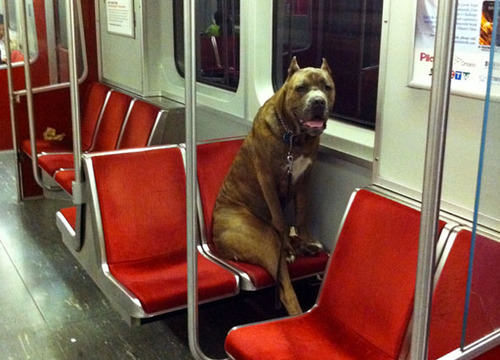
    I take the subway to the office every day and oftentimes I find myself standing there thinking about what the most efficient subway car interior would look like. I guess it’s the architect and designer in me, but I keep trying to rethink the seating arrangement.
    image

    My first thought is always that the perpendicular seats that shoot out into the middle of the train are a complete waste of space. If you’re tall (I’m 6’3”), they’re actually uncomfortable to sit in. Every time I do, I feel as if my femur is too long for the allotted space. 

    One top of that, nobody ever wants to sit in the interior seat—primarily, I think, because they’re cumbersome to get in and out of when somebody is sitting beside you. So you end up with a countless number of cases where those benches are only half occupied.

    But what’s really interesting about this thought exercise is that it can’t be done without also closely analyzing human behavior. Here’s what I’ve noticed here in Toronto.

    People want to be as far away as possible from other people on the subway. It’s weird to sit beside someone unless you really have to. In fact, try this exercise: Walk onto a sparsely populated subway and sit directly beside somebody. I bet you that person will move and/or give you a dirty look.

    What this means is that the end seats always fill up first. People don’t want middle seats, which, I’ve learned, is why they put grab poles in the middle of benches longer than 2 seats. They’re trying to simulate an end seat and make that middle seat feel less like it’s, well, in the middle. You get a pole in between you and the person next to you.

    But before sitting in the middle seat, most people would rather stand. Standing is preferable to rubbing shoulders with someone, unless the subway train gets really busy, in which case people will start to sit anywhere. Typically people like to stand right beside the doors, because there’s a place to lean and it’s easy to get off when your stop comes. But this isn’t ideal from an onboarding and offboarding standpoint. It’s people in the way.

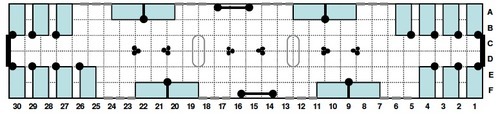
    Of course, there are many others who have spent a lot more time than me thinking about this topic. A quick search revealed this Wired article talking about this very subject. And below is the layout that they recommend. The design is from the Transportation Research Board.
    image

    Their recommendation is to basically remove the seating around the middle doors, so that it’s easier for people to get on and off the train, and to stack airplane style seating towards both ends. In this scenario, the middle gets optimized for standing and the ends get optimized for sitting.

    Now it’s your turn. Do you think this would be better or worse than what you have today in your city? Let me know in the comments below.
  • How Toronto is growing

    If there are two things we like to talk about here in Toronto it’s that there are a lot of condos going up and that it’s becoming increasingly difficult–some would say impossible–to get around. Just this past weekend, I had 2 or 3 people tell me that biking is the only practical way to get around downtown and that it’s fairly easy to outwalk a streetcar on either Queen Street or King Street.

    Usually these statements are followed by a question, asking what the city is doing to address these issues. The unfortunate reality is that I think urban mobility is going to get worse before it gets better (although I am thrilled about the Eglinton Crosstown line now under construction). If you’re a regular reader, you’ll know that I’m a supporter of a Downtown Relief Subway line and that I was disappointed by John Tory’s recent transit proposal.

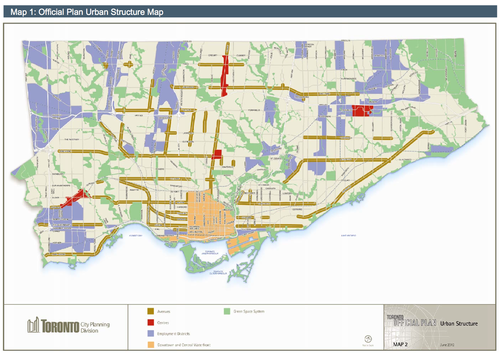
    The best way to explain why I feel this way is to talk about how and where Toronto is growing. In my post on John Tory’s transit proposal, I talked about how Toronto is developing in the shape of an upside down letter T. And the reason for that is because in the city’s Official Plan, the “Downtown and Central Waterfront” area is identified as a growth node and is shaped more or less like an upside T. It’s the light orange in the following map.

    image

    In addition to the downtown core, the areas shown in red are earmarked as “Centres” for growth. There’s one in each borough (Etobicoke, North York and Scarborough) and one at Yonge & Eglinton, which most people would consider to be the heart of midtown. Finally, you have the “Avenues” which are the greenish brown lines on the above map. Those are areas that city also hopes will accommodate future growth.

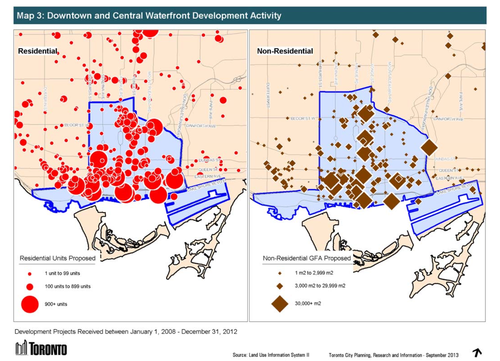
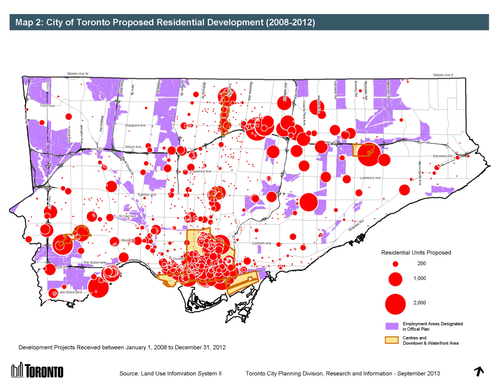
    Now, let’s look at where development is happening in the city. Here’s residential development from 2008 to 2012. The biggest circle represents 2,000 proposed residential units.

    image

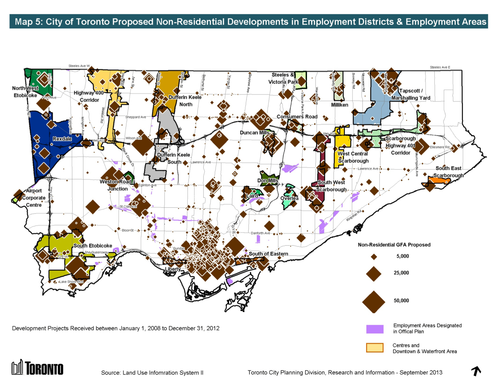
    And here’s non-residential development. The largest diamond represents projects with a non-residential floor area greater than 50,000 square meters (~540,000 square feet).

    image

    What should become immediately apparent is that growth–particularly on the residential side–is happening more or less according to plan. The biggest “outliers” are really the development happening along Mimico’s waterfront and all the development happening along Sheppard Avenue East. But those are because of the water and the Sheppard subway line.

    In both the residential and non-residential cases though, the downtown and central waterfront area is quite clearly receiving a significant share of the development happening in the city.

    image

    Which always makes me wonder: Why are we so reluctant to build proper transit in the core?

    The city’s Official Plan is clearly funneling growth to downtown and yet we continue to propose, fund, and build subway lines in areas where the population densities are lower and ridership levels will inevitably be less. Which ultimately means that the required government subsidies to keep those lines operating will be higher.

    I’m not suggesting that the inner boroughs don’t also need top notch transit and infrastructure. They absolutely do. But I get frustrated when politics trumps rational city building. And so does everybody else who’s stuck with inadequate mobility options.

    Images: City of Toronto

  • Toronto mayoral candidate announces regional express line

    image

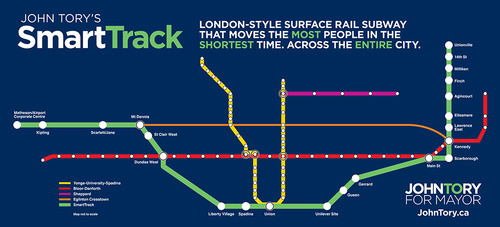
    Yesterday Toronto mayoral candidate, John Tory, proposed a transit line called SmartTrack. It’s part of his One Toronto transit plan. If you’re interested in watching the full 30 minute announcement, click here.

    As somebody who came out of the gate as a strong proponent of the “Yonge Relief Subway Line” (and as somebody I immediately supported for that reason), this proposal first hit me yesterday as a disappointment. Not because I don’t think we need a regional express rail network in the region (we do), but because I feel that he is backing away from that initial commitment and depriving the core of the transit infrastructure it needs.

    As soon as I found out about the plan, I immediately emailed one of my friends at Metrolinx. I told him I thought it was an “epic fail”. He pushed back and asked me to consider the merits of Tory’s plan. After having slept on it (and calmed down), I’m now prepared to talk about both the benefits of SmartTrack and why I was disappointed. 

    SmartTrack is basically a regional rail plan, intended to move people from the outer and inner suburbs to and from downtown using an integrated fare system. That is, riders will not have to pay a separate fare to transfer from subway to SmartTrack. 90% of the track needed for the plan is already existing, which means it will be cheaper and quicker to build compared to the full relief subway line. It will also bring employment centers such as Airport Corporate Centre in Mississauga into the transit network. For these reasons, the SmartTrack plan would certainly be beneficial for the region. 

    But, there’s a densities mismatch.

    If you look at the number of stops proposed in Scarborough and Markham, and compare it to the number of new stations proposed for downtown (1 – Spadina station) and the downtown shoulder neighborhoods (2 – Liberty Village and the Unilever site), the plan starts to look lopsided. SmartTrack would help residents of downtown get out to the suburbs, but it would do little to help them move in and around the core.

    If you look at the way Toronto is intensifying on a map, it looks like an upside down letter T. Density now hugs the waterfront and then follows our subway lines up north. I believe that the SmartTrack plan would help to relieve the pressures on those subway lines, but I don’t think it adequately addresses the bar of the T that now runs parallel to the lake.

    So while I do think that the Toronto region would be well served by regional express rail, I don’t think we can forget about the central part of the city. This shift in focus may have something to do with where Tory believes his voter base now sits, but let’s not forget that there’s a strong correlation between population density and transit ridership levels. 

    Now, let’s hear from you. What do you think of Tory’s One Toronto plan and SmartTrack proposal?

  • New startup wants to solve urban congestion through data and lotteries

    image

    If you’re a regular reader of Architect This City, you’ll know that I’m a supporter of congestion and road pricing. Any valuable good or service, such as a road, that’s offered for all intents and purposes as free, will never be able to keep up with demand. You need to price it.

    However, the political risk associated with implementing something like this has made it such that few cities around the world have done it. London and Singapore are the two most common examples.

    The more populist solution is to simply build more roads and highways, even though study after study shows that this doesn’t work. If it did, we would have already solved the problem of traffic congestion. And we most certainly haven’t.

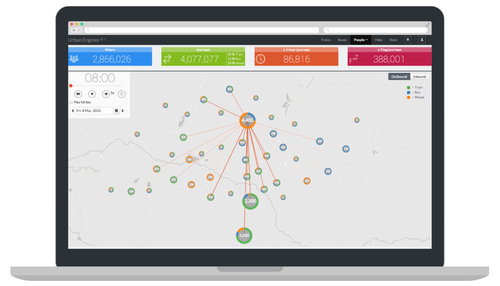
    Which is why I’m excited about a new startup that recently launched called Urban Engines. Their solution is twofold. It’s based on incentives and on treating people and cars in cities as sensors that feed back data into their network. Here’s a brief video. If you can’t see it below, click here.

    [youtube https://www.youtube.com/watch?v=oaCp5Tl-uAc]

    The data piece is almost a no-brainer (provided they can get the data). The more data we can collect about the way people and cars move in a city, the more they’ll be able to optimize and manage the flows. The possibilities are endless.

    But what I found really interesting is their incentives based approach. Typical road pricing methods are, one could argue, a punitive approach. As traffic increases so does the price of the road. (I like to look at it as efficient pricing.)

    With Urban Engines, their approach is the opposite: it’s to reward people–through money and lotteries–for driving during off peak times. It’s smart because selling a reward program to cities will be a lot easier than selling a new charge.

    Overall, this a great example of how startups are stepping up to solve some of our most important societal problems. For more information on Urban Engines, check out their website and this writeup on CityLab.

  • $30 million class-action lawsuit against condo developer

    Last Sunday the Toronto Star ran this article talking about a $30 million class-action lawsuit against developer Elad Canada. The claim is that the developer failed to deliver on the promise of direct underground subway access from its project—Emerald City Condominiums—to the Don Mills subway station.

    The developer, however, doesn’t feel that they made such a representation:

    The lawyer for condo developer Elad disputes the claim saying, “there was never any representation that there would be underground access” from the condo building to the subway or directly to Fairview Mall: Both are easy to reach by walking out the lobby doors and six metres to the subway entrance right out front.

    But when you check the project’s website, it says the following:

    Emerald City is also a commuter’s dream come true. With easy underground access to the Don Mills subway, you can be in downtown Toronto in just minutes.

    Now, I suppose you could argue that, since it’s the subway, that all access is underground. And that it’s certainly “easy”. But when I read the above statements, I can understand why somebody might think there’s underground access to the subway station from within the building. That’s what I would think. It’s misleading.

    But I want to hear from all of you (especially if you’re a lawyer).

    Do you think the developer unfairly led purchasers into believing that they would have direct and underground access to the subway station from their building?

  • Who’s paying for transit expansion in Toronto?

    Recently blogTO did a piece outlining the sources of funding for Toronto’s six active transit projects: the Spadina subway extension, the Eglinton Crosstown LRT, the Georgetown South GO line improvements, the Union Pearson Express, the Sheppard East LRT and the Finch West LRT. It broke down as follows:

    image

    You can find all the specific numbers here, but what is obvious is that the province is paying for most of this city’s transit expansion. Unfortunately though, it’s being done on an ad hoc basis. Toronto first asks for money and then the province decides whether or not it wants to give it.

    This is problematic for a few reasons.

    First, it’s an inconsistent funding stream. We all recognize the need for better transit and infrastructure in the city, but the big question is always: Who’s going to pay for it? So far, as we can see, it’s been the province. But that’s not always a sure thing. And it can often become political. If we’re going to get serious about building transit, Toronto needs a consistent funding source that would allow us to start building and not stop.

    Second, how come, as one of the major economic engines in this country, we aren’t in a position to pay for our own infrastructure? It’s because our governance structure does not properly reflect the economic realities of today’s world: 

    Most local governments are formed by a charter or act granted by the province or territory. Local governments are not mentioned in the Canadian Constitution other than to say they are responsibility of the provinces. Consequently, municipalities can be created, amalgamated, or disbanded at the whim of the provincial government which controls them. They are also limited in the amount of interaction they have with the federal government because this would infringe upon an area of provincial jurisdiction. Since each province is responsible for creating local governments in its own territory, the names, functions, and powers of local bodies vary widely across the country. Local governments generally have limited powers, namely creating local by-laws and taxation (property tax).

    And yet cities, not provinces, are our biggest economic drivers. We have it backwards. And so I think it’s critical that we look long and hard at ways in which we can better equip our cities with the tools and resources to compete globally. Transit funding is just one example.

  • Every street can’t be everything to everyone

    Yesterday I spoke about why Toronto shouldn’t be so quick to dismiss streetcars and light rail. Today, I’d like to talk about some of the hard decisions we need to face if we really want to get our city moving.

    Toronto is a city of neighborhoods and small main streets–at least in the areas where our streetcars live. Streets such as King and Queen are only 4 lanes. And the problem we’re facing is that we’re trying to accommodate every single use case on them: cars, on-street parking, cyclists and streetcars. But in doing so, we’ve made the experience terrible for everybody. Streetcars move at a snail’s pace, drivers are frustrated by the lumbering streetcars, cyclists fear for their life driving by parked cars (doors can swing open at any time), and so on.

    And with the rise of downtown shoulder neighborhoods such as Liberty Village, King West, the Distillery District and the soon to be complete West Don Lands, the strain on our east-west corridors is only going to get worse–much worse, in fact. Already the King streetcar is the busiest streetcar route in the city, moving almost 60,000 people per day. That’s more than the (under utilized) Sheppard subway line.

    What I hope is clear to the ATC community though, is that the answer isn’t uniformly the car. We can’t have every single resident from Parkdale to Leslieville hopping into their car and driving downtown to their office at Yonge & King. It ain’t going to work. And so we’re going to need to make some difficult decisions about how we’re going to get our city moving on the backbone of transit.

    Sure the downtown relief subway line (screw the politics I’m attaching it to downtown) would be the ideal solution to connecting our emerging shoulder neighborhoods, but that’s not going to happen overnight. And so how do we improve the efficiency of what we already have? First, we need to accept the fact that every street isn’t going to be everything to everyone at all times. We need to choose who we want to optimize for.

    So here’s an idea that’s been floated many times before but never acted upon: let’s get rid of cars on King St and Queen St in the core during rush hour.

    This would give our streetcars the room to efficiently move people across downtown, minimizing the dreaded “bunching up” that occurs as a result of traffic congestion. It would make transit a reliable choice and there are ways to pilot it. But let’s be clear: this is not about being anti-car. It’s about optimizing uses and getting people moving. Cars would continue to get priority on Richmond St and Adelaide St, and transit riders (as well cyclists) would get priority on King and Queen.

    Of course, the Rob Ford viewpoint would say that we should be optimizing all streets for cars and getting the streetcars completely out of the way. But if that’s the approach we want to take, then we’re building the wrong kind of city. We shouldn’t be focused on intensifying and creating new inner city neighborhoods, because that only tips the scale in favor of transit. Instead, we should be focused on decentralization.

    But that’s what not we’re doing. We’re intensifying our city to the point that we’re now faced with a number of difficult–yet enviable–decisions about how we’re going to live and how we’re going to move around in the future. We’re a city in transition.

    Our mission here should be to figure out how to move people around the city as efficiently possible. Let’s put politics aside and recognize that time is one of our most precious resources. And when we put people in lumbering streetcars and debilitating traffic jams, we’re completely squandering that resource. It hurts productivity and it hurts our overall prosperity as a global city.

    There’s a place for subways, streetcars, buses, bikes and cars in our city. So let’s just get on with making them all work.

  • All streetcars are not created equal

    With Toronto preparing to deploy the first batch of its new streetcars this summer, there’s been a lot of talk about streetcars in general. Rob Ford has said he wants to get rid of them all together and I hear a lot of other people expressing similar frustrations: Streetcars are rolling stop signs. Streetcars block 2 lanes of traffic. Why don’t we just use more buses? Streetcars cause traffic. And so on.

    So what should we do?

    First, let me start by saying that buses suck. I’m a huge proponent of public transportation in cities, but there’s nothing quite like a rush hour bus ride to have you question your economic status in life. Bus routes have also been shown to have little economic development value, where as fixed rail lines (such as streetcar, LRT and subway) generally increase surrounding property values and spur investment.

    Second, my view is that streetcars themselves as a transportation technology aren’t the problem. It’s our execution. I’ve touched on this topic before on ATC, but I’d like to reiterate a few points here. 

    The value of light rail is that it’s a relatively inexpensive way (compared to subway) of efficiently moving a lot of people. But in order to do that, you need deploy it in a sensible way. In my mind, that primarily involves 3 things: giving streetcars their own dedicated lanes (grade separation), having a reasonable number of required stops, and streamlining the onboarding and off boarding process. Today, we don’t do a great job at most of these things (although our new streetcars will use a proof of payment model).

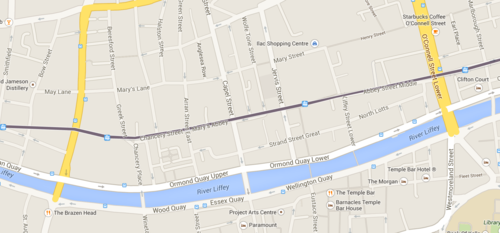
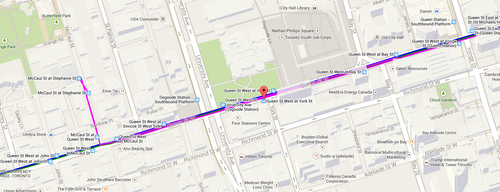
    Take a look at this comparison between Dublin’s Luas light rail system and Toronto’s streetcar system. Both images are at the same scale. Notice the dramatically different stop spacing. Much of the Luas system also runs on its own dedicated lanes.

    Dublin:

    image

    Toronto:

    image

    Every time a Toronto streetcar stops it generates waste. Cars are forced to stop behind it. Everyone on the streetcar has to sit and wait while somebody fumbles through their change looking for a token. But there are other ways to do this. There are ways to make light rail more subway-like, despite the fact that it may be above ground.  And so I don’t think we should be so quick to write off all streetcars.

  • Moving people instead of cars

    As of this week, Architect This City is now being syndicated on MobilityLab. Here’s the first post. MobilityLab is a US-based think tank focused on “transportation demand management”, which is just a fancy way of saying that their focus is on optimizing for the movement of people, instead of cars.

    Not every post from ATC will get syndicated on MobilityLab, but hopefully many of the ones focused on mobility will be. But really this post this just to tell you that if you’re interested in transportation, mobility and sustainability, you should check out MobilityLab

    To get you started, here are their top 10 stories from 2013.

  • Improving urban mobility

    If you’ve ever ridden a busy Toronto streetcar, you’ll know this story:

    You’re waiting outside in the cold for a streetcar. When one–actually 4–finally arrive all bunched up together, they’re so packed with people that you’re not actually able to get on. You try one anyways and the driver makes an announcement for everyone to “move back” so that more people can onboard via the front door. After a few minutes of people shuffling to try and get further back, you’re finally able to squeeze on–even if you are virtually sitting on the driver’s lap. You then travel about 2 blocks before the streetcar stops and the same thing repeats. The result is an absolutely infuriating mobility experience that usually makes walking the preferred choice. Who said that downtown already has enough subways?

    Over the weekend, I was watching this TED talk with Charlie Rose interviewing Larry Page of Google. One question that Rose asks Page is about why he’s so fascinated with transportation and mobility. That is, why is Google so committed to driverless cars? Page then talks about his experience of waiting for buses when he was a student at the University of Michigan and how he would think about all the inefficiencies in the system. He also talks about how half of the urban fabric of Los Angeles is made up of roads and parking lots and that this is a terrible outcome of the mobility choices made in that city.

    I’ve said before that transportation is one of the biggest challenges facing Toronto today. And I truly believe that. But that’s probably the case in most, if not all big cities. Getting people around a city efficiently is such a fundamental need. It stimulates economic growth and it improves quality of life. And those are typically the reasons why people choose to live in cities: to make money and to have a better life. 

    Now, I’m a big proponent of public transportation, but I’m also excited by the advances being made outside of mass transit. With driverless cars, electric cars, networks such as Uber and Hailo, and the emergence of the sharing economy, you could easily imagine a bunch of different ways in which mobility could be improved in our cities. Take, for my example, my own driving patterns. I probably drive my car 2, maybe 3 hours per week these days. That translates into a weekly utilization rate of roughly 1.2%! (2 hours / 168 hours week). That’s terribly inefficient. We can do better. And I think we will.