Daily insights for city builders, delivered every morning at 6 AM ET. I’m Brandon Donnelly — a Toronto-based real estate developer and founder of Globizen. I’ve been writing here since 2013.
I’ve written about the Ponte Tower in Johannesburg before. At 54 storeys, it is the tallest building in Africa. It’s located in Hillbrow, which is an inner city neighborhood known for its crime and poverty.
In the 1970s when the tower was built, Hillbrow was an Apartheid-designated white-only neighborhood and the tower was filled with affluent residents. But that didn’t last long and eventually the wealth fled for the suburbs.
Here’s a brief 6 minute video talking the Ponte Tower. Let’s call it the real estate perspective. Click here if you can’t see it below.
Now, here’s a Real Scenes documentary talking about the thriving electronic music scene in Johannesburg. I think it’s fascinating to look at a city from a particular subculture and, compared to the first video, I get a very different feel for the city. Click here if you can’t see it below.
“The two greatest stores of wealth internationally today is contemporary art….. and I don’t mean that as a joke, I mean that as a serious asset class,” said Fink. “And two, the other store of wealth today is apartments in Manhattan, apartments in Vancouver, in London.”
In case you wondering, Laurence Fink is the founder and CEO of BlackRock Inc., which today is the largest asset manager in the world. They have over $4.77 trillion in assets under management according to their website. That’s a mind boggling number.
And if you read the Bloomberg article cited above, you’ll see that this interest in both art and apartments represents a shift away from gold as the de facto safe haven.
“Historically gold was a great instrument for storing of wealth,” the chairman of BlackRock Inc. said at a conference in Singapore on Tuesday. “Gold has lost its luster and there’s other mechanisms in which you can store wealth that are inflation-adjusted.”
What’s interesting and probably most relevant to the Architect This City community though is this investment focus on apartments.
When people talk about a possible housing bubble in Canada they often cite house prices to median household income as a key ratio. The question then becomes: How can house prices be such a high multiple relative to local incomes?
That’s relevant, but it’s not the entire story for cities like New York, London, and Vancouver. That ratio alone assumes that real estate isn’t a global investment vehicle. And for some people people it is exactly that.
We all know that the Greater Toronto Area is growing and intensifying at an incredible pace. In fact, last year the region set a record with 25,571 new condominium units completed.
If you listen to industry experts, such as George Carras of RealNet, they’ll tell you that this level of intensification — which usually means condominiums — is really a decade in the making. That’s when the government set out to explicitly encourage this type of growth.
But in the decade since that decision, we’ve seen both government and the market evolve in terms of what that intensification should look like. It started out with a largely high-rise building typology. Tall buildings were to be allowed in the downtown, as well as in specific growth nodes throughout the region. But for everything in between — the officially designated “neighborhoods” — there was to be no development.
This is what I’ll call the first stage of intensification.
Then, we started to think about mid-rise intensification along the avenues. Most of these “avenues” (also an official term) cut through those same stable neighborhoods, but the main streets were seen as an appropriate place to allow additional growth. It makes perfect sense and so guidelines were created to help dictate what this new building typology should look like.
This is what I’ll call the second stage of intensification.
And it’s one that I’d argue we’re currently living through with new mid-rise projects like DUKE in the Junction (TAS project), Kingston&Co in Kingston Road Village (another TAS project), Abacus Lofts on Dundas West, and The Hive in Etobicoke. These are all mid-rise buildings going up in established neighborhoods.
With the recent decision to also allow wood frame buildings up to 6 storeys in Ontario (instead of 4), we’ll probably see an even greater surge in mid-rise buildings once the private sector gets its head around this shift.
So what’s next?
I think it’s inevitable that we’ll eventually see low-rise intensification within our established neighborhoods. We started by avoiding them altogether, and then deciding that it was desirable to build along their periphery. But as demand for urban housing continues to increase, I believe it’s only a matter of time before we start to loosen the reins on our single family neighborhoods.
Some of you might be thinking that this is going to be a bad thing, but I actually think the opposite. Projects such as Vancouver’s Union Street EcoHeritage prove that it’s entirely possible to intensify existing neighborhoods through sensitive and beautiful infill interventions. And of course, let’s not forget about laneway housing.
The fact of the matter is that Toronto has already been intensifying its neighborhoods for a very long time — likely since the beginning — by converting single family homes into duplexes, triplexes, and other multi-family dwellings. We just haven’t been doing it in any sort of structured way.
I don’t know when this will change, but I think it’s only a matter of time. And that will be the third stage of intensification.
This morning I stumbled upon an interesting documentary (via The Urbanophile) about two New York skyscrapers that were built in the 1930s as telecommunications buildings: the Western Union Building and the AT&T Long Lines Building. It’s fascinating to see how they have evolved along with technological change. Click here if you can’t see the video below. It’s only 8 minutes long.
Montreal is one of my favorite places on the planet. In fact, if I have one regret in life it’s that I didn’t do my undergrad at McGill University. Living in Montreal as a poor student would have been the best. Though I shouldn’t complain because I did spend quite a bit of time there when I was a poor student.
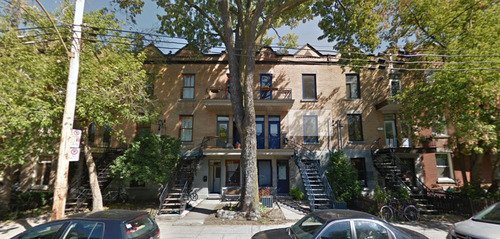
If you’ve ever been to Montreal, the image at the top of this post will look familiar. The urban landscape of Montreal–at least in the residential areas–is filled with exterior staircases. They’re all over the place. And this always strikes everybody as a bit odd given that it’s a pretty cold and snowy place a lot of the time. Nonetheless, those staircases are quintessentially Montreal.
Some people think it was done to minimize the amount of interior space that needed to be heated, but I’ve never really gotten a definitive answer. Either way, all those stairs are an interesting byproduct of Montreal’s commitment to one predominant building type: the multiplex. A multiplex is essentially a small apartment building containing a handful of units. They’re usually only around 3 storeys high. And they’re all over the Ville de Montréal.
To be honest though, I don’t think I’ve ever really explicitly thought about this defining Montreal quality. But then last night I stumbled upon an interesting blog post called “Les escaliers de Montréal vs towers of Toronto." (escaliers = stairs) In it the author talks about how Montreal is essentially this city of multiplexes (with stairs everywhere) and Toronto is this, more modern, city of towers surrounded by single family homes.
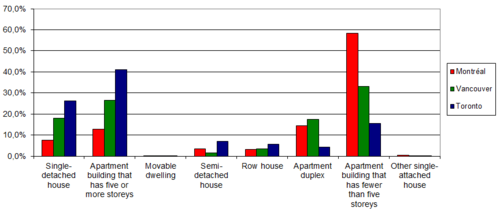
And here’s the data to back it up:
When it comes to single-detached houses and apartment buildings taller than 5 storeys, Toronto dominates. But when it comes to apartment buildings less 5 storeys, it’s all Montreal. And if you add in apartment duplexes, you’ve accounted for almost 75% of Montreal’s housing stock. Note: These figures are for the city proper and don’t include any amalgamated suburbs.
The author’s explanation for this comes down to zoning and timing. Since Montreal is an older city, the belief is that Montreal was simply further along in its evolution when formal land-use planning came into effect and started to order the city. I generally agree with this hypothesis, but I think it’s also worth keeping in mind that, just because a Toronto house might be zoned as single family, doesn’t mean it’s actually begin used as such.
A lot of the older houses in Toronto have been subdivided into what are effectively illegal multiplexes. Since this is all happening under the radar, nobody really knows what the actual stock of multiplexes might be. Nonetheless, there’s no denying that there are some real differences between the urban fabric of Montreal and Toronto.
I’ve spoken about the term YIMBY before and this site is exactly that: a site dedicated to “saying yes in my back yard” to new development in New York. It was founded by 23 year old Nikolai Fedak and currently receives 75,000 monthly visitors. He has plans to expand to other cities and I’ve already emailed him to see if he has any plans for a Toronto YIMBY.
At a time when it’s common to hate on developers and new developments, it’s refreshing to see a site dedicated to the exact opposite. That’s not to say that all developments are good (New York YIMBY has no problem blasting the ones that suck, as it should), but it’s certainly framing development as a positive thing for cities.
In growing cities like New York and Toronto, development is going to happen. And so I would rather we focus on how to make it happen in the best way possible instead of just saying no.