Daily insights for city builders, delivered every morning at 6 AM ET. I’m Brandon Donnelly — a Toronto-based real estate developer and founder of Globizen. I’ve been writing here since 2013.
For Alex’s article, the Globe asked “prominent urbanists, architects, and scholars” from around the world to comment on what Canadian mayors should be focused on right now as we build the cities of tomorrow.
Here’s a list of what they said:
Make people, not cars, happy
Decrease speed limits
Empower city governments
Leverage density
Embrace the science of big data
Mix residences and workspace
Turn streets into destinations
Redevelop the inner suburbs
It’s a great set of recommendations. So I would encourage you to check out the full Globe and Mail article.
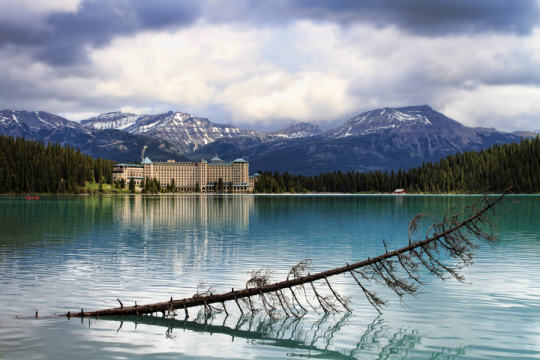
I’m writing this post from the Lakeview Lounge at the Fairmont Chateau Lake Louise. The view of the (frozen) lake and mountains is absolutely stunning (see above). I can totally see why people move to the Rockies and never leave. Frankly, I’m not sure how I’m going to ever go home 😉
This Chateau was first built up in the late 19th century by the Canadian Pacific Railway. Developed as a way to encourage ridership and fund railway expansion, its position on the eastern edge of Lake Louise was probably a fairly obvious choice (although only when accompanied by rail). It’s designed to take full advantage of the views of the lake and the mountains.
The interesting thing about Dovercourt Village – and specifically Geary Avenue – is that they seem like unlikely places for new investment. Many of the buildings aren’t particularly beautiful. And there’s a rail line and a set of power lines running through the middle of it.
But if the buzz around Dovercourt Village proves to be true, then it could very well end up as a new yuppy enclave in the city. I’m not going to debate the merits of gentrification today, but I think it’s interesting how change can seemingly emerge out of nowhere.
If you rewind 10 years to before Ossington Avenue became the hotspot that it is today, many of you would have probably classified it as an unlikely place for gentrification. Located beside the Centre for Addiction and Mental Health (CAMH), the area wasn’t considered desirable at the time. (CAMH has since undergone a lot of change.)
But oftentimes change can come out of nowhere. It just takes few enterprising pioneers who see something that nobody else does.
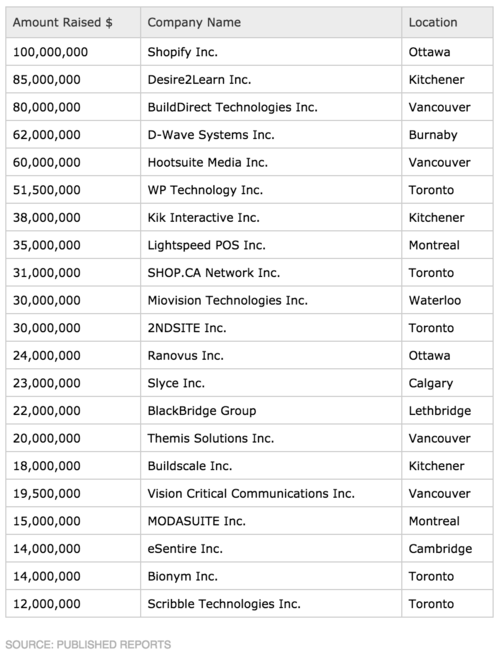
To put things into perspective, total venture dollars invested in Canada last year (2014) was around $1.9 billion. In the US, that number is estimated to be somewhere around $48 billion. So there’s a big spread here. But the Globe is arguing that there’s a shift towards medium-sized Canadian tech companies raising larger and larger rounds.
Here are the top 21 largest venture capital investments made in Canada over the last 18 months:
At the same time, there’s also an attitude change that seems to be taking place. Confidence is growing. Here’s a quote from Mike McDerment of Freshbooks from the same article:
“Our goal is to be an anchor tenant in Toronto. At Freshbooks, we want to build a global company that really contributes in some meaningful way to the city,” Mr. McDerment said. He touts the local schools and talent pool and downplays the Valley’s head start.
“The money is shameless – it’ll just go wherever. It wants the opportunities,” Mr. McDerment said. “I don’t see why Toronto can’t beat Silicon Valley.”
All of this is important because the medium-sized companies of today will hopefully become the large-sized companies of tomorrow. And that’s what you need to build a thriving startup hub. You need big successes. You need those companies going public and generating wealth for their employees and communities.
Thankfully, that seems to be where we’re headed. The first company on the list above – Shopify – is already preparing for a dual US-Canada IPO.
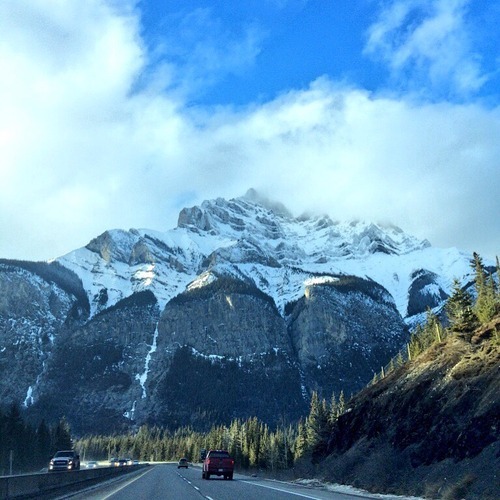
Having just spent the weekend in Calgary and Banff, I’ve been thinking a lot about importance of picking the right city in which to live. I’m not saying that I don’t love Toronto. Because I do. But I am incredibly envious of cities – like Calgary, Vancouver, and Denver – that have such easy access to incredible mountains.
Now, this might not matter to a lot of people, but it does to me. It’s a personal thing. There’s something really nice about landing in a city and seeing people leaving the airport with skis and snowboards in hand. And there’s something really nice about a city where so many people are active, outdoorsy, and fit.
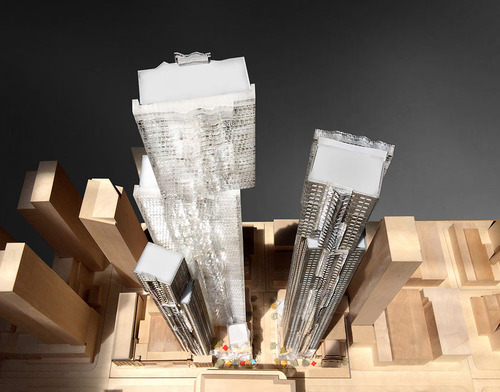
The developers behind the much talked about Mirvish+Gehry project in Toronto (Projectcore) recently released a video showcasing the architectural model. It’s a great way to see the project from every angle. Click here if you can’t see it below.
I’ve written about this project a number of times before and my view has always been that I’m excited by the project, but that I don’t think we should be demolishing all of the heritage buildings on-site. This latest scheme – with two towers ranging from 82 and 92 storeys – is the result of that compromise.
What are your thoughts on Mirvish+Gehry? And what do you think the condos will ultimately go to market at? My guess would be somewhere around $1,000 per square foot.
A few days ago, Bill Gurley – who is an investor in Uber – wrote a really fascinating blog post called, Uber’s New BHAG (Big Hairy Audacious Goal): UberPool. Bill doesn’t update his blog very often, but when he does it’s incredible stuff.
I’ve touched on UberPool briefly before. But basically it’s a true “ride sharing” service where people with overlapping routes can easily share the same car – much like people do today informally. The obvious advantage of this is cost. It’s cheaper to share.
What’s most fascinating about this service though is how it fits into Uber’s larger mission to drive transportation costs down. And there’s a specific reason for that (via Bill Gurley):
When Uber launched its low-cost UberX offering in the summer of 2012, the company quickly realized that the demand for its transportation services is HIGHLY elastic. As the company achieved lower and lower per-ride price points, the demand for rides increased dramatically. A lower price point delivered a much better value proposition to the consumer, yet still remained a great business decision due to the remarkable increase in demand.
So what Uber quickly figured out was that if they could increase the utilization rate for drivers (the time actually spent with passengers), they could charge consumers lower prices while at the same time maintaining driver salaries. Prices went down, but volume went up.
One way to do that is to obviously decrease driver downtime by improving liquidity on the marketplace. But another way is to simply increase the number of passengers being transported at one time. Hence the creation of UberPool.
But it doesn’t stop there.
Because of all the transportation data that Uber now has (the company has a data group called the “math department”), they can fairly accurately predict what a price cut will do to their ridership levels. This allows them to “forward invest” their capital in new services – such as UberPool – before they even have the revenue from the anticipated increase in ridership.
So what does this all mean?
It means that Uber is going to get cheaper and cheaper and cheaper. Uber is trying to get to what they call “The Perpetual Ride”, which basically means that drivers will always have customers (100% utilization). That’s quite a goal, but it would mean the absolute lowest prices for consumers (barring any other changes to their cost structure).
Dirt cheap transportation is a pretty compelling value proposition, which is why I continue to believe that cities should be hard at work trying to figure out how to harness this transportation shift.
If you’re interested in this topic, I would encourage you to give Bill Gurley’s blog post a read.
It should start from the premise that the fundamental underpinning of the Canadian economy to have prosperity is dependent on the success of the cities, because 80 per cent of Canadians live in cities. -Toronto mayor John Tory
This week the leaders of Canada’s 22 largest municipalities are gathering in Toronto to figure out how to put urban issues on our national agenda. This is a topic I’ve touched upon many times before on Architect This City, but I continue to believe that it’s one of our most pressing issues.
We know that the vast majority of Canadians live in cities (see above quote) and we know that the vast majority of our economic output is concentrated in cities. In fact, roughly half of Canada’s GDP is produced in our 6 biggest cities alone – Toronto, Montreal, Vancouver, Calgary, Edmonton, and Ottawa-Gatineau.
But despite this concentration of wealth and economic activity, our governance structures do not reflect this reality. They’re outdated. They were built for a Canada that has passed. And so in my view, there’s a significant amount of untapped potential lying dormant in our cities if only we could get around to properly empowering them. There’s a “stimulus package” waiting to be unleashed.
In anticipation of this week’s leadership meeting, the Globe and Mail published an article called, Canada’s big city mayors ready to push urban agenda. And in it they included a number of interviews with Canadian mayors. It’s fairly long, but definitely worth a read. Here are a few relevant sound bites…
Vancouver mayor Gregor Robertson
We have an archaic system. Cities aren’t recognized in our constitution. It’s unbelievable. But Big City Mayors have set aside those important gaps because the needs are now so urgent on housing and transit, we can’t afford to spend a couple years debating structural change. For the time being, the focus is just on ensuring there’s more federal capital provided for transit and other urban infrastructure.
Calgary mayor Naheed Nenshi (on municipal funding sources)
I would prefer to levy myself, so that I’m ultimately accountable to my citizens and, if they don’t like it, they can get rid of me. Allowing others to levy the tools takes away predictability and stability, as well. That said, we’re starving here, and any improvement to the system that leads to those predictable, stable cash flows is a good thing.
Winnipeg mayor Brian Bowman (on the most pressing issue facing Canadian cities)
I’d say without question infrastructure and new funding models to modernize the ways that cities fund themselves. That’s something I’ve started discussions on already with some of my counterparts, Mayor [Naheed] Nenshi in Calgary, Mayor [Don] Iveson in Edmonton as well as Gregor Robertson in Vancouver. We’ve talked about a number of topics including the missing and murdered indigenous women and girls issue, public transit and rapid transit development. But the one consistent theme is that the way cities are funded is outdated.
Toronto mayor John Tory
I start from this premise: Are people paying enough taxes? In many cases, you could argue, not only are they paying enough taxes, they can’t afford to pay any more. We should be looking at the total amounts paid to all three levels of government and how that is being allocated. Do we believe that, in the case of Toronto, the federal and provincial governments are making adequate investments in transit, given the amount of money they take out of this area in taxation? I would say the answer is: not yet. [But] they have been doing better.
Montreal mayor Denis Coderre
We are negotiating a new pact between the province and Montreal, and it’s all about municipal autonomy. We need tools so we’re not always waiting in the hallway at the end of legislative sessions looking for amendments to make the city work better. Since 85 per cent of immigration in Quebec is going to Montreal, we need more control over tools of integration, like job creation and housing. Montreal needs financial leverage…
Some of you might be aware that I’m involved with a non-profit group here in Toronto called The Laneway Project.
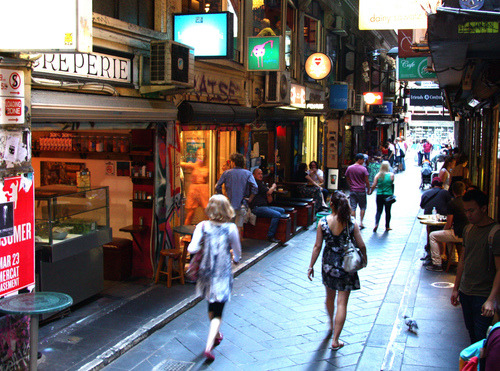
Our mission is to transform the city’s under-utilized laneways into safe, vibrant, and people-friendly spaces – which is something that has been done with a lot of success in other parts of the world (see Melbourne above).
Today I’m excited to announce two things.
First, the group has received funding from the Ontario Trillium Foundation. This is great news because it’s obviously a lot easier to execute on a mission when you have some resources behind you.
And that ties into the second announcement.
The funding received from the OTF is going to be used for 2 laneway transformation projects here in Toronto. Think of them as pilot projects that will help to reorient Torontonians into thinking about laneways as viable public spaces and to demonstrate that this group is about real action.
Once the 2 laneways have been chosen, The Laneway Project will work with those local communities to come up with a vision and then an implementation plan. But before that can happen, there needs to be 2 laneways.
So if you’re a community group, resident association, business improvement area, or some other passionate group, now is your chance to nominate your laneway. Get in touch with The Laneway Project before February 7th, 2015 by clicking here.
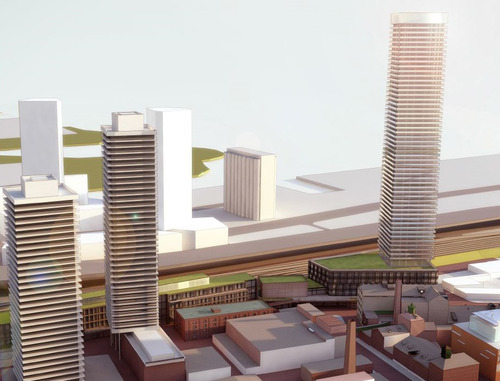
It’s the tower on the right hand side of the picture above. The 2 towers on the left are existing, although they’re quite recent. The development site is currently a parking lot and it abuts a railway corridor to the south.
The reason I bring up this project now is because I recently saw this notice go out from the Gooderham & Worts Neighbourhood Association. It’s an announcement for a public meeting that I believe just happened earlier this week (I think they meant to say 2015 instead of 2014).
After I saw the notice, I decided to share the rendering on social media to see what people thought of the proposal. The general consensus seemed to be that the tower looked a bit cookie cutter (though to be fair it’s hard to tell from renderings like this) and that 57 storeys was simply too tall for the area. I got comments back like “enough is enough.”
Now, I’m not here to say that 57 storeys is exactly the right height for this building and this location (though it might be), but I am saying that I don’t think it’s as important as most people think it is. I think we’ve become over-fixated on height, at the expense of other important design issues.
Part of this has to do with how we communicate projects and how we tell the story. If you look at the city’s website for this project, you’ll see that this is how it’s explained:
The City has received an Official Plan Amendment and Rezoning application for a 57-storey mixed use tower and a 5-storey commercial building containing 496 residential dwellings, 5,048 square metres of retail gross floor area, and 21,243 square metres of office gross floor area. The 5-storey commercial building is within the Distillery District, and the 57 storey tower is immediately south west of the Distillery District.
About the only thing that I think most people (outside of the industry) would understand are the heights of the buildings. Everything else – from the Official Plan Amendment to the number of square metres of gross retail area – is likely lost.
So it’s actually not surprising that most people just look at one or two renderings and the number of storeys, and then make a judgement call about whether or not it would be a positive thing for the city.
Now, I know why we communicate projects in such a clinical way. It’s to appear impartial. But there are so many other considerations when it comes to great city building.
How does the building meet the street? What are the first couple of floors like at eye-level? What’s the materiality? What would the experience be like for someone having a coffee on a patio outside of the building? What kind of commercial tenants will there be? Is there a unique leasing/programming strategy? What’s the overall vision for the project?
Again, I’m not saying that height is completely irrelevant. I simply fear that we might be losing sight of the bigger picture. The Distillery District is a magical place in Toronto. It’s hands down one of my favorite places to be. In fact, I’ll be there this weekend for a Winterlicious dinner. But I honestly couldn’t tell you how tall the existing towers are. Are they in the 40s?
I could, however, tell you exactly what it’s like to walk down the Distillery’s intimate cobblestone streets and sit on a patio with a beer in hand. It’s a beautiful thing.
In yesterday’s post about the 3 stages of intensification, I mentioned a project in Vancouver called Union Street EcoHeritage by SHAPE Architecture. I used it as an example for sensitive low-rise intensification.
Since it’s a very cool project (and most of you probably didn’t click through), I thought I would dedicate today’s post to explaining the project.
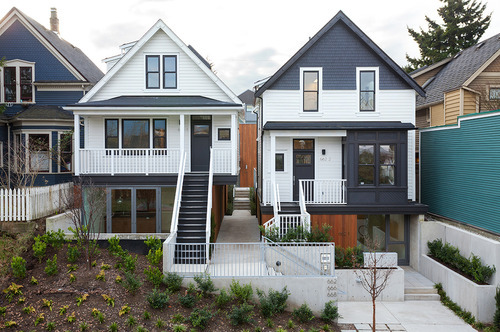
The picture at the top of this post is what it looks like today (the front elevation). If you were to pass by it, I suspect most of you would just think it was a pair of renovated single family homes. But there’s much more to it. What started out as only 2 dwellings, ended up as a site for 7 dwellings.
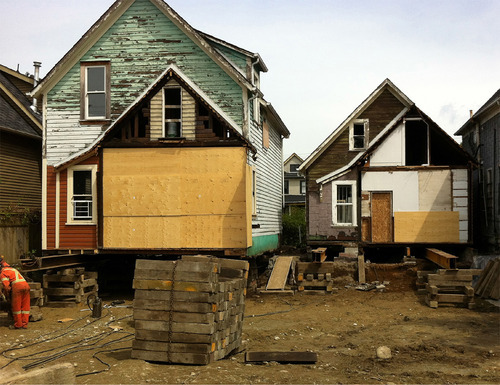
Here’s the before shot:
The homes were moved and actually raised up in order to accommodate additional density. Here’s a section that better explains what was done (black is existing; green is new):
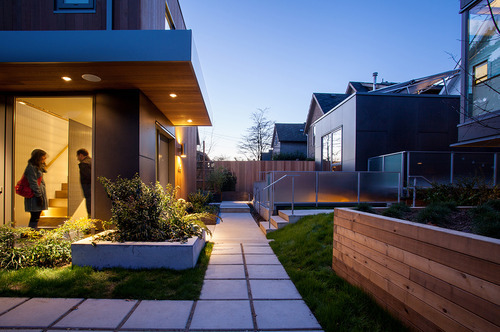
The 2 existing homes were raised up so that an additional dwelling unit could be placed beneath each one. At the same time, additional units were added in the rear, both attached to the existing homes and at the back of the site facing the laneway. And so this project is actually one part laneway house.
Here’s a photo of what that rear interior space looks like (it’s stunning):
Not surprisingly, this project won a bunch of awards and has been widely celebrated as an affordable housing solution. It’s exciting to see Vancouver take the lead on low-rise intensification. It’s one of the reasons that I think it’s only a matter of time before Toronto starts to look towards similar solutions.