Daily insights for city builders, delivered every morning at 6 AM ET. I’m Brandon Donnelly — a Toronto-based real estate developer and founder of Globizen. I’ve been writing here since 2013.
I just stumbled upon a fascinating documentary series called Real Scenes. Each film explores “the musical, cultural and creative climate” within a particular city.
Below is Real Scenes: New York (click here if you can’t see it below). It’s an inside look at the underground music scene that has developed in Brooklyn, but that is at the same time being threatened by development and rising rents. Disclaimer: There’s a lot of f-bombs and a lot of hating on gentrification.
I’ve only watched the New York video from this series, but I plan to watch each and every one of them. The other cities are Tokyo, Johannesburg, Paris, Berlin, Detroit, and Bristol.
What’s fascinating about these short documentaries is that they give you a glimpse into a particular undertone within each city – one that would otherwise be hard to get if you weren’t living there and engrossed in the scene.
It’s also interesting to see how some people view change within cities.
To some, transforming a neighborhood from one that looks like a “bomb went off” to something more pristine, is a good thing. But to others, it’s the worst possible outcome. It all depends on your frame of reference.
Now, how do I get them to make a Real Scenes: Toronto? 🙂
Those of you from Toronto might be aware that the city is currently assessing the possibility of a “relief subway line” that would connect the downtown core back up to the Bloor-Danforth subway line in the form of a stretched out “U”.
The reason this line is being called a “relief line” is that – in addition to providing local service all across downtown and its “shoulders” – it would also relieve much of the pressure that the Yonge-Bloor interchange is facing today. Instead of always having to connect at that location, passengers coming from the east and west would be able to do so sooner as a result of this new subway line (bypassing Yonge-Bloor).
For those of you who are regular readers of ATC, you might know that I’m a big supporter of this relief line. I believe it should be our number one transit priority. It’s going to cut through areas of the city that have some of the highest population and employment densities, and so it’s an area where I think subway makes sense. The ridership would be there.
Many people at the city also seem to agree:
For the *next wave* of projects, our modelling demonstrates the relief line is critical. RT @donnelly_b biggest gap in your opinion?
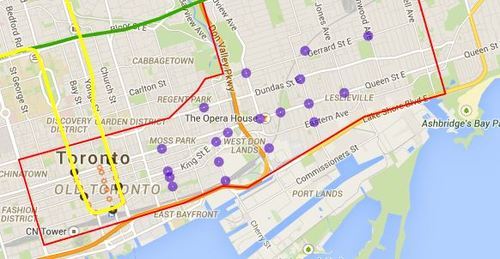
Given that an assessment is currently underway, the city is looking for feedback from the public. One of the ways you can do that is by clicking here. The site will allow you to comment on the potential station locations (shown below using purple circles). I did it this morning and I would encourage you to do the same if you’re from Toronto.
For clarity, this current study is only for the eastern portion of the relief line (study area is outlined in red below).
Once you’ve given this some thought, I’d love to have a discussion in the comments about where you think the relief subway line should go (or if you even think it’s a good idea in the first place).
My initial thought is that it should connect into King station, run along King Street East, merge with Queen Street East near the Don Valley, go through Riverside and Leslieville, and then start making its way north to Danforth Avenue.
My reasons are as follows:
King Street East is the most vibrant pedestrian street on the east side of downtown. There isn’t enough commercial activity further south.
King Street would allow it to eventually cut right through the Financial District when it heads westward.
The connection to Union station (for GO Transit, VIA Rail, and the Union-Pearson Express Train) would be manageable from King Street. Plus, SmartTrack may feed directly into Union.
King Street is roughly the midpoint between Queen Street and Lakeshore Boulevard. And if you place it too far south, it would take away from the proposed Queen’s Quay LRT line.
Having it merge into Queen Street near the Don Valley would allow it to service both Regent Park to the north, as well as the West Don Lands neighborhood to the south. It would also allow for a connection to a Cherry Street LRT line servicing the future Portlands neighborhood.
Queen & Broadview is emerging as a major node with a significant amount of density in the pipeline. And further north, Dundas & Carlaw is similarly seeing a lot of intensification.
But I may have missed a few things. These are just my thoughts. What are yours?
This past Saturday night I was out with a few friends in my neighborhood (St. Lawrence Market area). And I was delighted to see how busy it was. Virtually every bar or club we walked by had a line down the street.
Being the city geek that I am, I started thinking about two things: (1) how often I get localized to my neighborhood (I have data to back this up) and (2) what makes a “complete neighborhood”, such that you’re even able to be localized?
In some ways the idea of a “complete neighborhood” is universal. Everybody needs a grocery store and access to food, for example. But in other ways, a “complete neighborhood” is very much a personal thing – you want goods and services that are important to you.
So today I thought I would do a quick breakdown of the goods, services, and amenities that I really value in my neighborhood and that I think make it more or less “complete.” This list is a combination of universal and personal choices in no particular order. At the end, I summarize some of the things I wish I had.
What I have:
A 5-10 minute walk to subway and streetcar
A 24/7 grocery store
A world famous food market (St. Lawrence Market)
Staple coffee shops (Starbucks and Balzacs)
Lots of restaurant and food choices (including decent Mexican, one of my favorite foods, and Pho, for when I feel a cold coming on)
2 drugstores (Shopper’s Drug Mart and a new Rexall)
A great gym that’s less than a 10 minute walk away
An outdoor/athletic store that also fixes bikes
Cool local bar (AAA) where I can watch the Raptors (because I don’t own a TV)
Over the past week I’ve had 2 separate people ask me my thoughts on the future of the condo market in Toronto. One of them was working on a University study and one of them was trying to figure out what (condo) property managers would look like in the future.
To be clear, the questions weren’t motivated by the typical “bubble” debate that the media loves to headline, rather these were questions about the long term future of condos in this city.
I haven’t written about this topic explicitly, so today I thought I would summarize my responses for the Architect This City community. There’s probably a touch of aspiration in the responses I gave, but it’s more or less what I’m thinking and what I believe has a good chance of happening over the next 10-20 years.
Here are some of my thoughts (not an exhaustive list):
Intensification is going to continue in Toronto and that is going to mean more condominiums and other types of multi-family dwellings. Rental apartments is the product type du jour right now within the real estate community.
As intensification continues, I think we’re going to see a tipping point in the near term with more families opting to have and raise children in condos in the city. Part of this will be driven by a desire to stay in the city (walkable communities), but part of it will also be driven by the economics (i.e. high price) of low-rise housing in the city.
As families begin to fill in condos (not just young single professionals and empty nesters), we’ll see developers and cities respond with more family friendly buildings, amenities, and program choices. This could mean anything from children’s play spaces within buildings to redesigned public spaces and parks.
In line with this shift, I think we’ll also see more sophisticated executions of “mixed-use.” Rather than just stacked uses (retail at the bottom, a few levels of office, and a residential condo tower above), developers and operators are going to start thinking about the ecosystem they are creating. (Related discussion in the comment section of this post.)
It’s probably a bit safe to predict that sustainability will become more important going forward. But I think that as more families and long-term end users opt for condos, that consumers will become more interested in building and energy performance. Technological advancement (both hardware and software) will also give this a boost.
Finally, and this applies somewhat to real estate in general, I believe that we’ll see a lot more openness and transparency all across the industry. There will be much better access to data and information. Similar to above, this will be aided by advances in technology and networks.
Now it’s your turn. What do you think of the above list? And what will the condo market — either in Toronto or in your city — look like in 10-20 years?
I’ve written quite a bit about the advantages of a “rail + property” model when it comes to building public transit. It’s a model that works quite successfully in other parts of the world, such as in Hong Kong.
However, in North America the notion of land value recapture or of transit authorities acting as real estate developers is still very much in its infancy. We’re myopically focused on rail.
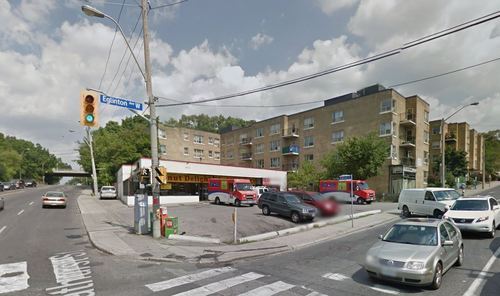
Which is why I said about 3 months ago that if the stations along the new Eglinton Crosstown LRT line in midtown Toronto became single storey and single purpose buildings, that we will have missed an enormous city building opportunity.
Since that post I had a number of conversations with the folks over at Metrolinx and I was delighted to learn that there were in fact plans to build additional density on top of the stations. And as of today they’ve gone completely public with that intention.
Metrolinx, with the help of Avison Young, has just issued a request for proposal (RFP) for 4 sites along Eglinton Avenue in the city. Two of them are at Keele Street, one of them is at Weston Road, and the last one is at Bathurst Street. The 4 sites could generate between $14M – $22M.
The objective is to find suitable developer partners to help them build on top of their planned LRT stations. And it’s a step in exactly the right direction for Metrolinx and this city.
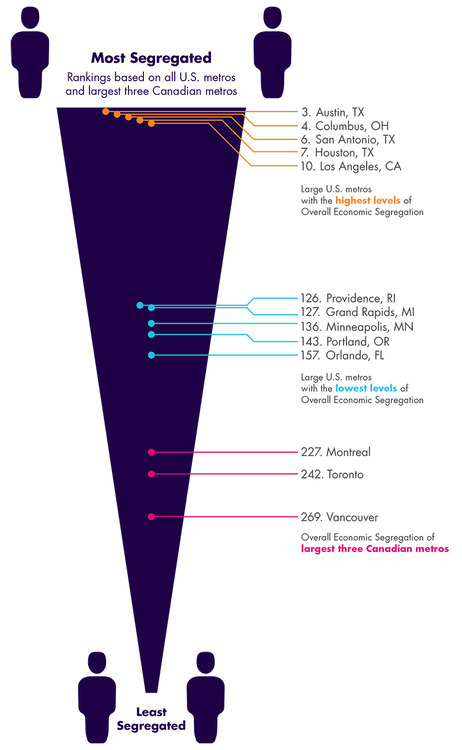
The report looks at the physical sorting and separation of advantaged and disadvantaged groups within cities. And it did so across 70,000+ Census tracts in the US and in terms of 3 different dimensions: income, education, and occupation.
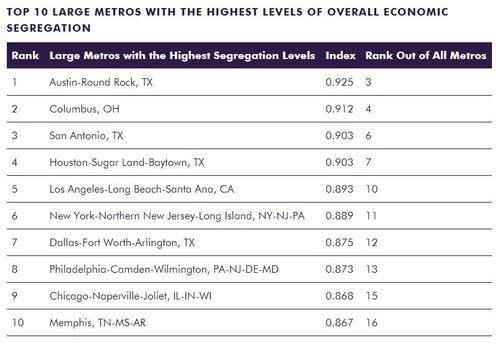
Here are the most segregated “large metros” in the US:
And here are some of their broader findings – taken verbatim from page 9 of the study (click here for the full report):
Economic segregation is positively associated with population size and density. It is also positively correlated to two other sets of factors that follow from metro size and density: how people commute to work and the breakdown of liberal versus conservative voters.
Economic segregation tends to be more intensive in high-tech, knowledge-based metros. It is positively correlated with high-tech industry, the creative class share of the workforce, and the share of college grads. In addition, it is associated with two key indicators of diversity, the share of the population that is gay or foreign-born, which tend to coincide with larger, denser and more knowledge-based metros.
Economic segregation is connected to the overall affluence of metros, with positive correlations to average metro wages, income, and economic output per capita.
Race factors in as well. Economic segregation is positively associated with the share of population that is black, Latino, or Asian, and negatively associated with the share that is white.
Economic segregation is associated with income inequality and even more so than with wage inequality. Its effects appear to compound those of economic inequality and may well be more socially and economically deleterious than inequality alone.
The research team also looked at how Canada’s 3 largest metros – Toronto, Montreal, and Vancouver – compare to those in the US in terms of segregation.
The finding was that Canadian cities are overall less segregated than US cities, but that it should still be considered an area of concern. The most segregated of Canada’s 3 largest metros was found to be Montreal.
My view is that our economy is going through a profound shift right now. We’re transitioning from the industrial age to the information age. And in its wake, we’re seeing a number of disruptions, one of which appears to be rising inequality and segregation.
That’s not to say that I think this transition is a bad thing (I don’t think it is), but I do think we should be carefully considering and designing our future.
Lloyd’s thesis is basically that Ed is wrong in arguing that reducing the barriers to building is the most effective way to maintain housing affordability; that cities are really made out of flesh, rather than bricks and mortar; and that urbanists need to move beyond the view that a city’s past should be preserved at all costs.
Lloyd then goes on to argue that rather than continuing to over-intensify cities like New York, San Francisco, and Toronto, we should be turning our attention to former powerhouses like Buffalo and trying to figure out how to reinvigorate those cities. The bones are already in place.
Now, I don’t disagree that there’s lots of potential in cities such as a Buffalo and Detroit. I’ve written a lot about Detroit and I’m genuinely rooting for the city. But I don’t think it’s as simple as it sounds to shift our attention, and I don’t agree with all of the critiques of Glaeser’s work.
As important as built form is, cities like Buffalo and Detroit remind us that architecture and buildings alone aren’t enough to build a city. There are countless masterpieces – such as Michigan Central Station in Detroit – that regrettably sit abandoned. You need people and communities.
There’s also a snowball effect.
As a city becomes more successful, there’s a natural tendency for more people to want to be there. It’s no different than the network effect experienced by a social network. A social network without people has no value. But the more people you add to it, the more valuable it becomes and the more difficult it becomes to replace.
So it shouldn’t come as any surprise that people will put up with expensive real estate and small apartments just to live in cities like San Francisco. That’s where they want to be. And as long as the demand to live in those cities is increasing, I continue to believe that it makes sense to build more, not less, housing and to make it reasonably easy to do so.
At the same time, I believe whole heartedly in heritage preservation. As a trained architect, there’s a strong possibility that I would shed an actual tear should a building with heritage value be torn down in my city or in any city in the world.
And that’s why when I was on CBC radio last week I said that neighborhood investment needs to be a balance between preservation and progress. The Twittersphere later blasted me for using the term “progress”, but I think you get my position.
My interpretation of Glaeser’s work has never been that he supports completely erasing a city’s past in order to make way for the future. If that is his position, then I too disagree with it.
My interpretation has instead been that he supports removing unreasonable barriers to development so that cities are able to supply – or can at least try to supply – enough housing to meet growing demand. This also doesn’t exclusively mean high-rise intensification. It could mean removing the barriers in front of things like laneway housing. And I continue to believe that this is a good idea.
I don’t believe that this approach alone will solve all housing problems, but I do think it’s a great place to start.
Last Tuesday the app launched in 10 cities across North America. So if you’re in Boston, Chicago, Los Angeles, New York, Portland, Seattle, San Francisco, Toronto, Vancouver, or Washington D.C., you can go ahead and download it right now.
The biggest “wow factor” is probably the augmented reality feature that allows you to hold your phone up and see transit information overlaid on top of the street in front of you.
But more fundamentally, the real potential lies in the platform’s ability to collect data on the way people move in cities and on how transit lines are performing, so that it can be fed back to improve overall efficiency.
That’s why the company is also working with cities to give them 24/7 analytics and reporting on how every bus, car, and train is performing in their networks.
My hope is that with better data at our disposal, we’ll be able to elevate the discussions around transit and transit planning. Without great data, it’s too easy for these discussion to become political.
Back in 2006 when I was fresh out of architecture school and looking for work, I knocked on the door of a design company based in London with my polished resume in hand. I was sleeping on a friend’s couch at the time and the company seemed like a perfect fit for me – so I went for it.
There’s no happy ending to this story though – because I didn’t get past the front door that day – but there’s never any harm in trying. As my friend told me the morning I went: fortune favors the bold.
They call themselves “a residential and hotel design company”, but their model is actually more unique than that. Founded in 1999 by John Hitchcox (a property developer) and Philippe Starck (a rockstar designer), the firm partners with local real estate developers around the world and creates value through design, branding, and marketing expertise – as well as through celebrity names like Philippe Starck and Jade Jagger.
What makes their model interesting is that, unlike the real estate developers they partner with, they’re not assuming the same level of risk (unless, of course, they co-invest). They get paid (well) for the design services and marketing expertise they provide, as well as the brand equity that they bring.
This is similar to what Donald Trump does with some (most?) of his developments now. Want the Trump name on your building? Pay $X. Want Philippe Starck at your condo sales launch? Pay $Y.
When I was in architecture school, I used to wonder why we didn’t talk about the importance of branding and marketing. I thought we should. Which is probably why I ended up in business school afterwards.
I think there’s a lot of potential in overlaps and hybrid business models, which is why I was excited to learn today that YOO has just launched a new architectural practice called YOO Architecture.
I’m sitting in Calgary International Airport right now waiting for my flight back to Toronto. This marks the end of the 6th Penn Annual (our annual ski and snowboard trip). We all had an amazing time and I can’t wait until next year’s annual. We’ve already (pretty much) decided that it’s going to be in Park City, Utah.
As you can probably tell, I like traditions and routines. As boring as that might sound, I think there’s a lot of value in doing the same thing over and over again.
It’s why I do an annual ski and snowboard trip every February with some of my closest friends (to a mountain we’ve never been to before). It’s why I write something – no matter how short it might be – every day here on Architect This City. It’s why I lift weights 3-4 times every week. It’s why I’m interested in brand building (creating equity takes consistency and time). It’s why I love the permanence of real estate. And it’s also why I like dollar cost averaging when it comes to investing.
I guess you could say I like the long game. I enjoy having “disciplines.”
And that’s because I think there are very few substitutes for hard work and sustained efforts. We all love to talk about those overnight success stories, but in reality they’re often the farthest thing from overnight. I know that it takes time to get great at something. And I also know that I’m not always going to be right. But the simple act of not stopping can take you pretty far.
In any event, I hope you enjoyed all the mountain town talk (I have a few more ideas I want to write about) and my Snapchat stories (if you followed along). I got really into Snapchat on this trip. And that’s because I think the platform is at a tipping point where brands are going to start thinking of it as a legitimate marketing channel – and not just an app for teens.
Do you have any routines or disciplines? If so, feel free share them in the comment section below. Or if you hate routines, tell us why.