Daily insights for city builders, delivered every morning at 6 AM ET. I’m Brandon Donnelly — a Toronto-based real estate developer and founder of Globizen. I’ve been writing here since 2013.

Tag: toronto

  • A new chapter

    Photograph St. Lawrence by Ralph Sobanski on 500px

    St. Lawrence by Ralph Sobanski on 500px

    I have an announcement to make on Architect This City today.

    Next week I’m joining the development team at CAPREIT (TSE: CAR.UN) here in Toronto. CAPREIT is one of Canada’s largest residential landlords. They are a growth-oriented real estate investment trust with over 41,839 residential units in major urban centers across both Canada and Ireland.

    They also happen to be headquartered in the St. Lawrence Market area, which means I now live and work in the same neighborhood. As we discussed here, location matters a lot.

    So here’s to a new chapter. I’m looking forward to diving into the multi-family business. Change is good.

  • Waterfront Cities of the World comes to Toronto

    image

    This morning I was interviewed for a Montreal-produced TV show called Ports D’Attache. The English version of the show is called “Waterfront Cities of the World” and it airs on Discovery. 

    Here’s a list of all the cities they’ve visited in the first 4 seasons and here are all the shows from the first 2 seasons in English (which you can watch online for free).

    Rather than a travel show, it’s a look at the “spirit and soul” of each waterfront city through the lens of “local personalities.” There’s definitely a lot of fodder for city geeks and so I thought you all might find the series interesting.

    Toronto was the last stop of season 5. The other cities from this season include Philadelphia, Budapest, Rome, Taipei and Kuala Lumpur, to name only a few of them. 

    I’m glad that they decided to come to Toronto and I’m delighted that they invited me to be on the show. The team was great and, if you haven’t already noticed, I love supporting this city.

    The show will first be released in French (with my comments dubbed over), but an English version will follow. Once that version is released, I’ll circulate a link.

  • Where are Millennials going to move when they start having children?

    Photograph Kembangan by Jason Waltman on 500px

    Kembangan by Jason Waltman on 500px

    Earlier this week I attended RealNet’s Q1 2015 market update webinar for the Greater Toronto Area. If you don’t already subscribe to RealNet, you should consider it. They’re one of the best sources for Canadian real estate market information.

    During their webinars, they occasionally run interactive surveys where they ask the audience a question and participants respond using their web browser. On this particular webinar, they asked the following question, which I thought was interesting:

    What is the likely housing moving by Millennials in raising their families?

    A) Move Up – Embrace urban high-rise housing forms

    B) Move Out – Accept extended commutes (including the Greater Golden Horseshoe and Hamilton Area) to find affordable ground oriented housing

    C) Move In – Cohabitate parental homes

    It’s an interesting question because it’s one that I’ve asked myself a number of times. Sure, Millennials are rushing back to cities and living in high density and walkable communities, today, but what are they going to do and where are they going to move when they start having children?

    As a Millennial myself, I know that I’ve always told myself that I want to stay urban for as long as I can (i.e. Move Up). But I’m only one data point. And given the seemingly endless demand for low-rise housing in Toronto, I always felt like I was in the minority. I figured that the majority of people, at least here in this city, still want a ground-related home when it comes time to raise a family.

    Putting aside economics, I still think that may be the case for a lot of home buyers. But the majority of people on this week’s RealNet webinar (which would be almost exclusively folks from the real estate industry) either think that preference is going to change (or already has) or that consumers won’t have a choice due to affordability.

    50% of the people on the call answered A – move up and embrace urban high-rise housing forms. The balance was about 44% for B and 6% for C.

    That’s not the outcome I expected to see. So today I’d like to re-ask this question to the Architect This City Community. Where do you think Millennials are going to move once they start having children? Please let us know in the comment section below.

  • Ace Hotel coming to Toronto’s Fashion District

    https://500px.com/embed.js

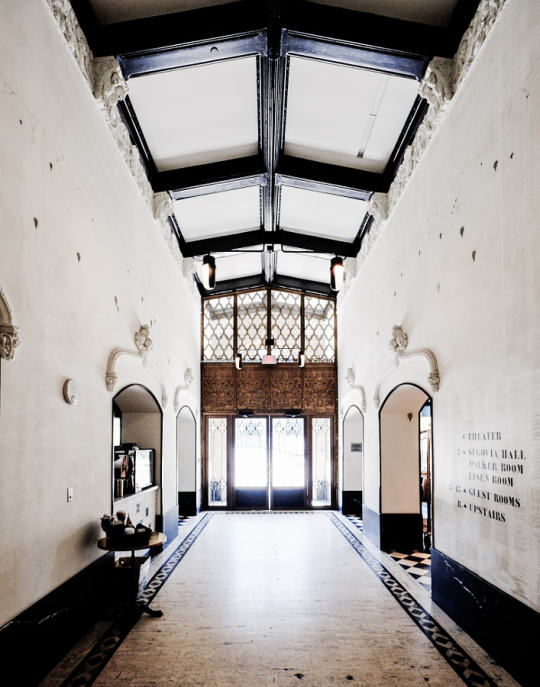
    The word on the street right now is that Ace Hotel will be opening up a location in Toronto’s Fashion District at 51 Camden Street. 

    Unlike its other outposts around the world, which entailed the renovation of a historic building, this one will be a new build. And according to HotelChatter, Shim-Sutcliffe Architects have been retained for the project.

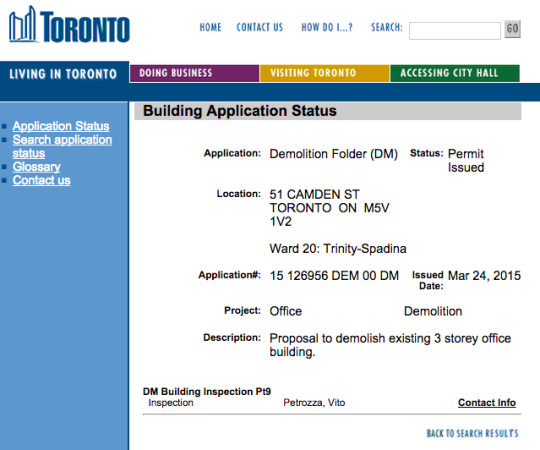
    Already a demolition permit has been issued for the existing 3 storey office building:

    image

    For those of you who may not be familiar with the Ace Hotel brand, the first hotel opened in Portland in 1999 when 3 friends transformed a halfway house into an affordable hotel for creative types. 

    Since then, the hotel has expanded to New York, Los Angeles, Seattle, Palm Springs, as well as many other cities, and has become a kind of cultural institution for the creative class.

    I’m excited that they have (allegedly) picked Toronto for their next property and I’m excited that Shim-Sutcliffe will be (supposedly) designing it.

  • A Jane’s Walk about the Gardiner Expressway

    image

    This May 2nd at 1:00pm I’m going to be participating and speaking at a Jane’s Walk here in Toronto called, Gardiner Expressway: To be or not to be? 

    The other “walk leaders” include Andrew Hilton, City Councillor Jaye Robinson, Ed Levy, Kyle Baptista, and architect Les Klein (Quadrangle Architects).

    This will be my first time going to a Jane’s Walk, but it’s clearly a topic that I’m interested in. For over a year I have been arguing that we should remove the Gardiner East (the portion east of Jarvis Street).

    This has proved to be a contentious position and topic. One critic said that I only want to remove the Gardiner East so that – as a real estate developer – I can make it harder for people to get into the city, which in turn will force them into buying more condos in the city. 

    That was not my thinking.

    Instead, I view it as an opportunity to truly unlock the eastern portion of Toronto’s waterfront and the Portlands area. Take a look at the Keating Channel (shown above) and tell me whether or not you could imagine a better and more urban kind of waterfront. I get excited when I think of the potential.

    And, if we’re going to do this, I believe now is the time, before the area gets developed. Because once it gets developed around the Gardiner, things will never be quite the same – even if we do eventually remove or bury it.

    Click here for more information on the Jane’s Walk. Please also keep in mind that there will be many other viewpoints expressed at the Walk. This is just mine.

    Image: Gardiner Expressway and Don River, Flickr

  • Condo or rental apartment — does it matter?

    Photograph Community by Evgeny Tchebotarev on 500px

    Community by Evgeny Tchebotarev on 500px

    Toronto is the condo capital of North America. For a number of years now, there have been more condos under construction in this city compared to any other in North America, including New York.

    But recently the real estate community has become incredibly interested in building multi-family apartments (also known as purpose-built rental buildings). Which is why about 7 months ago I wrote a post called, Rise of rental.

    It has been decades since Toronto built rental apartment buildings at any sort of scale. That means that our existing stock is generally pretty old and that condominiums – rented out by individual investors – have been almost exclusively fulfilling the need for rental apartments in this city.

    But given that purpose-built rental apartments are on the rise, I’ve been thinking a lot lately about them and about the consumer perspective. 

    And so here’s my question to you:

    If you were looking for a place to rent, would it make a difference whether it was a condominium (rented out by an individual investor) or whether it was a professionally managed apartment building? You can assume that the suite itself is identical.

    There are obviously many differences between both forms of tenure, but I’m curious to what extent that factors into the decision making process for consumers. It hasn’t really been an option in recent years, but that seems destined to change.

    I hope we can have a discussion in the comment section below.

  • Why Toronto-Waterloo needs all-day two-way urban rail service

    image

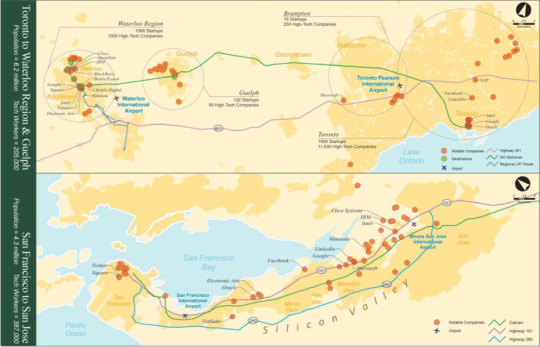
    This morning I stumbled upon an interesting Medium article talking about the need for an all-day two-way urban rail service between Toronto and Waterloo. 

    The argument is that along this corridor sits a technology ecosystem that is second in size only to San Francisco-Silicon Valley and that current connectivity levels represent a missed opportunity of epic proportions. Presently this rail service will feed you into Toronto during the morning rush hour and take you back out in the evening rush hour. But that’s it.

    According to this report prepared by the City of Kitchener (which is beside Waterloo), efficient train service would stitch together an ecosystem of approximately 12,800 technology companies, 2,800 startups, and 205,000 technology employees. It would also connect 6 universities and 4 colleges, many of which are ranked top in the world.

    There’s an argument here that this is exactly the sort of thing that governments should be doing to encourage innovation and entrepreneurship. Rather than trying to be heavily involved in actual startups, they should be creating an environment that maximizes output and then getting out of the way. 

    I think this makes a lot of sense. Don’t you?

    Image: The Innovation Express

  • Moving downtown

    Last month it was announced that Amazon will be taking 127,000 square feet across 5 floors in a new office tower in Toronto’s emerging South Core neighborhood. The space will be used for about 800 employees and they’re expected to take occupancy this fall.

    At the same time, I learned that Amazon will be joining Apple (positioned 6 floors below them in the same tower) and Cisco in South Core.

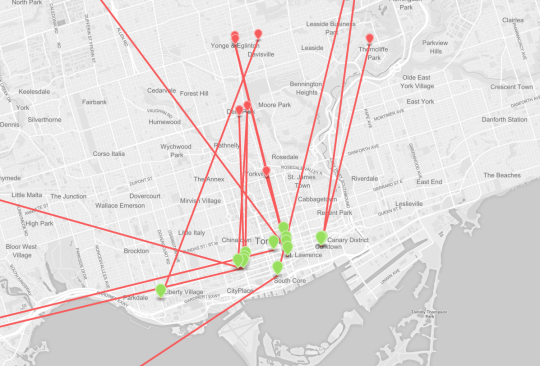
    On top of all this, a friend of mine then tweeted out a list of major tenant re-locations here in the city. The data is from CBRE and the timeframe is from 2009 to 2014 (Q1).

    The first thing I noticed when I looked at the data is that there’s a clear trend towards downtown. Perhaps that was the point of the study, but it’s still interesting nonetheless. 

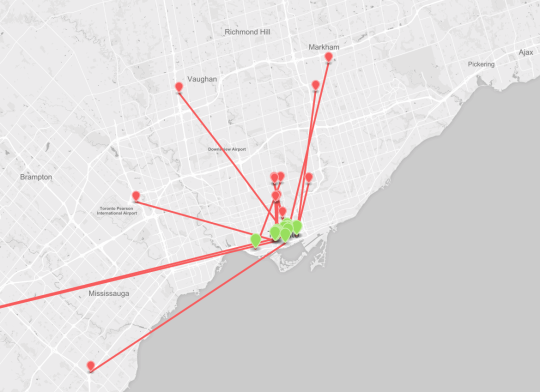
    From Google and Deloitte to eBay and Aol, every single tenant in the CBRE list is or will be moving downtown (or to the shoulders of downtown).

    Here’s what that looks like from a regional scale (red marker is where they were; green marker is where they are going):

    image

    And here’s what it looks like zoomed in closer:

    image

    This, of course, is a trend that has been happening for years. But I still think it’s worthwhile repeating how clearcut it seems to be. 

    Companies know that their greatest asset is human capital. And they have quickly realized that a lot of young smart people want to live and work in dense walkable communities. They’re simply moving to where people already want to be.

    So here’s a question for the Architect This City community: On a scale of 1 to 10, how important is a company’s location when determining whether or not you’d like to work for them? Let’s talk about it in comment section below.

  • A comparison between low-rise and high-rise housing costs

    Earlier this week the Globe and Mail reported that the average price of a house in Toronto has risen to $613,933 and that the average price of a detached house has risen to $1,042,405. Those are a big numbers.

    Low interest rates are a big part of this story. But there’s also a supply story at play here. The low-rise housing market in this city is heavily supply constrained and so we have an environment where people with more money simply outbid those with less money.

    The high-rise side of the market, on the other hand, is creating lots of new supply. And in my opinion that’s why its price growth has been more moderate in recent years and why the pricing spread between low-rise and high-rise housing continues to widen.

    Assuming these trends continue, one of the things I’ve thought about and written about in the past is whether we’ll eventually seeing a point where high-rise housing actually becomes a more affordable option for families. Because right now, if you’re in the market for a 3 bedroom home, a low-rise house is likely your most affordable option.

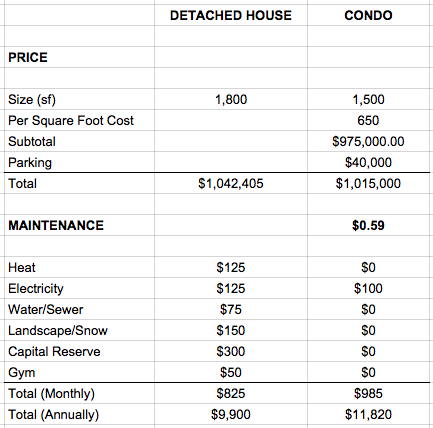
    Here’s a quick comparison that I did up this morning between a detached house and a high-rise condo:
    image

    For the detached house, I assumed 1,800 square feet at a price of $1,042,405. That’s the average price mentioned above. 

    For the condo, I assumed a 1,500 square foot 3 bedroom home. I priced it at $650 per square foot (which would be above average for the city) and then added $40,000 for a parking spot. Here you have a slightly smaller condo, but it’s also priced slightly less.

    I then compared operating/maintenance costs. For the condo, I assumed a maintenance fee of $0.59 per square foot (which I think is reasonable) and then added $100 per month for electricity. Typically electricity is billed outside of maintenance fees.

    For the detached house, I tried to create a similar living situation. I assumed that the owner wouldn’t be cutting their own grass or shovelling their own snow. I assumed that money would be put away each month as a capital reserve for future house expenses (similar to the reserve fund in a condo). And I assumed a gym membership since most condos have a gym. I ignored property taxes and insurance.

    The detached house still works out to be a less expensive to operate in this scenario, but not by much. Overall, the two appear quite comparable. Which is why I wouldn’t be surprised if we see a tipping point in the future where all of a sudden families start finally adopting the mythical 3 bedroom condo.

    I have published my spreadsheet to the web in case you disagree with my assumptions and want to create your own.


  • 10 ways that cities can take advantage of the urban manufacturing revival

    image

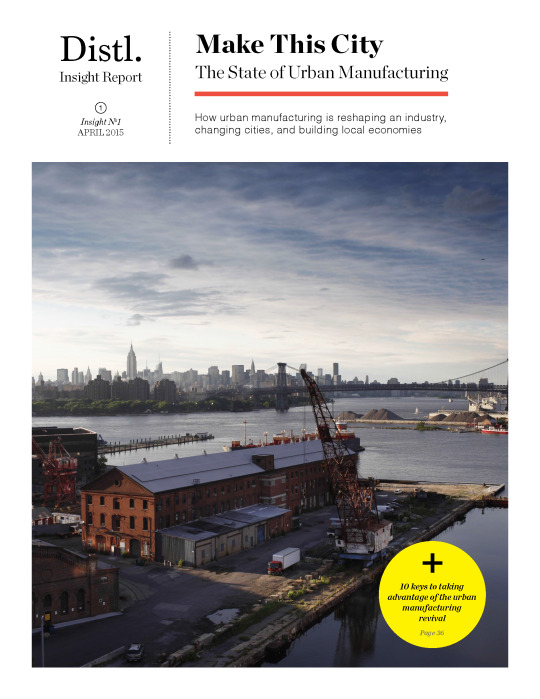
    My good friends over at Distl here in Toronto have recently published their first Insight Report. It’s called, Make This City: The State of Urban Manufacturing, and it’s available via free download here. I like the title 😉

    The report is 39 pages and is really well put together. There’s research, case studies spanning San Francisco to Toronto, and some great takeaways for city builders.

    Since the internet likes listicles, here’s a preview of some of those takeaways – 10 ways that cities can take advantage of the urban manufacturing revival: 

    1. Preserve urban industrial areas
    2. Focus on the niche
    3. Public investment is a good investment
    4. Think mixed-use
    5. Diversify learning
    6. Redefine industrial assets
    7. Connect supplier & retailer
    8. Leverage your city’s brand
    9. Form supportive organizations
    10. Leverage partnerships with both the private and public sectors

    But it’s definitely worth a complete read and I plan to do exactly that this weekend. Click here to download Make This City.