Daily insights for city builders, delivered every morning at 6 AM ET. I’m Brandon Donnelly — a Toronto-based real estate developer and founder of Globizen. I’ve been writing here since 2013.

Tag: toronto

  • Monocle’s Top 25 Liveable Cities — 2016 Edition

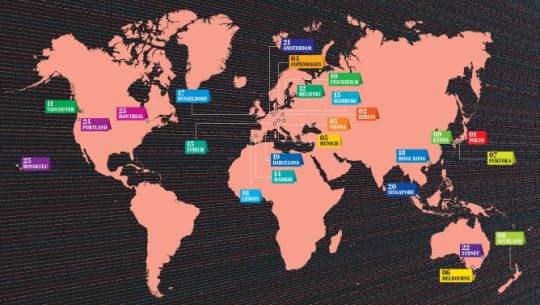
    Monocle’s annual survey of the top 25 most liveable cities in the world was just released. It’s now in its 10th year. I found it in my inbox this morning and it was a good reminder that it was about time I renewed my subscription. I’ve been a regular reader of Monocle since 2007, but I let my membership lapse last year.

    Of course, any sort of list like this is going to be subjective. It all depends on the methodology you use. Still, their annual survey is an interesting way to see what each city is up to and where the tides are going. This year Monocle put extra weighting on each city’s nightlife. If you’re not a subscriber, here’s a short video you can watch. It will give you a rundown of all the cities. (I was happy to see Montréal creep onto the list. Incredible city.)

    This focus on the night is something that I’ve been writing about a lot both on this blog and elsewhere. It’s an idea that’s picking up momentum around the world as an economic development strategy. But for whatever reason, uptake seems to be slower here in North America.

    I like how architect Anna Dietzsch puts it in this video. She says that Rio may have the beaches, but Sao Paulo (where she’s based) has the night. That’s exactly how cities should be thinking about this opportunity. It used to be that cities thrived almost entirely because of location, waterways, transport, and other natural features (example: Buffalo). But increasingly, it’s becoming about things like nightlife.

    Vancouver may have the mountains, but Toronto has…

    Image: Monocle

  • What I’m doing next

    image

    A number of you have asked if I’m moving to New York. I can see why that was inferred from some of my posts, but that was actually not my intention. I am not moving to New York. (Sorry New York friends. I’ll visit soon.)

    Toronto is home base. I hope it’s clear how much I love this city. Sure, I’m a big fan of New York and Miami and Vancouver and Berlin and Tokyo and Jackson (to name some of the places I have on my phone’s weather app), but I made a deliberate choice to station myself here.

    Because unlike some of the other industries I write about on this blog, city building is hyper local. What I do involves the built environment. And that doesn’t generally happen via a laptop on a beach in Bali (at least not for extended periods of time).

    It happens by being on the ground, interfacing with local communities, meeting face-to-face with the city, and poring over drawings with smart people who know far more about their respective disciplines than I ever will. It is a collaborative and local effort. It’s about getting into the details.

    And so to be successful in this business, I think it helps to find a home and take long bets. I’m not saying that I will never work on projects in other cities (I have and I would), but I am saying that I’m not moving to New York right now and that home remains Toronto.

    On that note, here’s what I have to tell you. Later this year I’ll be joining Slate Asset Management as VP of Development.

    A bit about Slate:

    Slate is one of the most active acquirers, owners, and managers of real estate in Canada right now. Founded in 2005 by two brothers (Blair and Brady), Slate has over $3 billion of assets under management across over 16 million square feet and over 130 properties.

    All of this is done through four main investment vehicles: 

    1) The first is Slate Advisors. It acts on behalf of and alongside private institutional investors — such as Greystone.

    2) The second is Slate Office REIT (TSE:SOT.UN). It is a pure play Canadian office REIT focused on downtown and suburban properties all across the country.

    3) The third is Slate Retail REIT (TSX:SRT.U). It is a pure play REIT entirely focused on grocery-anchored U.S. retail properties. (Remember how many times I’ve written on this blog about how grocery has one of the lowest online shopping penetrations?)

    4) And the fourth: Slate is also starting a grocery-anchored retail platform in Germany. It is similar to #3, except that it’s in Germany.

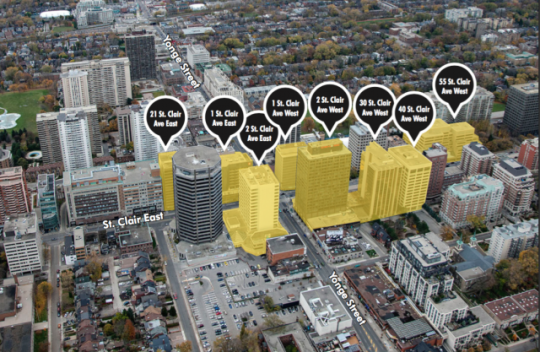
    Most recently, Slate has been in the news because of the position it has taken at Yonge + St Clair in midtown Toronto — a perfect example of “finding a home and taking long bets.” Slate, in partnership with Greystone, owns all 4 corners of the intersection and about 60% of the properties along the St. Clair corridor.

    Here’s a diagram of those Slate buildings:
    image

    In case you didn’t put two and two together, the 8-storey mural I wrote about two weeks ago is going up (right now) on the side of a Slate building (1 St Clair Avenue West — shown above). The British street artist known as Phlegm is doing it.

    Up until today, the focus of Slate has largely been on acquiring undervalued / overlooked real estate and creating value through re-leasing and overall repositioning. That will certainly continue. But given what I do, I am sure you can posit what’s also next.

    I’m genuinely excited to be joining such a talented group of real estate professionals. As I mentioned last week, I wasn’t in the market for anything new. I was heads down working on cool projects. But life happens. And Slate quickly demonstrated to me that the incredible success they have seen to date is precisely because of how progressive, nimble, and entrepreneurial they are.

    On that note, I have “one more thing” to share today.

    In parallel to all of this, and with the support of Slate, I am also starting a boutique city building company called Globizen. The name is derived from Global + Citizen.

    The objective is to build a company that embodies everything I write about on this blog. I want it to be lifestyle and design-driven. I want it to leverage technology to improve the way that cities and the building industry operate. And I want it to function as a vertically integrated real state + design firm, focused on sustainable urban infill development. Think of it as city building by and for the responsible global citizen.

    It’s still early days, but the thinking is that this new platform could compliment the larger Slate platform in some way. It’s too early to say how exactly, but everyone is open to having those discussions. And that’s what matters at this stage.

    I am going to end with a quote. It’s by Partner and Co-Founder, Blair Welch:

    “On all of our deals we have had people say ‘can’t’ to us. They say ‘Can’t be done, can’t do that, can’t raise money, etcetera.’ At Slate, we don’t do ‘can’t’ well.”

    I like that a lot. So here’s to finding a home, taking long bets, and not saying can’t. Onward my friends. 

  • Urban pet peeve: copycatting

    One of my biggest pet peeves is when cities copy things from other cities. 

    Let me give you an example. Whenever I see one of those red double decker tourist buses roaming around Toronto, I always look to see if it’s the type that has London signage and destinations plastered all over it. And when it is, I cringe. (I saw one earlier today.)

    Why would anyone design a tourist bus that makes you feel like you’re half in another city? I don’t get it. The whole reason people are getting on that bus is because they’ve come to visit this city. It should make you feel like you’re here and nowhere else. It should feel locally authentic.

    To be clear, I’m not saying that we shouldn’t be learning from other cities and building on top of other’s great ideas. That’s precisely what we should all be doing. I’m talking about kitschy copies with little additional thought put into them. And I can think of many examples beyond just tourist buses.

    Am I just being pedantic?

    What about you? Any urban pet peeves?

  • Two open real estate development positions

    I recently alluded to some life changes on this blog. Well, I am now ready to share: I am leaving my development position at CAPREIT.

    I wasn’t intending to leave. I wasn’t looking to leave. And frankly, I felt conflicted. But sometimes life has a funny way of presenting opportunities that you just have to say yes to. As my mother likes to tell me: “Life is what happens to you while you’re busy making other plans.” More on this in a later post. Stay tuned.

    What I would like to talk about today are the opportunities that this may create for some of you. There are now two open development positions at CAPREIT. Both positions would be based in downtown Toronto (St. Lawrence Market).

    The first opportunity is essentially a Director level role where you would be responsible for growing the development team at CAPREIT. You should be able to lead a team, identify new development opportunities, create pro formas, assemble/manage consultant teams, secure development approvals for complex urban infill sites, and generally lead projects and people through the entire development lifecycle. For more information and to apply, click here.

    The second opportunity is at the Coordinator level. You would be reporting day-to-day to the above person and you should have working knowledge of the development process. For more information and to apply, click here.

    I would just like to add that in both cases you would be working on some very exciting urban infill projects and you would be joining an organization with great people and a great corporate culture. I mean this sincerely. If you have any questions about the two roles, feel free to reach out to me directly. And if you’re in the market, consider applying.

  • We’re eliminating parking minimums

    I’ve been writing about the hypocrisy of parking minimums for years now. Some posts here, here, and here. 

    To me, it doesn’t make sense to try and promote more sustainable forms of urban mobility while at the same time mandating a minimum number of parking stalls in every new development. 

    Do you want people driving or not driving? Pick one.

    That’s why I was happy to see the following action item in the province of Ontario’s five year plan to transition to a low-carbon economy and fight climate change (thank you Ken Wilcox for bringing it to my attention):

    image

    I haven’t gone through the entire action plan and so this post is not a commentary on that. It is, however, a commentary on subsection 1.4. I believe it is the right thing to do and I’m stoked to see it in the plan.

  • Global street artist paints 8-storey mural in midtown Toronto

    This morning

    (Friday, July 8th)

    at 11AM eastern time, the global street artist Phlegm will start work on a giant 8-storey mural at the corner of Yonge + St. Clair in midtown Toronto. It’s going up on the west elevation of 1 St. Clair West.

    Here’s what it will look like when it’s complete:

    image

    The piece is intended to be experienced at two different scales. From afar, you read it as a human figure embracing itself. (See it?) Once you get closer, you are then drawn into an intricate interpretation of the Toronto landscape – both built and natural.

    Embedded within are depictions of the Royal Ontario Museum (including Daniel Libeskind’s Crystal), the SkyDome (yes, the SkyDome), the St. Lawrence Market (my hood), the CN Tower (obligatory), as well as other landmarks in the city. It’s going to be awesome.

    The project is a STEPS Initiative and it is being supported by the City of Toronto, Slate Asset Management, CBRE, CIBC, and a few others. They have also setup a great website with a live webcam, so that you can follow along as the artist works.

    At the time of writing this post, nothing yet has happened. But by the time it reaches you (email subscribers) it should be well underway. The hashtag for all of this is #PHLEGMPAINTS. 

    Big things are starting to happen at Yonge + St. Clair.

  • Home prices and negative interest rates

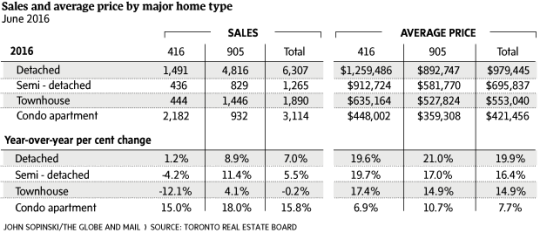
    This morning, I am looking at the following chart of average home prices in the Greater Toronto Area:

    It’s from this Globe and Mail article.

    These are staggering numbers. The average price of a detached home in the suburbs (905 area code) increased 21% year-over-year. In the city (416 area code), the increase was 19.6% YOY. These numbers are almost unbelievable.

    The article focuses on low supply (decrease in listings) and high demand. And that is certainly a big part of what’s going on here in this city, as well as in many others.

    But of course, the backdrop to all of this is our low / zero / negative interest rate environment.

    Larry Summers has a great post on his blog (which I discovered this morning via Fred Wilson) that talks about this “remarkable financial moment.” In some instances, real interest rates are actually negative! (You should read his post.)

    There are always people threatening that interests rates just have to go up. But Larry, as well as others, continue to argue that natural real interest rates are likely to remain close to zero going forward.

    Fred mentions Albert Wenger on his blog this morning and I have written about him before as well, here. In his book World After Capital, Albert argues that capital is no longer the scarce resource of our time. Instead, it has become attention.

    If you believe all of this to be true, then perhaps the numbers at the top of this post aren’t so unbelievable after all.

  • The most fascinatingly boring city in the world

    The Guardian Cities UK is currently focusing on all things Canada for a special week-long series. The first post is up and it’s about why Toronto is “the most fascinatingly boring city in the world.” The piece is by Stephen Marche.

    I don’t agree with everything in the essay – or maybe I just despise being called boring, steady, and predictable – but there are a number of great gems that I would like to reblog today. Here are the 5 that stood out for me.

    1. Chicago vs. Toronto:

    “What Chicago was to the 20th century, Toronto will be to the 21st. Chicago was the great city of industry; Toronto will be the great city of post-industry. Chicago is grit, top-quality butchers, glorious modernist buildings and government blight; Toronto is clean jobs and artisanal ice-creameries, identical condos, excellent public schools and free healthcare for all. Chicago is a decaying factory where Americans used to make stuff. Toronto is a new bank where the tellers can speak two dozen languages.”

    2. London vs. New York vs. Toronto Bankers:

    “In London and New York, the worst stereotype of a banker is somebody who enjoys cocaine, Claret and vast megalomaniac schemes. In Toronto, a banker handles teachers’ pension portfolios and spends weekends at the cottage.”

    3. Montreal vs. Toronto:

    “I was 19 when he said that, and I knew even then that for the rest of my life, Canada’s future would be built on money and immigrants. I wasn’t wrong. Most Canadian business headquarters had already taken the five-hour drive west. After 95, the rest followed. Montreal decided to become a French-Canadian city. Toronto decided to become a global city.”

    4. The last time Toronto built a white elephant subway line:

    “On any given morning on the Sheppard subway line in the north of the city, you can sit down in perfect peace and order, although you will find little evidence of good government. As the latest addition to Toronto’s fraying infrastructure, the Sheppard subway is largely untroubled by urban bustle. The stations possess the discreet majesty of abandoned cathedrals, designed for vastly more people than currently use them, like ruins that have never been inhabited. Meanwhile, in the overcrowded downtown lines, passengers are stacked up the stairs. The streetcars along a single main street, Spadina, carry more people on a daily basis than the whole of the Sheppard line, whose expenses run to roughly $10 a passenger, according to one estimate. A critic has suggested that sending cabs for everybody would be cheaper.”

    5. On Mayor Tory:

    “The current mayor, John Tory, is not an idiot, although he is hardly a figure of the “new Toronto”. He represents, more than any other conceivable human being, the antique white anglo-saxon protestant (Wasp) elite of Toronto, his father being one of the most important lawyers in the city’s history. The old Wasps had their virtues, it has to be said – it wasn’t all inedible cucumber sandwiches and not crying at funerals.”

  • Building new, better cities

    Earlier today my friend Saadat sent me the following tweet:

    //platform.twitter.com/widgets.js

    It’s a link to a new research project by Y Combinator – the famed Silicon Valley seed accelerator. They want to explore the possibility of building new and better cities.

    I don’t have the time for something like this, but if any of you are city experts (I know a lot of you are) and you’re based in or willing to be based in San Francisco (I think they are flexible on this), you should absolutely consider applying to be their full time “Cities Researcher.” The deadline is July 30, 2016.

    Here’s a taste of what they are thinking about…

    There are many high-level questions we want to think through, for example:

    – What should a city optimize for?

    – How should we measure the effectiveness of a city (what are its KPIs)?

    – What values should (or should not) be embedded in a city’s culture?

    – How can cities help more of their residents be happy and reach their potential?

    – How can we encourage a diverse range of people to live and work in the city?

    – How should citizens guide and participate in government?

    – How can we make sure a city is constantly evolving and always open to change?


    And there are tactical questions we want to dig into, for example:

    – How can we make and keep housing affordable? This is critical to us; the cost of housing affects everything else in a city.

    – How can we lay out the public and private spaces (and roads) to make a great place to live?

    – Can we figure out better zoning laws?

    – What is the right role for vehicles in a city?

    – Should we have human-driven cars at all?

    – How can we have affordable high-speed transit to and from other cities?

    – How can we make rules and regulations that are comprehensive while also being easily understandable?

    – Can we fit all rules for the city in 100 pages of text?

    – What effects will the new city have on the surrounding community?

    The convergence of city building and tech is something that I’m deeply interested in. I also think it’s inevitable. And I think that Toronto – thanks to our robust real estate industry – is in an ideal position to be a leader in this space. So I would love to see someone from here take on this job.

    But even if you’re not from Toronto, you should still apply because it’s an exciting initiative 🙂

  • The Scarborough Subway Extension is a mistake

    Last weekend over dinner, a friend of mine asked me what I thought about the Scarborough Subway Extension debate going on in Toronto right now. Costs are coming in higher than initially projected and the usual back and forth is taking place. Transit blogger Steve Munro has a good post on this called Spinning a Tale in Scarborough.

    I haven’t written much about the Scarborough Subway, but I do have a strong opinion. I believe it’s a mistake. I am not saying that we shouldn’t be building higher order transit in Scarborough – we absolutely should – but it does not need to be an expensive subway line. There are more sensible solutions.

    Here are a few things to consider:

    Light rail transit (LRT) does not equal streetcar. As an avid user of the King streetcar, I’ll be the first to admit that something needs to be done to address the city’s busiest streetcar routes. They are broken. But this is not what was being previously contemplated for Scarborough. True LRT – which Toronto does not yet have – is far more effective at moving people.

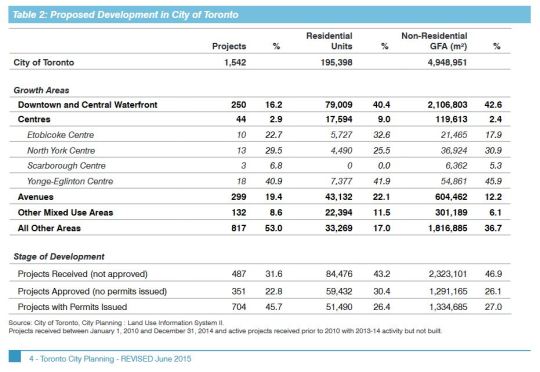
    Scarborough Centre is seeing almost no new residential and commercial development. In fact, the “Centres” in general are not seeing much development. The largest share is happening downtown, along the central waterfront, and along the “Avenues.” We shouldn’t ignore this when making our investment decisions. Transit and built form go hand in hand. 

    I also do not buy the argument that we are building this subway in anticipation of demand 50 or 100 years from now. We are not in a position to be proactive about our infrastructure. We are desperately playing catch up and there are already lots of high growth and high density areas in the city which today are completely underserved by higher order transit. 

    Finally, a new subway line with low ridership will mean higher operating cost subsidies to keep it afloat. And at the rate that Scarborough Centre is growing today, this would likely continue for many years into the future. Not only is this debate about spending money today, it is about spending money well in the future, month after month.

    So let’s be clear: the Scarborough Subway Extension debate is about politics. It is not about transportation planning.