Daily insights for city builders, delivered every morning at 6 AM ET. I’m Brandon Donnelly — a Toronto-based real estate developer and founder of Globizen. I’ve been writing here since 2013.

Tag: toronto

  • Learning from King Street

    Toronto is now a week into the King Street Transit Pilot.

    It’s still early days and transit guru Steve Munro hasn’t yet published any before and after route performance. He will. But already the sentiment seems to be clear: This shit is working. There are many recounts of people’s commute times being more than cut in half. 

    As somebody who walks this stretch of King every day, this isn’t surprising to me. There has been a dramatic reduction in the number of cars on the street.

    What is perhaps surprising is that none of the surrounding streets seem to be any busier. I would like to see the data, but it feels as if most of the cars have simply disappeared. Are more people now taking transit? Has this been your impression?

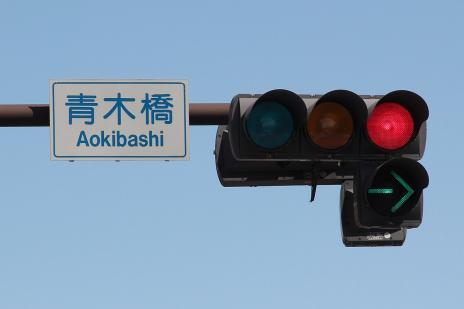
    Of course, the pilot isn’t perfect. What is not working are the signs that tell drivers they can’t drive through most of the intersections (only turn right). The circular green lights confuse them or they simply don’t care. 

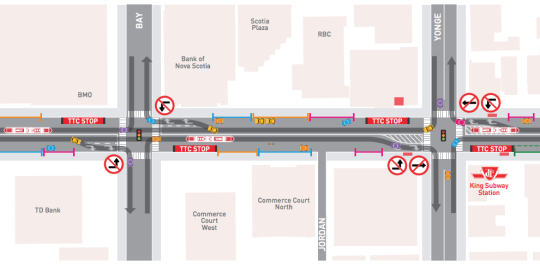
    There have been suggestions for better signals, such as this one:
    image

    And if the pilot in its current incarnation does stick, I am sure there will be many additional improvements like this one made. But even at this early stage, Toronto is calling the pilot a “transit miracle.”

    When City Council approved the pilot in the summer it had a preliminary cost estimate of $1.5 million. (Figure excludes the lost parking revenue associated with removing approximately 180 on-street parking spaces).

    This is a relatively minuscule amount considering it has had an immediate impact, basically overnight, on the commute times of the 65,000 or so people who use this line every day.

    And it feels even more minuscule when you consider that our Scarborough Subway extension is expected to cost $3.35+ billion to build and only service around 64,000 people a day when you look far into the future – 2031 to be exact.

    The lesson here on King Street should be that light rail and surface transit routes can move lots of people very efficiently and cost effectively when you empower them to do precisely that.
  • The Toronto and Vancouver housing markets

    CIBC World Markets recently published this report by Benjamin Tal talking about the Toronto and Vancouver housing markets. Here is an excerpt:

    “But when the fog
    clears it will become evident that the
    long-term trajectory of the market will
    show even tighter conditions. The supply
    issues facing centres such as Toronto and
    Vancouver will worsen and demand is
    routinely understated. Short of a significant
    change in housing policies and preferences,
    there is nothing in the pipeline to alleviate
    the pressure.”

    It’s a good read. Worth your time.

    One stat that stood out and directly relates to some of the topics that we frequently talk about on this blog is the shift in Toronto from low-rise to high-rise housing.

    In the report there’s a chart showing the “change in [housing unit] completions” in 2016 as compared to 2000. The switch from low-rise to high-rise is almost 1:1 in Toronto. In other words, we substituted high-rise housing for low-rise housing. 

    I think this speaks volumes about the fundamentals underpinning the Toronto condo/apartment market. We are continuing to build up because it is the future of housing in this city.

  • The King Street Transit Pilot has started

    Back in January 2016, I wrote about Toronto’s ambition to transform King into a “transit first” street across the downtown core. 

    The King streetcar is the busiest surface transit route in the entire city (65,000 riders / day on average) and it was – and continues to be – my opinion that the route was broken. Something had to be done.

    Well, that something is now happening. The “King Street Transit Pilot” officially started on Sunday, November 12, 2017 at 7am. Here are some of the key changes, many of which are also depicted in the above image:

    – No more on-street parking in the pilot area.

    – Cars can no longer turn left or drive through the intersections of the pilot area (except for taxis picking up drunk people from 10pm to 5am).

    – Cars must now follow a right-in/right-out approach. They can turn right onto King, but then they have to turn right off of King at the next intersection.

    – Most of the streetcar stops have been moved to the “far side” of each intersection. That is, after the lights. Passenger waiting areas are now in the curbside lane and protected by jersey barriers.

    – Cyclists can go through the intersections of the pilot area. “Bike boxes” have been added to intersections where there are north-south bike lanes to help with turning left.

    As to be expected, some people are upset about the above changes. There are also concerns that drivers aren’t going to obey the rules and continue to drive through the intersections in the streetcar lane. But this is a pilot project. It’s about learning and adjusting.

    It’s also important to keep in mind that King has at least 3x more transit riders than cars. This pilot is about figuring out how to best optimize the street so that it moves the greatest number of people as efficiently as possible.

    I’ll report back here on the blog once the pilot has settled in and there is a better understanding of its impact.

  • Planning dinner, smart cities, and privacy

    image

    This evening I attended the 27th Annual Toronto Planning Dinner. It’s an annual dinner for people in planning and development, put on by the University of Waterloo Planning Alumni of Toronto. Thank you Wood Bull LLP for the invite.

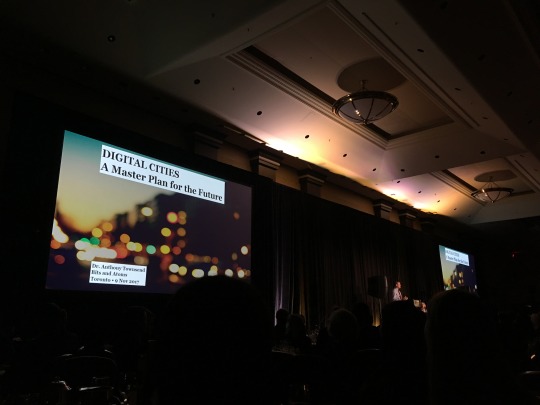
    The keynote speaker was Dr. Anthony Townsend. He is the author of SMART CITIES: Big Data, Civic Hackers, and the Quest for a New Utopia. I haven’t read it (yet), but his talk offered a preview of it and I think it would be of interest to all of you.

    It deals with many of the topics that we discuss on this blog, one of which is the interrelationship between our physical environment and the networks and software layers that we are now building on top of it.

    These layers have the potential to augment and enhance our cities (maybe make them smarter), but they also have the potential to do us harm. One important issue that Townsend brought up is that of privacy.

    Cities used to enable anonymity. 

    When essayist and art critic Charles Baudelaire wrote about “modernity” in 19th century industrializing Paris, it referred to an ephemeral and fleeting kind of urban environment. Pass someone on the street and you may never see them again. That must have felt sad at the time.

    Today we live in a fish bowl. 

    Networks connect us, check us in, ping us when we are nearby people we know, and help us find people to meet and date. And we already have devices, like Alexa, that spy on us in our homes so that companies can serve us targeted ads. (This is deplorable by the way.)

    Will the city of the future endeavour to do the same as we equip it with more “smarts”?

    I guess that’s why Townsend believes that privacy will define a big part of 21st century urbanism. There’s no doubt that it will be very important.

  • Toward more family condos

    The Ryerson City Building Institute and Urbanation recently published a terrific report called: Bedrooms in the Sky. Is Toronto Building the Right Condo Supply? 

    Here is a quick synopsis: The 35-44 year old age bracket in this city will see significant growth over the next decade; single family homes are really expensive; and we’re not building enough family-friendly condo units.

    When Urbanation looked at the data for all condo units currently under construction they found that the unit mixes still skewed toward 1-bedroom units, but that the number of 3-bedroom units is starting to trend upward. That feels right.

    The report also talks about the affordability gap between condos and houses. The average condo in the Greater Toronto Area costs about $511,000, while the average detached house costs $1,134,000.

    However, this isn’t exactly an accurate comparison because the average condo is smaller in size than the average house. I think a better metric is to look at price per square foot.

    Also, houses give you the flexibility of a secondary suite. Right now that usually means a basement apartment, but pretty soon it’ll likely include a laneway suite. That creates an additional income stream and helps with overall affordability.

    In any event, up until maybe recently, houses generally looked cheaper on a per square foot basis. And my view – which I have written about extensively on this blog – was that as soon as houses become “more expensive”, we’ll see an uptick in larger family-oriented condos.

    A few weeks ago I went to an open house in a desirable area of Toronto. It was for a 1,300 sf semi-detached house with good bones, but in need of a full gut. Basement was low, only suitable for humans around 5′ tall. It sold for $1 million.

    Let’s say that house needs $300,000 to bring it up to the level of a new condo. If that doesn’t include some sort of extension, now you’re in for $1.3 million or about $1,000 per square foot. You can still find a condo for less than that.

    Which is one of the reasons why I think we’re now starting to see an uptick in larger/family units. (We are trying to do it at Junction House.) 

    But like all things in real estate, these things move slowly. The condos under construction today were designed years ago. Changes take time to work themselves through the system.

  • Bringing laneway suites to Toronto

    This morning I presented and sat on a panel at BILD called “bringing laneway suites to Toronto.” The other participants were Councillor Mary-Margaret McMahon, George Pantazis (Planner at the City of Toronto), Mike Collins-Williams (Director, Policy at OHBA), and Andrew Sorbara (co-founder of Lanescape).

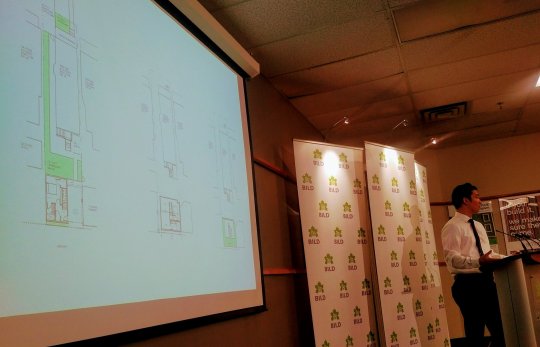
    Here is a photo that Mike took of me while I was talking about my failed laneway house:

    image

    For those of you wondering if/when this will happen in Toronto, here are the key takeaways from this morning: The city is already drafting laneway suite policies specific to Toronto & East York (not the other parts of the city) and they are due to report back to council in Q2-2018. Nothing is 100% certain at this stage, but there’s lots of optimism. 

    Councillor McMahon delivered this morning’s opening remarks and I was impressed by her deep commitment to laneway suites. I was also impressed by her stance on NIMBYISM, saying that education is important and that we can’t let NIMBYs stop what makes sense for the greater city.

    She gave the example of the 6 storey condominium in her ward that faced fierce community opposition a number of years back. If you can’t put a midrise building on a main street in this city, where can you put it? 

  • New Buca concept coming to midtown Toronto

    Earlier today Slate announced that King Street Food Company will be bringing a new Buca restaurant concept to the north west corner of Yonge + St. Clair in 2018. 

    (BlogTO calls Buca one of the best Italian restaurants in the city.)

    Below is a rendering of the new podium design at 2 St. Clair West, which is where they’ll be going. The design/rendering is by Gensler (the same talented group that did Ravine Bench).

    image

    The corner is going to be transformed into a double-height space and the architecture is meant to express that feeling of grandeur at the intersection. There will also be an outdoor patio at grade.

    We are all super excited about this.

    If you would like to read the full press release, you can do that here.

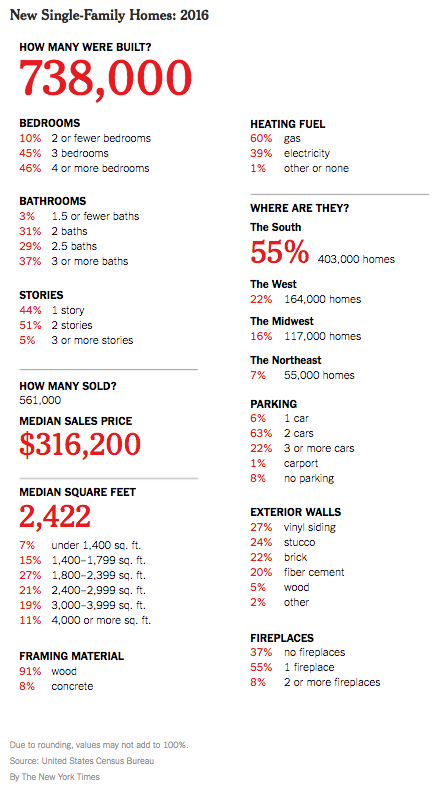
  • 738,000 single-family homes were built last year in the US

    The New York Times recently published “a portrait of new single-family homes” in the US in 2016. Here’s that portrait:

    For those of those living in dense urban centers, this portrait is perhaps a reminder that in many other places a large single-family home can be had for about the price of a studio apartment.

    Nothing in the above portrait likely surprised you, but it’s interesting to note that over half of all new single family homes delivered last year were in “The South.” Only 7% were built in the dense northeast.

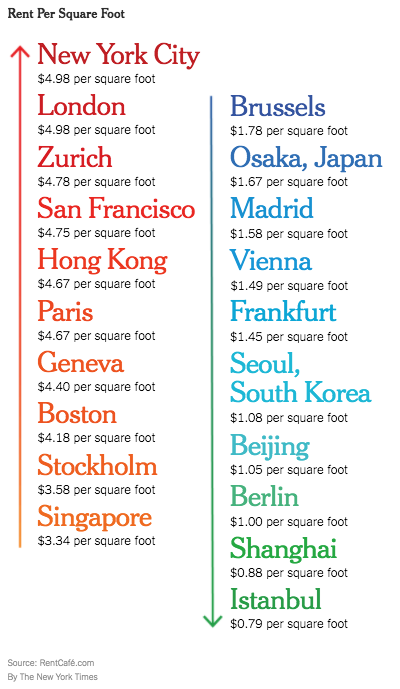
    The New York Times also recently looked at “international rents per square foot” using data from RentCafe. Here they are:

    New York City sits at the top with an average rent of $4.98 psf. This is across all boroughs. I am surprised by how low some of these international rents are. But averages rarely tell you the whole story.

    In any event, I do think that these two graphics start to speak to the economic spikiness that we are seeing across the US. 

  • Toronto’s first Airbnb-friendly condo building

    This week it was announced that the very first condo building in Toronto (and in Canada) has just signed on to Airbnb’s Friendly Buildings Program. The agreement will take effect on November 1, 2017.

    As the name suggests, the program is about bringing greater legitimacy and structure to short-term Airbnb rentals. Here are two key measures from this particular agreement:

    – Building security will now have full transparency with respect to who is hosting and who their guests are at any given time

    – Airbnb will share 5% of the building’s revenue with the condominium corporation (hosts will also need to pay $50/month to cover any additional maintenance costs)

    What’s compelling about the above is that there’s now a bit of a financial incentive for buildings/boards to support Airbnb rentals. 

    At the same time, if something happens, it’ll now be a lot easier to figure out who was responsible and then chargeback any relevant costs. Right now it’s all happening under the radar.

    My view on Airbnb is the same as the one I took (publicly on this blog) on Uber: It’s not going away. Many people clearly want it. An entire building just accepted it. So let’s figure out how to make it work better.

    One regulation that Toronto is currently exploring and that I think will materialize in some form is a limit on short-term rentals when the unit is not your principal residence.

    This is the difference between Airbnb’ing your place when you leave on vacation (or when you have an extra room) and buying a condo strictly as a short-term rental investment.

    It’s interesting to see the evolution of companies like Uber and Airbnb. Both would never have been successful if they started out by first asking for permission. 

    But now they are mature enough that they are being forced to play nice.

  • Locals hate you

    BlogTO recently reported that “snarky anti-condo signs” have been popping up around Toronto. Here is one of them via Instagram. It reads (in all caps): Dear Condo Dwellers: Locals Hate You Go Fuck Yourself

    I find these posters curious, though it is obvious that they are a reaction to growth, intensification, and general change in this city.

    For one, it implies that condo dwellers and locals are mutually exclusive. In other words, “locals” don’t live in condos. Presumably the implication is that they live in low-rise grade-related single-family housing. Or maybe they live in rental housing? Is it a tenure thing?

    According to the latest 2016 Census data, just over 26% of private dwellings in Toronto are condominiums. And about 30% of people live in a building that has 5 or more storeys. If you include “apartments” less than 5 storeys, this latter number jumps to 40%. So many potential non-locals.

    However, it could be that these posters are primarily directed toward new condos and new condo dwellers. This poster seems to have been plastered in front of this recently completed condo building on College Street.

    If that is the case, then I wonder if there is a temporal cut-off for the hate. For example, the condo building that houses (at its base) my regular grocery store was completed in 1983. 

    The units are large and the demographic seems to skew a bit older. Are these condo dwellers – some of which may have been there for over 3 decades – to be hated? Are they non-locals? Or does urban myopia set in after awhile and they become locals?

    At the same time, it wouldn’t be unusual for the residents of an older condo building to oppose a new proposed condo building. So perhaps “local” isn’t about building typology and it’s more about who came first. That’s certainly a tricky one. Better end here.

    A curious poster that could use a bit more specificity. What do you make of it?