Daily insights for city builders, delivered every morning at 6 AM ET. I’m Brandon Donnelly — a Toronto-based real estate developer and founder of Globizen. I’ve been writing here since 2013.

Tag: toronto

  • Less, rather than more, housing

    Earlier this year I wrote about the California housing bill (827) intended to dramatically increase housing supply around transit stations all across the state. Well that bill was rejected last month and the Los Angeles Times wrote this post post-mortem explaining why and how it went wrong. Their argument is that it came down to opposition from low-income residents who feared that an increase in housing supply would lead to greater displacement.

    On a related note, the Official Plan Amendment and Zoning By-law Amendment that would permit laneway suites in Toronto went to Community Council this week. They voted to defer the decision for a month. Only 3 of 13 councillors voted to pass the proposal, despite there being 185 letters of support and only 4 letters of opposition. For more information on what the hell happened, check out this Lanescape post.

  • The Cherry Street Lakefilling project

    It’s going to take a generation to build it out, but one of the most exciting revitalization projects in Toronto is going to be the Port Lands area. However, before that can really start happening and new communities can be built, the entire area needs to be flood protected. Currently about 290 hectares (717 acres) in this part of the city are prone to flooding.

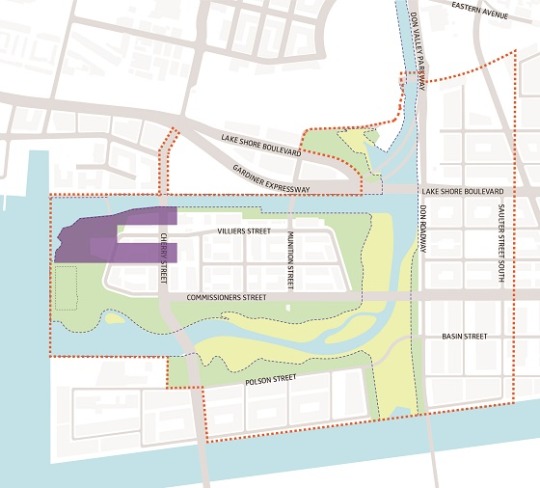
    One component of the flood protection program is the Cherry Street Lakefilling Project. Below is a plan of what that means (from Waterfront Toronto). The area in purple is new land that will be created as part of the process. Supposedly this is important for a few reasons. For one, it will allow the Cherry Street bridge to be relocated, which, in its current location, is creating a pinch point during floods.

    image

    I am mentioning all of this today because I am personally excited about this revitalization project. Hopefully I’ll see it complete in my lifetime. And maybe I’ll be fortunate enough to work on some of the buildings when that time comes. I also really wanted to share the below video with you all, showing the lakefilling in action. I bet many of you aren’t aware that this is happening.

    If you can’t see the video below, click here.

    [youtube https://www.youtube.com/watch?v=C0q_Wvn91zE?rel=0&w=560&h=315]

  • Toronto is finally ready to permit laneway suites

    Some of you might remember that last summer the city refused my laneway house/suite here in Toronto.

    Well that was last summer and this is this summer.

    On May 2, 2018 – which just so happens to be my birthday – Toronto and East York Community Council will consider a staff report for a City-initiated Official Plan Amendment and Zoning By-law Amendment that would permit laneway suites in the Toronto & East York District.

    Here are a couple of excerpts from the summary section (full report, here):

    This report recommends establishing a planning framework to permit laneway suites on lands within the Toronto and East York District that are designated as Neighbourhoods by amending both the Official Plan and City-wide Zoning By-law.

    A second unit can take many forms but is generally considered to be subordinate to the primary dwelling unit on a lot. Second units are an important part of the City’s rental housing stock. Laneway suites are one form of second unit.

    This report contains a detailed planning rationale for the introduction and regulation of laneway suites within the Toronto and East York area and discusses the policy implications and intent of proposed performance standards and criteria. 

    These performance standards and criteria intend that laneway suites will provide a new form of ground-related, rental and extended family housing that will fit appropriately within the scale of established Neighbourhoods, and limit their impact on the existing physical character, while contributing to the growth of the City’s rental housing stock.

    What a thoughtful birthday gift. Thank you.

  • Going down east

    I live in Toronto. 

    When I am headed north to cottage country, I say that I am going up north.

    When the Florida snowbirds talk about escaping the winter, they usually say that they are headed down south.

    These geographic references are fairly straightforward.

    If a friend were to move to Vancouver, I might say that she or he moved out west. This one starts to get a bit more interesting because it speaks to a location that is out, or away, from the center. Toronto is the center and that person has moved out from it.

    But the one that really made me think was down east. My mother was born in the Canadian Maritimes and when she references this part of the country she calls it down east. 

    I used to ask her: “Why is it called down east? Geographically, it is actually up east.”

    Turns out that down east is (probably) a nautical reference. It is used to identify parts of the east coast in both New England and Canada. The prevailing winds in these parts blow from the southwest. So when sailors traveled from the west to east they were going downwind.

    So there you have it. Do you have any peculiar geographic references in your part of the world?

    UPDATE: I should have also mentioned that the St. Lawrence River generally flows north-easterly and that there’s an elevational difference between what was formerly known as Upper Canada and Lower Canada.

    Photo by Matthias Jordan on Unsplash

  • Regional accents and “da Bulls”

    I find regional accents fascinating. 

    I generally think that Toronto has a fairly neutral accent. But then again, when I lived in Philadelphia, I used to notice the accident every time I came home. Maybe it is because I had adopted a bit of the Philly accent. For the record, I never picked up “youse.”

    According to some classifications, most of Western and Central Canada would fall under “General Canadian.” But I find that there are noticeable differences between the accents in Toronto and, say, Calgary. Really there are differences even within the Greater Toronto Area.

    CityLab has a recent article up about why city accents are fading in the US midwest. They chalk it up to two main factors: education and geographic mobility. But I also wonder if today’s online connectivity isn’t muting some of the local varietals.

    That’s the interesting thing about accents, they – much like the language itself – are constantly changing and evolving. On that note, I’ll end with this classic parody of the Chicago accent: Da Bulls!

  • The golden era of Canadian graphic design

    Over a year ago I wrote about a Kickstarter campaign that wanted to make a documentary to celebrate “the golden era of Canadian graphic design.” 

    And after I wrote about it, my friend Dave Wex – who, like me, is a lover of all things Canada – backed the project. Yesterday he flipped me the latest update. 

    The trailer is out and the world premiere of Design Canada is scheduled for Wednesday, June 13, 2018 at the Hot Docs Cinema here in Toronto. After that, it will move to Montreal and Vancouver. 

    If you can’t see the trailer below, click here.

    [vimeo 263571655 w=640 h=280]

    Tickets available, here.

  • Meet Replica

    Sidewalk Labs is currently building out a platform called Replica that will support them in their development plans here in Toronto. Replica is

    “a user-friendly modeling tool that uses anonymized mobile location data to give planning agencies a comprehensive portrait of how, when, and why people travel in urban areas.”

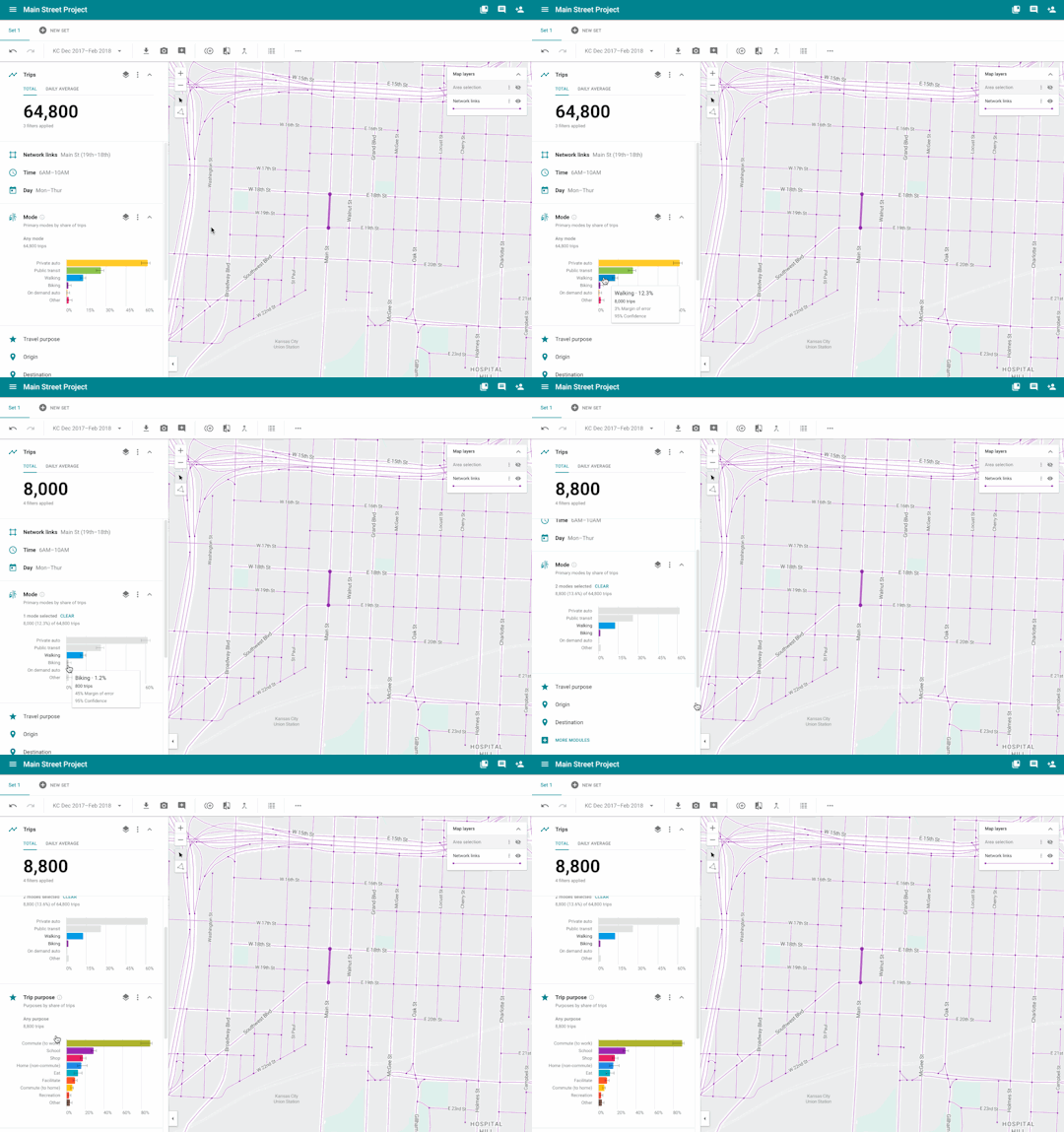
    Here is a preview of the Replica dashboard showing a section of Main Street in Kansas City. I hope the animated GIF shows up for you.

    The platform uses a combination of mobile location data (~5% of the population) and on-the-ground checks, typical stuff like manual traffic counts and transit boardings.

    The goal is to understand in real-time who is using a street, as well as how (driving? cycling?) and why (going to work?).

    Their introductory blog post obviously stresses the importance of personal privacy, but I am curious how they determine where people are going.

    I suppose if they pair journeys with destinations (and the durations at those destinations) they can make reasonable assumptions around the why.

    I think the benefits to all of this are clear. But does any or all of this worry you from a privacy standpoint?

  • Half of Toronto condos completed last year became new rental housing

    image

    Shaun Hildebrand (Urbanation) and Benjamin Tal (CIBC) published a report today called, “A Window Into the World of Condo Investors.” In it they revealed that last year (2017 data) no less than 48% of the Greater Toronto Area’s newly completed condo units were closed on by “rental investors.” In other words, almost half of the units became new rental supply.

    This stat was not surprisingly turned into clickbait-y type headlines like, “Half of Toronto condos bought last year were by investors”; whereas an alternate headline might read: “Half of Toronto condos completed last year became new rental housing.” Not as jarring, I know.

    In any event, there are a bunch of other interesting stats in the reports. Here are a few of them:

    – 80% of all new home sales in the GTA last year were condo.

    – Average resale condo prices (per square foot) increased by 26% last year and rents grew by 9%.

    – Over 20% of condo investors purchased their property with no mortgage.

    – Average down payment made by investors was 20%; non-investors were closer to 15%, likely because of mortgage insurance and other factors.

    – Out of the condo investors who took possession in 2017 with a mortgage, no less than 44% are in a negative cash flow position – meaning their rental income isn’t covering their carrying costs. 

    – The returns, which the report calls exceptional, have been coming in the form of price appreciation.

    – As a stress test for the market – what if all these negative cash flow investors suddenly sold their condos? – the report also estimates that if you took all of the rental investors who closed in 2017 with a mortgage and who are in a negative cash flow position greater than $500 per month, it would represent only 3.4% of the total annual supply of condos (both new and resale product).

    If you would like to check out the full report, you can do that over here.

    Photo by Scott Webb on Unsplash

  • Two new chiefs

    image

    There were some big announcements in the planning world this past week here in the Greater Toronto Area. Gregg Lintern (follow him on Twitter) was named the new chief planner of Toronto (he was previously the acting chief planner following Jennifer Keesmaat’s departure) and Andrew Whittemore (couldn’t find him on Twitter) was named the new chief planner of Mississauga.

    As I went through the articles announcing the above appointments, I couldn’t help but be reminded that this region is at an exciting and pivotal moment in its history. All of the talk is about improving urban mobility (i.e. becoming less dependent on cars); intensifying around transit stations (as well as gently intensifying neighborhoods); making downtown a better place for families; and so on.

    It can be easy to feel defeated in this big bad world of city making. Oftentimes things seem to get reduced to either urban vs. suburban rhetoric or, as if nothing else matters, this one simple question: “But, how tall is the building?” So its nice to know that those at the helm continue to see endless opportunity in this region. I know that I wouldn’t want to be doing what I’m doing anywhere else.

    Photo by mwangi gatheca on Unsplash

  • New high-rise home prices up 39.5% year-over-year

    February data (2018) for the new home market in the Greater Toronto Area was released this past week by BILD and Altus. I seem to have gotten into the habit of writing about this every month.

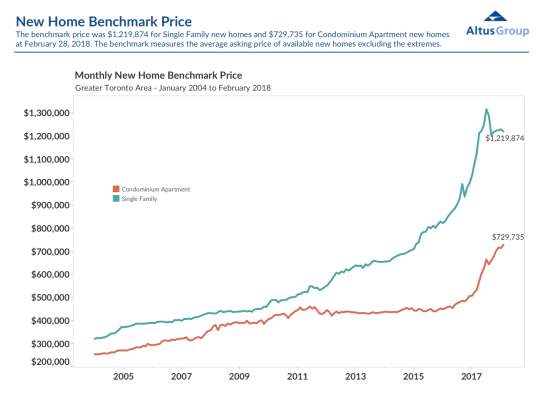
    The benchmark price for new low-rise single-family housing was down slightly from January to $1,219,874, but still up 12.8% from a year prior.

    The benchmark price for new high-rise housing was up a whopping 39.5% year-over-year to $729,735. But part of this is being driven by an equally dramatic increase in average unit sizes.

    Here is the relevant graph:

    image

    The story continues to be about tight supply, historically low developer inventories, and a lack of affordable low-rise product. 

    As I have argued many times before on this blog, I believe these factors — and in particular the last one — are, at least partly, driving this recent pop in high-rise pricing. People are priced out and now searching for substitutes.

    So my prediction continues to be that we will see a convergence (i.e. diminishing spread) between new low-rise and high-rise pricing.

    That will also bring about design and product changes on the high-rise side.