Daily insights for city builders, delivered every morning at 6 AM ET. I’m Brandon Donnelly — a Toronto-based real estate developer and founder of Globizen. I’ve been writing here since 2013.

Tag: toronto

  • Car-dependent spatial structure

    Earlier this week a 58 year old woman named Dalia was struck and killed by a car near the University of Toronto’s downtown campus. This tragedy has everyone talking about and questioning how to make our roads safer, though the answers are not difficult to find. Here is an excerpt from a piece that Richard Florida penned following the incident called, Toronto’s Deadly Car Crisis:

    Today, more Torontonians die from being hit by cars than from being killed by guns. In 2016, nearly 2,000 pedestrians and 1,000 cyclists in the city were hit by cars. Of these, 43 resulted in fatalities. On average, a pedestrian in Toronto is hit every four or five hours, and a cyclist every eight or nine. This means that Toronto’s rate of pedestrian deaths was 1.6 per 100,000 people in 2016 — worse than in Chicago, Seattle, San Francisco, Boston, Washington, D.C., Portland, Pittsburgh, Cleveland, and Buffalo. It has risen to 1.7 deaths per 100,000 people in 2017 and is on track to rise still further to 1.8 deaths per 100,000 this year. And, children and the elderly face the greatest risk of being struck and killed by a car. The problem is only getting worse. Across Canada, pedestrian fatalities increased by more than 10 percent between 2010 and 2016; at time when they decreased by more than 25 percent in European countries like Norway, Switzerland, and the Netherlands.

    The broader issue is what he refers to as Toronto’s “car-dependent spatial structure.” And it is detrimental to not only our public safety, as we saw this week, but also to our ability to grow as a global city. The Greater Toronto Area is projected to reach 10 million people by 2041. I agree with Florida that, for a number of important reasons, we are going to need to commit ourselves to a new model for growth.

  • Toronto Community Council voted unanimously in favor of laneway suites

    It happened.

    Today, Toronto and East York Community Council voted unanimously in favor of adopting a planning framework that would allow laneway suites on lands within the Toronto and East York District that are designated as “Neighbourhoods.” 

    If you’d like to see the actual vote (and the clapping that ensued), check out this YouTube video at the 41 minute mark. There are also some great speeches prior to the vote by Councillor Bailão, Councillor Perks, and others.

    Now, it still needs to go through City Council, but today remains an important milestone and a positive step forward. So kudos to everyone who has been working tirelessly to push this initiative forward.

    I would also like to take this opportunity to address some of the comments that I recently received about this blog, one of which is that I continue to offer a one-sided perspective on this issue of laneway housing in Toronto.

    Think of this blog – and I’m stealing this analogy from another blogger – as a bar. I am the bartender and I show up here pretty much every day. I’ve been doing that consistently for almost 5 years now.

    At this bar I sip on negronis – okay, it’s probably beer – and I talk about topics and issues that excite me and that are usually related to city building. If it doesn’t excite me, I don’t talk/write about it. And I get lots of emails every day asking me to write about things that do not excite me.

    If you would like to take a seat at the bar, have a drink, and join the conversation, you are more than welcome to do that in the comment section at the bottom of every post. In fact, it’s encouraged. I make a mean vodka soda.

    So maybe I’ll see you at the bar. The bartender is a fairly open-minded guy who enjoys good conversation.

  • A celebration of skateboarding culture

    I used to skateboard when I was growing up and so I have a lot of respect for the sport. This summer, from June 30 to August 12, The Bentway here in Toronto will be working with Build for Bokma and Vans to transform its outdoor (ice) skating trail into a summer-long celebration of skateboarding arts and culture. This is great.

    I am sure you all know Vans. But you may not be aware of Build for Bokma. They are a non-profit whose mission is to create skateable public structures. And their long-term goal is to develop a permanent skatepark that commemorates the late Canadian pro skateboarder, Justin Bokma.

    A big part of skateboarding culture is reimagining spaces and adapting to different urban environments. And if you think about it, that’s exactly what The Bentway is doing. They are reimagining a part of this city’s urban infrastructure. So I think this is a perfect fit and I am excited to see it come to life this summer.

  • Balkrishna Doshi

    On Friday evening, here in Toronto at the Aka Khan Museum, this year’s Pritzker Architecture Prize was awarded to Indian architect, Balkrishna Doshi. He is 90 and will receive US$100,000, as well as the honor of being the first Indian to receive architecture’s Nobel Prize. This year was also the first year it was awarded in Canada.

    Alex Bozikovic of the Globe and Mail sat down with Doshi while he was in Toronto. Article here. Doshi also lectured at the Daniels Faculty at the University of Toronto earlier in the week. 

    Some of you will probably recognize the name because of his collaborations with Le Corbusier and Louis Kahn. But as Alex quoted in his article, this year’s prize is about, “expanding the scope of architecture’s usefulness.” Doshi’s architecture is less about objects and more about the public good it creates.

    For more on Doshi, check here.

    On a related note, I was happy to see worlds collide in my Instagram feed this morning with this photo from the event. It’s a picture of Jeanne Gang, Meg Graham, and Andre D’Elia of Studio Gang and Superkul, respectively. 

    We are thrilled to be working on projects here Toronto with both firms.

    Photo via The Pritzker Architecture Prize

  • Many days in the Junction

    This morning blogTO did a post on how to spend a day in the Junction neighborhood of Toronto.

    I love the Junction. I’m planning to move to the Junction. And we have a development project in the area called Junction House. So know that I am entirely biased when I talk about this neighborhood. 

    A couple of my favorite places from blogTO’s list include Mjolk (Scandinavian interior design), Gerhard Supply (menswear), Playa Cabana Cantina (tacos and tequila), and Indie Alehouse (brewpub). 

    One spot that wasn’t on the list is the Italian restaurant, Nodo. Big fan of this place. Great pastas. Great negronorum. Yes, the plural of negroni is allegedly negronorum.

    One of the big game changers for the Junction – besides the reintroduction of alcohol in 1997 – is the Union Pearson Express train.

    Many people only think of it as civilized airport travel. But it also provides an incredible inner city service. It shows you the potential of Regional Express Rail in this region. We need more of this.

    We’ll be providing an update on Junction House very soon and I’ll be sure to blog it. So stay tuned.

  • Anachronistic employment areas

    Today I was at the Land & Development Conference here in Toronto. I started live tweeting during the breakfast, but my vintage iPhone 6 couldn’t keep up, so I had to stop. Some insights throughout the day. But a lot of what you would expect. I suppose it’s more about the networking.

    I would, however, like to reiterate something that Ken Greenberg mentioned about Employment Areas/Lands in Toronto. For those of you who aren’t familiar, these lands are essentially intended to serve one, and only one, purpose: employment. And the process for introducing a mix of uses, including residential, is an onerous one to say the least.

    I appreciate why this is the case. But I agree with Greenberg in that this kind of single use zoning is antiquated. It does not reflect the realities of the market today. There are other mechanisms we can use to maintain and provide for employment, and ensure that we don’t end up with a city of all residential.

  • Percentage of residential properties dedicated to single-family housing in US cities

    The Seattle Times has an article up about “widespread single-family zoning” that will feel familiar to many here in Toronto who, I know, are having similar conversations about the amount of land dedicated to low-density housing.

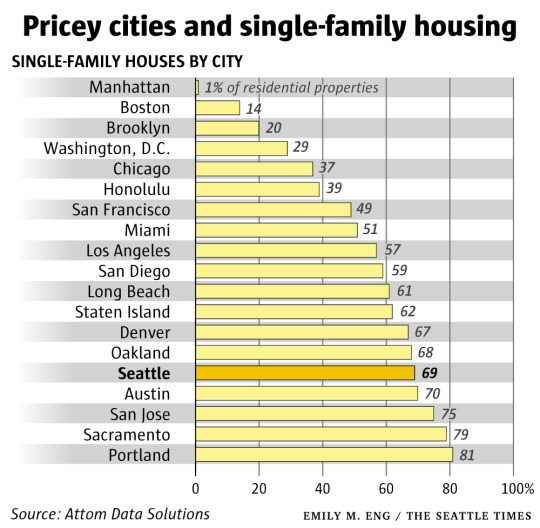
    The article, by Mike Rosenberg, estimates that 49% of all developable land in Seattle is dedicated to single-family housing; that 8% is dedicated to multi-family housing; and that another 8% is dedicated to commercial and mixed-use buildings. The rest of the land is institutional, open space, vacant, and so on.

    Of all the residential lots in the city, the estimate is that 69% of them are occupied by single-family houses. This is compared to 1% in Manhattan. 

    I tried to reverse engineer the 69% based on the land use areas in the article, but the math didn’t quite add up. In any event, the argument here is, of course, that single-family homes are too expensive in Seattle and that the city needs more land available for multi-family housing.

    Housing supply is no doubt important, but looking at the above chart, having a low, or lower, percentage of residential land dedicated to single-family housing doesn’t seem to necessarily guarantee affordable housing.

  • IBI launches Smart City Sandbox

    This morning I was at 55 St. Clair Avenue West for IBI Group’s annual general meeting. And at this meeting their CEO, Scott Stewart, officially launched a new accelerator called the Smart City Sandbox

    Here is a description of what that is taken from a press release that was also published this morning:

    The Sandbox is a smart city-themed accelerator, focused on bringing innovative new products and systems to urban environments that improve the quality of life for residents. A technology hub that supports small-and medium-sized enterprises (SMEs), as well as entrepreneurs and start-ups, the Smart City Sandbox will operate out of a designated space at IBI Group’s Toronto headquarters, be open to global applications, and officially open doors with its first smart city-themed cohort in September 2018.

    And here is a photo from this morning:

    Slate Asset Management is proud to be a founding partner of the Smart City Sandbox and we’re thrilled that it will live at Yonge + St. Clair in midtown Toronto. 

    Our role is to provide our domain expertise as asset managers and developers, and to offer participants in the program access to real-world building systems and data from our holdings in the area.

    For more info, go here.

    And if you were at (or listening to) the meeting this morning, I’m sure you noticed something that we talk a lot about on this blog. To thrive today, virtually every company now has to think and act like a technology company. IBI Group is doing precisely that.

  • Tech salaries and brain drain

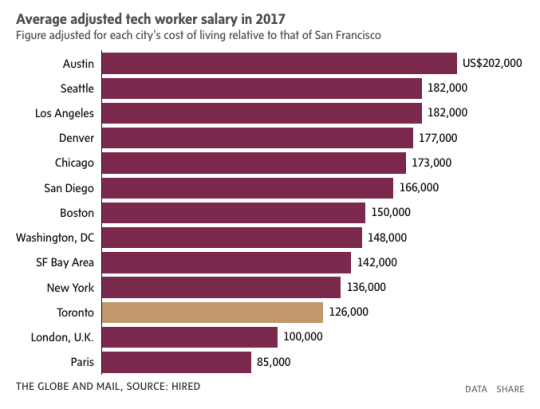
    The Globe and Mail recently ran an article arguing that tech salaries in Toronto are significantly less than those in the US and that it is leading to “alarmingly high rates” of brain drain. The claim is that the average tech salary in 2017 was US$73,000 in Toronto, compared to US$140,000 in the Bay Area or US$129,000 in New York City. 

    However, if you adjust these salaries for each city’s cost of living, the numbers look like this (chart taken from the same article):

    Now all of a sudden Toronto is lumped together with the Bay Area and New York City. It was adjacent to London even when you didn’t adjust the salaries. As Tobi Lütke – CEO of Shopify – points out in his Twitter rebuttal of the article, housing is the determining factor in this adjustment: “Toronto is a very expensive city, and Austin isn’t.”

    Lütke also points out, in case you’re in the market, that Canadian-based Shopify pays its tech employees well above market, provides stock compensation, and is currently “hiring like crazy”. But perhaps more importantly, he stresses the importance of Canadians building the economy of the country in which they are from. I feel exactly the same way.

  • New School of Cities

    The University of Toronto just announced a new School of Cities. It will begin operations on July 1 of this year (2018) and bring together researchers from various disciplines to address the world’s most critical urban challenges. 

    Insert stat here about the percentage of the population that will live in an urban area by 2050.

    There are more than 220 faculty members across 40 different academic divisions at the University of Toronto who are doing urban-focused work. The School of Cities is intended to bring those minds together.

    So far there are plans for a “global cities summit” and an “urban lab” that will also bring students, faculty, industry, and government together. The intent is for the School to act as a city builder both locally (Greater Toronto Area) and globally.

    This once again goes to show just how important we are all taking urban issues today. But I am sure this blog audience didn’t need to be reminded of that.

    If you would like to sign up for updates from the School of Cities, you can do that here.

    Photo by Jorge Vasconez on Unsplash