Daily insights for city builders, delivered every morning at 6 AM ET. I’m Brandon Donnelly — a Toronto-based real estate developer and founder of Globizen. I’ve been writing here since 2013.

Tag: toronto

  • Q4-2018 high-density land sales in Toronto

    image

    Bullpen Research & Consulting and Batory Management just published their Q4-2018 High-Rise Land Insights Report for the Greater Toronto Area. 

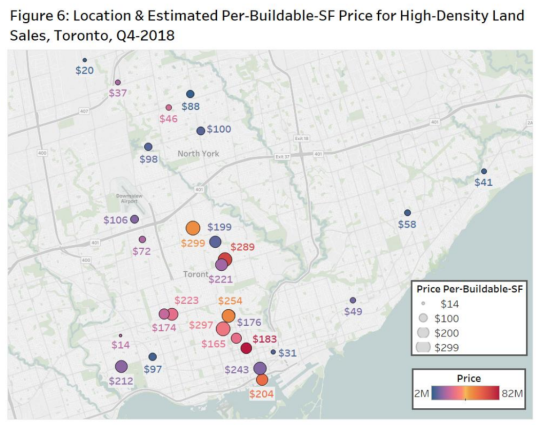
    Above is a mapping of the estimated per square foot buildable prices for the land that traded hands specifically in Toronto last quarter. 

    The average is $178 per square foot. And the projected average sale (condo) price is $1,097 psf. That sounds right. You basically need that kind of end pricing to make the math work with today’s costs.

    Across the GTA, the average spread between zoned and unzoned land was almost $40 psf. $159 psf versus $120 psf, respectively.

    A full copy of the report can be downloaded here

  • Non-load-bearing curtain wall

    image

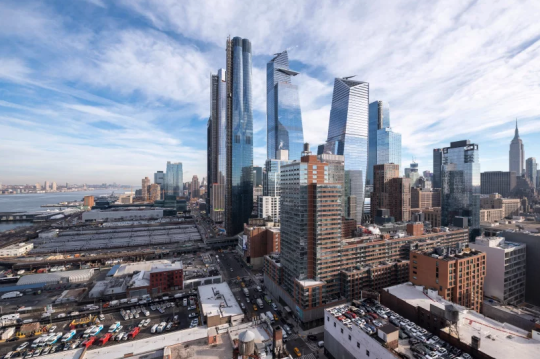
    Liz Diller of Diller Scofidio + Renfro was recently asked by designboom about how her firm approached the design of Fifteen Hudson Yards (the first residential tower in New York’s Hudson Yards).

    The firm had never designed a high-rise before. So while their typical approach would be to analyze program, here they were heavily informed by the views – both in and out from the site – as you move up the tower.

    The 88 storey tower transitions between two footprints. The base matches the street grid of the city, but as you move up the tower it transforms into a cloverleaf – allowing panoramic views of the city.

    It is a somewhat similar approach to what has been proposed by Studio Gang for One Delisle. Except for the transformation here is to a multifaceted cylindrical shape (a hexadecagon is what has been drawn).

    From the late 19th century when Chicago began to pioneer the modern skyscraper, architects and engineers have been thinking about how you treat a tall building as you move from top to bottom.

    Chicago architect Louis Sullivan responded to this challenge with his tripartite approach to design. He believed that tall buildings should be characterized by three main divisions: a base (bottom), a shaft (middle), and a cap (top).

    The technological innovation that allowed this thinking to flourish was the non-load-bearing curtain wall. Once the exterior walls of a tower no longer supported the actual building, architects then had the freedom to really experiment.

    This remains true to this day, but we no longer need to confine ourselves to only three parts. New technologies now allow for more.

    Today we have parametric modeling and other design tools that allow us to create new geometries and transitions; forms that would have been pretty complex to draw up in the past. 

    In the case of Fifteen Hudson Yards, every floor plate from 20 something and up is slightly different. I wonder what Louis would think of this.

    Image: Timothy Schenck via designboom

  • A mapping of development potential in Toronto

    I first met Monika Jaroszonek in 2017, right before she started RATIO.CITY. Since then she has developed some pretty incredible tools for the city building space.

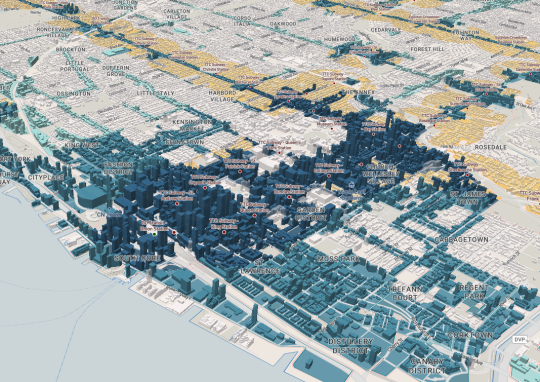
    Yesterday the company published this interactive visualization looking at development potential across the City of Toronto. The mapping looks for the following:

    The tool then ranks each development site – AAA, AA, A – according to how many of the above criteria it meets.

    It also flags land that it refers to as “Missed Opportunity.” These are lands located within 500m of a Major Transit Station, but that are designated as Neighbourhoods (considered stable) or Employment (whole other discussion).

    Based on this filter, about 5.6% of the City’s land is a “Missed Opportunity” and about 1.2% is AAA.

    When you look at the visualization, that is one of the first things you will probably notice; a lot of our transit infrastructure is currently underutilized as a result of land use policies.

    Image: RATIO.CITY

  • Laneway house on the market for $2,845,000

    I was looking at this laneway house for sale in Toronto today. It’s located near Queen and Bathurst. It has 3 bedrooms and 3 bathrooms and is about 2,331 square feet (that looks to include a basement). The lot appears to be just over 13′ wide. And the asking price is $2,845,000.

    Single family homes aren’t typically considered on a per square foot basis, but if you do the math here, it works out to be around $1,220 psf. The property previously sold in 2017 for $805,000, which was prior to it being redeveloped. So it likely traded based on land value.

    When Toronto first started considering modern laneway houses, some people thought that only individuals of questionable moral fiber would want to live in one. But today, there are countless examples of some pretty remarkable laneway houses. 

    And in some cases you might need about $3 million or so.

  • Director, Real Estate

    The University of Toronto is looking for a Director, Real Estate to manage their tri-campus portfolio of income producing real estate, as well as the development opportunities that they have on and adjacent to their three campuses. The downtown campus alone is over 120 buildings across 130 acres.

    A good friend of mine is helping with this search; I went to the University of Toronto (twice); and I believe that institutions, such as U of T, play an important city building function. So I’m sharing this opportunity with all of you today. For more on the University’s development strategy, click here.

    They are looking for someone with 10+ years of experience. The salary will be competitive and commensurate with this level of experience. And you would be reporting directly to the Chief of University Planning, Design & Construction. 

    If you’re interested, you can apply here. You have until January 25, 2019 to do that. I hope the position gets filled with a star. Also, sorry if this post isn’t relevant to you. Regularly scheduled programming will resume tomorrow.

  • And we’re back

    Welcome to 2019.

    I am currently in transit and catching up on some internet reading and email on my way back to Toronto.

    At this time of year it is, of course, common to reminisce (or lament) about what happened over the last year, as well prognosticate what may come.

    Over the last few years, I have done a bit of that on the blog. But I clearly didn’t do that this year while in Brazil (and away from any semblance of a workspace).

    So here’s what others have been writing and thinking about over the holidays:

    – 2018’s tech trends and tribulations in 14 charts. RecodeLink

    – 2018 was the year of the YIMBY. CityLab. Link

    – A cool girl’s guide to Toronto. Vogue. Link

    – Amazon’s annual Christmas press release. Link

    – Best travel posts of 2018. Design Milk. Link

    – Here’s (Almost) Everything Wall Street Expects in 2019. Bloomberg. Link

    – Here’s what to expect in cybersecurity in 2019. TechCrunch. Link

    – Naive to hope Toronto can change in 2019? That means we have work to do. Shawn Micallef. Link 

    – The 10 largest US venture rounds of 2019. TechCrunch. Link

    – What is going to happen in 2019. Fred Wilson. Link

    – Will a recession hit in 2019? Alan Murray. Link

    – Year in search 2018. Google. Link

  • Maple Valley? No.

    At this time of year, I am always amazed by the number of mass emails that I receive from unknown people and companies. They have my email address, clearly, and yet I only receive one email a year from them – a happy holidays email. I am not opposed to holiday cheer. I love Christmas. But if you’re looking to build any sort of meaningful rapport with an audience, my sense is that you ought to send more than one email a year.

    In other news, the Economist published an article this past week talking about how Toronto is attracting disaffected (Indian) tech workers from the US and, more particularly, Silicon Valley. It is largely a story of immigration and diversity. But at the end of it, the Economist also reports that some people are now calling Toronto, Maple Valley. Toronto immediately reacted to this moniker – negatively.

    Nobody refers to Toronto as Maple Valley. And these sorts of names are stupid. In the 1990s, the Flatiron District in Manhattan started being called Silicon Alley (at least by some). That name was also stupid. New York is New York. And Toronto is Toronto. If you’re going to assign a nickname, it should not be derivative. And in the case of Toronto, you probably also want to avoid kitschy Canadian stereotypes.

  • Toronto condo market outlook

    BNN Bloomberg just published this article on the Toronto condo market. It is based on a roundtable discussion that was held at their Toronto office last week with Jim Ritchie of Tridel, Jared Menkes of Menkes Developments, Shamez Virani of CentreCourt, and Jane Renwick of Diamond Kilmer Developments.

    The overarching theme is that, after a couple of frenetic record setting years, the market should settle down in 2019, which is likely a good thing. Hopefully that will also temper construction cost inflation. We have been seeing double digit increases over the last few years (hence some of the cancelled projects).

    But as Jared points out, the fundamentals here are still strong and there are a number of supply constraints creating upward pressure on pricing:

    Jared Menkes, executive vice president of high-rise residential at Menkes Developments was unwavering for the future. “There’s a lot of red tape that’s slowing down bringing more product to market,” Menkes said. “I promise you, pricing is going up.”

    For the rest of the article, click here.

  • Average January temperatures by global city

    In Edward Glaeser’s book, Triumph of the City, he argues that the average temperature in January is the single best variable to predict which U.S. cities have grown the most over the last century. Indeed, from July 2015 to July 2016, 10 of the 15 fastest growing large metro areas in the U.S. were in the south. Follow the sun and sprawl.

    Given this phenomenon, I thought it would be interesting to look at the world’s most influential cities (i.e. global cities) through this lens. Because let’s face it, New York and London aren’t all that warm in January. 

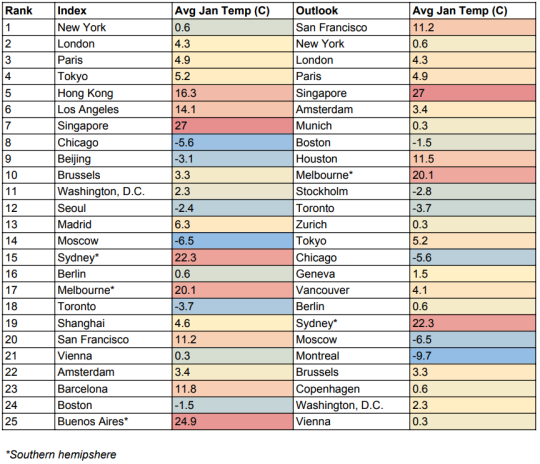
    Below are the top 25 global cities (taken from A.T. Kearney’s 2018 Global Cities Report), along with their average January temperature (taken from here). Note, there are two rankings. On the left is their global cities index. And on the right is their global cities outlook, which evaluates current potential. Cities that improved their economics & governance made the biggest leap on the right.

    image

    First of all, it’s interesting to see San Francisco jump so significantly in their outlook ranking. This has everything to do with tech and innovation. It’s also important to note that a handful of the above cities are located in the southern hemisphere, so “average January temperature” doesn’t mean the same thing (probably should have normalized to their winter).

    Montreal wins the award for the coldest city in this ranking. And there’s really only one city, Singapore, with a tropical climate. Though there are others, such as Hong Kong and Sydney, that would fall under subtropical. All of this isn’t enough for us to start inferring anything, but perhaps colder and more temperate climates aren’t such a bad thing for economic growth.

  • One Delisle unanimously supported at Design Review Panel

    One Delisle was at the City of Toronto’s Design Review Panel today where it received unanimous support. For those of you who may not be familiar with the process, at the end of every DRP session the panel members – who are all independent design professionals – vote on the project. They can support it, support it with conditions, or they can not support it and send it back for a redesign. One Delisle received 100% support.

    There were a number of positive comments around the need for more projects like this, and for better design in general, here in Toronto. That was really nice to hear. I also liked the comment that One Delisle feels like a tall building that one might find in London. And since every tall building in London has an endearing nickname – Gherkin, Walkie-Talkie, Cheese Grater, and so on – this too deserves one. 

    So let’s find a name. I have one in mind, but I’d love to hear from you in the comment section below.