Daily insights for city builders, delivered every morning at 6 AM ET. I’m Brandon Donnelly — a Toronto-based real estate developer and founder of Globizen. I’ve been writing here since 2013.

Tag: toronto

  • The top 30 cities for tech and startup companies

    The third edition of Savills’ annual Tech Cities report is now out. Savills is a global real estate company headquartered in London and a few years ago they started looking and what makes a successful “tech city.” As always, you should take these rankings with a healthy dose of scepticism. But this one is based on over 100 individual metrics across 6 main categories:

    • Business environment (such as the size of the financial services industry)
    • Tech environment (such as the amount of inward VC investment)
    • City buzz and wellness (is it a cool place to live?)
    • Talent Pool (is the city creating and attracting young/smart talent?)
    • Real estate costs
    • Urban mobility

    Here are the top 30 cities for tech and startup companies:

    New York takes the top spot, supposedly because of its deep talent pool and position as one of if not the capital the world. But my friends in the Bay Area tell me that their housing shortage is also starting to impact SF’s tech dominance.

    Generally, the report finds that the above “tech cities” should see their GDP rise by 36% over the next decade, compared to 19% for other developed cities. I’m not sure how much of this has to do with tech, but the above list does differ from what you’d see in a more conventional global cities index. Here you have Austin ahead of global cities such as Hong Kong. And you have Toronto ahead of cities like Tokyo and Paris.

    One takeaway that shouldn’t come as a surprise to readers of this blog is the rise of Chinese cities in the index. Beijing is ahead of New York, London, and San Francisco by a wide margin in terms of annual VC investment. And Chinese cities as a whole are starting to take a greater share of global VC dollars (second chart below).

    If you’d like to download a PDF of the full report, you can do that here.

    Image: Photo by Jason Briscoe on Unsplash

  • Redeveloping the Port Lands — among other things

    On Monday, Christopher Hume of the Toronto Star responded to the recent backlash against Sidewalk Toronto with a piece called, Anger over Google’s vision for Toronto waterfront is misguided.

    The below excerpt is what I was trying to diplomatically allude to with my post on net present value. We need to look at what we are getting and what we are giving up (by way of foregone revenue).

    What had civic (and provincial) nabobs gnashing their teeth was Sidewalk’s suggestion that it should receive a share of city property taxes and development fees. And what would the New York-based outfit do in return? A few things, it turns out. Specifically, it would finance the long-delayed Queens Quay LRT, build the infrastructure necessary to remake much of the Port Lands, launch a new wood-based construction industry and, oh yes, kick-start redevelopment of 140 hectares of long neglected landfill.

    I also don’t understand how the possibility of expanding into the Port Lands has come as a surprise to anyone. That was always integral to the opportunity here in Toronto.

    What your thoughts?

  • How to manipulate attention

    This Toronto Life article about a 32-year-old who has managed to buy 10 homes in the city is very Toronto Life. At a time where many young people are struggling to afford housing, here is a millennial who has bought 10 of them (albeit with some partners). The underlying message: You’re not working hard enough.

    I am fairly certain Toronto Life writes these sorts of articles because they know they’ll enrage people. As Facebook has taught us over the last few years, getting people pissed off is good for engagement. And engagement is what drives advertising-based businesses.

    Here is an excerpt from a recent Time article by Roger McNamee (a former Facebook advisor):

    One of the best ways to manipulate attention is to appeal to outrage and fear, emotions that increase engagement. Facebook’s algorithms give users what they want, so each person’s News Feed becomes a unique reality, a filter bubble that creates the illusion that most people the user knows believe the same things. Showing users only posts they agree with was good for Facebook’s bottom line, but some research showed it also increased polarization and, as we learned, harmed democracy.

    If you take a look at the Twitter conversations surrounding the above Toronto Life article, you’ll see the reactions you would expect: Troll article. Yeah, but how much debt has he taken on? He had help from wealthy friends. Here’s how a 32-year-old is eroding housing affordability in Toronto.

    I appreciate all of this, but I will never understand the need to shit on other people because of their successes, regardless of whether they are self-made or were born with a competitive advantage. Billionaire isn’t a bad word in my books. I am a first generation real estate developer, but I wouldn’t be at all upset if my great-grandparents had decided that buying land in Toronto was a good idea.

    Here is a guy that moved to Canada for University. Lived in a basement with cockroaches after leaving his first job after school. Took some risks. And saved his money instead of doing bottle service at the club on the weekends. I can respect that.

    But again, these sorts of articles are bound to make a lot of people cranky. And Toronto Life knows that.

    Photo by Tiago Rodrigues on Unsplash

  • Toronto to market 11 city-owned sites for new affordable rental housing

    At the end of last month, Toronto City Council adopted the “Housing Now” action plan. The first phase of the plan involves the public marketing of 11 city-owned sites for the purpose of finding non-profit and private sector partners to help redevelop the lands with new mixed-income housing. It is expected that these lands could accommodate about 10,000 homes.

    Here is the list of sites:

    As part of the offering, around 2/3 of the built units will need to be rental (the above chart shows more), and of these rental units, 50% will need to be affordable with rents set to 80% of Toronto’s average market rents. All of this should translate into approximately 3,700 new affordable homes. (Mayor Tory’s plan is to build 40,000 affordable rental homes by 2030.)

    The City wants to ultimately retain ownership of these lands, and so the sites will be offered up through long-term land leases. It looks like they’ll be for 99 years. The City will also be forgiving a number of fees and levies for the 3,700 affordable homes. They are pegging the PV (present value) of these development incentives at just over $280 million:

    Making use of surplus public land to increase the supply of affordable housing certainly makes a lot of sense. But there’s a cost burden associated with these affordable units, which is why discussions around inclusionary zoning often come back to offsetting measures. Who is going to pay for these subsidies?

    The above “financial incentives” — which in this case are simply foregone revenue — speak to this cost burden.

    Tables: City of Toronto

  • Construction update — MIRA, San Francisco

    The MIRA Tower in San Francisco is one of my favorite buildings by Studio Gang and probably my favorite tall building under construction right now. Here’s a video and a few photos from the San Francisco Chronicle’s urban design critic, John King:

    When we first met Studio Gang, this project hadn’t yet started construction. They broke ground in April 2017. But it was one of the designs that got us particularly excited about what a Studio Gang building could mean for midtown Toronto.

    Now that the MIRA Tower is well underway, I have to say that it looks even better than it did pinned to the walls of their Chicago studio. I can’t wait to see it in person once it’s complete.

  • Change, somewhere else

    I went snowboarding today. As always it was a lot of fun. If only Toronto had mountains.

    Here is a Canadian video about snowboarding from 1985 that, I think, does an excellent job demonstrating how resistant to change we humans can sometimes be.

    The video sure sounds silly today, but it probably didn’t in 1985. It aired on the CBC.

    I am writing this post on my iPad and there doesn’t appear to be a way to embed the video. The Tumblr app isn’t great. So all you’re getting today is a link.

  • Cost-plus pricing

    Today, Urbanation released its Q4-2018 market highlights report for the Greater Toronto Area. 

    The general media will pick up these numbers and tell you that there’s been a precipitous decline in the number of new condominium sales. But the reality is that 20,028 units were sold in 2018, which is actually in-line with 10-year averages for this region. 2017 was a particularly frenetic, and unsustainable, year.

    The average pre-construction sold price for a new condominium in the former City of Toronto (the core) was $1,117 psf last year, and $921 psf across the broader region. These numbers represent significant double digit increases from the year prior. But again, what I don’t think many people appreciate is that the cost environment has also changed dramatically over the last few years.

    Construction costs are way up, as are development charges and a myriad of other pro forma line items. The above numbers are simply a result of cost-plus pricing. Here’s where costs are at and here’s where we need to be to make the project feasible. Margins haven’t increased; in fact, they’ve probably been squeezed for many developers.

    I think this is an important topic that deserves more transparency and visibility. So I’m hoping to work with a developer friend of mine and publish something more substantial in the coming months.

  • Spaces for the Instagram age

    In 2017, the New York Times Style Magazine ran a piece on Harry Nuriev – and his design firm Crosby Studios – titled: The man designing spaces for the Instagram age

    Since then, Harry and his firm have been in Time Magazine, have had a solo show at Design Miami, and have been named to the Architectural Digest 100, among many other things.

    There has obviously been a lot of talk over the last few years about the impact that Instagram is having on physical spaces and design #IRL (in real life). 

    Some, or perhaps many, worry that it is having a “homogenizing effect on design.” Everyone is following a kind of global minimalism that looks good on social, but is maybe getting a bit monotonous. 

    There’s no question that online is having an impact on how we design offline. But I am far less fussed about it than most. 

    Architecture, design, and art have always reflected the cultural milieu at the time, and it just so happens that we are living through a period where the internet is transforming so much of what we know.

    It is always important to question what is going on. But I think Crosby Studios is doing some really great work.

  • Do Canadians embrace winter?

    Curbed published an article this week called, Why U.S. cities should stop whining and embrace winter. It is about Canada and how we allegedly embrace winter, which is arguably true, except I think there’s still a healthy dose of whining combined with trips to the south.

    I went ice skating a few weeks ago along the waterfront here in Toronto. It was a cold night and we debated whether we should skate or do something indoors involving Niagara’s finest red wines. We opted for skating and weren’t cold at all. It was great.

    I was reminded of this when I read the line: “The purpose is to get you skating. If you are skating, you are warm.” It is a good reminder that one of the keys to a successful winter space is physical activity. That and hot tubs.

    Photo by Joseph Barrientos on Unsplash

  • A new typology of cities

    Earlier in the week, my friend Rodney Wilts of Theia Partners sent me a JLL report called, World Cities: Mapping the Pathways to Success. I am admittedly only getting around to it now.

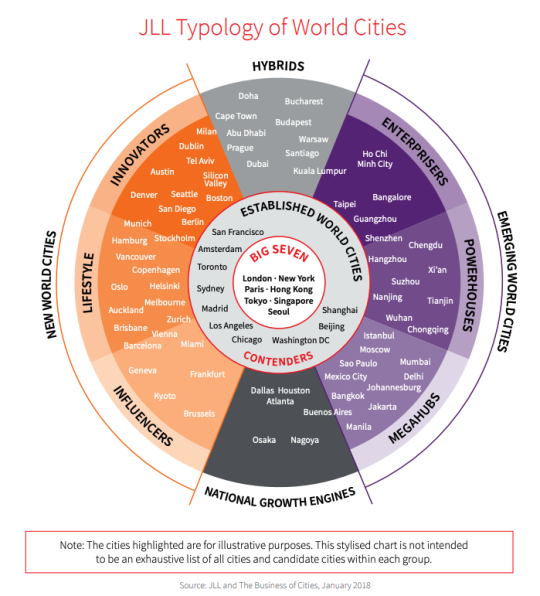
    The report proposes a new typology of world cities that looks like this:

    image

    It is based on 10 overall categories of cities, grouped into 4 main buckets. The first bucket is “Established World Cities”, within which there is the “Big Seven”, and then the “Contenders.”

    The Real Estate Highlights that accompany each category of city is a good place to start if you’re looking to do a quick scan of the report.

    Here’s a taste:

    One-quarter of all capital invested in commercial real estate globally currently lands in one of the “Big Seven” cities. And London and New York are easily at the top.

    Cities that recently graduated from “New World City” status – namely Toronto, San Francisco, Sydney, and Amsterdam – are all struggling to address housing and infrastructure deficits.

    “Lifestyle” cities – such as Vancouver, Auckland, and Oslo – are some of the most active investment markets. Biggest rental growth for prime offices (since 2000) in the “New World Cities” category.

    Click here for the full report.