Daily insights for city builders, delivered every morning at 6 AM ET. I’m Brandon Donnelly — a Toronto-based real estate developer and founder of Globizen. I’ve been writing here since 2013.

Tag: toronto life

  • Lisbon Hotel

    My friend David Wex recently opened up a new bar called Lisbon Hotel, and this evening I went to check it out with him. It’s not in Lisbon. And it’s not a hotel. But it is deliberately designed to feel like a hotel lobby bar, and it is a great place for drinks and snacks. I recommend both of the dishes pictured above — especially the cucumber and dill one.

    It’s also housed in the River City community, which his firm Urban Capital developed. And I think that’s something. Developers are often criticized when they put in boring (yet profitable) uses in the ground floors of their buildings. And this is not that (though hopefully it’s still profitable). This is him and his partners wanting to do something cool and help create a “place.”

    Who said new ideas need old buildings? Rhetorical question. It was Jane Jacobs who said this.

    For more on Lisbon Hotel, check out this profile in Toronto Life.

  • How Toronto landed its first Michelin Guide

    Back in May, I happen to come across a 1912 copy of Michelin’s Guide to France. It was exceedingly cool to see and I’d love to find a copy for my own library. (For those of you looking for a reminder on how the Michelin Guide works, click here.)

    After returning to Toronto, I then serendipitously learned that our city would be getting its own guidebook this fall, which will be a first for both Toronto and for Canada as a whole. A Michelin-starred restaurant means something to some people, and has generally been proven to drive tourism dollars — so this is perhaps a big deal.

    But there’s a lot of opacity around how these guides work and how a restaurant gets awarded one, two, or three stars. Who are these secretive reviewers? And is it really worth the money that governments need to pay to the French tire company? South Korea allegedly spent US$1.8 million back in 2016 to get its guide.

    Andrew Weir, who is the executive vice president of Toronto’s tourism marketing group, was recently interviewed about all of the behind-the-scene efforts that took place in order to make this upcoming guide happen. If you’d like to have a read, click here.

    In my view, all of this is very much an act of city building.

  • How to manipulate attention

    This Toronto Life article about a 32-year-old who has managed to buy 10 homes in the city is very Toronto Life. At a time where many young people are struggling to afford housing, here is a millennial who has bought 10 of them (albeit with some partners). The underlying message: You’re not working hard enough.

    I am fairly certain Toronto Life writes these sorts of articles because they know they’ll enrage people. As Facebook has taught us over the last few years, getting people pissed off is good for engagement. And engagement is what drives advertising-based businesses.

    Here is an excerpt from a recent Time article by Roger McNamee (a former Facebook advisor):

    One of the best ways to manipulate attention is to appeal to outrage and fear, emotions that increase engagement. Facebook’s algorithms give users what they want, so each person’s News Feed becomes a unique reality, a filter bubble that creates the illusion that most people the user knows believe the same things. Showing users only posts they agree with was good for Facebook’s bottom line, but some research showed it also increased polarization and, as we learned, harmed democracy.

    If you take a look at the Twitter conversations surrounding the above Toronto Life article, you’ll see the reactions you would expect: Troll article. Yeah, but how much debt has he taken on? He had help from wealthy friends. Here’s how a 32-year-old is eroding housing affordability in Toronto.

    I appreciate all of this, but I will never understand the need to shit on other people because of their successes, regardless of whether they are self-made or were born with a competitive advantage. Billionaire isn’t a bad word in my books. I am a first generation real estate developer, but I wouldn’t be at all upset if my great-grandparents had decided that buying land in Toronto was a good idea.

    Here is a guy that moved to Canada for University. Lived in a basement with cockroaches after leaving his first job after school. Took some risks. And saved his money instead of doing bottle service at the club on the weekends. I can respect that.

    But again, these sorts of articles are bound to make a lot of people cranky. And Toronto Life knows that.

    Photo by Tiago Rodrigues on Unsplash

  • Toronto real estate is out of control

    You can’t have an Easter dinner in Toronto right now without somebody bringing up the topic of our “crazy” real estate market. 

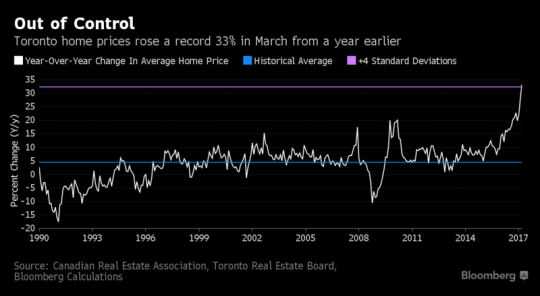
    Below is a chart from Bloomberg showing the year-over-year change in home prices in the Greater Toronto Area since 1990. It also shows the historical average (in blue) and how in March 2017 we hit 4 standard deviations above that. Home prices rose 33% in March compared to a year earlier.

    If I were a realtor, I’d probably tell you that the market is hot hot hot. Now is the time to sell because you’ll get some absurd number above your asking price and now is the time to buy because prices are going nowhere but up. Don’t miss out. 

    I would like to try and be a bit more nuanced than that. Here are 3 thoughts:

    1)

    There’s no question that low rates / cheap money is one of the root causes of the real estate valuations we are seeing today. But frankly I have no idea when or if that will change. There is an interesting argument out there that capital is no longer scarce. Our economy is going through a fundamental shift, which is why real estate is not the only asset class seeing these sorts of valuations and growth figures.

    2)

    There are a number of global factors which are helping to cement Toronto’s position as an alpha global city and destination for human capital. Think Trump, Brexit, and so on. I agree with Richard Florida’s argument that our real estate market will see more – not less – pressure going forward. Here is a snippet from a recent interview with Florida in Toronto Life:

    I think Toronto is going to get an even bigger influx of the creative class. With the rise of Trumpism, more and more people who might otherwise have gone to the United States are going to come to Canada. We’re going to see American tech companies invest more and more in Toronto. And if we think the housing affordability and economic divide we see today is bad, it’s going to grow ever more gaping. 

    3)

    I believe that there are always opportunities in the real estate space, but that you have to be disciplined, focused on fundamentals, and willing to do things that others won’t. What bothers me is when I hear people say things like: “Real estate only goes up. You can never go wrong.” I started my career pre-2008 and lived in both the United States and Ireland. I saw what down looks like.

  • Happy 100th Birthday, Jane Jacobs

    “We came to Toronto,” she says, “because it’s a place where you can work, it’s a place where you can live well, it’s a place where there is hope.” –Jane Jacobs (1971)

    It was my birthday this week (May 2nd). But it was also the birthday of someone far more noteworthy. This past May 4th marks what would have been Jane Jacob’s 100th birthday. (She passed in Toronto in 2006.)

    In commemoration of this, Toronto Life published a photographic essay, along with a short piece by Joe Berridge. Joe is a partner at the urban design and planning firm Urban Strategies. He’s also a great storyteller.

    Here’s an excerpt:

    Jane didn’t do nice—Toronto’s default emotional setting. She was cantankerous and argumentative: once you got on the wrong side of her, that was that. About 20 years ago, when I was working as an urban planner, we were on a panel together at Boston College. I was making some remarks about city planning she clearly thought rubbish—and she just interrupted me. “Joe, Joe, Joe,” she said (her squawky Scranton, Pennsylvania, accent made it sound like “jaw, jaw, jaw”). “You’re tacking nansense.” The audience agreed. After I spoke, an incomprehensible social science professor took the stage. Jane wasn’t fond of academics—she didn’t think they knew much—but to make matters worse, he kept addressing her as Professor Jacobs. “Staap calling me prafessa,” she barked. “I barely graduated high school.” He and I both slunk offstage in shame, clutching our notes.

    Jacobs was certainly a force to be reckoned with. Without a doubt, she left her mark on this city, as well as others, like New York. And I believe that she is part of the reason why – almost 50 years after she first moved to Toronto – we remain a city where you can work, live well, and where there is hope. I like that simple characterization.

    If you’d like to read/see the full piece by Toronto Life, click here.

  • Stuck in condoland?

    Toronto Life recently published an interesting article called Stuck in Condoland. A lot of people have mentioned it to me, so there seems to be a lot of interest in the topic. It basically profiles the lives of a few young families who live downtown and are trying to raise young children in relatively small condos (think 700 square feet).

    I thought it was interesting because I like the idea of small and efficient living. The average post-war bungalow in Toronto was probably less than 1,000 square feet. And so this modern notion that you need a big house in order to properly raise a family is a relatively recent phenomenon. Although we’re a richer city today and that’s what happens when people become wealthier: they consume more.

    But the article also makes it seem that developers only want to build small condos and that larger condos and single-family homes just aren’t profitable enough. Thus the reason all these families are being forced to into tiny shoeboxes in the sky. But that’s not really true.

    Look, just like every other for-profit business on the planet, developers are concerned with making money. And so they will always look for ways to increase efficiency, drive down costs, and so on. But there are certain realities of the market that developers don’t have control over.

    First, developers aren’t building new single family homes in the city (at any sort of meaningful scale) because there’s no land to do so. And because the land use policies in place and the current thinking around how we can more sustainably build our cities for the future dictate that we should be building more intensely. In other words, building up. So it’s not a question of developers not wanting to build single family homes; it’s a question of not being able to.

    Second, trust me when I say that if the market wanted large 3 bedroom family units, developers would build them. Mandating them is a useless exercise if people don’t want them or are unable to afford them.

    The challenge we face is that a reinforced concrete condo tower is more expensive to build than a wood-framed single family house. So until land values get to a point where single family homes become the more expensive option (compared to condos), I don’t think we’ll see a huge rush towards 3+ bedroom suites.

    This is my hypothesis at least. Because when you buy house, you’re really buying two things: the house itself and the land. If the house itself (wood) is cheaper to build on a per square foot basis than a condo (concrete), then the variable that will make a difference is the land. And as people like to say: “buy land, they ain’t making any more of it.”

    So what I’m saying is that I just don’t think the situation is as simple as: “developers are bad, all they want to do is build tiny condos and make lots of money.” It’s more complicated than that. But I do believe the question of how families are going to live in the city is an important one.