Daily insights for city builders, delivered every morning at 6 AM ET. I’m Brandon Donnelly — a Toronto-based real estate developer and founder of Globizen. I’ve been writing here since 2013.

Tag: topoli

  • It’s voting day in Toronto

    Today is municipal election day in Toronto.

    About 8 months ago I publicly announced here on ATC who I would be supporting, and my position hasn’t changed. I was disappointed by the fact that he ended up backing away from his initial promise of a true downtown relief subway line (see blog post), but I nonetheless continue to support his candidacy.

    In the words of Mike “Pinball” Clemons, he’s “the right man at the right time.” Click here if you can’t see the video below.

    [youtube https://www.youtube.com/watch?v=ouqv782giyw]

    But I’m not here to try and sway your vote. That is ultimately your decision. However, I am here to encourage you to get out and vote. Regardless of who you might be supporting, I think it’s important that you get out and take a position. So I hope you do that today.

    Happy Monday!

  • The new Regent Park

    Yesterday morning I went for a swim at the new Regent Park Aquatic Centre. I used to swim regularly when I was in grad school in the US, but it fell off when I moved back to Toronto and there wasn’t a convenient place for me to walk to. Having to drive to a gym or to a pool can really cut hurt how often you’re able to go.

    In any case, the pool was fantastic. On the west side of it are glass sliding doors that face the park. And since yesterday was such a beautiful day, they were all open while everyone was swimming lanes. The wooden ceiling also gives the space a nice, warm feel.

    The biggest surprise for me though was the universal change rooms. I had never been in a co-ed change room before – or one that was completely open and visible to the pool (there are small private rooms so you can actually change). For families, it makes a lot of sense. Everyone can go in together and it’s easy to watch your kids in the pool from within the change room.

    After my swim, I rode my bike around Regent Park and tweeted this out:

    What’s happening in Regent Park is incredibly exciting. To me, it feels like a return to the fundamentals of city building. They’ve reconnected the old street grid – which had previously been removed to create the old “towers in a park” scheme – and they’re clearly working towards a proper urban neighborhood with retail at grade and buildings pushed right up against the street.

    A big measure of success, though, will be how animated the streets become and how well the retail does. Because all of that isn’t quite there yet. But we’re on our way. And already I feel like we’re about to forget what the old Regent Park used to be like. Toronto may have lived with that neighborhood for over 60 years, but future generations will barely know it existed.

    Image: Shaigil

    //platform.twitter.com/widgets.js

  • $12,000 pink umbrellas

    image

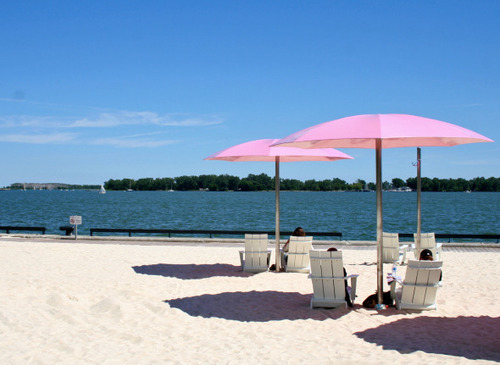
    Sometimes I like to start my mornings off by grabbing a coffee and walking down Jarvis Street to Sugar Beach and the lake. 

    I’ll find a Muskoka chair (Adirondack chair for you Americans) and position it underneath one of the iconic pink umbrellas. I mostly like to look out at the lake, but I also like the shade so that I can see the screen on my phone in case my Type A tendencies kick in and I want to check emails or mess around on Twitter.

    Oftentimes when I’m there–even early in the morning–there will already be other people at the beach. One time I came at 730am and a lady was there tanning in a bikini. I admired her dedication.

    Sometimes I need these moments. I like that sobering feeling you get when you take a time out from the everyday to just sit and think. It helps put things into perspective. And you could argue that great cities provide those kinds of spaces.

    But how valuable are those spaces? Can you put a price tag on it? Is it worth $1M? How about $14.1M, including $12,000 for each pink umbrella?

    Image: blogTO

  • Who’s paying for transit expansion in Toronto?

    Recently blogTO did a piece outlining the sources of funding for Toronto’s six active transit projects: the Spadina subway extension, the Eglinton Crosstown LRT, the Georgetown South GO line improvements, the Union Pearson Express, the Sheppard East LRT and the Finch West LRT. It broke down as follows:

    image

    You can find all the specific numbers here, but what is obvious is that the province is paying for most of this city’s transit expansion. Unfortunately though, it’s being done on an ad hoc basis. Toronto first asks for money and then the province decides whether or not it wants to give it.

    This is problematic for a few reasons.

    First, it’s an inconsistent funding stream. We all recognize the need for better transit and infrastructure in the city, but the big question is always: Who’s going to pay for it? So far, as we can see, it’s been the province. But that’s not always a sure thing. And it can often become political. If we’re going to get serious about building transit, Toronto needs a consistent funding source that would allow us to start building and not stop.

    Second, how come, as one of the major economic engines in this country, we aren’t in a position to pay for our own infrastructure? It’s because our governance structure does not properly reflect the economic realities of today’s world: 

    Most local governments are formed by a charter or act granted by the province or territory. Local governments are not mentioned in the Canadian Constitution other than to say they are responsibility of the provinces. Consequently, municipalities can be created, amalgamated, or disbanded at the whim of the provincial government which controls them. They are also limited in the amount of interaction they have with the federal government because this would infringe upon an area of provincial jurisdiction. Since each province is responsible for creating local governments in its own territory, the names, functions, and powers of local bodies vary widely across the country. Local governments generally have limited powers, namely creating local by-laws and taxation (property tax).

    And yet cities, not provinces, are our biggest economic drivers. We have it backwards. And so I think it’s critical that we look long and hard at ways in which we can better equip our cities with the tools and resources to compete globally. Transit funding is just one example.

  • Every street can’t be everything to everyone

    Yesterday I spoke about why Toronto shouldn’t be so quick to dismiss streetcars and light rail. Today, I’d like to talk about some of the hard decisions we need to face if we really want to get our city moving.

    Toronto is a city of neighborhoods and small main streets–at least in the areas where our streetcars live. Streets such as King and Queen are only 4 lanes. And the problem we’re facing is that we’re trying to accommodate every single use case on them: cars, on-street parking, cyclists and streetcars. But in doing so, we’ve made the experience terrible for everybody. Streetcars move at a snail’s pace, drivers are frustrated by the lumbering streetcars, cyclists fear for their life driving by parked cars (doors can swing open at any time), and so on.

    And with the rise of downtown shoulder neighborhoods such as Liberty Village, King West, the Distillery District and the soon to be complete West Don Lands, the strain on our east-west corridors is only going to get worse–much worse, in fact. Already the King streetcar is the busiest streetcar route in the city, moving almost 60,000 people per day. That’s more than the (under utilized) Sheppard subway line.

    What I hope is clear to the ATC community though, is that the answer isn’t uniformly the car. We can’t have every single resident from Parkdale to Leslieville hopping into their car and driving downtown to their office at Yonge & King. It ain’t going to work. And so we’re going to need to make some difficult decisions about how we’re going to get our city moving on the backbone of transit.

    Sure the downtown relief subway line (screw the politics I’m attaching it to downtown) would be the ideal solution to connecting our emerging shoulder neighborhoods, but that’s not going to happen overnight. And so how do we improve the efficiency of what we already have? First, we need to accept the fact that every street isn’t going to be everything to everyone at all times. We need to choose who we want to optimize for.

    So here’s an idea that’s been floated many times before but never acted upon: let’s get rid of cars on King St and Queen St in the core during rush hour.

    This would give our streetcars the room to efficiently move people across downtown, minimizing the dreaded “bunching up” that occurs as a result of traffic congestion. It would make transit a reliable choice and there are ways to pilot it. But let’s be clear: this is not about being anti-car. It’s about optimizing uses and getting people moving. Cars would continue to get priority on Richmond St and Adelaide St, and transit riders (as well cyclists) would get priority on King and Queen.

    Of course, the Rob Ford viewpoint would say that we should be optimizing all streets for cars and getting the streetcars completely out of the way. But if that’s the approach we want to take, then we’re building the wrong kind of city. We shouldn’t be focused on intensifying and creating new inner city neighborhoods, because that only tips the scale in favor of transit. Instead, we should be focused on decentralization.

    But that’s what not we’re doing. We’re intensifying our city to the point that we’re now faced with a number of difficult–yet enviable–decisions about how we’re going to live and how we’re going to move around in the future. We’re a city in transition.

    Our mission here should be to figure out how to move people around the city as efficiently possible. Let’s put politics aside and recognize that time is one of our most precious resources. And when we put people in lumbering streetcars and debilitating traffic jams, we’re completely squandering that resource. It hurts productivity and it hurts our overall prosperity as a global city.

    There’s a place for subways, streetcars, buses, bikes and cars in our city. So let’s just get on with making them all work.


  • John Tory is running for mayor of Toronto

    Yesterday I was at brunch for a good friend’s birthday and a few of us started talking about politics and the future of Toronto. We immediately became depressed by the fact that Rob Ford, could actually, get in again. For those of you outside of Toronto, I know this sounds like pure lunacy.

    We then speculated as to whether John Tory would ultimately run again. Though it would split the conservative vote (between Ford and Karen Stinz), I was hoping he would. Then, just like magic, Tory announced his candidacy. Here’s the video:


    While some would call it an oxymoron, John Tory is often painted as a “Red Tory”. He’s fiscally conservative, but then holds socially liberal views on issues such as same-sex marriages.

    But perhaps more importantly for the Architect This City audience, Tory is also a city builder. He’s Chair of the Greater Toronto CivicAction Alliance, which is non-profit group focused on transportation and economic development in the region. And this comes through in his clear support of the Yonge relief subway line (see above video).

    So even though this risks splitting the conservative vote, I will be supporting John Tory’s candidacy during this year’s mayoral election in Toronto.

  • Revisiting the Gardiner East debate

    Last week I argued that the eastern portion of the Gardiner Expressway (Jarvis Street over to the Don Valley Expressway) should be torn down and replaced by an enlarged Lake Shore Boulevard.

    To quickly summarize, here’s why I support removing the Gardiner East:

    • Now is the time to do it (before we develop the surrounding area and it becomes both more expensive and more difficult to do it).
    • It would go a long way to stitching our disconnected downtown back to the lake and realizing our ambitions for the revitalization of the waterfront.
    • Unlocking the full potential of our waterfront is hugely important.
    • In my opinion, the only way to build a big, well functioning city, is on the backbone of public transportation. And this—the tearing down of the Gardiner East—could represent that paradigm shift.
    • It is a portion of the Expressway that has relatively low traffic volumes.
    • It’s the cheapest option on the table.

    Somewhat surprisingly though, a lot of people disagreed with me. They told me that adding anything to our already long commutes would be simply unconscionable and that they would not support it, no matter how much it improved our waterfront.

    So in the spirit of avoiding confirmation bias (that is, only seeking out things that reinforce an already established belief), I thought I would share the following article: “Like It or Not, Most Urban Freeways Are Here to Stay.” It’s from Atlantic Cities and there are 3 key take-aways that I’d like to point out.

    First, I thought it was interesting that the interstate system in the United States was, from the onset, always conceived of as a solution to urban congestion. I always thought it was about connecting the country, but that, apparently, was a secondary goal.

    Second, cities all across North America are engaging in the same debate about what to do with their aging highways. Detroit is debating. New Orleans is debating. And so is Syracuse. Toronto is not alone. But we could be alone in taking the lead on this issue.

    Third, the author basically acknowledges that, while not ideal, we’re stuck for the time being with all these freeways and that the better solution is going to be a really tough slog:

    “This is not an easy assignment, seeing as how cars are purchases we make with our hearts, more than our heads. Logic won’t convince Americans to change their ways. What will? Maybe, over time, prohibitive fuel prices and withering tolls, and, most importantly, investment in useful and convenient public transit. Only when the carrot is irresistible, and the stick stings too sharply to bear, will the shift begin, and it will take years to play out.”

    And while I would agree that it’s not going to be easy, that’s par for the course with anything truly worthwhile. If it were easy, everyone would be doing it. But they’re not. And that’s why there are leaders and there are followers.

    People in Toronto like to talk about how our City sometimes lacks vision. Well, here’s our chance. I’m not worrying about what the commute is going to be like tomorrow, because I know there’s an even better solution for that problem. I’m worried about something even bigger. I’m worried about the kind of city we’re all going to leave behind to our children.

  • Toronto’s schism is hurting the city

    Instead of talking about the latest Rob Ford scandal (honestly, how is he still mayor?), I’d like to focus on his abilities as a transportation strategist.

    Here’s an excerpt from a Toronto Star article published this morning that talks about the urban vs. suburban divide in this city and our inability to depoliticize transit planning. It’s called, “Suburban envy only makes things worse: James.”

    image

    In another committee room, councillors were debating the proposed downtown relief subway line — only, they were afraid to name it such. Downtown is a section of the city that dares not voice its name, for fear that aggrieved suburbanites will rise up and object.

    This is not hyperbole. Not long ago, the mayor indicated he is not interested in the relief line until there are subways on Sheppard East and on Finch West. Why? Because downtown “has enough subways.”

    Downtown has enough subways? Do you think Ford looked at population density, number of stops, ridership levels, and so on, in order to come up with this position? Or did he just look at where his voter base resides?

    We need to get past this downtown vs. suburban schism. We’re all in this together. In fact, the whole Golden Horseshoe region is in this together. And until we start acting as a unified entity, we’re not going to reach our full potential.