Daily insights for city builders, delivered every morning at 6 AM ET. I’m Brandon Donnelly — a Toronto-based real estate developer and founder of Globizen. I’ve been writing here since 2013.

Tag: ted talk

  • I think Roman Mars would appreciate Utah’s new state flag

    Utah got a new state flag over the weekend that looks like this:

    And I immediately thought of this TED Talk by Roman Mars. For those of you who don’t know, Roman is the creator of 99% Invisible and a great lover of well-designed flags. His general rules of thumb are to keep things super simple and to use meaningful symbolism. And I’m fairly certain that he knows what he’s talking about because, in his talk, he refers to the Canadian flag as the gold standard for flags.

    In the case of Utah’s new flag, the symbols are this. The blue at the top is meant to represent Utah’s wide-open skies and lakes. The white in the middle represents its snowy mountains (of course). The red stripe is meant to represent Southern Utah’s red canyon landscape. The hexagon is meant to reference a honeycomb. And finally, the beehive is there because, well, Utah is the beehive state.

    Utah has long enjoyed this reference to beehives. Supposedly, it was early pioneers who started throwing around this reference because they believed it symbolized working together, perseverance, and overall industry. And that’s why the state’s official motto is, “Industry.” So I’d say that they used/kept the right meaningful symbolism.

    Though when I first saw the new flag, I immediately wondered whether the hexagon and honeycomb could have been made just a little simpler. Was the yellow fimbriation, for example, really needed within the blue hexagon? But the more I look at it, the more I like it and the more I think that Roman Mars would be happy with how this turned out. What are your thoughts?

  • COVID-19 in the developing world

    One of the things that Bill Gates mentions in his recent TED talk about the coronavirus is that we need to be aware of what might be coming in developing countries, particularly in the southern hemisphere with winter about to arrive. (There’s some evidence of a relationship with temperature.)

    So far, countries like Brazil have been criticized for taking a laid-back approach to fighting the coronavirus. But the same could be said for many, or perhaps most, countries around the world at the outset.

    However, in the case of densely populated slums — like Brazil’s favelas — the problem is expected to be more severe. Without the ability to socially isolate and without proper services, it is questionable whether they will be able to “flatten the curve” in the same way that some developed countries have. There’s also a lack of government oversight in these communities.

    Incidentally, the Financial Times is reporting that organized crime has started to step in to fill this void — and it is happening over WhatsApp. Here is an excerpt from the above article: “Whoever is caught on the street will learn how to respect the measure. We want the best for the population. If the government is unable to manage, organised crime resolves,” read one message sent to residents of a Rio de Janeiro slum.

    One hope is that rich countries will be largely through their outbreaks by the summer and that a vaccine will be well on its way.

    (On a related note, here is an excellent slide deck from the London Business School on the economics of this pandemic. It’s very comprehensive and worth a read.)

  • How to respond to the coronavirus

    I just finished watching this TED talk with Bill Gates. For those of you who are up on their TED talks, this is not the one from five years ago where Bill predicted a pandemic and told us all that we were nowhere near ready. (We, of course, didn’t listen.) This is one that was published a few days ago and talks about how we should be responding to the outbreak that we are currently living through. The Bill & Melinda Gates Foundation has been committing significant resources toward solving problems exactly like this one. So it’s interesting to hear his thoughts. In case you’re wondering, herd immunity isn’t the answer. We need (1) widespread testing and (2) to be extremely disciplined about our social distancing. In his words: “But money, you know bringing the economy back and doing money, that’s more of a reversible thing than bringing people back to life.”

  • Standard elements in non-standard ways

    A few people have now sent me this TED talk by architect Débora Mesa Molina. But I watched it for the first time today. I guess my personal brand is pretty closely associated with architecture and design.

    In it, she talks about her firm’s approach to using overlooked and/or standard building materials in unconventional ways. For example, here, she used stacked precast beams to assemble a house in Madrid (c.2008). The entire structure came together in only 7 days.

    My first reaction is that I like the idea and approach — which is really quite interesting — more than the final designs. I am also curious if there were any cost savings as a result of using “standard” materials. What are your thoughts?

  • Embracing our cities

    This is a great TED talk by Edward Glaeser about why it is time to embrace our cities. If you can’t see it below, click here.

    [youtube https://www.youtube.com/watch?v=ILDwnzQNlGc&w=560&h=315]

    The talk was filmed in 2012 – right around the time that Triumph of the City was released – but the video was published at the beginning of this year.

    It is also a good add-on to yesterday’s post about transportation costs and cities. I love how passionate Glaeser gets about these topics.

  • A cohousing case study

    There’s a lot of interest right now in micro apartments. Here is a recent example from New York City. Generally speaking the model is driven by a need to increase housing affordability: shrink the apartments; lower the prices. 

    To compensate for these smaller units, the buildings are often equipped with larger shared spaces and a desire to create a sense of community.

    The below TED talk by architect Grace Kim is an interesting case study of a project that started, first, with a desire for cohabitation. Her thesis is that cohousing can make us happier, less lonely, and more socially connected.

    The cohousing community that she profiles is one that she both designed and developed and one that she now lives in and practices architecture out of.

    If you can’t see the video below, click here. It’s only 10 minutes. After you’ve watched it, let us know in the comment section below if this is a community you could see yourself being a part of.

  • Educational attainment and urban success

    We know that educational attainment matters a great deal for the economic success of our cities. In fact, by some measures, it is the single most important factor.

    City Observatory found that 60% of the variation in per capita income across large U.S. metro areas could be explained simply by the percentage of the population with a 4-year college degree.

    So education matters a lot.

    Many of you have probably seen this entertaining TED talk by Sir Ken Robinson called: Do schools kill creativity? It has almost 47 million views at this point. 

    Well, he was recently interviewed by Ingrid Peritz of the Globe and Mail and I have to share the following quote, because I think it’s terrific (particularly the part in bold):

    “We need to recognize that children have a huge range of natural abilities and they all have them differently. Our education systems are designed to focus on a small band of those. If you have a narrow conception of ability, you end up with a very big conception of disability or inability.”

    More people with a college degree seems to be a pretty good thing. But the solution doesn’t start there. Logically, it starts much earlier – with children. 

    All of this matters not just because people with a degree should, on average, make more money and have a higher quality of life. 

    But because it’s heartbreaking to think that some young child with incredible talents might be being mislabeled as inept simply because we have a system that is, well, inept.

    I recommend you read the interview with Ken.

    Photo by Christian Fregnan on Unsplash

  • What is your city’s flag?

    How often do you see it around town? 

    Here in Toronto, I can’t say that I see ours all that often outside of city hall. Am I missing it? Here’s what it looks like:

    image

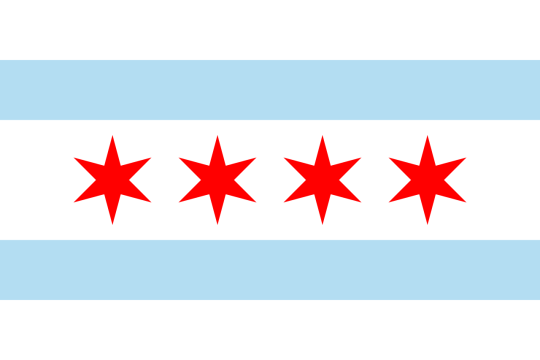
    In other cities, such as Chicago, the city flag seems to be far more ubiquitous. Here’s what Chicago’s looks like:

    image

    In the case of Toronto’s flag, the two white bands are meant to represent the architecture of Toronto City Hall. The maple leaf is the Council Chamber at the bottom. And there is some suggestion of a letter “T” for Toronto. Wikipedia says the “T” is supposed to be found in the blue space between and above the two towers of city hall, but I’ve always seen the two white bands as being the “T.”

    In the case of Chicago’s flag, the blue bands represent the lake and river (I like that) and the four six-sided stars represent significant events in the history of the city (positioned between the two bodies of water to mimic its actual geography).

    Roman Mars of 99% Invisible has a great podcast and TED talk on this topic. (The study of flags is known as vexillology.) In both instances, he outlines what he believes to be the 5 rules of great flag design. They are:

    1. Keep it simple
    2. Use meaningful symbolism
    3. Use 2-3 basic colors
    4. No lettering or seals
    5. Be distinctive

    Toronto’s flag generally conforms to these rules. But there’s something about the positioning of the maple leaf that makes the flag feel a bit arbitrary to me. I want to rationalize it.

    In any event, I think it could be really interesting if all of us shared our city’s flag in the comment section below and made a comment about how ubiquitous it is within the urban landscape.

    Roman makes the argument that a great flag gives people something to rally behind. And with cities only becoming more important on the global stage, there’s something to be said about having a well-designed flag today.

    I wonder if there will be a correlation between good flag design and ubiquity. My guess: probably.

  • How megacities are changing the map of the world

    In advance of his new book, titled Connectography, Parag Khanna recently delivered an interesting TED Talk called, How megacities are changing the map of the world. It’s about 20 minutes long.

    A lot of what is covered won’t be new to this audience, but I like how he talks about the importance of urban connectivity, the shift from political to functional geography, and the idea that, in a megacity world, countries can actually be the suburbs of some cities.

    One thing you might notice about the talk is how he glosses over both Canada and Europe. This is a reminder to me that if Canadian cities are going to continue to compete against the emerging megacities of the world, we are going to need to think at the scale of the megalopolis. And a big part of that means a focus on extra-urban connectivity.

    Click here if you can’t see the embedded talk below.

    https://embed-ssl.ted.com/talks/parag_khanna_how_megacities_are_changing_the_map_of_the_world.html

  • To connect rather than isolate

    When I was
    a kid growing up in the suburbs of Toronto, I never played in the backyard. I
    played in the streets. That’s where all the kids came together.

    We would
    play baseball in somebody’s driveway, using one of the garage door “squares” as
    the strike zone. We would play football on corner lots, where it was tackle on
    the grass and “two-hand touch” on the street. And we would wax our curbs so
    that we could skateboard them.

    None of these
    spaces were ever really intended for baseball, football, or skateboarding, but
    we kids repurposed them.

    As people,
    including families, continue to move into urban centers around the world, I
    have no doubt that the next generation of children will once again repurpose
    spaces for play. But that doesn’t mean that we don’t have work to do when it
    comes to properly preparing our communities for people of all shapes and sizes.

    One of the
    most interesting design challenges facing us today has to do with our towers.

    Architects
    have long been obsessed with the idea of vertical villages. Le Corbusier’s Unité
    d’habitation
    in Marseille had two shopping streets embedded within the tower
    that were intended to act as public spines. I don’t know how well they did, but
    it was a highly progressive idea for the time.

    Following
    on this idea, I was recently watching a
    TED talk with architect Ole Scheeren
    (thanks Mariane) and I was fascinated
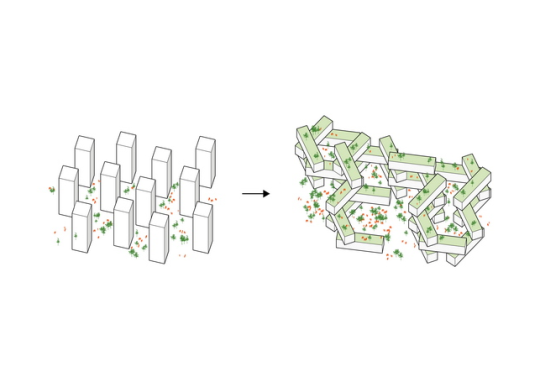
    by his obsession with breaking down the raw verticality of towers.

    His belief
    was that, yes, cities are and will continue to become more dense through tall
    buildings, but that most towers isolate rather than connect people. His work strives to do the opposite.

    And this
    one of the big trends that I think we will see more of in our cites. We will see
    new forms of urban connectedness and a blurring of private, public, and
    semi-public spaces. Screw Euclidean zoning.

    On that
    note, I am reminded that I owe the ATC community a post on my predictions for
    2016. I hope to get that out shortly.

    Diagram via Büro Ole Scheeren