Daily insights for city builders, delivered every morning at 6 AM ET. I’m Brandon Donnelly — a Toronto-based real estate developer and founder of Globizen. I’ve been writing here since 2013.

Tag: technology

  • Real estate + tech

    If you’re interested in tech and tech products, you might be familiar with a platform called Product Hunt that helps you discover new products/startups on a daily basis. They launched back in 2013 and have since become an important part of the startup ecosystem.

    Here in Toronto, the Product Hunt community has been incredibly active with organizing regular meetups. Every 2 months they host an event, which includes a keynote speaker, 3 product demos from local startups, a panel discussion, and of course the usual drinks.

    The next Product Hunt Toronto event (#7) is scheduled for Thursday, November 26th at 6pm and the focus is on digital products serving the real estate industry. Back when I became obsessed with this space, this would have been considered pretty niche. But today there’s a tremendous amount of interest in the overlap between real estate and tech. And I’m thrilled to see that.

    If you’re also interested in this space, you should grab a ticket right now. They just went on sale yesterday, but usually sell out within a few days. At the time of writing this post, there are only 82 tickets left. I’m also going to be delivering the keynote talk. So I hope to see you there 🙂

  • Will parking spaces in cities become more, or less, valuable in the future?

    Parking Garage by Nuno Silva on 500px.com

    https://500px.com/embed.js

    Lately I’ve been having discussions around the future value of parking spaces in urban centers. So yesterday I tweeted out this poll:

    //platform.twitter.com/widgets.js

    The sample size is very small, but for what it’s worth, there are some/many people who believe that urban parking spaces will become more valuable in the future.

    This is a reasonable assumption. 

    Over the last couple of decades here in Toronto, I would guess that parking ratios for new multi-family developments have probably fallen by more than half. It used to be that you had to build 1 to 1.5 parking stalls for each unit and now we seem to be sitting somewhere close to 0.5. Although, there are also exceptions and some projects today are getting built with no parking.

    So given that the supply side of urban parking spaces seems to be getting constrained and many cities are actively trying to encourage other forms of mobility, it’s not unreasonable to believe that parking stalls will only become more valuable. That’s why a new underground spot in Toronto might cost you $60,000 today and why some spots in New York can even fetch a $1 million

    But this assumes that the demand for parking will remain more or less the same. What if it doesn’t stay the same? What if we were to experience a tipping point that rearranged urban mobility? What if the cost of driving became so high that people stopped driving at scale? In these scenarios, the demand side of the equation would change.

    If you’re a regular of this blog, you probably know what I’m going to say next. But already I can think of two innovations that would contribute to the above scenarios: Uber and driverless cars.

    Uber’s goal is to continually drive down the cost of transportation and eventually get you to no longer own a car. They know very clearly that the demand for transportation services is highly elastic and that the cheaper they get the more you will use them. And the way they get cheaper is by continually increasing the utilization rate of their drivers/cars. An idle driver/car is the enemy.

    Of course, the other way to drive down fares is to remove the driver all together. And once you’ve done that, there is, in theory, no reason that a car should ever sit idle – like they do today. (The utilization rate for my car is around 2%.) And if a car is never sitting idle, then why would you ever need to park it? Certainly you wouldn’t need to park it as often as you do today.

    All of this isn’t going to happen tomorrow, but I believe – despite the supply constraints – that we are going to end up with excess parking spaces in our cities. And that will mean that they are going to be perceived as less valuable than they are today. I also believe that it will eventually seem silly to drive your own car. 

    What do you think?

  • A Detroit story of single family homes and pianos

    NO MORE MUSIC by Shawn Whitehead on 500px.com

    https://500px.com/embed.js

    I was reading Aaron Renn’s blog this morning and a post called, How Urban Planning Made Motown Records Possible, caught my attention. 

    His argument – taken from a book called Once in a Great City: A Detroit Story – is that the prevalence of pianos in black working class and middle class families was a key ingredient in Detroit ultimately punching above its weight musically.

    Here’s an excerpt that Aaron Renn shared on his blog:

    The family piano’s role in the music that flowed out of the residential streets of Detroit cannot be overstated. The piano, and its availability to children of the black working class and middle class, is essential to understanding what happened in that time and place, and why it happened, not just with Berry Gordy, Jr. but with so many other young black musicians who came of age there from the late forties to the early sixties. What was special then about pianos and Detroit? First, because of the auto plants and related industries, most Detroiters had steady salaries and families enjoyed a measure of disposable income they could use to listen to music in clubs and at home. Second, the economic geography of the city meant that the vast majority of residents lived in single family homes, not high-rise apartments, making it easier to deliver pianos and find room for them. And third, Detroit had the egalitarian advantage of a remarkable piano enterprise, the Grinnell Brothers Music House.

    Detroit is obviously not the only city with lots of single family homes. But it’s fascinating to think that this housing typology, combined with a number of other socioeconomic factors, could be what ultimately led to the creation of the Motown Sound.

    It’s also interesting to think about what kind of talent we might be squandering in our cities. I mean, look what happens when people have access to things like pianos (in the case of Detroit), computers (in the case of people like Bill Gates), and cheap/vacant space (in the case of Berlin and its clubs). They create amazing things.

    This is one of the reasons why I think we sometimes underestimate the importance of small scale moves when it comes to spurring innovation in cities. We forget that people will do incredible things when they are, quite simply, given the freedom to work on projects they are passionate about.

    If we could harness these passions instead of focusing so often on big political announcements, I think we’d all be better off.

  • Technology is eating the world

    Large Gantry Crane on Sunset by Sasin Tipchai on 500px.com

    https://500px.com/embed.js

    Earlier today the comment section of an old post I wrote about UberX was revived with a discussion around technology and what it means for human capital.

    The concern expressed was that technology and machines are going to put us all out of a job. And it stemmed from a discussion around driverless cars. Clearly we are headed in that direction and so eventually we will no longer need to drive or have people drive us around. This means that something that was once a job will no longer exist.

    But I am not yet convinced that it will be as dire as some believe it will be – though it could very well necessitate some significant structural changes in the economy.

    Here are two things to consider:

    Marc Andreessen has written and tweeted a lot about the topic of “robots eat all jobs” and his argument is that this line of thinking often revolves around something called a lump-of-labor fallacy. This is the idea that there is a fixed amount of work to be done. And so when technology replaces humans, we are just making the labor pie smaller.

    But the reality appears much different. Human wants and desires increase and we find new ways to put people to work. One of the examples I’ve heard Marc give, that I really like, has to do with buildings. In the past, there used to be a guy whose only job was to shovel coal into a furnace. He physically heated the building. But eventually technology did away with that requirement and that job. Is that not progress? Or should we go back to that in order to put people to work?

    All this said, unemployment and job displacement are still serious issues for cities and countries. Which is why some people – including many capitalists – believe that minimum wages will not be enough going forward. We will also need to look at things like a “basic income guarantee” to redistribute wealth and ensure that, no matter what, everyone has a certain amount of money to live.

    At first blush, this doesn’t feel right. But I think it’s important to remain open minded and engage in discussion. Hopefully we can do a bit of that today in the comments below.

  • Fred Wilson on where the New York tech ecosystem is heading

    Venture capitalist Fred Wilson is the poster boy for the New York tech industry. And this morning he posted an interesting video on his blog of a recent talk he did at Google NYC.

    At the 4:50 mark he begins talking about the evolution of the tech sector in New York and how it became what is probably the second most active startup hub in the United States.

    Given yesterday’s post on talent and the recent CityAge conference I participated in, I thought this video would make a great follow-up. There’s talk of lifestyle, diversity, gender equality, and talent within cities.

    Fred is heavily involved in growing and improving computer science education in New York, which is a perfect example of how cities can better leverage the people and talent they already have – as opposed to just focusing on bringing in new talent. Coding is a valuable skill to possess.

    I also found it interesting that Fred ended up in New York precisely because his wife wanted to live in New York. And that had a lot to do with all of the things you can do in the city, outside of work.

    If you can’t see the video below, click here.

    [youtube https://www.youtube.com/watch?v=_fZCrasNIfQ?rel=0&w=560&h=315]

  • Foursquare uses their global foot traffic data to accurately predict iPhone sales

    I am a fan and long time user of Foursquare – now known as both Foursquare and Swarm.

    Foursquare has struggled against competitors such as Yelp.com when it comes to local business recommendations. And I have less than 100 friends on my Swarm. It doesn’t seem to be that popular here in Toronto.

    But I’ve always loved the data collection aspect of Foursquare / Swarm. Even though most people don’t seem to care about that. When I check-in somewhere, such as the gym, it’ll tell me how many weeks in a row I’ve been there, whether it’s a new personal record, who else is nearby, and a host of other things.

    I’ve always felt like there was so much potential in all of the data it was collecting.

    Well the company is starting to make better use of that data. Recently they used their foot traffic data at Apple stores (I am assuming this goes beyond just check-in data) to predict the number of iPhones that Apple was going to sell globally following the launch of the 6s and 6s Plus.

    They predicted between 13 to 15 million handsets and it turns out they were right:

    This validates the accuracy of our prediction and while we’re proud of the result, we certainly aren’t surprised. Foursquare’s data is essentially the world’s biggest panel of foot traffic data — we have the best sense of the trends and patterns of the movement of people and their phones around the world.

    This is powerful stuff. If there were a way for me to be bullish on Foursquare beyond just writing this post, I would be.

  • Advancing green building technologies, one condo suite at a time

    This evening I had a fascinating conversation with Subhi Alsayed of Tower Labs. If you haven’t yet heard of Tower Labs, I would encourage you to check them out. Here’s their mission statement:

    Our mission is to facilitate the adoption of green building products, technologies and practices through pilot and demonstration projects in highrise buildings; and accelerate the evolution to a low-impact, sustainable urban environment.

    What they do is test out new green building technologies in one-off condominium suites. And since they were founded by both MaRS and Tridel (which is one of, if not the largest condo developer in Toronto), they have plenty of opportunities to do just that.

    This is important because the real estate industry is notoriously slow at innovating. I’ve written about this many times before. Whenever you try and introduce something new, there’s always a lot of change management that goes along with it. The construction trades, to use one example, need to get their heads around it. And until they do, they’re going to charge a premium for it.

    So by creating a one-off test case, everybody gets to see how it works, how it is built, and, most importantly, how it actually performs in the real world.

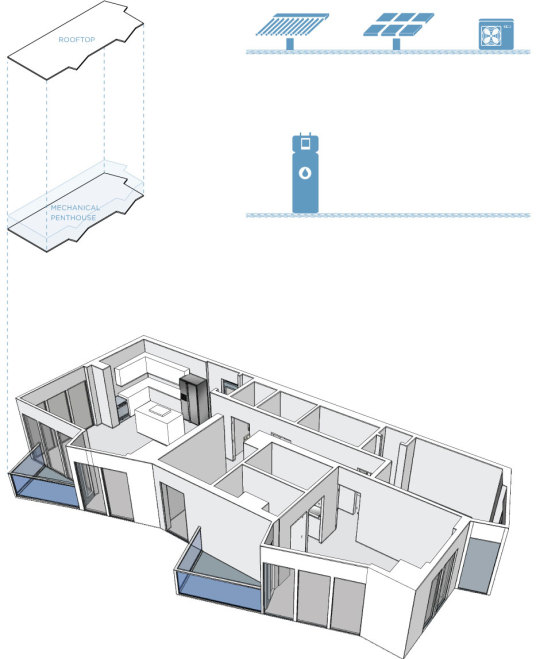
    One of the projects that they’re working on is something called NetZED, which stands for Net Zero Energy Dwelling. As the name suggests, it’s a condominium suite that produces as much energy as it consumes. 

    The way it works is by trading energy. At night when the sun isn’t out and the panels on the roof aren’t able to produce energy, the suite “borrows” electricity from the building. But during the day when the sun is out, the suite powers itself and then returns any borrowed electricity to the building. Click here to learn more about the suite. It’s being built in the Aqualina Condos on Toronto’s waterfront.

    image

    I find all of this incredibly exciting. Not only because they’re working towards a more sustainable future, but also because they’re applying their efforts towards the multi-family building typology (towers). Given that most of the world now lives in cities, this is an important building typology to make even more sustainable.

    Image: Tower Labs

  • When everyone thinks you’re wrong

    Sunset by Paolo Mastrogiacomo on 500px.com

    https://500px.com/embed.js

    I was recently talking to my good friend Jeremiah Shamess about the current state of development land sales in Toronto (he does this for a living) and he said something to me that I found really interesting.

    He said that because the market is so competitive, you can really only win development sites in one of two ways. Either you’re willing to spend the most money or you see something and have a vision that nobody else sees.

    And it was this second piece that really stood out to me because it reminds me of one of my favorite investing frameworks.

    Warren Buffet is famous for saying that you should be fearful when others are greedy and you should be greedy when others are fearful. And what I’m about to talk about is really that same core philosophy.

    Here’s how venture capitalist Fred Wilson put it (reiterating something that Bill Gurley said):

    I saw Bill Gurley say that you can only make money by being right about something that most people think is wrong. His logic was that you can’t make money by being wrong. And you can’t make money by being right about something everyone else knows. So you have to be right about something that most people think is wrong. I really like that framework.

    But this doesn’t just apply to technology companies or stocks. It applies to city building, most industries, and probably most things in life if you think about it.

    If all you’re doing are things that everyone else is doing, then how can you expect to outperform? You’re going to revert to the mean.

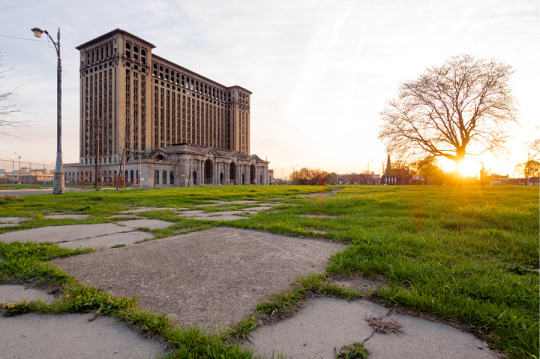
    Take, for example, billionaire Dan Gilbert and Detroit. Not everyone believes that Detroit will come back. In fact, I suspect there are probably more people who think it won’t come back, than people who think it will. Otherwise, it would already be back.

    But Gilbert is unquestionably long on Detroit (via Forbes):

    As you’ve likely heard, over the past four years Gilbert has become one of Detroit’s single-largest commercial landowners, renovating the city with the energy and impact of a modern-day Robert Moses, albeit bankrolled with his own money. He’s purchased and updated more than 60 properties downtown, at a total cost of $1.3 billion. He moved his own employees into many of them–12,000 in all, including 6,500 new hires–and cajoled other companies such as Chrysler, Microsoft and Twitter to follow.

    If/when Gilbert proves to be right about Detroit, then he will have been right about something that most people thought was wrong. And because of that, he will no doubt make a lot of money.

  • This is a personal blog

    The internet has created an interesting dialogue between personal identities and corporate brands.

    In the pre-internet and pre-blogging days, it was harder for individuals to establish a strong brand and public identity for themselves, unless of course they were somebody famous. The cost of doing so was simply prohibitive. To promote meant print, TV, radio, billboards, and so on.

    But now promoting can mean anything from tweets to writing a blog like this one. And that has opened up the opportunity for anyone to put themselves out there.

    The dialogue, or tension in some cases, is that it becomes a balancing act: what should I be putting out there? Myself, some faceless brand, or a mixture of the two? Brandon Donnelly or Architect This City?

    If you a run a company, you’re probably debating this. Do I create a personal social media account, one for my company, or both? And how do I go about managing both?

    To be clear, this blog is a personal blog. It’s not a business. 

    Some people have suggested I start to allow multiple authors and turn it into more of a platform. But I thought about that and that’s not what I want to do. Which is why I continue to write at brandondonnelly.com (i.e. myname.com). I like that I can send this URL to anyone and they’re able to quickly understand who I am and what I’m about.

    Because what I write about are things that I’m passionate about: cities, design, real estate, technology, and so on. But I also mix in personal things so that I feel as if I’m writing a public journal. There are many benefits to keeping a journal (my 4th grade English teacher Mr. Hoad-Reddick told me so). And that’s really how this whole blog phenomenon started – they were personal places.

    Over time though, blogs evolved to become less personal and more corporate. And I am sure that some of you would rather I keep things strictly business around here.

    But to be honest, my favorite people and brands to follow online are the ones that do make their content personal. Yes, I want to learn new things about interesting topics, but I also enjoy the connection that comes with reading somebody’s personal journal and engaging in discussion with them.

    In fact, I hate it when my Twitter feed becomes nothing but companies tweeting out polished articles and reports. That’s boring. I like seeing real people in my feed. People sharing what they’re doing and how they’re feeling. People being authentic, genuine, and even vulnerable.

    And ultimately I find it makes their non-personal content that much more engaging. You have context. You understand their thought process. You can read between the lines. Those connections are what social media and blogging are really all about.

    So I’m thinking that I’m going to try making this blog a bit more personal and a bit more playful. I hope you enjoy it. And if you don’t, I’m sure you’ll tell me about it in the comments below.

    On that note, I’m off to the gym to lift some weights. Besides blogging, that’s another one of my habits that I need to do on a regular basis in order to feel normal.


  • Why I write something every single day, even if it’s garbage

    I was out for brunch last weekend with a few close friends from high school. It’s a “monthly reunion” that happens nowhere close to every month. But the hope is certainly there.

    During brunch the topic of my blog came up. And one of my friends asked me how I got started and how the hell I keep up with one blog post every single day. (I get that second question all the time.)

    I’ve written about this before, but I think it’s worth revisiting.

    Earlier this week venture capitalist Fred Wilson wrote a post on his blog called The Blank Screen. And I really liked how he described the experience of writing a daily blog post:

    Sometimes this process produces great insights for me and possibly others. Sometimes it produces garbage. But I’ve come to realize that the daily post, and its quality or lack thereof, is not really the thing. It is the ritual, the practice, the frequency, the habit, and the discipline that matters most to me. And, I would suspect, the same is true of the readers and commenters who frequent this blog.

    Fred’s blog was a major source of inspiration for me. I saw him doing it. I saw the value he was getting out of it. And I wanted to do it too. So I did, almost 2 years ago. 

    But he also inspired me in another way.

    Venture capital and real estate development share many similarities in my mind, even down to the way that deals are often structured with preferred returns and promotes.

    But the interesting thing about venture capital is that it went from a largely closed and “ivory tower” kind of industry to now one where almost every venture capitalist blogs, tweets, and strives for greater transparency (when possible).

    I thought this was a fascinating shift and it made me think that the exact same thing was bound to happen in real estate development. So I am trying to make that happen. Hopefully this blog is helping.