Daily insights for city builders, delivered every morning at 6 AM ET. I’m Brandon Donnelly — a Toronto-based real estate developer and founder of Globizen. I’ve been writing here since 2013.
I was reading Fred Wilson’s AVC.com blog this morning (as I do every morning), and I thought his post on trust was a really important one. He was talking about it in the context of building successful web applications, but I don’t think it’s only applicable to internet businesses.
No, the most important question in marketing something to someone who hasn’t purchased it before is,
“Do they trust me enough to believe my promises?”
Without that, you have nothing.
I thought this was such an awesome, yet simple, post that I actually circulated it to a bunch of people in the office after I read it. Because whether you’re marketing widgets, marketing private cloud storage, marketing to investors, or marketing new condominiums, that question of trust is paramount.
And it’s for that reason that I think social media and mediums such as blogging have become so important. Customers want to feel like they trust you before they buy your product. The best brands know this and forge “relationships” with their customers. And with the tools at our disposal today, it’s become a lot easier for companies to do that.
I’m reading a great book right now called Tech and the City. I’m only 31% of the way through it (according to my Kindle app), but already it’s been an interesting read. It’s about the making and rise of New York City as a technology and startup hub – which, is fairly recent phenomenon. There aren’t too many cases where New York plays second or third city, but tech is one of those instances. Silicon Valley dominates.
The book talks about the deliberate efforts that were made, by the Bloomberg administration as well by many others, to diversify New York’s economy away from financial services and towards technology, startups, and entrepreneurship. It gives you all the backstory about the rise of Silicon Alley in the 90s, its subsequent crash in the dot com era, and all the players involved. And yes the reference to Sex and the City is both on purpose and explicit throughout the book.
But at a time where cities all around the world are trying to replicate the success of Silicon Valley, the takeaways from this book are perhaps universally applicable. It certainly got me wondering if, here in Toronto, we’re doing enough to prepare our city to dominate in the 21st century.
A few weeks ago I had coffee with a friend of mine who is a partner at a Toronto-based enterprise software company called Polyform Labs. Their products are geared towards the commercial real estate industry and, since I’m a big proponent of introducing more technology into the real estate space, I thought I would share a little bit about them with you all today.
The first of their 4 main products is called Lingo, which is a machine learning tool that helps companies quickly review legal documents and contracts. In the case of commercial real estate firms, the most obvious use case is leases. These documents are often hundreds of pages long and, if you have a big portfolio of properties, I’m sure you can imagine how quickly these pages add up.
What’s neat about Lingo is that you basically upload a lease and then the tool interprets and summarizes all of the clauses for you. It then tells you where you’re potentially exposed and where your risk factors are. And if by chance it gets it wrong, you can correct it and the system will actually get smarter – hence the machine learning part.
I’m not going to go through their entire product line, but I did also want to mention one more called Aura. They call it a “location-aware loyalty engine”. And you may have heard of similar products out there in the marketplace. What it does is use the MAC address on mobile phones (which is a unique, but anonymous, identifier) to track how people and crowds move through spaces.
The most common use case I’ve come across is within shopping malls and retail spaces. It’s used to determine which stores have the most foot traffic, which departments and aisles draw the most people, how long people stay in each store, where they buy, and so on. So even if you didn’t already know about this technology, you may have already been giving up your location data. There are lots of mall landlords using it.
And it’s producing some interesting data. For example, as soon as somebody buys one thing in a mall, their propensity to buy something else grows exponentially. This is what the data tells us and I can certainly relate to it from my own experience. So as a mall landlord and tenant, you are obviously trying to figure out ways to encourage people to make that first purchase.
The other use case that (obviously) came to my mind was with respect to city planning and urban design. How could we harvest anonymous location data to improve the way we design both our private and public spaces? Imagine if we had this data for subway stations, public parks, public plazas, and so on. I bet we would discover all kinds of ways to improve the experience within our cities. I’d like to see the location data for Trinity Bellwoods Park in Toronto on a sunny summer day.
But I digress.
If you’d like learn to more about Polyform Labs and their real estate products, click here.
As an architecture and city lover, it’ll probably surprise you that I’ve never been to Chicago. I think it may have to do with the fact that it has always felt like a sister to Toronto–another Great Lakes city of comparable size. And when you travel, you often want something novel.
But that’s no excuse.
Thankfully I’m happy to report that last week I booked a trip to Chicago for this August. I’ll be there for an extended long weekend. But since it’s for a bachelor party, it remains to be seen how much archi-touring I’ll actually get a chance to do.
When most people think of skyscrapers they think of New York. But in actuality, if there’s one city that gave birth to the modern skyscraper I would argue that it was Chicago. And it was made possible by the steel industry.
Before the late 19th century, tall buildings were largely built with their exterior walls supporting most of the loads. This meant that the taller you went, the thicker the walls had to be near the bottom of the building. This is why older buildings often feel so heavy and permanent.
But when structural steel became widely available, a new building form was created. All of a sudden architects and builders could create relatively light weight structural steel frames to support the building. The skin, or outside of the building, was no longer carrying the weight.
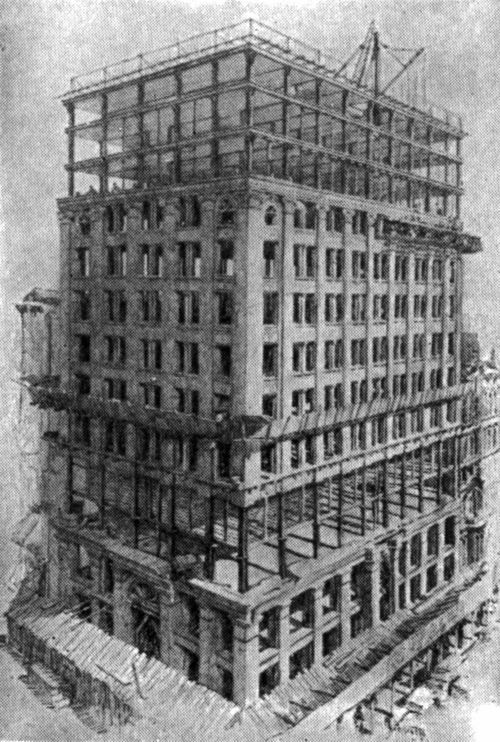
That made images like this possible:
For most of us today, this building under construction looks fairly typical. First the structure goes up and then it gets clad with its window and exterior skin. But at the time, this sort of construction technique–with the 3rd and 4th floors still unenclosed and the upper floors finished–would have blown people’s minds. It was an entirely new way of building.
Steel framed buildings removed the technical limitations of building tall and also opened up entirely new possibilities for architectural expression–such as the all glass building. Today, there’s a lot of criticism around our glass buildings. But it’s interesting to note that it started as the futuristic dream of architects.
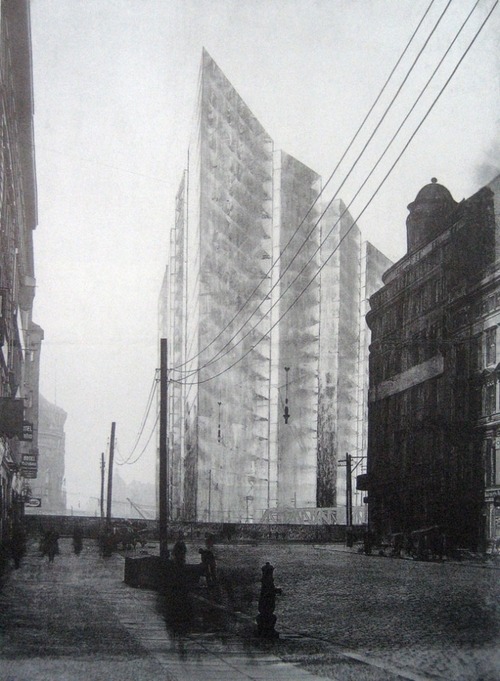
Freed from the technical limitations of load-bearing exterior walls, architects such as Mies van der Rohe began dreaming of transparent, all glass buildings. For them it represented modernity. It was the future. Above is an early charcoal sketch of that dream by Mies.
But our fixation with glass and transparency has never been because of environmental efficiency. It was about light, transparency and feelings of modernity. So as sustainability becomes increasingly critical, we should remember that there’s still lots of innovating left for us to do.
Art and architecture has always been a representation of the time and era in which it was created–which is one of the reasons I’m so interested in technology today. It’s our era. It’s our “structural steel”. And it’s going to impact our cities.
When posterity looks back on us and what we’ve done, I’m sure that will be clear.
If you’re a regular reader of ATC, you’ll know that I often talk about cities in the same way that many people talk about products and services. (See: The business of cities.) And I do that because cities are our new economic unit and so I find it helpful to think of them as businesses fighting to attract and retain the best talent and win over customers (i.e. residents and businesses).
“This is an open challenge to the all the mayoral candidates. In the past 10 years, Toronto has undergone a cultural, artistic, and technological renaissance: The ROM, the AGO, and OCAD U all underwent architectural makeovers; TIFF rose to prominence as one of the most prestigious film festivals in the world; Nuit Blanche was unleashed in 2006, and Luminato in 2007, both to huge acclaim; the high-tech industry has created 30,000 new jobs; and The New York Times admitted that Toronto’s culinary scene is more ethnically diverse than the five boroughs. But here’s the thing: The story we tell ourselves and the world about our remarkable city needs an overhaul. Toronto Needs a Creative Director is a campaign committed to building a better story by better mobilizing the arts, culture, and technology sectors to enhance civic engagement. The CDTO (the office of Creative Direction for the City of Toronto) would function as a lab for incubating ideas where art, culture, politics, science, and technology intersect.”
Truthfully, I’m not yet sure if a Creative Director is the ideal approach. I haven’t had a chance to give it enough thought. But I am certain that Toronto would benefit from a bunch of smart people who were focused on telling our story to the world, crafting our brand and identity, and honing the experience of living or visiting this great city.
The journey of Architect This City has been an organic one. When I first started blogging regularly in September 2013, I had no plan in mind other than that I wanted to write about cities. I had just come off working full-time on my startup, Dirt, where I had gotten into the habit of writing and I enjoyed it immensely. So I wanted to continue.
Cities seemed like the perfect umbrella to capture all of my passions: architecture, design, planning, real estate, and even technology. And so I rebranded brandondonnelly.com—which I had already been using as a microblog—and slapped the title “Cities” on it. (That personal microblog has since become brandondonnelly.me.)
Then, after a few months of blogging, I was having drinks with a good friend of mine and telling her about my new daily discipline. She immediately asked me what it was called and, when I replied by saying that I didn’t really have a name for it, she insisted that I create one immediately. Since she’s one of the brightest people I know, I gave it some serious thought. A few days later, Architect This City was born.
I liked the idea of having a distinct brand, because then it meant it could grow beyond just a personal blog. It could become a real community of people passionate and committed to building better cities. And that ultimately became the goal as I got deeper and deeper into writing.
Since that time last year, I’ve had friends guest blog on ATC. It has gone on to become syndicated on Mobility Lab and Urban Times. And it has been featured by the Guardian in the UK has one of the big city blogs in the world. But even more exciting are the moments when somebody tells me, either face-to-face or through a quick message, that they’re really enjoying ATC and that they read it daily. That’s what keeps me going.
Lately though, I’ve been thinking about what’s next. What’s the purpose of ATC? What’s the why? I thought about writing a manifesto of sorts, but that just seemed unnecessarily onerous. So I sat down, primarily on the subway, with Evernote, and I wrote a purpose statement for ATC:
To promote the building of beautiful and environmentally sustainable cities that offer strong economic opportunities and a high quality of life.
That’s really what I believe cities should do. They should be enjoyable and beautiful places to live life and they should empower people to get richer. At the same time, we need to be aware that as more and more of the world’s 7 billion people move into cities, the need for environmentally sustainable solutions is only going to increase.
So those are the kinds of discussions I hope we can have on ATC. Regular scheduled programming will continue as usual, but hopefully now the why is clearer. If you have any feedback on the above statement, I would love to hear from you in the comment section below.
I’ve been a Foursquare user for a number of years now. I like seeing which friends are nearby and where I’ve been. I love the data aspect of it. It’s a kind of urban “spidey sense.”
Sometimes when you “check-in”, the app will tell you the last time you were there (if it’s been awhile), how many consecutive weeks you’ve been there (which I like seeing when I check-in at the gym), and also give you any tips that others may have left about the place you’re at–such as, try the sea urchin ceviche.
But Foursquare has been struggling. Check-ins proved to be a bit of a fad and Yelp solved the what-do-you-want-to-do-tonight problem better. However I’ve always felt that, on a fundamental level, Foursquare had the potential to be so much more powerful than Yelp.
Well, today the big news in the tech world is that Foursquare is unbundling its app. There will be Foursquare and there will be Swarm. Foursquare will be a recommendation engine that helps people find places to eat, drink, shop and so on (just like Yelp), and Swarm will be all about social–seeing where your friends are and which ones are nearby. And along with this unbundling, there will be no more check-ins:
But how can Foursquare personalize its users’ results if they are no longer collecting check-ins, the foundation of Foursquare’s recommendation engine? Crowley smiles and says something a bit shocking. He no longer needs check-ins, the meat and potatoes of Foursquare’s entire business and data collection engine for the last five years.
Not only has Foursquare collected 6 billion check-ins, he says, but it has collected five billion signals to help it map out over 60 million places around the world. Each place is a shape that looks like a hot zone of check-ins — of times when people have said “I’m here.” Foursquare’s “Pilgrim” location-guessing engine factors in everything from your GPS signal, to cell tower triangulation, to the number of bars you have, to the Wi-Fi networks, in order to create these virtual shapes.
Now that it has this data, Foursquare can make a very accurate guess at where you are when you stop moving, even without a check-in, it’s a technology it hopes will allow it to keep its database of places fresh and accurate. Foursquare calls these implicit check-ins “p-check-ins,” or Neighborhood Sharing. Take your phone into four or five different Japanese restaurants over the course of six months and without a single check-in Foursquare will learn that you like Japanese food and start making recommendations for you based on that data.
There will obviously be a number of people who have anxiety about an app that’s passively tracking everywhere they go and then trying to feed them recommendations (come eat here!), but I do think they’re on to something.
The opportunity with Foursquare (and its data) is that the recommendations can be tailored. If I’m looking for a place to eat, Foursquare will already know that I love Mexican and that I just worked out (meaning I’m probably extra hungry). Personally, I’m okay with that.
But then I start to wonder how this might impact cities. If the process of discovery becomes this automated and this tailored, how might it change the way we organize and design our cities?
Though it’s sometimes common to downplay “this for that” startups (that is, derivative startups that try and borrow a model and use it in another market), Storefront–which can be described as Airbnb for retail spaces–has just raised a $7.3 million Series A round.
Storefront is a marketplace for short term retail space (think pop-up shops). People with space simply create a listing and decide how much they would like to charge per day, per week or per month. In doing so, Storefront “helps all sorts of brands, sellers, and merchants to create their first brick and mortar retail experience.”
What I find interesting about Storefront, and other startups like Airbnb, is that they’re really rewriting the way real estate marketplaces work. Instead of large retail landlords (Storefront) and multinational hotel operators (Airbnb), technology is allowing individuals to now participate in these marketplaces. Supply is being decentralized and anyone with extra space can participate.
You could argue that these sorts of informal and short term rentals are nothing new, but I don’t think there’s ever been the possibility of scaling up like there is today. I mean, just look at how much attention Airbnb has been getting in New York. These startups are having an impact on the way the larger market functions.
Change is coming. And I think we’ll see a lot more of it in the real estate space.
Earlier this week a friend of mine was live tweeting a public consultation meeting for the revitalization of Berczy Park in the St. Lawrence Market neighborhood of Toronto. And since I live in the neighborhood, it’s a project that I’ve been following particularly closely–although anything related to the built environmental generally fascinates me.
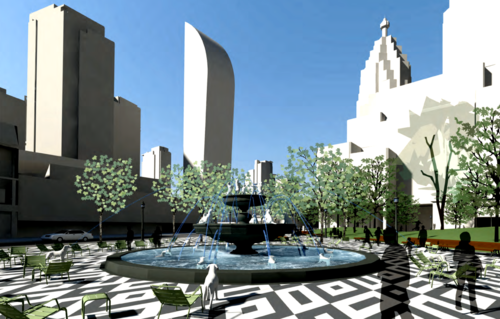
As soon as I saw the pictures he was tweeting out, I was immediately excited. And after reviewing the full design package (which you can download here), I must say that I think it’s going to be a brilliant change for the neighborhood.
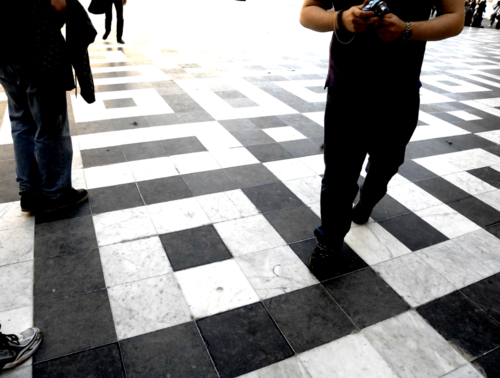
On an entirely superficial level, I like the paving motif they’ve chosen; even if it does appear to be be a copy from somewhere else (see above photo). I don’t think one should underestimate how small details, like paving, can have a huge impact on how one feels in a space, whether inside or out. It all counts.
But beyond just cosmetic changes, there are a couple of significant design changes being proposed.
First, a larger kid-friendly green space is being proposed on the west side of the park. And what was interesting to see was how the community overwhelmingly expressed a need for this play area. I’d like to believe that this speaks to the growing acceptance of raising kids downtown. There are certainly lots of families in the St. Lawrence.
Second, the south portion of the park is being “opened up” with a much larger hardscape area. The result will be a bigger promenade along Front Street, as well as, what I hope, will become an “urban stage” for people to hang out, breakdance, busk or try and sell me things I don’t need.
But equally exciting is the fact that along with the revitalization of Berczy Park will come a public art competition. It’s already in the works, but there aren’t any pretty images to share, just yet. Regardless, I think the topic of public art is an interesting discussion.
In a lot of cities around the world, there are mechanisms in place to encourage or mandate public art. Commonly, it comes in the form of a “Percent for Art” program, which means that, in the case of a new construction project, 1% of the construction costs would or should go to public art.
But the fact that we, at least in some cities, have programs to mandate it, should immediately signal to you that public art is not something universally believed in. And certainly it’s one of those things where it’s hard to measure the return-on-investment.
But that doesn’t mean it doesn’t or can’t exist.
In fact, I would argue that in today’s information and digital age it’s only going to become more important. We are living in a world of too much information and too little time. We’re living in a noisy world and, whether you’re a corporation or a city, the only way to stand out is to be remarkable. You need to bring delight to people.
Because when you do, you get noticed (and probably shared on Facebook, Twitter, Instagram, Tumblr, Snapchat, Vine, 500px, Flickr and maybe even Google+). As one example, how many of you recognize the public art piece below? It’s in Vancouver and I’ve seen it pop up a number of times in my social news feeds. It’s something that brings delight to people.
But at the same time, it’s something that speaks to and creates a sense of place. What could be more Vancouver than a giant blue raindrop along the waterfront? And that’s really one of the ironies of today’s digital world. Despite the fact that, no matter where we are, we’re all hyper connected through technology, more and more of us are gravitating back towards cities. We want to live close to other people and we want to feel a sense of place.
When done properly, public art can help cities achieve that. Whether it’s the famous LOVE sculpture or Richard Serra’s controversial Tilted Arc, public art can make you stop and take notice of your environment. It can give you that sense of familiarity or it can take you by surprise. Either way, it gives you a sense of place.
Two things happened yesterday. And since there’s a nice tie in, I’d like to talk about both of them.
First, here at TAS, we launched a new condominium project called Kingston&Co. We had already gone public with some information, but we now have an updated rendering and we’ve gone live with a public Q&A section on our website (kingstonandco.ca). The questions are all geared towards topics that we think are on a lot of people’s minds and anybody can respond. Instead of trying to cover up the elephant in the room, we wanted to do the opposite and get it out and into the open. It’s all about promoting greater transparency.
Second, I watched this 45-minute interview with author and entrepreneur Gary Vaynerchuk last night before going to bed. It’s a great video and I would encourage you to watch it if you have any interest in entrepreneurship, social media, marketing, capitalism and overall hustle. But if you don’t have the time, here are some of my key takeaways. Gary makes, on average, between $3-5 million a year selling the social media dream (but it could be more depending on things like his angel investments). Everybody is a media company first. He has clients putting 100% of their marketing dollars into social media and they’re seeing a ROI. It took him 1 ½ years to get anybody to care about his video blog Wine Library TV. And don’t just ask. Give as well.
That last point is a tie in to his latest book called Jab, Jab, Jab, Right Hook. And what he’s effectively saying is that, as a brand, you need to be mostly giving to your customers (that’s the jab). It could be valuable content you produce via social media or whatever. It’s you, delivering value to your customers in some way. Then, once you’ve done that, you can go in for the right hook, which is the ask: Buy my stuff. The idea is that you build up trust with your customers and develop a relationship so that you get the privilege of asking them to give you money.
The alternative, of course, is what we’re all already familiar with: brands constantly bombarding people with right hooks. It’s the let’s throw a bunch of shit up against the wall and see what sticks approach. And it’s related to the whole permission marketing vs. interruption marketing debate popularized by marketer Seth Godin.
But Gary’s argument–and I found this really interesting–is that constant right hooks is the approach we had to take before the internet and things like social media. Those right hooks were so expensive to deliver through billboards, print ads, TV commercials and so on, that companies simply couldn’t afford to be delivering any jabs. But all that has changed with social media and technology. Now, the best brands succeed by building trust and establishing relationships with their customers–often one-by-one.
And this is exactly what we’re trying to do with Kingston&Co. We know that there’s a lot of discussion happening in the marketplace around condos and we didn’t want to ignore it. We wanted to address it. And if you look at our messaging, you’ll notice that in most cases we’ve put “Join the conversation” ahead of the typical “Register now.” That’s because we truly do want to have a conversation.