Daily insights for city builders, delivered every morning at 6 AM ET. I’m Brandon Donnelly — a Toronto-based real estate developer and founder of Globizen. I’ve been writing here since 2013.

Tag: tech

  • Rentberry brings open bidding to rental market in San Francisco

    A new startup out of San Francisco, called Rentberry, has just launched, allowing tenants to openly bid on rentals in the city. Think of it like a rental auction. Landlord lists property. And then tenants compete for it by submitting offers. 

    Not surprisingly – especially since we’re talking about San Francisco – there’s concern that this will do nothing but drive up the city’s already high rents.

    But I think the key detail is that the platform will make public the total number of applicants. As a tenant, it’ll even tell you how your credit score compares to those of the other bidders (presumably, so you can gauge how aggressive you might need to be on your bid).

    The real estate industry is rife with information asymmetries. So anything that improves transparency is something that catches my attention. If you’ve ever bought or rented a place in a competitive market, you know that one of the worst things you can hear from the broker is: “We have another offer.” (Even worse: “We have 12 other offers.”)

    It’s frustrating because it now means you’re competing. But even more frustrating is the fact that you have no way of assessing whether or not that statement is fact or fiction. Yes, I realize that there’s a code of ethics that’s supposed be followed, but you and I both know that games are played all the time.

    In fact, I think someone could easily make a full career out of just trying to correct the information asymmetries inherent in the real estate industry. Who knows what sort of impact they might be having on the market. So I’m excited to see how things pan out for Rentberry.

  • Is Toronto a world-class city?

    image

    Earlier this week I was on a panel discussion called Building Toronto Tomorrow. One of the questions was about whether or not Toronto is world-class city. It elicited a good discussion, so I thought I would talk about that today on the blog.

    Shamez Virani, President of CentreCourt Developments, responded by saying that he thinks Toronto is the greatest city in the world and that he wishes more people would just accept how incredible this city is. I agreed with him.

    I also responded by saying that I hate this question. I think it reeks of insecurity and I think it’s a bit of a red herring. It distracts from more direct and meaningful questions – questions such as our livability and our position as a global city.

    Because the reality is that Toronto is one of the most livable cities in the world and, in my view, we are the only true global city in Canada. We are an important node in the global economy for the flow of goods, people (we’re particularly good at this), capital, and now information. There’s a lot to be proud of.

    But that’s not to say that we’re perfect. Everyone knows we need better transit. And to name a few others (non-exhaustive list), I also think we need to:

    • Get a move on road pricing.
    • Loosen up our archaic alcohol laws and start using nightlife as a competitive advantage for attracting talent.
    • Acknowledge through our governance structures that cities are what drive today’s information economy.
    • Stop thinking about the Canadian/Toronto value proposition as being about cost savings. That is, buy this from us because our currency is weaker than yours. This is anti-innovation and there are much better ways to create sustainable value. (Innovation is still a weak spot.)
    • Focus on developing an information economy that leverages the unique talent and knowledge base of Toronto. For example, I think we’re in a great position for real estate + tech innovation.
    • Do everything we can to encourage big tech IPOs in this city. They are critical to developing the ecosystem.

    There’s a saying in Silicon Valley that you “make what you measure.” It means that whatever you decide to focus your attention on, is invariably what you end up making – regardless of whether or not you happen to be focusing on the right metric.

    In the context of Toronto, I think we’d be better served if we focused on and quantified our position in the global economy, as opposed to chasing some idea of “world-class.” The latter will grow as the former grows.

    I also think that this needs to be balanced against our livability. Sometimes there’s a tension. But there are cities – the best example is perhaps Tokyo – who have managed to pair a high quality of life with one of the strongest positions in the global economy.

    Is there anything else you think we should be doing? We can talk about it in the comments below.

    Image: Building T.O Toronto (BuzzBuzzHome Event)

  • Introducing Tech:NYC

    Following the lead of San Francisco, a new non-profit, member-supported organization for New York tech companies has just launched. It’s called Tech:NYC. Here are their goals, taken from this blog post:

    Tech:NYC’s primary goals are to support the growth of the technology sector in New York City, to increase civic engagement by leaders of the New York tech community, and advocate for policies that will attract tech talent, jobs, and opportunity to NYC.

    Tech:NYC will advocate for policies that: 1) underscore a regulatory environment that supports the growth of technology companies and technology talent in NYC; 2) promote inclusivity; and 3) ensure access for all New Yorkers to connectivity, technology tools, and training.

    What makes something like this important is that many public policy issues are now rooted in the tech sector. Think about all the debate regarding ride-sharing, home-sharing, drone regulation, contract employees, and so on.

    But what is also clear is that many cities are struggling to deal with these issues. As I’ve argued before, just saying no to innovation that doesn’t fit neatly into our currently regulatory boxes is often shortsighted. 

    So how do we put in place policies that deliver the right results and that are balanced? How do we grow the tech base while at the same time managing the disruptive fallout? That’s what this group hopes to do.

    And it strikes me that every big city could likely benefit from an organization like this.

  • Lists, disciplines, and AI

    I have a bit of an obsession with my calendar, lists, and goals. On the home screen of my phone I have Wunderlist, Evernote, Google Drive, and 2 calendar apps (more on that in a second).

    This obsession is probably one of the reasons I write this blog. I like writing, drawing, and documenting things. It helps me sort through my thoughts. I have everything from a list of cities I want to visit to a list of billion dollar business ideas (yes it’s really called that).

    But the other reason I like to keep lists is because – as I said in this post – I’m trying to be cognizant about overcommitment. And when I write things down, it serves as a reminder of what I’m doing and what I’m allowed to focus on.

    One of the ways I do that is through repeatable goals (or disciplines). These are non-negotiable things that I’ve committed myself to and that I just have to grind out – such as writing on this blog every day. I can tell you that some blog posts come out a lot easier than others. But I’m a firm believer that there are few substitutes for just showing up every day and putting in the work.

    On that note, let me tell you why I have 2 calendar apps on my phone. I’ve been testing out the latest version of Google Calendar because of a new feature they rolled out this month called Goals.

    What it does is automatically schedule repeatable goals. So for instance, you could tell it that you want to work out 3 times a week for 1.5 hours each time and that you prefer to work out in the evenings. It will then go and find 3 times for you to do it every week for all of eternity. 

    If a conflict arises, that’s no problem. As soon as you enter another appointment, the app will automatically reshuffle your calendar goals to make sure that you still get your 3 workouts in. It’ll even learn your preferences as you make changes to these appointments over time. 

    So far I’ve been finding this feature really useful. I used to do this for myself manually, but now I have a computer that does it for me. Even better.

    It’s also a glimpse into the future that Sundar Pichai, CEO of Google, was talking about on a recent earnings call:

    “We’ve been investing in machine learning and AI [artificial intelligence] for years, but I think we’re at an exceptionally interesting tipping point where these technologies are really taking off,” he said. “That is very, very applicable to businesses as well. So thoughtfully doing that externally we view as a big differentiator we have over others.”

    “In the long run, I think we will evolve in computing from a mobile-first to an AI-first world,” Pichai said in closing. “And I do think we’re at the forefront of developments.”

    For the past 5 years, it’s been all about mobile. But now much of the tech community – including the CEO of a pretty big company – is saying that artificial intelligence is next. What do you think this will mean for cities?

  • BARF is fighting for more housing in San Francisco

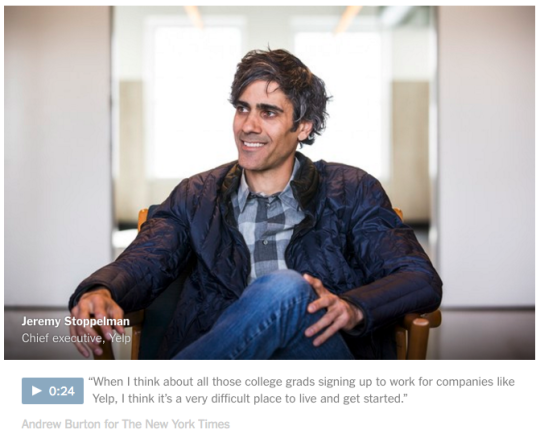
    A new YIMBY activist group is starting to gain meaningful traction in San Francisco. They were recently featured in the New York Times and they have managed to secure the financial backing of people like Jeremy Stoppelman – co-founder and CEO of Yelp. 

    (All excerpts in this post were taken from the NY Times.)

    image

    The group is called SF BARF, which stands for SF Bay Area Renters’ Federation. The group, however, supports new development of all kinds. So I think the name is more driven by the fact that the founder, Sonja Trauss, wanted the acronym to be BARF. It speaks to their shit disturbing approach:

    “Her group consists of a 500-person mailing list and a few dozen hard-core members — most of them young professionals who work in the technology industry — who speak out at government meetings and protest against the protesters who fight new development. While only two years old, Ms. Trauss’s Renters’ Federation has blazed onto the political scene with youth and bombast and by employing guerrilla tactics that others are too polite to try. In January, for instance, she hired a lawyer to go around suing suburbs for not building enough.”

    The impetus for all of this, of course, is San Francisco’s lack of affordability and severe housing shortage. Housing supply is decades behind the city’s population and job growth. 

    Most people are directing the blame at the tech community for bidding up housing. But there’s clearly growing recognition that housing supply matters.

    As a real estate developer, my industry obviously benefits from fewer barriers to building. So let’s get that out there:

    “Ms. Trauss’s cause, more or less, is to make life easier for real estate developers by rolling back zoning regulations and environmental rules. Her opponents are a generally older group of progressives who worry that an influx of corporate techies is turning a city that nurtured the Beat Generation into a gilded resort for the rich.”

    But let’s also be clear that I don’t believe we should be developing roughshod over our cities. New development should respond to what’s already there and give back. 

    At the same time, housing supply matters a great deal. A big part of the reason that cities like San Francisco, New York and Vancouver are so expensive is that they’re naturally supply-constrained markets. Geographically, they are either peninsulas or islands.

    When you overlay tight land use restrictions, fierce community opposition and/or foreign investment on top of this geography, it should come as no surprise to anyone that demand is outstripping supply. 

    New supply won’t solve every problem, but I do agree that it is an important part of the solution.

  • How much market share are New York’s yellow cabs losing to Uber?

    Todd W. Schneider recently mined data from the New York City Taxi & Limousine Commission to create a chart summarizing yellow taxi, Uber, and Lyft usage

    The data only runs up until January 2016, but here’s what he found:

    “…yellow taxis provided 60,000 fewer trips per day in January 2016 compared to one year earlier, while Uber provided 70,000 more trips per day over the same time horizon.”

    The Uber data only begins in 2015, but you can still see how quickly it is growing and how yellow taxis are losing market share. Five years ago, yellow taxis were reaching over 500,000 trips per day (a pretty amazing number) and in January of this year they were at about 350,000 trips per day. 

    It also appears that Lyft is struggling to gain traction.

    image

    What’s also great about Todd’s blog post is that he has set it up so that his chart will automatically update as new data becomes available. So if you’re interested in this topic, you should bookmark his post.

  • How Premise is crowdsourcing economic data in developing countries

    I have to tell you all about a company that I just discovered called Premise. I think it’s incredible what they’re doing and a perfect example of mobile (smartphones) eating the world.

    The problem that Premise is solving is that of developing-world economic data being both not timely enough and not all that accurate/granular. This is important, because lots of big organizations – ranging from governments to private companies – are making funding and investment decisions based on this inadequate information.

    So here’s what Premise did:

    They put smartphones into the hands of the people who are on the ground in these places. They paid them meaningful amounts of money (relative to local wages). And they developed a technology platform that could index and analyze the millions of local observations being sent in. So far they have paid out over $3 million to their contributors located across 34 countries.

    As an example: Premise has developed food price indices. And the data comes directly from locals physically going to the market on a regular basis (which most would do anyways) and snapping photos of the food + prices. This allows Premise to provide basically realtime pricing data. (There are checks and balances to ensure data integrity.)

    Why does this matter? 

    Because it allows Premise, for instance, to figure out exactly what happens to food staple pricing when something like an Ebola epidemic hits:

    “Premise started tracking food prices in Monrovia on September 8, and throughout the month we observed upward pressure on prices (our Liberia indices and data are freely available at data.premise.com). The price of rice, Liberia’s primary food staple, increased 12% during September. Moreover, we saw significant price differences across the city. Prices in neighborhoods with the most exposure to Ebola were 8-12% higher on average than relatively unaffected neighborhoods. As the disease tore through the city, market sellers avoided the worst-hit areas and trade declined.”

    This is powerful information and just one example of what Premise is doing. Obviously this data is also of use to for-profit companies, which is how the company has managed to raise over $66 million in VC funding. But I think there will also be big benefits for these developing countries. As the saying goes, you make what you measure.

  • Moving to the big city

    When I was 18 years old, I
    moved from the suburbs of Toronto to Waterloo, Ontario, which is about an hour
    west of the city.

    I largely did this for two reasons.

    Firstly, I had started
    visiting friends at both Wilfrid Laurier University and the University of
    Waterloo while I was in high school, and I thought that I wanted
    that kind of University town experience.

    Secondly,
    I started University as a Computer Science student and I figured that Waterloo
    was a pretty good place to study that. Research In Motion (later renamed to
    Blackberry) was an important company at the time and interesting things were happening.

    Though
    to be clear, I was a student at Laurier and not at the University of Waterloo – the better of the two schools for Computer Science – because I didn’t have
    the grades for the latter.

    But a
    funny thing ended up happening. I hated living in Waterloo. I felt so out of
    place. So much so that I spent every weekend back in Toronto visiting my
    friends who had instead decided to go to the University of Toronto.

    And I
    remember vividly how I felt during those weekends. I would stand in my friend’s
    apartments – most of which had dens and solariums that were hacked into
    bedrooms so that they could afford to live there – and I would look across the skyline and
    think to myself: why the hell do I not live here?

    So I
    transferred to the University of Toronto. And that solved that.

    The
    reason I bring up this story today is that I was reminded of it while reading a recent CityLab article by Richard Florida called, The
    Self-Confident City
    .

    The three
    main arguments in the article are:

    (1) Where
    we choose to live has a massive impact on our life outcomes.

    (2) Self-confident
    people – according to a recent study – seem to be drawn to big cities.

    (3)
    Self-confidence can also be a self-fulfilling prophecy
    for people in big cities.

    Now,
    I don’t know if it was really self-confidence and youthful hubris that told me I needed to live in a bigger city than Waterloo. (It was probably part of it.) All I know is that I
    wanted to live in a super dynamic place that felt bigger than me. I wanted to
    feel like I was a small fish in a big pond trying to make some sort of
    meaningful dent.

    That
    was true for me when I was 18. And it remains true for me today at 32.

  • The Death and Life of Great Italian Cities

    image

    I am sure that a lot of you know where the title of this post comes from. It’s a riff on one of the most important and influential books in the world of city planning: The Death and Life of Great American Cities by Jane Jacobs (1961).

    But when Jane Jacobs first wrote this book, there was no such thing as smartphones and nobody was “checking-in” to hipster dive bars on Foursquare

    So instead of leveraging big data, her analyses and arguments were based on observation. She walked the streets of New York and Toronto and figured out what made cities thrive and what made cities die. That was her brilliance.

    Today, however, we have data – lots of it. And so recently, a group of researchers set out to test Jane Jacob’s theories using mobile phone data. The study was called, The Death and Life of Great Italian Cities:
    A Mobile Phone Data Perspective
    .

    More specifically, they set out to test the following 4 essential conditions:

    “She [Jane Jacobs] argued that, to promote urban life in large cities, the physical environment should be characterized by diversity at both the district and street level. Diversity, in turn, requires four essential conditions: (i) mixed land uses, that is, districts should serve more than two primary functions, and that would attract people who have different purposes; (ii) small blocks, which promote contact opportunities among people; (iii) buildings diverse in terms of age and form, which make it possible to mix high-rent and low-rent tenants; and (iv) sufficient dense concentration of people and buildings.”

    To accomplish this, the team assembled and studied data from the following sources:

    • Mobile phone activity (specifically internet activity)
    • OpenStreetsMap Data
    • Census Data
    • Land Use Information
    • Infrastructure Data
    • Foursquare Data (Venues API)

    Ultimately, they determined that Jane Jacobs knew what she was talking about. The above conditions are essential to urban vibrancy and they apply to Italian cities, just as they did and do to American cities. But this test was valuable, because the more that we can measure and quantify cities, the better I think we’ll get at creating and promoting urban vitality. 

    Now imagine if you overlaid the findings of their report with residential and commercial rents. I bet you’d also find that there’s a strong business case for urban vitality.

    I’ve heard a number of people say that, eventually, every company will be a software/technology company. And I don’t think we’re far off from that reality. To me, this study feels like an early example of what that might look like for city building.

    On a side note, the picture at the top of this post is of the Spanish Steps in Rome. I took it on a weekend trip in 2007. I was living in Dublin at the time.

  • Everything you ever wanted to know about automated vehicles

    Last fall, David Ticoll (who is a research fellow at the Munk School of Global Affairs at the University of Toronto) published a thorough discussion paper called Driving Changes: Automated Vehicles in Toronto

    If you’re interested in driverless cars, and I know that a lot of you are, then it’s definitely worth a weekend read. It’s fairly long. He gets into the various automation levels, the transition period, the implications for policy makers, the benefits, and so on.

    Here’s a quick snippet on the topic of benefits:

    “This report provides bottom-up analysis based on Toronto-specific data. The result is a conservative estimate that were AVs to be at a 90% adoption rate in Toronto today, the result would be annual savings of $6 billion, or 4% of the City’s $150 billion gross
    domestic product. This includes $1.2 billion from reduced collisions, $2.7 billion out of congestion costs, $1.6 billion from insurance, and $0.5 billion from parking fees and fines. AVs will provide other quantifiable social and economic benefits that range from fewer deaths and hospitalizations thanks to lower particle emissions, to productivity gains in many business sectors.”

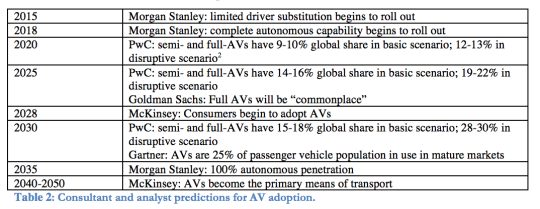
    But of course there’s the question of: when will this happen? Below is a chart from the paper that was assembled using various consultant/analyst predictions. Based on this, we’re still over a decade away from the consumer adoption of automated vehicles.

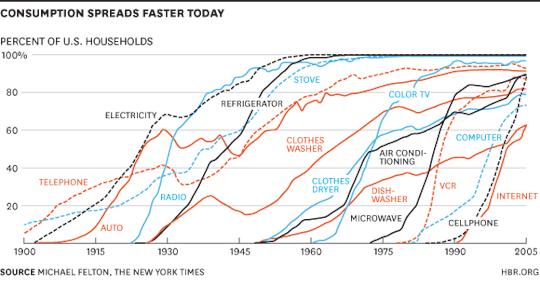
    However, these are just estimates and history has shown us that the adoption rate for new technologies has been increasing over time. Below is a chart by Michael Felton, which is also from the paper, that shows this phenomenon. Take a look at the telephone in comparison to the internet.

    Maybe I’m being overly optimistic (it wouldn’t be the first time), but consumer-facing driverless cars, at least to me, feel pretty close to the horizon.