Daily insights for city builders, delivered every morning at 6 AM ET. I’m Brandon Donnelly — a Toronto-based real estate developer and founder of Globizen. I’ve been writing here since 2013.

Tag: tech startup

  • Nobody wants to collect NFTs anymore

    Back when everyone wanted to buy and trade crypto, my friend Evgeny started a marketplace for NFT photography called Sloika. This, to me, felt like an obviously good idea, both in general and for him specifically. Evgeny had previously cofounded the photo company 500px, and so Sloika was initially conceived of as 500px, but for web3. This is a good story.

    I have collected a number of photos via Sloika and, in general, I continue to regularly collect NFTs. Of course today, relatively few people want to trade and collect NFTs. The market is largely dead. What is obvious is that there was a giant NFT bubble and it popped in 2022, along with some other asset bubbles.

    But does this necessarily mean that NFTs and NFT art are bad ideas?

    When I think of bubbles I often think of something that Fred Wilson wrote on his blog. His argument was that bubbles tend to be directionally right; it’s the magnitude that we get wrong. A good example of this is the dot com bubble. Yes, it was a massive bubble. But it was directionally right. The internet was going to matter — a lot it turns out.

    Even if we go back to “tulip mania” during the Dutch Golden Age — which is often brought up as the pinnacle of dumb bubbles — one could argue that it was still directionally right. Today, tulips remain the most sold flower in the US. So we still love them; we just got a little too excited back in the 17the century.

    When it comes to NFT art, I like to think in terms of these questions:

    • Will humans continue to appreciate art? (Seems obvious.)
    • Will humans continue to want to collect things? (This is arguably a fundamental human instinct.)
    • Will provenance and authenticity continue to matter in art? (Blockchain technologies are really good at this.)

    Perhaps the only question that remains is whether people will want to collect digital art. But even this feels fairly obvious to me. The challenge, I think, is that the display side of the market needs to be more built out. Because alongside the instinct to collect things is the instinct to display them. That’s why NFTs initially took off as profile pics on social media.

    So as a start, I think more, better, and cheaper displays would be a big help. There’s something very different about projecting an NFT in your living room versus having it live in a crypto wallet on your phone or computer. You need to really experience it, just as you would a conventional piece of art. And like all art, context matters.

    I haven’t yet invested in a dedicated NFT display, but I plan to do that in the near future. And I’m looking forward to displaying my collection of NFTs, including the one at the top of this post. It’s a drone shot of the west side of Toronto in the middle of winter, and it was gifted to me by Evgeny. Thank you for that. It’s an honor to have it as part of my art collection.

    Photo: Six Bling (via SuperRare)

  • Market making for houses

    Matt Levine’s latest Money Stuff column does a good job explaining why a lot of smart people are trying to figure out a market-making model for homes (see companies such as Opendoor):

    People want to apply the market-making model to homes. This makes sense. Buying or selling a home is a long slow uncertain annoying process. The value of immediacy is high, especially for a seller. If you decide to sell your house and go to a website and spend 10 minutes filling out a form and then someone wires you cash for the value of your house, that is much much much better than hiring a broker and listing the house and holding open houses and so forth. You’d be willing to pay a market maker a lot for that immediacy. (By selling your house to the market maker at a discount.) And if the market maker is good at acquiring houses, then it will have a lot of inventory, which will make it a good seller of houses. If you want to buy a house, you will naturally go to the market maker’s website, because it’s where the houses are.

    Levine also explains why a market-making model is that much more difficult for homes compared to things like stocks. In a slowing/slumping housing market, it’s pretty easy to lose money as a market maker. (That is, unless you can somehow accurately predict that a slump is coming.)

    Last month, Opendoor lost money on 42% of its home transactions. This is a result of them buying homes from people when prices were X and then selling these homes many months later when prices were less than X.

    However, I’m not so sure that this has to be an existential problem. Opendoor’s primary value proposition is instant liquidity for homeowners. And this value proposition is at its strongest when the market is in fact slumping. Because the alternative — selling with a broker — is less attractive.

    So the current environment may eventually turn out to be a boon for Opendoor. Of course, we won’t know for a number of months.

    Full disclosure: I am long $OPEN. And yes, it is painful right now.

  • Rich people and nerds (in Miami)

    Back in 2006, Paul Graham penned an essay about how to be Silicon Valley. Since then, it seems like every city on the planet has tried to replicate the successes of the Valley. At the time, his argument was pretty simple. Geography used to be destiny when it came to cities. New York City, for example, is arguably what it is today because of its geography and its deep harbor, which created a natural competitive advantage compared to other east coast cities such as Boston and Philadelphia. But this, he argues, has become far less relevant. Now, you can create a great city pretty much anywhere. So what are the necessary ingredients?

    Paul argued that you only really need two kinds of people to create a technology hub: rich people and nerds. You need people creating new things and you need rich people to fund those new ideas. That’s it. So in theory, if you could just dump a bunch of these kinds of people in one place — Nunavut? — you’d perhaps get unicorns coming out the other end. He goes on to say that Miami is a perfect example of a city that has lots of the former, but very few of the latter. It has lots of rich people, but, in his words, it’s not the kind of place that nerds like. So it is/was not a good startup city. (I’m a nerd and I like Miami.)

    But the year is now 2021 and a global pandemic seems to be helping to change this dynamic. Every tech entrepreneur and/or investor now seems to want to move to either Austin or Miami. To that end, SoftBank recently announced that it has earmarked $100 million for startups that are based in Miami or that plan to be based in Miami in the near future. It’s perhaps a good testament to the momentum that seems to be developing around the startup scene in the city, which is something that their mayor has been incredibly vocal about.

    But here’s something to consider. Was Paul right about the two requisite ingredients for a successful startup hub? And if so, does Miami now have enough nerds? Maybe this recent influx of people was just what it was missing.

    Photo by Cody Board on Unsplash

  • More than a real estate company — a state of consciousness

    Matt Levine’s most recent Money Stuff article is classic Matt Levine. It is both entertaining and informative. This one is on WeWork – the coworking startup that has committed to 14 million square feet of office space around the world and will have $18 billion in rent payments due over the next decade.

    Here is an excerpt:

    WeWork Cos. is a real-estate company with a couple of innovative twists on the model. First, rather than owning its buildings, it rents them: It leases office space from regular real-estate companies, adds … beer? … or whatever, and then subleases the space to tenants at higher rates. And second, rather than being valued like a real-estate company, it gets valued like a hot tech startup — “the sharing economy,” ping-pong tables, etc. — so it can raise gobs of money from SoftBank Group Corp. at a $20 billion valuation without ever getting particularly close to profitability. And look at all these words:

    “Indeed, to assess WeWork by conventional metrics is to miss the point, according to [Chief Executive Officer Adam] Neumann. WeWork isn’t really a real estate company. It’s a state of consciousness, he argues, a generation of interconnected emotionally intelligent entrepreneurs.”

    Really, what sort of multiple would you put on a state of consciousness?

  • Opendoor is now selling ~300 homes per month

    Farhad Manjoo of the New York Times published an article this morning about Opendoor – a startup that I have written about multiple times on this blog – called, The Rise of the Fat Start-Up. (His definition of “fat” is that the startup owns lots of hard assets, which considered atypical in tech.)

    Below are a couple of interesting tidbits from the article:

    • Opendoor has raised over $300 million in equity and over $500 million in debt since inception.
    • Opendoor plans to be in 10 cities by the end of this year.
    • Average commission charged on Opendoor is 7.5%, which is higher than a traditional real estate agent and higher than what was quoted before in the press. The higher % is because of certainty and convenience.
    • Opendoor offers a leaseback option if you’d like to stay in your house for a period of time after you’ve sold it.
    • Their conversion rate (offers made to closings) is about 30%.
    • Other startups are now in the market with similar models, including Offerpad and Knock. Zillow is working with Offerpad on a pilot. Someone is starting to feel threatened.

    The article also quotes a blogger and real estate analyst named Mike Delprete. Heads-up: His blog is called “Adventures in Real Estate Tech.” I’m sure this will appeal to many of you. I obviously just subscribed.

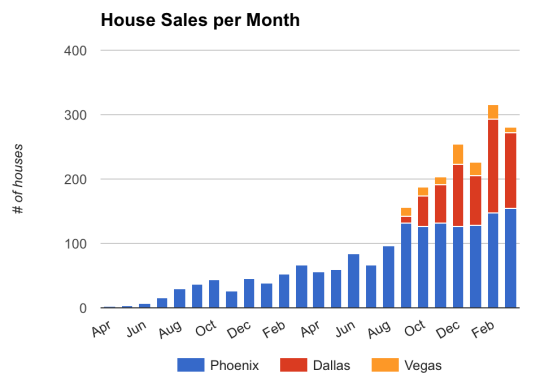
    Mike dug into MLS records in order to figure out Opendoor’s transaction volumes, since the company is not releasing this information. Here’s what he found (the chart is up to March 2017):

    The trend line is certainly moving in the right direction. But Mike also believes that Opendoor is only netting around $8,320 in profit per home and that much of it is driven by appreciation. There’s also substantial risk in owning so many homes – each one is usually held for a few months.

    But you can be sure they’re thinking well beyond where they are at today. Expect many more updates on this blog.

  • Envelope Beta

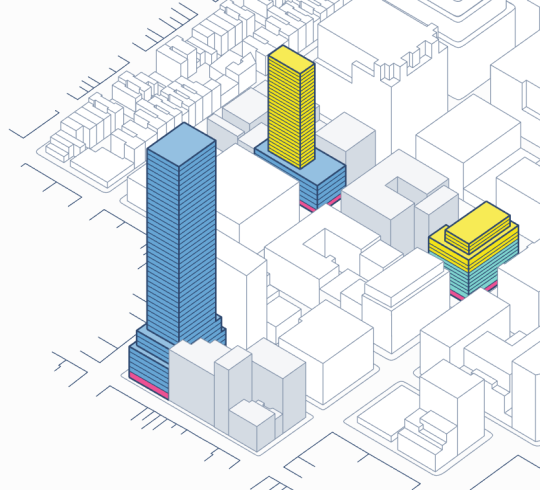
    My friend Bruce of getrefm.com (real estate financial modeling) just introduced me to a new real estate startup called Envelope. Basically it’s 3D mapping software that allows you to quickly visualize the zoning envelope for a particular site. It’s similar to what Flux.io was initially trying to do.

    Now, I think this is very cool, but my first reaction was: What if the zoning is out of date? What if approvals/entitlements are done a site-specific basis? This isn’t the case in every city, but I’ve heard some people in Toronto argue that this city basically has no zoning code. (We can debate that one in the comments, I’m sure.)

    That being said, there are still many design guidelines in this city that shape built form and I could see a tool like this being incredibly useful. They’re still in private beta but I would like to try it out. Hopefully they’ll see this blog post and let me have an early peek.

    Image: envelope.city

  • New York, San Francisco, Toronto

    Yesterday it was announced (here, here, and here) that Toronto-based Top Hat has raised $22.5 million (USD) in Series-C funding. The round was led by New York-based Union Square Ventures.

    I am always excited to see Toronto-based startups doing well and I am particularly excited by this remark in USV’s blog announcement:

    “Also worth noting is that Toronto continues to impress us with its quality and diversity of companies. We now have five investments there, placing Toronto third as a location in the USV portfolio after New York and San Francisco.”

    Here is another quote from Fred Wilson’s blog:

    “Toronto is a great place for startups. In addition to five investments of ours that are HQ’d there, I know of at least one other USV portfolio company that has much of their engineering team in Toronto. The talent, mindset, and quality of the people in the Toronto/Waterloo tech/startup community is really top notch and we love investing there.”

    Go Toronto. 

    (Of course, Toronto really means Toronto-Waterloo. That’s the geography of the ecosystem.)

  • Snap Inc.

    Snap Inc. (Snapchat) nailed the launch of Spectacles. I want a pair.

    If you haven’t been following, it all started with a pop-up vending machine in Venice Beach. But like Snapchat itself, it was an ephemeral installation that eventually disappeared, moving on to Big Sur, California. At the time of writing this post, the countdown is on to discover where the vending machine will pop up next. It’s a viral marketing play that aligns very well with their brand.

    But there’s even bigger news.

    Earlier this week it was revealed that Snap Inc. has filed for an initial public offering. It plans to go public by as soon as March 2017 and expects to be valued somewhere around $25 billion. Remember when everyone flipped out because Evan Spiegel had rejected Facebook’s acquisition offer of $3 billion?

    Here’s their revenue story from Vanity Fair:

    Last year, Snapchat brought in $59 million in revenue—a low number that reflected the embryonic stage of its business. This year, however, Snapchat predicts it will generate revenues between $250 million and $350 million. And in 2017, the company estimates it will reach revenues between $500 million and $1 billion, based on “bullish sales targets.”

    I’ve been a Snapchat fan for awhile now, so I am thrilled to see the company going public. As Fred Wilson wrote on his blog this morning: “Snap is a great company led by a creative and ambitious founder and they have a loyal and growing use base. I think Snap can be an excellent public company.”

    If you’ve got people’s attention, you can figure out how to monetize it.

  • Transparent offer platform

    A new “transparent offer platform” called Haus has just launched in California to serve the residential real estate market. The way it works is that all offers are submitted online. And once an offer has been confirmed, it – along with all of its terms – gets revealed to every other potential buyer. See image below.

    image

    I’ve seen a number of different iterations of this same idea, which tells me that this is a well-identified problem in the real estate market. Here’s a snippet from a recent TechCrunch article announcing Haus:

    “We think the openness will create a more efficient market and that the number of offers and price will ultimately be dependent on demand,” said Haus GM Sarah Ham. “Bidding wars are a common, almost accepted, part of the real estate process today. But with our approach, buyers know where they stand. Buyers will know what they need to offer to make their offer competitive, but they also won’t negotiate against themselves.”

    I completely agree that this is a problem that needs to be solved. It will create a more efficient marketplace. However, in this market, I suspect that the current information asymmetries largely benefit sellers, to the detriment of buyers. So I wonder if the supply-side of the marketplace will be willing to participate at scale. What’s really in it for them?

    Side note: Haus is the latest project from Expa, which is a “startup studio” that works on its own ideas, as well as partners with other founders. I am very interested in this approach to creation because I think you have to try and make a lot of things if you want to do truly innovative things.

  • The change order (ruminations on innovation)

    If any of you are in the
    business of creating – whether that’s a mobile app or a building – I’m sure
    you understand that the product or thing you’re working on will naturally
    evolve and change over time – probably in unexpected ways.

    In fact, I usually take this as a positive sign. When I have my
    head in a project and I’m focused on solving problems, ideas will naturally
    start to flow. I start thinking of things that I never would have thought
    about at the outset. That’s why I generally think of creativity as a process,
    rather than as some divine gift.

    But the challenge with all of this is that many of our existing business
    processes are not set up to deal with this kind of ambiguity. If anything we
    try and punish these sorts of deviations. If it wasn’t pre-meditated at the
    beginning of the project, we call it “scope creep” and charge extra for them as
    “change orders.” These two words equal death in construction.

    Now, don’t get me wrong, I completely understand the realities
    of running a business and the importance of managing scope and resources. It’s
    a balancing act. Without some structure, nothing would get done. 

    But the more that iterative
    lean methodologies and “design thinking” can be embedded into our processes,
    the more value creation I believe we will see.

    My thinking is as follows: At
    least part of the reason that innovation comes from startups and new market
    entrants is that the founders aren’t usually sitting around talking about defined
    scope and laying out elaborate business plans. They’re focused on creatively
    solving problems and doing whatever it takes to get there.

    It’s also one of the reasons
    that conventional wisdom dictates that tech startups shouldn’t outsource development.
    It’s too core a competency and you can’t “move
    fast and break things
    ” if you don’t have that in-house and you’re constantly worried
    about eye-popping invoices hitting your desk.

    I have always seen lots of
    parallels between startups and architecture. In both of these worlds, the idea
    you start with is rarely what you end up with (at least that’s the case in
    architecture school). You research, learn, and iterate along the way and that
    leads you in new and unexpected ways.

    And in my view, that’s often what
    the path to innovation looks like. Because if you define the entire path at the
    outset, how can you expect to go anywhere new? And if you’re not going anywhere
    new, how can you expect to outperform the market?