Daily insights for city builders, delivered every morning at 6 AM ET. I’m Brandon Donnelly — a Toronto-based real estate developer and founder of Globizen. I’ve been writing here since 2013.
Here’s an interesting, though not shocking, chart from a recent Globe and Mail article talking about “Canada’s dysfunctional housing market.” What is noteworthy is that Toronto is dead last when it comes to the number of new 3+ bedroom homes built between 2016 and 2011.
Peterborough, for example, is a census metropolitan area with somewhere around 130,000 people. And yet, based on this data, it is building more family-sized homes than Toronto.
Why this is not surprising is that the vast majority of new homes now built in Toronto are high-density and built out of reinforced concrete. This means that they are relatively expensive on a per square foot basis.
In fact, you could argue that mid-rise housing — the exact high-density type that is supposed to be most attractive to families — is the most expensive to build. What this means is that if you’re building a 3+ bedroom home in this way, it’s not going to be affordable to most.
It also means that people are going to go shopping elsewhere: Ottawa, York, Simcoe, Durham, and so on. The expected market outcome is decentralization. But in my mind, this raises an important question: Is this what people really want?
This is a great debate. And many will argue that grade-related suburban housing is exactly what people want. What we are seeing is a result of raw consumer preference.
However, the costs are so skewed in favor of low-rise housing, that I think it’s hard to say with absolute certainty the degree in which this is true. What if higher-density 3+ bedroom homes were the cheaper option? My bet is that we would see a lot more centralization.
The development charge rate for a 2+ bedroom apartment in the City of Toronto is currently $80,690 per unit (effective June 6, 2024). As development charges work, this is supposed to pay for the growth-related impacts of adding a 2+ bedroom apartment in the city.
However, the above chart suggests that there are also impacts to not building that 2 or 3 bedroom apartment in an already developed area next to existing infrastructure. It means the home goes somewhere else (further away) or doesn’t get built at all.
I am, of course, more grid than cul-de-sac, but here is an interesting NFT art project that is launching on December 12, 2023 at 1PM EST. It’s called Cul-de-Sacs:
“Cul-de-Sacs” explores the banality of suburban sprawl through the anachronistic stylization of American folk art. The algorithm generates flattened representations of suburbia at range of scales, interspersed with the remnants of rural life.
The starting price is 0.2 ETH and the resting price is 0.05 ETH. What this ultimately means is that these NFTs are being offered by way of a Dutch action.
Dutch auctions are a price discovery mechanism. They start with a high asking price and then gradually lower it until a price is reached where the quantity demanded equals all of the available supply.
In other words, it’s a way to determine what the market thinks a particular thing is worth. In this case, though, the resting price is 0.05 ETH. Meaning there’s a floor.
If lots of people are willing to pay 0.2 ETH for this art, it could sell out right away and that will prove to be the market price.
But if few people want to buy it, then the price will gradually fall to 0.05 ETH, and that is where it will hang out until all of the available supply is absorbed. If/when that happens.
Another important feature of this auction process is that if you buy early, and the price subsequently drops, you get a refund equal to the difference between what you paid and the final achieved price (thought to be the market price).
So there is zero incentive to wait for a possible price decline; everyone ends up paying the same price no matter what. You’re encouraged to bid aggressively.
And because all of this is now happening on a blockchain and enshrined in code, you can be confident that this is exactly how the process will work and that you’ll get any refunds that you deserve.
It’s been raining all morning, but apparently there is an ocean hidden in the above picture. We also got in after dark and so all I really saw was what I could see on the drive from the airport.
Whenever I am reminded that the vast majority of built form in North America is car-oriented in nature, I can’t help but think of how sticky all of this is going to be.
Witold Rybczynski put it accurately when he said, “urbanism and architecture observe different time lines.” Buildings may take forever to build, but relative to urban form, they actually change pretty quickly.
New materials and styles emerge, and so do new buildings. But the streets that surround them change so slowly, that for all intents and purposes, they mostly don’t change.
What that means is that, for better or for worse, most of what we see is likely to persist. No wonder there is an arms race going on with autonomous vehicles.
In 1932, Frank Lloyd Wright — the architect who hated tall people — published a book called The Disappearing City. And in this book, he proposed a city planning concept known as the Broadacre City. Wright would go on to spend the rest of his career trying to both promote and perfect this concept, but the salient point is that it was fundamentally anti-urban:
Imagine spacious landscaped highways …giant roads, themselves great architecture, pass public service stations, no longer eyesores, expanded to include all kinds of service and comfort. They unite and separate — separate and unite the series of diversified units, the farm units, the factory units, the roadside markets, the garden schools, the dwelling places (each on its acre of individually adorned and cultivated ground), the places for pleasure and leisure. All of these units so arranged and so integrated that each citizen of the future will have all forms of production, distribution, self improvement, enjoyment, within a radius of a hundred and fifty miles of his home now easily and speedily available by means of his car or plane. This integral whole composes the great city that I see embracing all of this country—the Broadacre City of tomorrow.
It’s important to remember that this was first proposed before the arrival of today’s suburbs. So this was Wright’s response to the squalors of urban life at that time. Many have called the Broadacre City a precursor to the modern suburb and, in many ways, that makes sense. Integral to his plan was, “the man seated in his automobile driving on highways.”
But others see the plan as something totally different. It was about low-density and self-sufficient communities that could sprout up along highways, and not necessarily rely on some sort of decaying urban core. It was thought of as a place for Americans to return to the land.
Whatever your opinion, you’ll be happy to know that Kith has just collaborated with New Balance and the Frank Lloyd Wright Foundation on a trainer that commemorates this utopian vision. It is called the New Balance Made in USA 998 – Broadacre City, and naturally it comes in a variety of colorful earthy tones.
So if you’re looking to celebrate the ethos of Wright and eschew the modern and walkable city, these are, I would think, the shoes for you. Apparently they’re available online, or at Kith Tokyo, which is maybe intended to be ironic? Let’s sell this Broadacre shoe from the largest urban center in the world.
Let’s add some historical context to yesterday’s post about autonomous vehicles. As the regular non-autonomous version of cars started to infiltrate our cities in the early 20th century, largely following the creation of the mass-produced Ford Model T, there was a general view that cars were dangerous and a menace to cities. Arguably, not much has changed.
So in the 1930s, the Federal Housing Authority decided to publish a pamphlet explaining what street networks it thought were suitable for this new emerging car world and which street networks were not. The exact terms that they used were “bad” and “good”, and here’s what that looked like (taken from this CNU article):
The “bad” ones are largely how the US liked to design its cities before the arrival of the car. Some historic settlements, like Boston and Manhattan south of 14th street were based on different street logics, but as far back as the 1680s, William Penn had already started laying out a grid iron plan for Philadelphia. And in reality, this kind of street pattern goes all the way back to ancient cities.
However, when the car arrived, these grid iron plans were thought to offer an inadequate amount of separation between people and machine. The solution was to optimize around the car and introduce a clear hierarchy of different streets. Big streets for moving cars quickly, and smaller streets, like cul-de-sacs, for people to live on.
These “good” examples, of course, represent the modern suburb. But we now recognize that these types of street networks are unequivocally terrible for walkability, the environment, public health, social equity, and a whole host of other things. I mean, look at this extreme example of two suburban homes in Orlando whose backyards adjoin but are technically separated by 7 miles and a 20-minute drive!
My point with all of this is that, for many/most at the time, this was progress. Cars were the future and there was optimism about the kind of freedoms and other benefits that they would bring to people. And this optimism is perhaps not all that different from what many people feel today, myself included, when it comes to autonomous vehicles.
So on the one hand, you could point to the car and say, “look at all the damage that this thing did to our cities. Let’s not do that again. Autonomous vehicles must be stopped.” But that’s akin to wishing the car was never invented. Another option is to point to the negative externalities associated with the car and say, “look at what we’ve done. We can do better. Let’s make our cities better.”
Positive change, no matter how late, is always a possibility.
Maybe it’s confirmation bias, but I continue to feel like there is a groundswell of interest in trying to improve housing supply and overall affordability. The YIMBY movement continues to gain steam. Here are are few excerpts from a recent M. Nolan Gray article where he calls for an end to zoning as we know it today:
In nearly every major U.S. city, apartments are banned in at least 70 percent of residential areas. San Jose prohibits apartments in 94 percent of its residential areas. The most a developer can build in these zones is a detached single-family home.
The results speak for themselves. Houston builds housing at 14 times the rate of peers like San Jose. And it isn’t just sprawl: In 2019, Houston built roughly the same number of apartments as Los Angeles, despite being half its size. Since reforms to minimum-lot-size rules were put in place in 1998, more than 25,000 townhouses have been built, overwhelmingly in existing urban areas.
To be clear, Houston has made its share of planning mistakes. But, free of zoning, the city can constantly remake itself. That Houston is now one of the most affordable and diverse cities in the country is no accident.
The relationship between housing affordability and constraints on development is a well-documented one. If you want more affordable housing, you generally want fewer, rather than more, constraints on delivering new housing.
But as I was reading through the article, I couldn’t help but think more specifically about the relationship between sprawl and affordability. Because it is also true that, for a variety of reasons, the former has tended to help the latter (or at least coincide with it), which is why Gray felt it was important to say “and it isn’t just sprawl” when talking about Houston.
Part of this relationship has to do with the fact that expansionist development tends to be of the low-rise stick-built varietal, which is a relatively cost effective way to build. Whereas the higher density infill stuff tends to be built using more expensive materials like reinforced concrete. But of course there are many other factors at play, including lower land costs.
So I think one really interesting question is this one here: To what extent could we break this relationship between sprawl and affordability with what Gray is advocating for? In other words, how cheap could we make new infill housing in our older cities if we were to greatly loosen zoning controls or possibly even remove them all together?
I don’t know the exact answer, but I know that directionally it would be better.
What do you think of this beautiful low-rise apartment building? It is called Spadina Gardens and it was built (allegedly illegally) on Toronto’s Spadina Avenue in 1906, shortly before the City enacted an outright ban on “disease-breeding tenements” (i.e. apartment buildings) in all residential neighborhoods.
This, of course, is a form of exclusionary zoning. Our predecessors had decided that apartments were bad, they promoted disease and immorality, and that they were likely to destroy or at least corrupt Toronto by making it, you know, less waspy.
Important studies are underway here in Toronto, and across North America, to determine whether we should do something about this longstanding city building tradition. Should we allow a mixture of different housing types in our residential neighborhoods, or should we keep things just the way that they are? That being low-rise and single-family.
In the meantime, we are implementing things like inclusionary zoning, which I guess makes some people feel better about themselves and the current state of affairs. But in the end, it sits very much on top of our exclusionary past.
Low-rise single-family home neighborhoods remain off limits. Apartments should only go in select locations (provided they don’t bother the single-family homes). And any efforts to create greater affordability and diversity should only impact the new apartments and not the low-rise single-family homes that already exist.
I would encourage all of you to have a listen to 99% Percent Invisible’s recent episode about Toronto’s “missing middle.” It does a great job explaining why Toronto looks and performs the way that it does today, and why it’s time that we do something about it. It’s also highly relevant to not just Toronto, but many cities across North America.
The “drive until you qualify” approach to finding housing that you can afford is a well established practice. Anecdotally, I can tell you that I have friends who are right now looking for a grade-related home under the C$1 million mark. This constraint, as most of you know, is pushing them to the outer reaches of Toronto’s suburbs. But if it were up to them, it would be their preference to stay in the city. According to the “two millennials” behind The Habistat, the average distance of an entry level detached house from the Toronto core (defined as a 3 bed, 1 bath under $800,000) is now 81.8km.
There’s a lot to be said about this. For one, home prices across many/most markets are way up. Earlier this week on the blog it was mentioned that the average price of a US home is up about 19% year-over-year. This is likely unsustainable. We are coming off of a period of easy money policies and at some point things will normalize along with the broader economy. Looking at the equity and crypto markets, it may be happening right now, but I don’t really know. (Fred Wilson wrote a post last year calling this “one of the great asset bubbles of modern times.”)
We know that the centralizing forces inherent to most cities have been weakened during this pandemic. For periods of time, they were completely off. So it is no surprise that we have seen greater decentralization (sprawl) than what might have ordinarily happened. I was in a (zoom) meeting this past week with somebody who has spent the last two years traveling around South America while working remotely. It sounded like a lot of fun and I was admittedly a little bit envious of her adventures. But as I argued at the beginning of this year, I think most people are going back to offices and this centralizing force will have an impact on real estate.
Because “driving until you qualify” is a function of an affordability constraint, it tells you certain things about consumer preference, but not all things. What I mean by this is that it tells you that somebody is willing to trade the cost of a commute for more space and/or the housing type of their choice. This has been an easier trade during COVID because the cost of commuting has been relatively — albeit temporarily — low for many people. So less of a discount for distance. But what I think this doesn’t tell you is what true consumer preference would be if all things were more equal and we increased housing supply and options in other areas of our cities.
At the same time, there’s a very real question of whether the measuring stick in the above chart should be a grade-related detached house? Is this a reasonable expectation in the same way it was for prior generations? I am not a fan of dictating what people should and shouldn’t do. But maybe 100km away from the core becomes untenable. And again, maybe if we increased both supply and options, we would find new housing preferences revealing themselves. I am specifically thinking of those who would prefer to stay in the city, but can’t find something they think is suitable.
At the end of the day, we can’t ignore the fact that we are profoundly hypocritical when it comes to the delivery of new housing. We acknowledge that we’re in a housing crisis and we acknowledge that we need more affordable housing (both for sale and for rent), and yet we continue to make it systematically more difficult and more expensive to deliver it. The development charges, parkland fees, and many other costs that continue to increase and get applied to new housing are a real worry to those in the industry.
It is a worry because we’re all wondering how much price elasticity is left in the market. That is, how much more can consumers afford before they stop buying and renting? It is a worry because it means that new rental housing, which has always been a challenge to pencil in our market, is now completely infeasible in many more submarkets. Our solution to all of this is to mandate a certain number of affordable units in new developments. But this is yet another tax on new housing.
To be fair, the delivery of new housing is subject to countless competing interests. This is arguably why it is such a tricky problem to solve and why there are no easy answers. But that’s what we do around here. We explore new ideas. And maybe, just maybe, there are other options besides just driving until you qualify. Next up (or soon up): A look at the competing interests behind new housing.
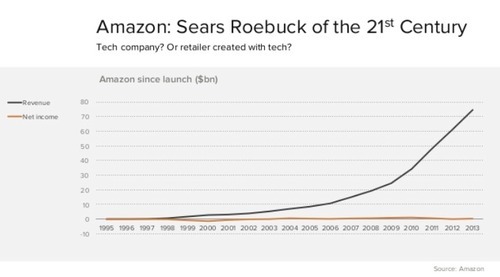
One company that came up during our discussion was not surprisingly Amazon.com. But the initial comment was that they don’t make any money. Fortunately for me I had just gone through a presentation by venture capitalist Benedict Evans the night before called: Mobile is eating the world. And so I pulled out my phone and presented this slide:
The fact that Amazon operates with basically no net income is on purpose. Look at their revenue growth! So I wouldn’t dismiss them as being a fad. They may only account for 1% of all US retail sales today, but I’d put money on that percentage growing.
The other reason I bring up Amazon is because, in some ways, I think of them as the online equivalent of a big box store. Just like a Walmart or Costco, where you can buy everything from tires to groceries to prescription drugs, I buy a lot of different things, besides just books, off of Amazon.com. You might do the same as well. And this is where I see the immediate threat to offline retailing and retail real estate: big box stores.
In the second half of the 20th century, big box stores were incredibly disruptive to the retail landscape (and to cities). They used cheap land on the outskirts of cities, cheap buildings, and economies of scale to offer rock bottom prices to consumers. The value proposition was about cheap, not about differentiation. But as cheap as they may be, the internet can still do it cheaper.
And retailers know this, which is why I think they all now sell groceries. Groceries have a very low online penetration. Basically everybody still buys groceries in-person. So if you offer that, you have a reason to draw people inside your store, where they will hopefully buy all the other stuff that they need. But as the online value proposition continues to get stronger, I think we’ll see many other, more significant, changes.