Daily insights for city builders, delivered every morning at 6 AM ET. I’m Brandon Donnelly — a Toronto-based real estate developer and founder of Globizen. I’ve been writing here since 2013.

Tag: startups

  • “Project Snowball” cracks down on UberX drivers in Toronto

    https://500px.com/embed.js

    This afternoon I saw on Twitter that Toronto Police are now starting to crackdown on UberX drivers in the city. The investigation is called “Project Snowball” and they have already charged at least 11 people. The fines are anywhere from $200 to $20,000.

    My response on Twitter was the following:

    I get that Uber is a highly disruptive company. I’ve written about it many times before. But at the end of the day, this is not just about Uber. This is about a larger shift in the economy.

    The buzz term is “sharing economy.” But one of the ways I like to think about it is like so: Facebook doesn’t produce any of its own content, and yet you could define it as a media company. Airbnb doesn’t own any rooms, and yet it is disrupting hotels. Uber doesn’t own any cars or plates, and yet it is disrupting the taxi industry.

    What’s happening is that the internet and mobile phones are allowing for peer-to-peer connectivity and more decentralized forms of marketplace supply.

    What does that mean?

    It means that instead of having a fleet of cars or a centralized hotel building, anyone with an extra car or an extra room (and an internet connection) can plug themselves into the market. And that represents an entirely different cost structure for businesses.

    It’s worth noting that prior to Uber, Travis Kalanick founded a peer-to-peer music sharing company called Scour (1998). Its closest equivalent would have been Napster. Remember Napster? This is not a new trend.

    That said, I still think we’re at the early stages of this shift. I predict that many other industries will see disruptors similar to Airbnb and Uber. And so when I look at it in this context, I have a hard time believing that fining UberX drivers is the most enlightened way forward.

    I believe we should instead be taking a leadership position and trying to figure out how to adapt our rules and regulations to this changing economy. Toronto is not alone in this battle. But we could certainly be the one to lead the way out.

  • Towards more publicness

    Back when the commercial internet first started to take off it was uncommon to use your real name online. Instead people relied on usernames and other pseudynoms to represent themselves. I honestly can’t remember what I used in those days, but I’m sure it was something ridiculous.

    Over time though that started to change. 

    Blogging started to take off in the late 1990s. And we started to become more comfortable sharing personal information online. Perhaps the biggest shift though, came with the introduction of Facebook in 2004 (over 10 years ago!). All of a sudden people – young college students initially – started sharing lots of personal information online, including photos of themsleves and their friends.

    But this wasn’t an overnight change. When Facebook first launched, privacy was an important component. It still is, but I would argue that it has become less central given how public a lot of other social media platforms are today. Twitter, for instance, is what it is today largely because of its publicness. 

    For my own social media accounts, I have made every single one of them completely public. From Twitter to Facebook to Instagram to Snapchat, nothing I post to social media is restricted in any way. And I do that because I believe we are headed towards a world with more – not less – openness, transparency and publicness.

    Of course, I’m not just talking about social media and tech. I’m talking about open data in general.

    Earlier this year, the Toronto Real Estate Board clamped down on real estate brokers who were publishing historical sales data online. Citing privacy concerns, TREB ordered them to stop or lose their access to the MLS system. 

    For those of you not from familiar with the Toronto real estate market, historical sales data for homes is not open and published online. You generally need to go through a realtor to get access to this data. Some think this is the right approach. And others think it is antiquated.

    But as I explained above, our conception of what should be private can, and will, evolve over time.

    Here are the details on my home:

    I purchased it in September 2012 for exactly $400,000 (Canadian). It’s a 650 square foot condo in the St. Lawrence Market neighborhood of Toronto. It has one bedroom, a 400 square foot terrace, one parking spot, and 10′ ceilings.

    Sooner or later, I believe this information will be freely available online. But since that’s not the case today, I figured I would just tell you. Sharing this information is not a big deal for me.

  • John Maeda’s #DesignInTech Report from SXSW

    One of the most interesting talks that I attended while I was in graduate school at Penn was by John Maeda

    John operates at the intersection of design, technology, and business, and I find his work fascinating. He’s probably best described as a graphic designer, visual artist, computer scientist, academic, and author. And when I heard him speak in 2008, he was also President of the Rhode Island School of Design.

    More recently though, John has entered the world of venture capital by becoming a “Design Partner” at Kleiner Perkins Caufield & Byers (KPCB) in Silicon Valley. But what’s really interesting about this move is that when he joined KPCB in January 2014, he was the first designer to arrive on Silicon Valley’s legendary Sand Hill Road. No other VC firm had a designer in-house.

    And that’s because design hasn’t, at least historically, been considered that important. In fact, in some cases it was seen as being detrimental. Brian Chesky – cofounder of Airbnb – has gone on record saying that when they were first starting out, Silicon Valley didn’t think that a bunch of designers from RISD could build and run a company. Boy were they wrong.

    So that’s changing. As of this month (March 2015), there are now 6 other designers on Sand Hill Road. The venture capital community has seemingly woken up to the value of great design.

    John Maeda has branded this shift, #DesignInTech. And he recently gave a presentation on the topic at SXSW. It’s a great read, particularly if you’re somebody who cares about design. Click here if you can’t see it below.

    //www.slideshare.net/fullscreen/kleinerperkins/design-in-tech-report-2015

  • Why brick-and-mortar stores should be scared of same hour delivery

    Venture capitalist Fred Wilson wrote a post on his blog today called, Same Day/Same Hour Delivery.

    The post is about why he believes that Walmart could get the “most disrupted by the Internet.” And it has to do with the rapid rise of same day and even same hour delivery from ecommerce companies. If you can order it online and receive it within an hour, why bother going to a brick-and-mortar store?

    His post reminded me of one I wrote towards the end of last year called, The threat to big box retailing. But since Fred is in the business of making bets on technology companies and he has accumulated a significant amount of wealth doing that, I thought you might like to also hear it from him.

  • Incubating new ideas in cities

    A couple of days ago I wrote about a documentary series called Real Scenes. It’s a fascinating series that examines the electronic music scene in a bunch of different cities from New York to Berlin to Tokyo. 

    What’s fascinating about these films is the inside look it gives you into how these “scenes” develop. Berlin, for example, is absolutely on fire right now. It has a thriving startup scene and a reputation for being a major force in the world of electronic music.

    How did that happen?

    The documentary leads you to believe that Berlin was able to establish itself as, arguably, the techno music capital of the world by having lots of empty buildings and nobody cracking down on squatters after the Berlin Wall fell. Quite literally, the scene appears to have started as a result of illegal techno parties being thrown in abandoned buildings. 

    It’s a perfect and perhaps extreme example of Jane Jacobs’ famous line that new ideas require old buildings. The rents are simply too high in new buildings for anything experimental. Landlords naturally prefer to rent to triple-A tenants who will pay the highest rents. And who can blame them. 

    But just like there’s tremendous value in incubating new startups before they’re even close to turning a profit, there’s obviously value in empowering new ideas, new concepts, new retailers, and new businesses to flourish within cities. 

    I’m not exactly sure how that could be done in the context of new developments, but it’s on my mind right now as a result of some discussions I’ve been having with some incredibly smart and ambitious people in this city.

    So today I’d like to turn it over to you. How could we make it so that new ideas flourish even in new buildings? Since investment naturally drives up rents, does that mean it will always put pressure on those crazy instigators who just need cheap space?

  • “Great ideas are Obvious in retrospect.”

    Photograph San Francisco Sunset by Nathan Camarillo on 500px

    San Francisco Sunset by Nathan Camarillo on 500px

    The title of this post is a line from a Medium post that Biz Stone wrote back in August 2012. For those of you who might not know, Biz Stone is one of the cofounders of Twitter, as well as the cofounder of something called The Obvious Corporation.

    Obvious is a “company” that I’ve been following on and off for a number of years – I’m fascinated by the model and how it has evolved. It was founded back in 2006 by Biz Stone and Ev Williams (another Twitter cofounder) as a kind of “product lab” for new ideas. But since then it has gone through a number of iterations.

    Though I suspect that most people haven’t heard of Obvious, it was actually the parent company of Twitter before Twitter took off and became independent.

    But even more interesting is the fact that Twitter was actually a side project for a company called Odeo (a failed podcasting startup) that in turn was owned by Obvious. So specifically, Twitter started as a side project of one of the companies within a larger “product lab.” Nobody said innovation was straightforward.

    When Twitter eventually took off, their focus naturally shifted away from Obvious to it. They had a rocket ship of a company to build and run. 

    But in 2011, Ev and Biz, along with Jason Goldman (of Twitter), decided to “reboot Obvious.” The most notable outcome of this reboot has been the creation of writing platform Medium, which I believe still technically sits within Obvious. (Click here if you don’t know what Medium is.)

    Then in December of last year (2014), Ev Williams announced the third chapter of Obvious – now called Obvious Ventures – with this post called: It’s Obvious. Again. In short, they’re a venture capital firm with an approach that they call #worldpositive:

    We’re entrepreneurs. We’ve helped a lot of companies launch, grow, and generate great financial returns. A few of these companies also deliver positive social and environmental benefits with every dollar of revenue they earn. We want to fund and build more of those. That’s what we call #worldpositive venture capital.

    Already they’ve publicly announced investments in 10 companies, one of which I’ve written about before on Architect This City (Flux.io).

    I decided to tell this story today for 3 reasons.

    It shows you how non-linear innovation and careers can be. I love the idea of #worldpositive investing. And finally, because some of the startups that Obvious Ventures has invested in – such as Flux.io and Loup – are directly related to the future of cities.

  • Why Revelstoke could become the next…

    Photograph Mackenzie Avenue, Revelstoke by Ian Houghton on 500px

    Mackenzie Avenue, Revelstoke by Ian Houghton on 500px

    Despite being rainy and unusually warm, I had a great time in Revelstoke, BC. I first heard about the city a few years ago when I told a close friend of mine (who is an avid snowboarder) that I was going to Whistler. He told me: “Forget Whistler. Go to Revelstoke.”

    Revelstoke has been on the map for skiers and snowboarders for decades. Some consider it to be the helicopter skiing capital of the world. But there are only so many people who can afford $1,000+ per day skiing, so it wasn’t until 2007 when the first gondola opened up on Mount Mackenzie that people started calling Revelstoke the next Whistler, the next Jackson Hole, the next Zermatt, and so on.

    As both a snowboarder and a real estate developer, this is of course exciting. Everybody wants to be a part of the next big thing and they want to call it before anyone else. That’s how you make money – by being right about things before the masses catch on and/or when everyone else thinks you’re wrong.

    But 2007 happens to come before 2008. And 2008 wasn’t a kind year to the real estate community. Revelstoke was no exception.

    The condos at the base of the mountain weren’t selling (about half of the ones that did sell were sold to Canadians I was told). Expansion plans to become the largest ski resort in the world were scaled back. And the resort teetered on the brink of bankruptcy. But since then, new ownership has taken over the resort and the sentiment on the ground seems to be that Revelstoke – as a real estate play – is somewhere near the bottom.

    But something even more interesting is happening in Revelstoke, beyond just luxury condos at the base of a mountain. And since I was on the disabled list for the second half of my vacation, I had time to explore.

    I was fortunate enough to meet a local entrepreneur (who happened to also be from Toronto) and his message to me was clear: Ontario is moving in. Both talent and capital from Ontario are starting to flock to this small mountain town of almost 8,000 full-time residents (it’s technically classified as a city). And from my experience at the bars and restaurants in town, he appears to be right.

    Now, you might be thinking these people are just ski bums looking for an excuse to live in a mountain town. But is that such a unique and bad thing? Today’s up and coming generation is looking for lifestyle + career. And so if your city or community can offer both, you have a competitive advantage when it comes to attracting talent.

    Revelstoke knows they have the outdoor amenities and the “epic pow”, so now all they need to do is bring the businesses. And that’s exactly what Revelstoke wants to do. If you’re an entrepreneur or business owner, Revelstoke wants you to move there. I’m serious. The vision is to create a sustainable live, work, and play mountain community in the BC interior.

    I hope that happens.

    Drop me a line if you want to talk mountains and business.

    Post Update: The beautiful photo of Revelstoke at the top of this post was taken by Ian Houghton out of BC. This is his business website and this is his Facebook page

  • 21 largest venture capital investments in Canada

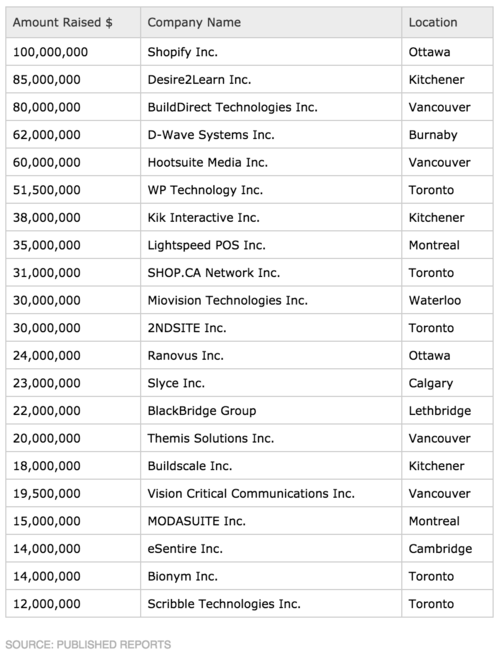
    The Globe and Mail published an interesting article this evening looking at the 21 largest venture capital investments in Canadian tech over the last 18 months. It’s called: Who needs Silicon Valley? Canadian startups scoring bigger deals.

    To put things into perspective, total venture dollars invested in Canada last year (2014) was around $1.9 billion. In the US, that number is estimated to be somewhere around $48 billion. So there’s a big spread here. But the Globe is arguing that there’s a shift towards medium-sized Canadian tech companies raising larger and larger rounds.

    Here are the top 21 largest venture capital investments made in Canada over the last 18 months:

    image

    At the same time, there’s also an attitude change that seems to be taking place. Confidence is growing. Here’s a quote from Mike McDerment of Freshbooks from the same article:

    “Our goal is to be an anchor tenant in Toronto. At Freshbooks, we want to build a global company that really contributes in some meaningful way to the city,” Mr. McDerment said. He touts the local schools and talent pool and downplays the Valley’s head start.

    “The money is shameless – it’ll just go wherever. It wants the opportunities,” Mr. McDerment said. “I don’t see why Toronto can’t beat Silicon Valley.”

    All of this is important because the medium-sized companies of today will hopefully become the large-sized companies of tomorrow. And that’s what you need to build a thriving startup hub. You need big successes. You need those companies going public and generating wealth for their employees and communities.

    Thankfully, that seems to be where we’re headed. The first company on the list above – Shopify – is already preparing for a dual US-Canada IPO.

  • Marginal cost = 0

    Earlier this week I wrote a post called: The pull from services to products. And in it I made mention of the fact that part of what’s driving this pull towards products is that the marginal cost of servicing additional users or customers is almost nothing in a world of internet services and products.

    Well the reality is that this phenomenon is driving a hell of a lot more. It could – and probably will – fundamentally change almost all aspects of the economy.

    I know that sounds like a pretty audacious statement, but if you watch the following 10 minute talk by Albert Wenger (Union Square Ventures) you might start to feel the same way. He outlines 5 changes being driven by the fact that in the digital world, marginal cost = 0. The impacts go well beyond tech, capturing sectors such as transportation and industrial real estate.

    [youtube https://www.youtube.com/watch?v=sVEtTzlqsoE?rel=0]

    If you can’t see the video, click here.

  • Do you know where you spend your time?

    Yesterday my friend Sachin Monga published a really great article on Medium called, 2014: My Year in Review. It was broken down into a few sections that included everything from his favorite blog posts of the year to all of the images he posted on Instagram. He called it “a stream of personal observations, data, and highlights for the year.”

    And it put my end of the year blog post to shame.

    One section that really stood out for me though was Places & Transit. Using a mobile app called Moves, Sachin extracted an incredible data set for where he physically spent his time and how he got around in 2014. I can’t believe I haven’t heard of this app yet – it’s totally in my wheelhouse. But I’m clearly late to the party. Facebook bought them in the first half of last year.

    The data set included how many hours he spent at home and at work. His top 3 most visited coffee shops. His top 5 most visited friends. How many nights he stayed in a hotel. His average daily commute time. And his total distance walked and cycled, among many other things. It was fascinating. I love data – especially when it was previously impossible or difficult to collect it.

    He was also able to translate his data into a set of beautiful maps, showing where he spent his time and how he got around. Here is his personal map for Toronto. The larger the circle, the more often he was there. Blue lines are cycling. And green lines are walking.

    image

    And here’s San Francisco (where he now lives):

    image

    After reading his post, I immediately downloaded Moves. And I can’t wait to see how my personal map of Toronto will look like in a few weeks and months. Once I have enough data points, I’ll be sure to share it with you all here.

    In the interim, do you have any ideas for what this kind of data might be used for? I can certainly think of many. Let us know in the comment section below.