Daily insights for city builders, delivered every morning at 6 AM ET. I’m Brandon Donnelly — a Toronto-based real estate developer and founder of Globizen. I’ve been writing here since 2013.

Tag: startups

  • The emotional journey of creating anything great

    Welcome to 2017. (We better have flying cars by 2020 or I’m going to be pissed.)

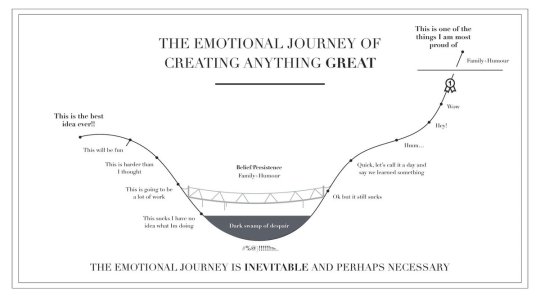
    I found the following chart on Howard Lindzon’s blog. It’s called “The Emotional Journey Of Creating Anything Great" and it’s getting shared around town right now.

    I’m sure that you’ve seen other similar charts before, but it doesn’t hurt to drive home this point, particularly as all of us kickstart the new year and promise ourselves that we’re going to be better, faster, stronger.

    The point of this chart is that when you’re creating anything new and great, there will always be the period of time that this diagram refers to as the “dark swamp of despair.” This is where you question your life decisions and wonder if you’re wasting your time trying to create this new and great thing.

    I never fully appreciated this phenomenon until I worked on a startup. Though for me, it felt more like a manic depressive rollercoaster. One week I was killing it and the next week I was in a dark swamp of despair searching for a way out. 

    And it’s because when you’re creating something new, you have few, if any, points of reference to reassure yourself that you’re on the right path. If it is truly great, then it’s probably something novel. And if it’s new, then by definition it hasn’t been done before. So it is unknown whether it’s truly a dark swamp of despair or if it just feels that way right now because things are tough.

    Because of the emotional nature of this journey, I have found myself really questioning the worth of things like caffeine and alcohol. I used to think the former made me more productive – the latter certainly doesn’t – but I’m not so sure that is the case. So as an experiment, I cut out coffee last month.

    I don’t believe in new year’s resolutions, so that’s not what all of this is about. It’s far better to talk about the things you’ve remained committed to, than to talk about the things you’re planning to do.

    This is simply a reminder that there will always be ups and there will always be dark swamps of despair. The key is to have the confidence and conviction to charge through those swamps any way you can. Onward my friends. I’m really looking forward to 2017 and I hope you all are as well.

  • A location intelligence company

    I have written about Foursquare a number of times over the years (here and here) and I continue to be a regular user. I am intrigued by all of the location-based data that they collect through their apps. 

    Below is a recent Recode Decode (podcast) with Dennis Crowley (co-founder) and Jeff Glueck (CEO) of Foursquare. They are talking about what’s next for the company. If you can’t see it below, click here.

    https://art19.com/shows/recode-decode/episodes/aa400a60-ebc1-49bb-96b1-0d7aac7ca9e8/embed?theme=black

    Here’s a content sample from Recode:

    Today, Foursquare makes most of its money from selling that data to big companies, calling itself a “location intelligence company.” But as co-founder Dennis Crowley and CEO Jeff Glueck explained on the latest episode of Recode Decode, hosted by Kara Swisher, they haven’t stopped thinking about everyday users.

    “Imagine a friend is walking alongside you,” Crowley said. “Can we make a personality like that, that talks to you in that sense? It’s not 30 years out. We’re going to be playing with this stuff a year from now.”

    “I want to make that Scarlett Johansson that whispers in your ear, but it’s all about local places and local discovery,” he added. “I want to replicate the experience of walking through the city with a friend that knows the city inside and out, and I want to make that for millions of people.”

    I thought some of you might find this interesting.

  • The 2×2 investment matrix

    Today I am thinking about product/market fit.

    Product/market fit is startup speak for being in a good market and having a product that satisfies the needs of that market. This may sound intuitive, but having the best product doesn’t matter if there’s no market for it. I like this line from Marc Andreesen: “Markets that don’t exist don’t care how smart you are.”

    So the first takeaway is to create products that people care about. Sounds simple enough. But another reason why this is a thing worth talking about is that markets evolve and there’s always a chance that you can unlock a new market that nobody else is servicing. That’s obviously riskier, but it’s an ideal scenario.

    Below is another way of thinking about that. It’s a quote from Andy Rachleff.

    “Investment can be explained with a 2×2 matrix. On one axis you can be right or wrong. And on the other axis you can be consensus or non-consensus. Now obviously if you’re wrong you don’t make money. What most people don’t realize is if you’re right and consensus you don’t make money. The returns get arbitraged away. The only way as an investor and as an entrepreneur to make outsized returns is by being right and non-consensus.”

    It’s a lot scarier to be charting new territory and sitting in the non-consensus camp. Consensus is comforting. But this is how the game works. I try and remind myself of this on a regular basis. I would like to say more, but I will leave it at that for today’s post.

  • Sign me up for Spectacles

    image

    Snapchat just changed their company name to Snap Inc. and announced a new product called Spectacles. They are sunglasses with an integrated video camera that captures a 115 degree field of view. Compared to the camera on your phone, this is more similar to what our eyes see.

    Here’s their announcement video:

    [youtube https://www.youtube.com/watch?v=XqkOFLBSJR8?rel=0&w=560&h=315]

    Some of you are probably thinking that Google already tried something like this and failed. But that doesn’t mean that Snap won’t be successful. I think Spectacles will be a huge success. 

    Evan Spiegel is calling them a fun toy right now, but lots of meaningful products start out that way (including Snapchat itself). Regardless, it strikes me as absolutely the right move for a company like Snap.

    What differentiates Snapchat is that, relative to other social platforms, the content that gets shared is far more natural and unfiltered. It empowers a different kind of conversation and a different kind of content creation.

    Still, there is something about pulling out your phone that takes you out of the moment. And Snapchat is all about sharing that moment. That’s where Spectacles come on. They are further minimizing the barriers to sharing.

    But here’s the other thing: Snap made them look cool. Google Glass looked positively dorky. I already want to take a pair of Spectacles snowboarding and on tours around different cities. I can think of so many interesting/entertaining use cases. If I were GoPro, I’d be anxious right now.

    Snap, if you’d like to send me a pair to test out, please shoot me an email. Thanks 🙂

  • The Toronto startup ecosystem in numbers

    When I met with all of the lovely folks from Amsterdam last week, one of the things that I mentioned about intensification is that it is almost certainly a contributing factor towards innovation, agglomeration economies, and the overall startup ecosystem here Toronto. 

    I don’t know to what extent, but I feel it happening. And there’s lots of research correlating urban density with innovation

    The continued densification of Toronto means it is constantly becoming easier to schedule that morning coffee before going into the office or to pop into that meetup after work. And those sorts of things are hugely valuable in today’s economy.

    I talked about a number of local startups in my presentation, including 500px, Wattpad and Wealthsimple. But I didn’t show any hard data. So I’d like to do that today. Below is a chart showing total venture funding (internet/software) and the number of deals (Seed to A/B/C/D) in Toronto since 2009:

    image

    It was taken from this Medium post. Supposedly this places us 12th in the world as far as startup cities go.

    Again, who knows how much of this venture growth has been helped along by intensification. After all: “Silicon Valley proper is soul-crushing suburban sprawl.” But I would bet money that it’s moving the needle in the right direction.

    Here is another relevant post by venture capitalist Albert Wenger where he talks about the great startup ecosystem that Toronto is growing. He posted it earlier today.

    All of this is important because some of these deals will spawn big companies. And those companies will the hire lots of people, as well as consume space. 

    Real estate developers like to talk about how they create jobs. And we do. But we can’t have a city of people just building buildings. People and businesses need to fill that space and that hinges on entrepreneurs who are willing to go out there and forge something new for themselves. Fortunately, Toronto seems to have a growing number of those kinds of people.

  • The universities that produce the most funded founders

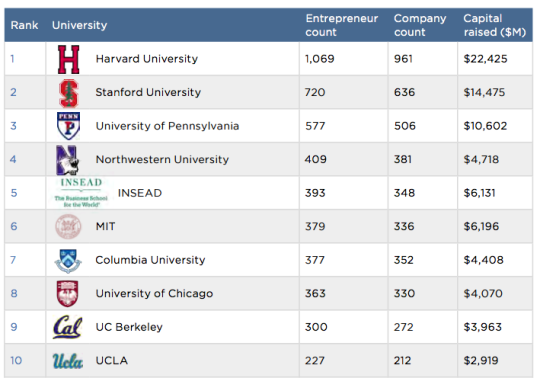
    PitchBook recently published a report looking at which universities produce the most funded founders.

    What they did was track founders of companies that received a first round of venture funding between January 1, 2006 and August 15, 2016. They then looked at which school they graduated from and sliced the data to find companies valued over $1B (”unicorns”), big exits, Ivy vs. non-Ivy league alumni, and so on.

    The full report can be downloaded here for free. However, you’ll need to enter your email. Below are some of the key highlights.

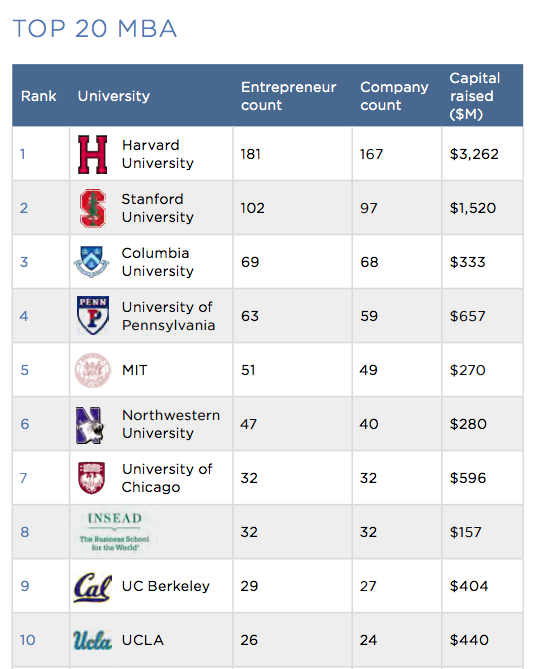
    Top 10 MBA:

    Top 10 MBA by female founders:

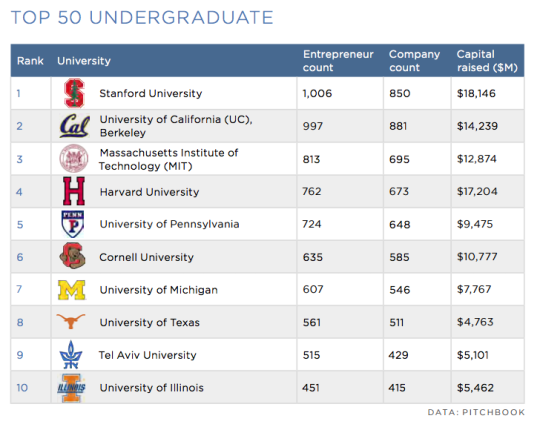
    For all of you Canadian readers, the top undergraduate schools include:

    • University of Waterloo (#20)
    • McGill University (#32)
    • University of Toronto (#33)
    • University of British Columbia (#49)

    McGill does quite well in the unicorn department, placing in the top 10. However, it is clear that Canadian universities need to step up their game.

    Of course, the question remains: what is it that is holding us back? How much of it is the school itself and how much of it is external and perhaps cultural?

  • Business model innovation

    Fred Wilson has a great post up on his blog today about open protocols. By open protocols he is referring to things like TCP/IP (transmission control protocol and internet protocol), HTTP (hypertext transfer protocol), and SMTP (simple mail transfer protocol). Whether you realize it or not, you rely on these protocols every single day if you go on the internet, browse the web, and write emails.

    If you’re interested in these sorts of nerdy things, I recommend you read his post. I’m not going to write about open protocols today – though I do find them fascinating. Instead, I would like to talk about the last paragraph of his post. 

    Here it is:

    “I believe that business model innovation is more disruptive that technological innovation. Incumbents can adapt to and adopt new technological changes (web to mobile) way easier than they can adapt to and adopt new business models (selling software to free ad-supported software). So this new protocol-based business model feels like one of these “changes of venue” as my partner Brad likes to call them. And that smells like a big investable macro trend to me.”

    This is interesting to me for 2 reasons.

    First, business model innovation is incredibly powerful. Once a company has built itself up around an existing model, it can be painfully difficult to change. Imagine you have a 200 person sales team that would become unnecessary should you pivot your business model. Are you going to fire them and make the switch?

    This is also one of the reasons why some tech companies can exist for so long before they make any money. Sometimes – but not always – it’s because the investors believe that if the company has users, attention or whatever it may be, that they will figure out a way to monetize them/it. And maybe, just maybe, it’ll be a business model that no one has ever thought of before.

    Second, look how he is publicly sharing his investment thesis. Why would he do that? Shouldn’t he just go off and do it and not tell anyone? Clearly, he too believes that there’s greater value in being open and transparent.

  • Transparent offer platform

    A new “transparent offer platform” called Haus has just launched in California to serve the residential real estate market. The way it works is that all offers are submitted online. And once an offer has been confirmed, it – along with all of its terms – gets revealed to every other potential buyer. See image below.

    image

    I’ve seen a number of different iterations of this same idea, which tells me that this is a well-identified problem in the real estate market. Here’s a snippet from a recent TechCrunch article announcing Haus:

    “We think the openness will create a more efficient market and that the number of offers and price will ultimately be dependent on demand,” said Haus GM Sarah Ham. “Bidding wars are a common, almost accepted, part of the real estate process today. But with our approach, buyers know where they stand. Buyers will know what they need to offer to make their offer competitive, but they also won’t negotiate against themselves.”

    I completely agree that this is a problem that needs to be solved. It will create a more efficient marketplace. However, in this market, I suspect that the current information asymmetries largely benefit sellers, to the detriment of buyers. So I wonder if the supply-side of the marketplace will be willing to participate at scale. What’s really in it for them?

    Side note: Haus is the latest project from Expa, which is a “startup studio” that works on its own ideas, as well as partners with other founders. I am very interested in this approach to creation because I think you have to try and make a lot of things if you want to do truly innovative things.

  • Rinse and repeat

    image

    Venture capitalist Matt Turck has a post up on his blog that is packed full of information about the New York City tech ecosystem. (He has also written similar posts about Berlin and Paris.)

    His overall thesis is that New York – as a startup/tech hub – is only now starting to catch up to the hype of 4 or 5 years ago. He now refers to NYC as the de facto Number 2 after the Bay Area.

    If you’re interested in all of this, you can go read his full post. But I would like to pull out 2 points. The first is about the “rinse and repeat” cycle that happens over time that allows cities to become substantive startup hubs:

    As any student of emerging tech ecosystems knows, the key dynamic to success is the “rinse and repeat” cycle. You need several waves of successful tech companies to go through the whole cycle of founding, financing, scaling and significant exit.   Post-exit, the hope is that successful founders, employees and investors then contribute back both money and expertise to the next generation of tech startups, a few of which eventually become highly successful themselves and then provide money and expertise to the following generation.

    The trouble is, each successive cycle takes years, because the average successful startup takes 5 to 10 years to get to a large exit.

    One key reason the Silicon Valley has become such a powerful network is that this “rinse and repeat” cycle has been happening there for decades, at least since the 1940s and 1950s (Hewlett Packard), with a real acceleration in the 1970s and 1980s (Apple IPO, founding of Kleiner Perkins, etc).

    I’ve written about this idea before, but didn’t refer to it as “rinse and repeat.” I’m thinking about adopting that terminology going forward.

    The second is a list of New York-based startups. Matt uses it as an example of how entrepreneurial activity in New York is operating across a broad cross-section of different industries. That’s an important characteristic to identify.

    However, I also thought you might find it valuable to see what startups are out there, particularly if you happen to work in one of the below verticals/horizontals. I certainly went right to the real estate line.

    Fintech: Betterment, IEX, Fundera, Bond, Orchard, Bread
    Health: Oscar, Flatiron Health, ZocDoc, Hometeam, Recombine, Celmatix, BioDigital, ZipDrug
    Education: General Assembly, Schoology, Knewton, Skillshare, Flatiron School, Codecademy
    Real estate: WeWork, HighTower, VTS, Compass, Common, Reonomy
    Enterprise SaaS: InVision, NewsCred, Sprinklr, Namely, JustWorks, Greenhouse, Percolate, Mark43, Movable Ink
    Commerce infrastructure: Bluecore, Custora, Welcome Commerce
    Marketplaces: Kickstarter, Vroom, 1stdibs
    On Demand: Handy, Via, Managed by Q, Hello Alfred
    Food: Blue Apron, Plated, Maple
    IoT/Hardware: littleBits, Canary, Peloton, Shapeways, SOLS, Estimote, Dash, GoTenna, Raden, Ringly, Augury, Drone Racing League
    AR/VR/3D: Sketchfab, Floored

    I was happy to see my friends at Floored in the above list. They are under AR/VR/3D, but they service the real estate industry.

  • One lease for the world

    image

    If you’re looking for more evidence that the way we live and work is changing, then check out a new startup called Roam. They describe themselves as an international network of communal spaces. So far, they have locations in Ubud (Bali), Miami, and Madrid. Buenos Aires and London are coming soon.

    The way it works is that you start by signing a lease for either a week or a month. You get a private room and bathroom, but everything else, from the co-working spaces to the kitchens, are shared amongst the community. Like other co-working and co-living environments, the community they build is critical.

    However, what really differentiates Roam is that you can sign one lease and then live all over the world, freely traveling across their properties. All of the locations are offered up at the same price and you can stay for as long as you’d like.

    In my line of work, I don’t have the flexibility of living like a global nomad. But today, there are many people who can. And I also know that there are many people who would prefer to live like this. It’s liberating in so many ways.

    My friend and I actually had a similar idea to this back in University and we spent some time working on it. At the time, and this was over a decade ago, we felt that there was a segment of people who increasingly wanted to live like global citizens. I still believe that to be true and, clearly, so do others.

    To date, Roam has raised $3.4 million in funding.

    Image: Ubud kitchen via Roam