Daily insights for city builders, delivered every morning at 6 AM ET. I’m Brandon Donnelly — a Toronto-based real estate developer and founder of Globizen. I’ve been writing here since 2013.
I usually write on Architect This City every day. But this past weekend I skipped both Saturday and Sunday, which is something I haven’t done in the 15 months that I’ve been writing this blog. I hate missing days. I really do. But I had no choice. I was at Startup Weekend here in Toronto.
Last Friday night, hundreds of people from Toronto’s startup community convened at the MakeWorks coworking space in Toronto’s west end to pitch and hear new business ideas. The floor is always open to anyone who would like to pitch, but you only have 60 seconds (hard stop) to convince the crowd that your idea is worth pursuing. This past weekend there were about 40 pitches.
Following the pitches, the crowd then gets to vote on their favorite ideas. The top pitches – there were 13 selected this past weekend – get to move on and the people who delivered those pitches become team leaders. They are then asked to get up one more time to tell the crowd who they need to develop their idea over the weekend. Once that happens, everyone starts scrambling around to try and put together a team. It’s all about hustle.
Immediately after the teams are formed, the work starts.
By Sunday at 5pm, you’re expected to have validated your idea and problem in front of real people, executed on some sort of minimum viable product (the solution), and ideally brought in some of your initial customers. Because at the end of the weekend, all the teams get up and deliver a 5 minute pitch in front of a panel of judges who assess you on how well you did against those 3 objectives.
It’s a weekend of raw adrenaline. I wouldn’t be surprised if I lost about 5-10 pounds as a result of how little food I ate and how much coffee I consumed.
I pitched a real estate related idea – just like I did 2 years ago at the last Startup Weekend I attended – and I was fortunate enough to win the top pitch on Friday night. I think it may have been because I said fuck in my pitch. Although, a lot of people also remembered me from the previous Startup Weekend and started calling me “Mr. Real Estate.”
Pitch 11 – Brandon dropping F bombs. Let others tell you the value of your home. #SWTO
Our team ultimately didn’t place – which may have been because it was an Internet of Things themed Startup Weekend and we weren’t that – but I think we developed a super solid business idea.
Either way, I had a blast. We knocked on people’s doors to validate our idea. We got a ton of positive feedback on what we were trying to do. And I was fortunate enough to meet a bunch of smart and ambitious people. I was so impressed by what our team accomplished.
But what I also love about events like Startup Weekend is that it shows you how vibrant the startup ecosystem really is in Toronto. There is no shortage of passionate entrepreneurs in this city fighting to change the world. And what’s great about this community is that they all know how hard it is to start something from nothing, and so they’re incredibly supportive.
If you have any interest, I would encourage you to check out events like Startup Weekend. They’re a lot of fun and they all contribute to the greatness of this city.
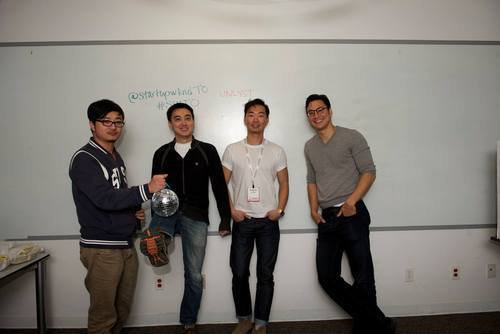
Image: The Unlyst Team at Startup Weekend TO 2014 (Jerry, Louis, Landon, and me)
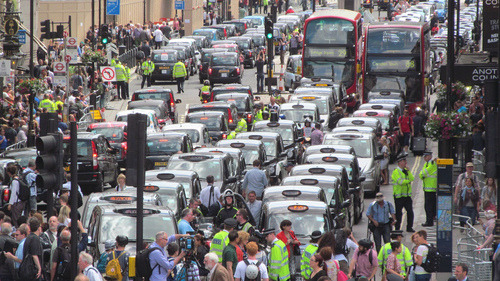
One evening this past spring I was leaving a Rotman School event at Liberty Grand on the west side of Toronto. There aren’t a lot of taxis coming through this part of the city, so I figured I was going to have to wait while I hailed one from my phone. But as luck would have it, one happened to be pulling up just as I walked out of the hall.
As he drove up and rolled down the window, I told him that I was going to the St. Lawrence Market area and that I needed to pay by credit card (I was trying to be a nice guy and avoid the inevitable fight when he was dropping me off). He responded by saying, “My machine is broken. Can’t you pay with cash?” I told him, “No, unfortunately I don’t have any cash on me. I need to pay with credit card.” He then rolled up his window and drove up closer to the entrance of the hall.
Faced with this scenario, I did what most people would probably do nowadays: I pulled out my phone so that I could hail either an Uber or a Hailo cab (I’m sad that Hailo has since left the North American market). I decided on Hailo (it was cheaper until UberX came along) and ordered a car.
But within a few minutes, the same taxi with the broken credit card machine circled back around, rolled down his window, and told me that his machine was now working and he would take me to the St. Lawrence Market. Knowing exactly what had happened, I said to him, “Wooooow, that’s funny that within the span of a few minutes your machine has magically started working again.” He wasn’t happy with that response.
Now, we all know why he didn’t want to take my credit card. He didn’t want to pay the fees and he wanted the cold hard cash. And who can really blame him for wanting to maximize his profits. But for the end user, this experience sucks. When it’s 2 in the morning and all you want to do is go home to bed, you don’t care about the few dollars he’s trying to save. You just, want, to go, home.
And that’s one of the reasons why Uber (and previously Hailo) is having such a huge impact on the market. Even before UberX arrived (the cheaper alternative), lots of people were more than willing to pay the Uber premium. And they continue to pay their controversial surge prices. But that’s because the experience is so much better than what’s offered today.
We all know that Uber is under a lot of fire for what they do, but Toronto mayor Tory is 100% right in saying that ridesharing and peer-to-peer taxis are here to stay. Toronto may be seeking a court injunction to stop the service in this city, but I would agree that it’s likely going to be a big waste of money. The cat is already out of the bag.
What’s happening here is no dissimilar to what happened with Napster. A court order may have forced the company to shut down, but it didn’t maintain the status quo for the music industry. That industry went, and continues to go through, a lot of change. So a better option, would be for everyone to sit down together and figure out what the future of the taxi industry is going to look like. Because I can guarantee you that it’ll continue to change.
Early this morning, before the sun even came up here in Toronto, I had a video conference call with a sharp and talented entrepreneur in Luxembourg. His name is Fräntz Miccoli and he’s working on an interesting startup called KonnectR.
The idea is to create a platform to connect with new people at any point in time and wherever you might happen to be. It may sound like a “hook-up” app, but that’s not the intent. He came about the idea while traveling and looking for other smart and engaging people to hang out with.
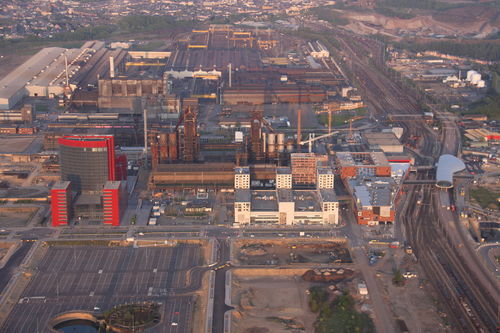
When we started the video conference call this morning, I showed him my window so that he could see the sun just starting to rise. He then showed me his coworking space, which made it seem like he is working out of an old industrial steel mill. Turns out, he is.
The area of Luxembourg he’s working out of is called Belval, which is a neighborhood in the west end of the country’s second largest city, Esch-sur-Alzette. The neighborhood used to consist of the largest steelworks in the country. But with the decline of steel production in Luxembourg, the area fell into decline. Today, it’s being reborn as a 21st century mixed-use community.
The developer behind the project is called Agora. And the site – equal to about 120 soccer fields – will house everything from residences and offices to shopping and cultural institutions. The University of Luxembourg has also centralized their campus in the new neighborhood. Having institutions “anchor” a community is becoming quite common for urban renewal programs. Here in Toronto, we did a similar thing with George Brown College along the waterfront.
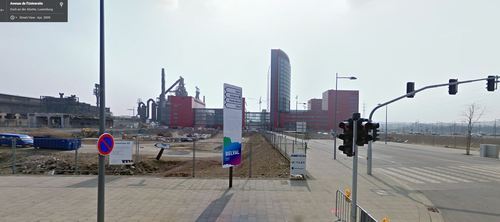
To give you a better sense of the transformation taking place in Belval, here’s a streetview photo from 2009:
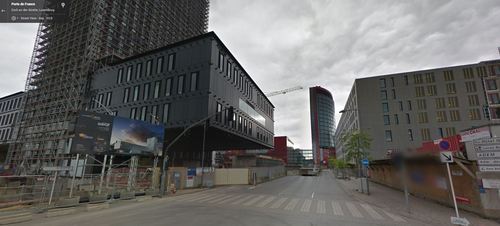
Here’s another one from the same intersection in 2013 (notice the same tower in the background):
I’m always fascinated by urban renewal projects of this scale because it so clearly speaks to the evolutionary nature of cities. Industries die. Businesses disappear. And new uses need to be found. In this case, the area has gone from steel production to tech startups. That’s not surprising.
But at the same time, I think it’s important that we don’t completely erase the past. Here, I think it’s great that they’re preserving some of the blast furnaces and other industrial structures. It gives the area character and a sense of place – which is oftentimes hard to manufacture and always better when it’s authentic.
McKinsey recently put out a great interview with one of the founders of Airbnb, Brian Chesky, talking about the relationship between his company and cities. I thought it was fascinating. Click here to watch the video.
If you don’t feel like doing that, I’ve also pasted the interview transcript below and bolded some of the really interesting takeaways. Let us all know what you think in the comment section below.
It’s a currency of trust, and that used to live only with a business. Only businesses could be trusted, or people in your local community. Now, that trust has been democratized—any person can act like a brand.
Airbnb is a way that you can, when you’re traveling, book a home anywhere around the world. And by anywhere, I mean 34,000 cities in 190 countries. That’s every country but North Korea, Iran, Syria, and Cuba.
The reason we started was I was living with my roommate, Joe, in San Francisco, and I couldn’t afford to make rent. That weekend, the International Design Conference was coming to San Francisco. All the hotels were sold out. Joe had three air beds. We pulled the air beds out of the closet, we inflated them, and we called it the “Air Bed and Breakfast.”
The reason it’s grown so fast is, unlike traditional businesses, we don’t have to pour concrete. The infrastructure and the investment was already made by cities a generation ago. And so all of a sudden, all you needed was the Internet.
The ‘disruption’ debate
I never really loved the word “disruption,” because it suggests that maybe it’s the kid in a class who was disruptive, who probably didn’t add a lot to class. I think that we have a lot to add to society.
Over time, cities have gotten so big that the sense of community has gotten lost. And I think once you know everyone, that community can reemerge. And as far as our relationship with cities, we can’t succeed without a city. Or we can’t really thrive without a city. We don’t want to thrive in spite of a city. And I think if we work together, it’s going to be amazing. I think the people win. And I think if we don’t work together or if we fight, the loser isn’t really us or the city—it’s the people in that city.
Getting cities to embrace sharing
Fundamentally, the idea of the sharing economy is going to be great for cities. It means that people all over a city, in 60 seconds, can become microentrepreneurs. And they can be empowered. And they can make an income. Now, this is amazing, but it’s also complicated because there are laws that were written many decades ago—sometimes a century ago—that said, “There are laws for people and there are laws for business.” What happens when a person becomes a business? Suddenly these laws feel a little bit outdated. They’re really 20th-century laws, and we’re in a 21st-century economy.
It’s probably going to be a fair amount of work to revise some of the laws and rethink the way cities and platforms work together, but I think that work is worth it. Because what cities don’t have to do is invest billions of dollars in infrastructure to create jobs. Whereas historically, to create opportunities, cities would need massive projects and investments, these jobs only require the Internet. Now what they need to do is navigate the legal framework, which is typically outdated. We want to work with the cities. We’re not telling them that their laws are terrible. The world continues to change. Laws must continue to adapt for that world.
We want to help cities understand what our world looks like so they can modernize the laws to make sense. We’re not against regulation. We want to be regulated because to regulate us would be to recognize us.
Airbnb’s plans for growth
We want travelers to be able to book homes anywhere. Anywhere includes Asia. Asia’s a nascent market for us. Number two, we’re also looking at other use cases. Airbnb started as a way for travelers to find a budget way to vacation in a city. But now we’re starting to see people who aren’t on a budget. They want a much more high-end experience. And the third is that at the end of the day, if you’re traveling to Tokyo, you’re not traveling to Tokyo to stay in a home or a hotel. You’re traveling to Tokyo—if you’re on vacation—because you want to have an experience. And we’d love to do more to make that experience special and memorable.
The future of sharing: Your free time
I don’t think people would view the jobs created in the sharing economy as jobs. I don’t even know if they get counted as jobs when the White House has a new jobs report. They are jobs. As far as I can tell, people are working, they’re making income, and they depend on that income. Half of our hosts depend on it to pay the rent or mortgage. Maybe it’s a new kind of job. Maybe it’s like a 21st-century job. Tom Friedman talks about how in the future people may not have jobs. They’ll have income streams.
I believe that the sharing economy broadly can probably provide tens of millions of jobs or income streams for people all over the world. This is going to have a pretty big effect on the economy, mostly a good one.
The sharing economy started by democratizing and creating access to probably two of the biggest assets people have: their homes and then their cars. But I think the whole idea of ownership is changing. When my parents were young, owning things was a privilege, and there was a sense of romance to owning a house, owning a car.
Today’s generation sees that ownership also as a burden. People still want to show off, but in the future I think what they’re going to want to show off is their Instagram feed, their photos, the places they’ve gone, the experiences they’ve had. That has become the new bling. It’s not the car you have; it’s the places you go and the experiences you have. I think in the future, people will own whatever they want responsibility for. And I think what they’re going to want responsibility for the most is their reputation, their friendships, their relationships, and the experiences they’ve had.
So I think the biggest revolution will be in the biggest asset of all. The biggest asset is not a house. It’s not a car. It’s people’s time. People’s time may start with just gigs: waiting in line for you, delivering something for you. Over time, I think it’s going to move upmarket. And eventually, menial tasks become real trades, and real trades become art forms.
Somebody may say, “I cook a great brunch. I wonder if people would enjoy having brunch at my house?” And you could be able to book a brunch at someone’s house, instead of at a restaurant. That person isn’t trying to create a restaurant, they’re just allowing someone to have brunch. They build a reputation. One day, that person can be a Michelin-rated chef in their house.
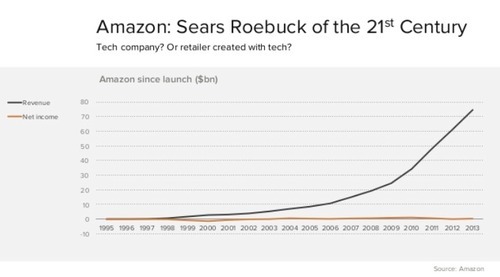
One company that came up during our discussion was not surprisingly Amazon.com. But the initial comment was that they don’t make any money. Fortunately for me I had just gone through a presentation by venture capitalist Benedict Evans the night before called: Mobile is eating the world. And so I pulled out my phone and presented this slide:
The fact that Amazon operates with basically no net income is on purpose. Look at their revenue growth! So I wouldn’t dismiss them as being a fad. They may only account for 1% of all US retail sales today, but I’d put money on that percentage growing.
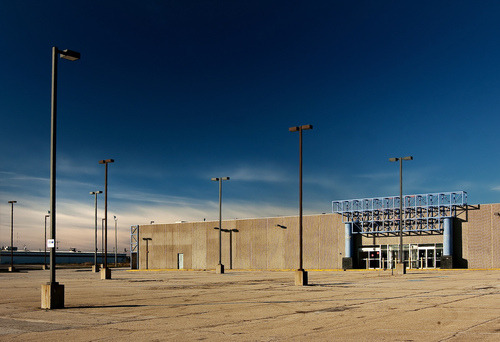
The other reason I bring up Amazon is because, in some ways, I think of them as the online equivalent of a big box store. Just like a Walmart or Costco, where you can buy everything from tires to groceries to prescription drugs, I buy a lot of different things, besides just books, off of Amazon.com. You might do the same as well. And this is where I see the immediate threat to offline retailing and retail real estate: big box stores.
In the second half of the 20th century, big box stores were incredibly disruptive to the retail landscape (and to cities). They used cheap land on the outskirts of cities, cheap buildings, and economies of scale to offer rock bottom prices to consumers. The value proposition was about cheap, not about differentiation. But as cheap as they may be, the internet can still do it cheaper.
And retailers know this, which is why I think they all now sell groceries. Groceries have a very low online penetration. Basically everybody still buys groceries in-person. So if you offer that, you have a reason to draw people inside your store, where they will hopefully buy all the other stuff that they need. But as the online value proposition continues to get stronger, I think we’ll see many other, more significant, changes.
In addition to technology, the conversation touches on a bunch of different topics such as why it’s beneficial to be an optimist and why change can be difficult for people to accept.
But they also hit on a number of broader economic shifts, such as the replacement of labor by machines, and the rise and decline of industrial production in the US. Here’s a snippet on that latter point:
You’ve described the middle class of the 20th century as a myth.
There are two middle classes. There’s the historical middle class—which is the bourgeoisie—starting in the, like, 1600s. This was the businesspeople and the traders, the merchants, the butcher, the baker, the general-store manager, the guy who was going off to China to go get silk and bring it back. Businesspeople.
But in the 1940s something really significant happened, which is we bombed the rest of the industrialized world. And so the industrial base of Germany was obliterated. Japan was reduced to rubble. The rest of Continental Europe was bombed. England was bombed. The industrial base of the world was bombed. The one major industrial country that wasn’t bombed was the United States. So the United States became the monopoly producer of industrial goods.
The army bombed the American middle class into existence?
It was an accident of history. We had a window of opportunity which we took full advantage of. We had this window from basically 1945 to 1966, 1968, in which we were basically running unopposed. In that window, all kinds of wonderful things happened. One of the things that happened was the rise of this new idea of the middle class, which there was no historical precedent for, which was college-level wages for high-school-level education. As long as there’s no competition, it’s all well and good. The minute the Japanese show up, the minute the Germans show up, it just all falls apart.
Click here for the full conversation. It’s an interesting read.
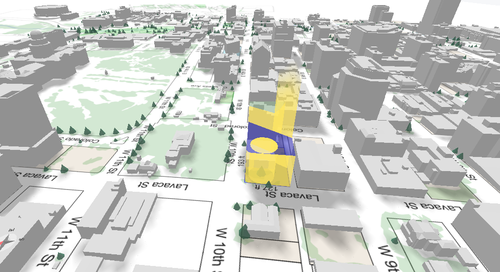
I recently wrote about a startup called Flux.io in a post titled: How technology could completely change the real estate development industry. Given that I received a lot of positive feedback on this post, I thought I would let you all know that, as of today, you can now test out the product yourself for free online.
At Flux we believe that data, analytics, and visualization can help bridge understanding between stakeholders and result in smarter growth and faster development and faster building. The Austin Preview of Flux Metro is an important first step in this direction.
Flux Metro aggregates geographic data from public and private sources to build a three dimensional visualization, starting with downtown Austin. Alongside a rendering of the existing landscape, Metro shows what can be built on a lot or parcel under the zoning code. It considers more than 10,000 code sections for land use guidelines, height limits, floor area limits, setbacks, and view access rights as well as the locations of protected trees and daylight shadows to project what can be built and how it fits into the existing environment.
We believe that everybody should be able to understand what a zoning code means for their city and that visual representations are the best way to create a shared understanding.
Click here to signup and give it a try. It is based on Austin’s development code and on the same building site that was shown in the video I shared in my post.
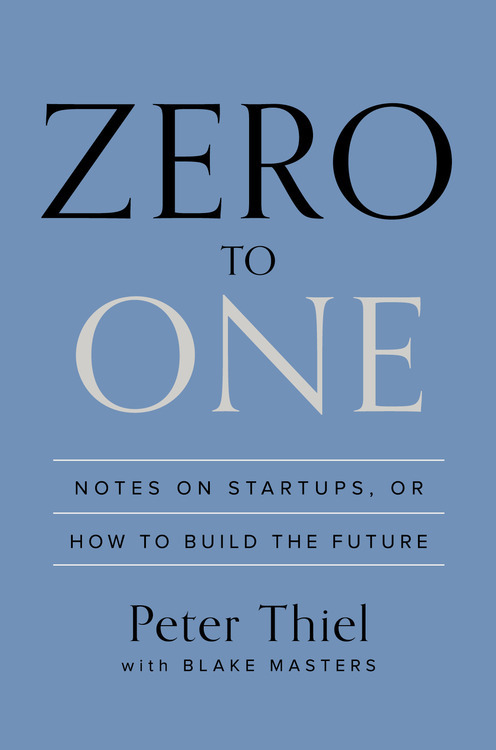
I just finished reading Peter Thiel’s new book, Zero to One: Notes on Startups, or How to Build the Future. For those of you who may not be well-versed in the world of technology geeks, Peter Thiel is an entrepreneur and investor. He was one of the founders of PayPal back in 1998 and was the first outside investor in Facebook in 2004. He invested $500,000 for a 10.2% stake in the company!
While the focus of the book is obviously on technology startups, it’s less about “here’s how you build a startup” (there is no formula) and more about “here’s how to think about the world, humanity, and the future of our civilization.” So even if you’re not a founder, or startup and technology enthusiast, I think you’d still find it really interesting.
As one example, Thiel makes the distinction early on in the book between what he calls “vertical or intensive progress” and “horizontal or extensive progress.” The specific example he gives is of typewriters and word processors. If you take one typewriter and figure out how to make 100 of them, you’ve made horizontal progress. However, if you’ve just replaced typewriters with word processors, you’ve made vertical progress.
In other words, vertical progress is doing new things and horizontal progress is just copying things that we know already work. In the grand scheme of the world, he argues that globalization is really just a form of horizontal progress. The rise of China is a result of them copying what has already worked in developed countries. But the true way to advance our economy and civilization is to not just copy – that’s easy – it’s to do, new, things.
That, of course, is a lot harder to do. But to build the future, you need to build things and do things that haven’t been done before.
If you’re involved in the built environment in any way, shape, or form – as a developer, architect, policy maker, and so on – I would highly recommend you watch the video below. My friend Candice Luck, who I went to Rotman with, sent it to me this morning with a link starting at the 24 minute mark. I haven’t yet watched the whole thing, but given how interesting this short section was, I plan to.
The video is a talk by Steve Jurvetson, who is a venture capitalist with DFJ. He was one of the founding investors in Hotmail and currently sits on the board of companies like SpaceX and Tesla Motors. At the 24 minute mark he talks about a startup called Flux.io that hasn’t yet launched their product, but is working towards “reimagining building design”. They’re a spin-off from Google X and plan to officially launch in early 2015.
Rather than try and describe the video here, I will just say that it’s an incredible example of how technology and digitization could completely change the real estate development industry. If you can’t see the video below, click here. The video starts at the Flux.io section.
Yesterday I wrote about the High Line Park in New York and the tremendous success that it has seen since the first section opened in 2009. It attracts somewhere around 5 million visitors a year and is thought to be responsible for over $2 billion a year in economic activity.
But the economic activity it’s generating and the future tax revenues it’s creating are really a byproduct of the fact that people, quite simply, love the High Line. It attracts people. And that reminded me of a short post I wrote earlier this year called: It’s all about people. Because if you think about it, that’s really the key metric for a lot of things in life and in business.
When you build a park like the High Line in New York or Millennium Park in Chicago, you’re designing it to attract people. When you build a mall, you seek out anchor tenants, because you know they drive foot traffic. When you build a new neighborhood, you’re trying to create street life from scratch. When you run a bar, you want headcount. And when you build a web or mobile app (or write a blog for that matter), you want registered users and eyeballs on your platform.
And you want these things because foot traffic, street life, eyeballs, impressions, users, and headcounts ultimately generate revenue. But here’s the thing: if you focus directly or too much on that end goal, you run the risk of missing an important step along the way, which is simply to delight real people.
In his most recent essay, startup guru Paul Graham put it perfectly when he said:
“The way to succeed in a startup is not to be an expert on startups, but to be an expert on your users and the problem you’re solving for them.
He’s obviously talking about technology products, but the same could be said for parks, streets, malls, plazas, and so on. To design and build better cities, we need to be experts on people. And we need to create spaces and environments that people actually want to occupy. Spaces that improve people’s lives.
Now, this may sound fairly obvious to some of you. But quite often I feel like we get sidetracked by things that don’t matter as much as people do.