Daily insights for city builders, delivered every morning at 6 AM ET. I’m Brandon Donnelly — a Toronto-based real estate developer and founder of Globizen. I’ve been writing here since 2013.

Tag: startup

  • The change order (ruminations on innovation)

    If any of you are in the
    business of creating – whether that’s a mobile app or a building – I’m sure
    you understand that the product or thing you’re working on will naturally
    evolve and change over time – probably in unexpected ways.

    In fact, I usually take this as a positive sign. When I have my
    head in a project and I’m focused on solving problems, ideas will naturally
    start to flow. I start thinking of things that I never would have thought
    about at the outset. That’s why I generally think of creativity as a process,
    rather than as some divine gift.

    But the challenge with all of this is that many of our existing business
    processes are not set up to deal with this kind of ambiguity. If anything we
    try and punish these sorts of deviations. If it wasn’t pre-meditated at the
    beginning of the project, we call it “scope creep” and charge extra for them as
    “change orders.” These two words equal death in construction.

    Now, don’t get me wrong, I completely understand the realities
    of running a business and the importance of managing scope and resources. It’s
    a balancing act. Without some structure, nothing would get done. 

    But the more that iterative
    lean methodologies and “design thinking” can be embedded into our processes,
    the more value creation I believe we will see.

    My thinking is as follows: At
    least part of the reason that innovation comes from startups and new market
    entrants is that the founders aren’t usually sitting around talking about defined
    scope and laying out elaborate business plans. They’re focused on creatively
    solving problems and doing whatever it takes to get there.

    It’s also one of the reasons
    that conventional wisdom dictates that tech startups shouldn’t outsource development.
    It’s too core a competency and you can’t “move
    fast and break things
    ” if you don’t have that in-house and you’re constantly worried
    about eye-popping invoices hitting your desk.

    I have always seen lots of
    parallels between startups and architecture. In both of these worlds, the idea
    you start with is rarely what you end up with (at least that’s the case in
    architecture school). You research, learn, and iterate along the way and that
    leads you in new and unexpected ways.

    And in my view, that’s often what
    the path to innovation looks like. Because if you define the entire path at the
    outset, how can you expect to go anywhere new? And if you’re not going anywhere
    new, how can you expect to outperform the market?

  • Rentberry brings open bidding to rental market in San Francisco

    A new startup out of San Francisco, called Rentberry, has just launched, allowing tenants to openly bid on rentals in the city. Think of it like a rental auction. Landlord lists property. And then tenants compete for it by submitting offers. 

    Not surprisingly – especially since we’re talking about San Francisco – there’s concern that this will do nothing but drive up the city’s already high rents.

    But I think the key detail is that the platform will make public the total number of applicants. As a tenant, it’ll even tell you how your credit score compares to those of the other bidders (presumably, so you can gauge how aggressive you might need to be on your bid).

    The real estate industry is rife with information asymmetries. So anything that improves transparency is something that catches my attention. If you’ve ever bought or rented a place in a competitive market, you know that one of the worst things you can hear from the broker is: “We have another offer.” (Even worse: “We have 12 other offers.”)

    It’s frustrating because it now means you’re competing. But even more frustrating is the fact that you have no way of assessing whether or not that statement is fact or fiction. Yes, I realize that there’s a code of ethics that’s supposed be followed, but you and I both know that games are played all the time.

    In fact, I think someone could easily make a full career out of just trying to correct the information asymmetries inherent in the real estate industry. Who knows what sort of impact they might be having on the market. So I’m excited to see how things pan out for Rentberry.

  • WeWork launches first co-living space in New York

    I’ve written about co-living spaces before – here and probably elsewhere on this blog.

    Well this morning, WeWork (the co-working startup currently valued at a cool $16 billion) unveiled its inaugural co-living space on New York’s Wall Street. It’s called WeLive and Vanity Fair describes it as “Soho House meets Airbnb meets a tricked-out Restoration Hardware storeroom, but for the Slack Set.” 

    Got it?

    Ultimately, this location at 110 Wall Street will have 600 fully furnished WeLive apartments, but they’re coming online in tranches. This first release includes 200 units. Here’s a bit of information on pricing from Fast Company:

    “There are 200 units available—ranging from $1,375 per person in shared apartments to $2,000 for an individual studio—all with the option of either a month-by-month or yearly lease (a $125 monthly fee covers amenities). The apartments are about 450 square feet on average, with the largest units topping out at 1,000 square feet (one-bedroom apartments in the area, by comparison, range in prices from about $2,850 for 451 square feet to $3,500 for 700 square feet). Each apartment comes fully furnished, minimally decorated, and set up with cable and Internet at move-in.”

    But this is not just about price. The WeLive concept is about creating a strong sense of community within the building. Every floor, for instance, has some sort of common area to foster interaction – a space for yoga classes, a laundry room with a big pool table, and so on.

    I am interested in seeing how this concept pans out because I’ve had discussions before with people in the industry about how condos/apartments might be programmed to feel a bit more like hotels. Years ago, I even spoke to a major European company about trying to pioneer a model like this.

    Because there’s something very social about being in a hotel – something that I really like. You can walk down to the lobby bar by yourself and you never know who you might meet. That’s not really the case in many multi-family buildings.

    Now, part of that might have to do with the fact that people tend to be more open when they travel. But maybe WeLive can help create that kind of social interaction within the apartment building. I think that would be a positive thing.

  • The value of lifestyle in attracting human capital

    When I was in Revelstoke, BC last year I met a number of people who had made the move out there from Toronto. When I asked if they missed living in a big city, pretty much everyone gave me the same answer: “No, I love it here.”

    This past week when I was in Park City, Utah, I similarly met a number of people who had made the move from New York and other large cities. And when I asked them the same question, I heard statements like: “I used to live in New York, but then I got a life and moved out here." 

    In these two examples, the obvious draw is the mountains. But it’s not like everyone just moved and became a ski bum. In fact, Inc Magazine recently published an article talking about Park City’s robust startup scene. People are figuring out how to combine hard work with the lifestyle they want.

    What I find interesting about this is that it runs counter to the trend of young people preferring big cities. Here’s a quote from NPR:

    “But affordable real estate and waterfront views don’t have millennials biting. They continue "a multigenerational pattern of young adults preferring more expensive urban areas over lower-cost rural ones because the lifestyles and opportunities in such places make the extra burden of cost worth it,” says Robert Lang, professor of urban growth and population dynamics at the University of Nevada, Las Vegas.”

    However, some small towns clearly have a unique lifestyle advantage: mountains. And that seems to be a strong enough draw that some people are simply figuring out how to create the economic opportunities for themselves.

    For me, this is yet another reminder that if you’re trying to attract the best human capital to your city or town, you need to think about lifestyle. And since young adults aged 18-34 are far more likely to move around than any other generation, you should also be thinking specifically about what this generation wants.

    Here’s a chart from CityLab that shows how precipitously migration falls off (in the U.S.) once people finish school and get settled in a job:

    image

    Obviously, not every town or small city is blessed with mountains. But there are many lifestyle advantages that can be created. It’s for this reason that I keep talking about nightlife and Toronto’s laughable 2AM last call. Those are lifestyle things and we can do better.

  • Coworking, coliving, and an old architecture school project

    Coworking spaces are big business.

    One of the biggest of those companies is WeWork. As of last month (November 2015), the company had raised close to a billion dollars from investors like JPMorgan Chase, Harvard Management, and Benchmark Capital, and was valued at $10 billion. (Remember though, this is in the private not public markets.)

    If you’re unfamiliar with coworking spaces, check out this post from The Spaces. It’s a great demonstration of how beautiful these spaces can be.

    All of this is interesting because it speaks to the changing nature of work. There are a lot of people freelancing, participating in the “online gig economy” and working on new ideas. And in many of these cases, they don’t want or need traditional office space and/or they want the community that many of these coworking spaces afford – both offline and online.

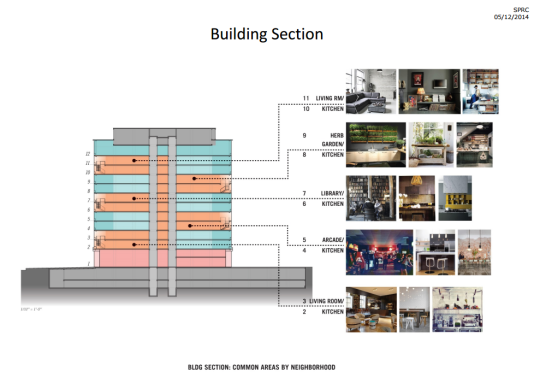
    But it’s not just the office that is changing. It’s also potentially living spaces. Since 2014, WeWork has been talking about their new coliving concept, WeLive. The idea here is to combine smaller living spaces with larger common areas and create an overall live-work community. And they are not the only ones thinking about this.

    Below is a building section of what this might look. It’s from a Vornado Realty presentation. They are working with WeWork to deliver their new WeLive concept in Crystal City, Virginia.

    It’s so interesting to see this concept come to fruition. Back in 2008 when I was in architecture school, I worked with a classmate of mine and designed a modular coliving apartment building. It was called the Philly Flex Dwelling and it worked like this:

    The idea here was to start with standard floor plates and use a structural exoskeleton to minimize interior columns. This way you could insert whatever prefabricated modules you wanted and also re-purpose the structure should you want to change the building’s use in the future. 

    This is not that dissimilar from what was originally proposed for One Bloor West here in Toronto. Though the goal there was column-free retail spaces. 

    The yellow spaces are the shared common areas and the remaining spaces are the residential living “pods.” We also designed a “solar skin” that was perfectly tuned to the building’s orientation and location in Philadelphia. The idea here was to maximize winter sun (for heating) and minimize summer sun (to keep the building cool).

    That was a fun project to work on.

  • Throwing butts

    For whatever reason, some of the people living in high-rise buildings believe that if you flick a cigarette butt off a balcony that it will magically disintegrate on the way down. It’s either that or they don’t give a shit about anyone else.

    Because if you happen to live in or manage a building which has patios or terraces at the base of tower, I bet you have this problem:

    image

    Above is a picture of a Belmont cigarette burning through the tarp covering the wooden harvest table on my patio. 

    It’s a destruction of property, an environmental concern (many butts end up in stormwater drains), and a pretty scary fire hazard. I know of many incidences where thrown cigarette butts have started fires in a high-rise building. It happened last year in my mother’s building.

    However, the frustrating thing about this problem is that it’s exceptionally difficult to stop. I know this because I sit on the board of my condo building. The typical response is for management to send out notices to all the residents asking them to stop doing this. But frankly, that does nothing.

    So if any of you know of a company or service (or have a product idea) that can help with this, please contact me. But if no such company or service exists, I am positive that you could create it today and sell to almost every condo corporation and property management company that have a condition where terraces or patios sit below a tower. Because inevitably, there will be someone upstairs throwing butts.

    Many buildings have a similar issue with dog poo. People simply don’t pick up after their dogs. So some property managers have started taking stool samples of every dog who lives in the building. That way they can easily determine which residents aren’t picking up after their dogs. I guess that’s what it takes to get some people to give a shit.

    Of course, this isn’t a problem just in buildings. Cities in general are always fighting litter. That’s why you see ideas like this pop-up:

    //platform.twitter.com/widgets.js

    This particular one (in London) was designed to stop people from throwing their cigarette butts on the street. Instead, you use your butt to vote. In this case: England vs. Australia.

    We talk a lot about big ideas here on Architect This City. What driverless cars will mean for cities, how laneway housing could help with housing affordability, and so on. But the smallest ideas can also matter a lot for city building. Sometimes we forget that.

  • Find the best local construction professionals at the lowest prices

    One of my closest friends, who also happens to be in the same industry, is currently testing out a new construction marketplace idea. It’s called Tenderlet and it’s an online platform that helps your average house or condo owner “find the best local construction professionals at the lowest prices.”

    Right now it’s just a basic website, but he is obviously thinking that it could grow into a far more robust online marketplace.

    The way it works is real simple:

    1. You tell Tenderlet about your construction job – everything from a water damaged ceiling repair to new hardwood flooring. 
    2. Tenderlet goes out and gets multiple quotes on your behalf (just like how the professionals do it). 
    3. Then Tenderlet comes back to you with at least 3 quotes and a recommendation. It’ll even handle scheduling and payments.

    Eventually he’s imagining that there will be a mobile app, reviews for the construction professionals, and a location dimension, which can make all the difference, particularly for smaller jobs. But you have to start somewhere.

    I think he’s on to something here. I know I want to use it. So I would encourage you to check out tenderlet.com and give it a try. If you have any feedback about the idea, I am sure he would love to hear from you in the comment section below.

  • Peer-to-peer solar startup

    Airbnb is a platform that connects people who have extra space with people who need space. It’s a peer-to-peer hospitality company.

    Yeloha, which is a startup I just discovered today, is a peer-to-peer solar company based out of Boston. 

    In the same vein as Airbnb, it connect people who have extra roof space (that’s suitable for solar collection) with people who want to buy solar energy (but may not have a solar friendly roof).

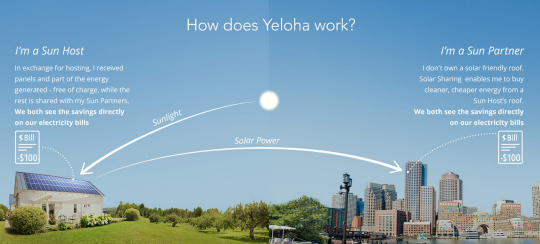
    Here’s an image from their website that explains how it works:

    image

    Basically, if you have a solar friendly roof, Yeloha will come and install solar panels on top of your place for free. You get to keep some of the energy that’s generated (about 1/3 apparently) which becomes a credit to your electricity bill. You are then known as a “Sun Host.”

    The remaining energy gets fed back into the grid and, if you don’t have a solar friendly roof, you can purchase this excess energy, which also results in a credit to your electricity bill. The solar electricity is less expensive than the regular grid electricity. In this case, you are known as a “Sun Partner.”

    I think this is a pretty neat idea. Neither party has to pay anything upfront. Both parties save money. And the result is more solar through a distributed and virtual net metering setup.

  • Urban Engines launches app

    [youtube https://www.youtube.com/watch?v=FZ8ODREybcs?rel=0]

    About 9 months ago I wrote about a new startup called Urban Engines that was trying to improve urban mobility by using big data to optimize transit usage. 

    Last Tuesday the app launched in 10 cities across North America. So if you’re in Boston, Chicago, Los Angeles, New York, Portland, Seattle, San Francisco, Toronto, Vancouver, or Washington D.C., you can go ahead and download it right now.

    The biggest “wow factor” is probably the augmented reality feature that allows you to hold your phone up and see transit information overlaid on top of the street in front of you.

    But more fundamentally, the real potential lies in the platform’s ability to collect data on the way people move in cities and on how transit lines are performing, so that it can be fed back to improve overall efficiency.

    That’s why the company is also working with cities to give them 24/7 analytics and reporting on how every bus, car, and train is performing in their networks.

    My hope is that with better data at our disposal, we’ll be able to elevate the discussions around transit and transit planning. Without great data, it’s too easy for these discussion to become political.

  • The Tesla Easter egg

    I was rushing to get to a real estate forum dinner last night and so instead of walking — which is normally what I would have done — I decided to grab an UberX. As some of you might be aware, I like UberX. It’s convenient to use. And the fares are cheaper than regular taxis. So why wouldn’t I use it?

    But last night I got an extra treat. A guy named Mike picked me up in his Tesla Model S:

    //platform.twitter.com/widgets.js

    According to Mike there are two of these “Easter eggs“ in the UberX Toronto fleet, which I was also told is now up to hundreds of cars. So it’s not everyday that you’ll get picked up in a Tesla.

    If you’ve never been in a Tesla, the first thing you’ll likely notice is the absolutely epic screen that sits in the dash. Most people’s laptops don’t have a screen this big. It’s gorgeous.

    But there are a bunch of small details that also standout. For example, the door handles sit flush with the door until they’re needed. Here’s a video of how they work:

    [youtube https://www.youtube.com/watch?v=UxavZ2QxuLY]

    But the real question that is probably on your mind is: Why is some guy with a Tesla driving around Toronto offering rides via UberX? That was certainly one of the first questions I asked him after I got in the car.

    And the answer is that he does it for fun.

    He actually owns a medical clinic in Markham, but comes downtown on the evenings and weekends to drive around and meet new people. In fact, he called it the “best networking tool on the planet.” Because as soon as he picks people up in his Tesla, they immediately take him seriously and want to have a conversation. That has translated into business relationships and even invites to parties. As in, he drives a group to a party and they ask him to come in — which he said he often does.

    If he really took it seriously and did it full-time, he figures he could make around $40,000 – 50,000 a year driving for UberX. And I believe that’s close to what a regular taxi driver would make. But again, that’s not why he’s doing it. Isn’t it interesting how things change?