Daily insights for city builders, delivered every morning at 6 AM ET. I’m Brandon Donnelly — a Toronto-based real estate developer and founder of Globizen. I’ve been writing here since 2013.

Tag: st lawrence market

  • Turns out, pedestrianization actually increases retail sales volumes

    As many of you know, I have been keeping a close eye on the pedestrian-only pilot that is currently underway on Market Street. And judging from all the engagement that my tweets usually get, a lot of you would love to see a lot more of this kind of urbanism both here in Toronto and elsewhere. (When Kensington Market?) The below photo was taken on Friday evening and Cirillo’s Academy, which is a culinary event space at the foot of the pedestrian-only stretch, was running some sort of event. All of the tables were filled with diners and it was basically a full fledged restaurant in the middle of the street. It was great to see.

    But the question that always comes up with these sort of initiatives, particularly here in North America, is: Will it hurt the businesses? To answer that, here’s a study that @economistcarson shared with me on Twitter that looks at the economic impact of street pedestrianization in Spanish cities. What the researchers did was essentially look at card transaction data from a major Spanish bank and then overlay it on top of land-use changes from an Open Street Map dataset. In doing so, they discovered some pretty important takeaways.

    Here’s what they found:

    • Pedestrianization actually increases retail sales volumes
    • Geographic location within a city tends to be insignificant
    • The two key factors for driving revenue are: (1) store density and (2) store category
    • For store category, the largest positive effect was observed for cafes, restaurants, bars, and other non-tradeable, local consumption activities

    What this last point is saying is that people, at least in Spanish cities, tend to prefer pedestrian-friendly environments when it comes to experience-based activities. And that makes complete sense. On the other hand, if you’re just running out for a little toilet paper and hemorrhoid cream, having a nice pedestrian-first experience is less critical. And this also makes sense.

    Some of you, I’m sure, will correctly point out that Spain has, on average, better weather compared to a place like Canada. And that their store densities and overall densities are likely higher, and that they have deep historic urban fabrics to rely on. All of these things are certainly factors. But I don’t think any of this should stop us from working to better optimize our cities for pedestrians. There are lots of successful examples all across Canada. It can work. Just look at Market Street.

  • Which building or structure would you say best symbolizes Toronto?

    I tweeted this out last night:

    blogTO then picked it up and it got quite a bit of engagement.

    Some people, okay a lot of people, used it as an opportunity to be tongue in cheek and respond with things like: cheaply built condos, boarded up Starbuckses, Hooker Harvey’s, Drake’s house in the Bridle Path, the crumbling Gardiner Expressway, and that McDonald’s at the northwest corner of Queen and Spadina (this one is no longer a contender for me now that they’ve gotten rid of their walk-up window).

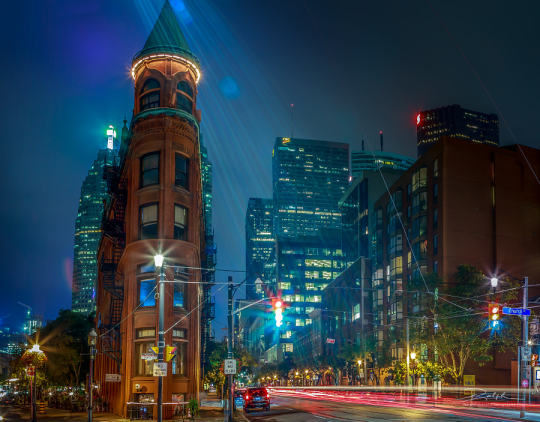
    Of course, there were also a lot of the usual suspects: The Sky Dome, The Gooderham Building (our miniature Flatiron Building), Casa Loma, The Royal Ontario Museum (specifically the expansion by Studio Libeskind), “New City Hall”, The Royal York Hotel, Honest Ed’s, The St. Lawrence Market, Robarts Library (University of Toronto), and a bunch of others that you might find displayed on the seat screen on your next Air Canada flight.

    But I’d like to unpack the initial question a bit more. Because what does it really mean for something to be a symbol of a city? And is there an important distinction between the symbols that resonate with locals on a personal level and the symbols that get exported around the world as a city’s brand and identity? Indeed, one of the criteria in most global city rankings is a prominent and recognizable skyline. Icons are important.

    Let’s consider an example. I agree entirely with Sean Marshall that “New City Hall” is a deeply symbolic building. Built in the early 1960s after decades of work, New City Hall was the outcome of an international design competition. And it was decidedly modern at a time when Toronto really wasn’t that modern. Montréal was the biggest and most global city in the country and multiculturalism hadn’t yet become a federal mandate. And so New City Hall symbolized our genuine ambitions to becoming something more.

    But does the rest of the world care? If you were to ask somebody my question on the streets of Rio de Janeiro or Tokyo, what would they say? What would they remember? The thing about most tall buildings or other city symbols is that they become abstractions. They turn into pictures on social media — like logos of a company. But maybe that’s all we can reasonably ask of the world. Maybe all that really matters is that a symbol has local significance; it’s then up to us to export it and tell that story to the rest of the world.

  • Should Market Street be pedestrianized?

    Next to the St. Lawrence Market (here in Toronto) is an appropriately named street called Market Street. It is a lovely street — perhaps one of the nicest in the city. It’s old and historic and it was completely redone several years ago (evidence here) with nice unit pavers, bollards, a curbless design, and seasonal restaurant patios.

    In the winter months, the restaurant patios are packed up and additional parking is added to that side of the street. It was designed to be adaptable and in my experience it seems to be working quite well.

    Right now the local Business Improvement Area is running a pilot project to see what this street might be like if it were to be pedestrianized. It was closed to vehicles this past weekend and the same will happen this upcoming weekend. Here’s a photo of what that looked like on Saturday:

    It’s not perfect. A number of people commented on Twitter that the seating needs some shade. But hey, it’s a pilot project. It is about giving people a taste of what the future could be.

    I am a fan of pedestrianized streets in the right locations and when executed well. And I think this stretch of Market Street is a perfect candidate. It’s already pedestrian-only to the north of Front Street and it has the right kind of “edges” to ensure that it can be properly animated.

    If you feel the same way, I would encourage you to fill out this short survey that the St. Lawrence BIA has put out. I would also be curious to hear your thoughts on pedestrianized streets in general. Leave a comment below.

  • Morning bagel run

    image

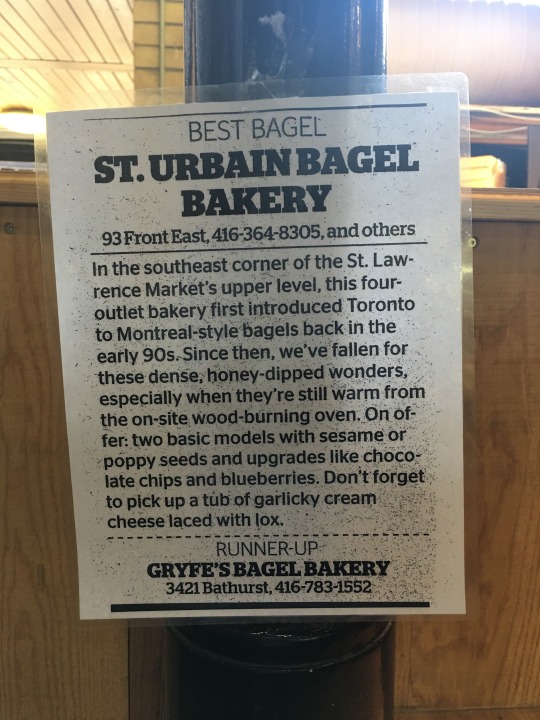
    This morning I woke up and decided that I could go for a bagel with lox and cream cheese. I figured, it’s the weekend, I’m going to treat myself. So I walked across the street to St. Urbain Bagel Bakery (see above photo).

    My Montreal friends reading this are probably thinking that this is no substitute for a Fairmount or St-Viateur bagel. But I enjoy St. Urbain. They are my go-to place for breakfast in the market.

    What I really value, though, is the ability to walk across the street and grab a bagel for breakfast. It’s a pretty simple action. Nothing complicated about it. 

    But in our world of constant traffic jams, cars that should soon drive themselves, and near-instantaneous online delivery, it can be easy to forget that there’s still something really nice about just walking down the street in the morning and saying hello to a human.

    I feel lucky that my neighborhood allows me do this. Not all do.

  • Global street artist paints 8-storey mural in midtown Toronto

    This morning

    (Friday, July 8th)

    at 11AM eastern time, the global street artist Phlegm will start work on a giant 8-storey mural at the corner of Yonge + St. Clair in midtown Toronto. It’s going up on the west elevation of 1 St. Clair West.

    Here’s what it will look like when it’s complete:

    image

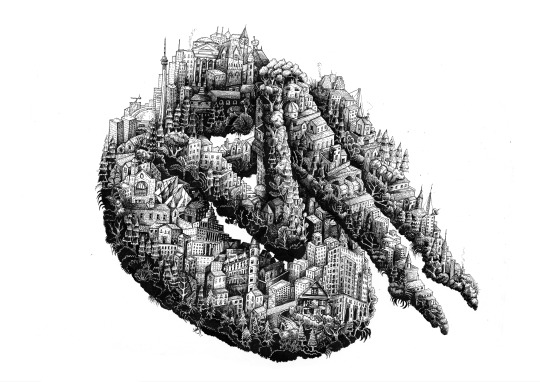
    The piece is intended to be experienced at two different scales. From afar, you read it as a human figure embracing itself. (See it?) Once you get closer, you are then drawn into an intricate interpretation of the Toronto landscape – both built and natural.

    Embedded within are depictions of the Royal Ontario Museum (including Daniel Libeskind’s Crystal), the SkyDome (yes, the SkyDome), the St. Lawrence Market (my hood), the CN Tower (obligatory), as well as other landmarks in the city. It’s going to be awesome.

    The project is a STEPS Initiative and it is being supported by the City of Toronto, Slate Asset Management, CBRE, CIBC, and a few others. They have also setup a great website with a live webcam, so that you can follow along as the artist works.

    At the time of writing this post, nothing yet has happened. But by the time it reaches you (email subscribers) it should be well underway. The hashtag for all of this is #PHLEGMPAINTS

    Big things are starting to happen at Yonge + St. Clair.

  • The year of the laneway

    Earlier this week, Metro News published an article saying that it’s going to be a big year for laneways in Toronto:

    “2016 is going to be the year where the evolution of our laneways lands at the forefront of our public realm strategy,” said Downtown Yonge BIA chair Mark Garner, who’s heading up the revitalization of O’Keefe Lane near Ryerson University.

    In addition to the Downtown Yonge BIA, much of this is being spearheaded by the non-profit group, The Laneway Project. This year they are expected to unveil plans for the revitalization of 3 laneways in the city – one of which is right in my backyard.

    I have a lot of respect for what The Laneway Project, the Downtown Yonge BIA, and others are doing in support of rethinking our laneways. And so today I just wanted to publicly thank them for their efforts. Thank you 🙂

  • Saturday morning bike ride to the Bluffs

    This morning I got up at 7:30am and met a good friend of mine at the St. Lawrence Market for breakfast.

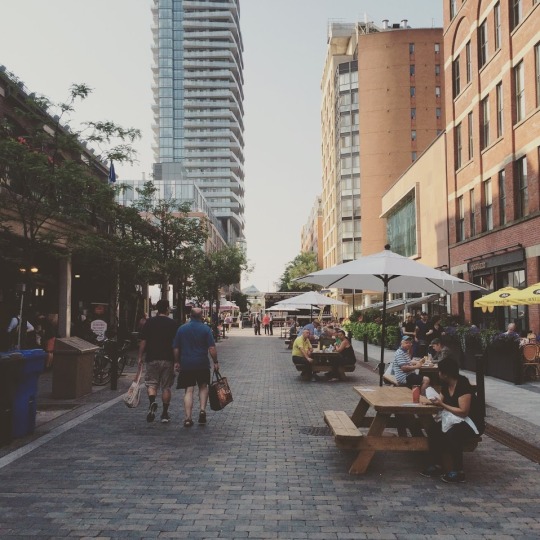
    Market Street is closed to cars today so it’s pedestrian-only. It should be this way all the time. They had a pig roasting on a spit when I walked by and a big stage set up. 

    Below is a photo of what it looks like. Keep in mind that this photo was taken just after 8:00am, which is why it’s not all that busy, yet.

    image

    When Market Street was redone a few years ago, the original vision for the street was for it to be pedestrian-only. But somebody told me that the city didn’t want that. Too bad. It strikes me as a perfect candidate for that.

    After breakfast, we then biked out to the Scarborough Bluffs in the east end of the city. If you click here, you can see the path we took via Strava. It’s only about 15km from downtown. The ride through the Beaches was by far the best stretch. The water was on my right hand side. The pavement was smooth and continuous. And I had George FitzGerald on my headphones for pacing.

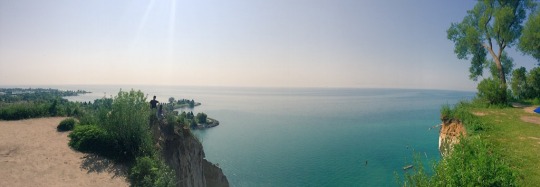
    When we got there, this was the view we were presented with:

    image

    It honestly doesn’t feel like Toronto. The water is turquoise and there’s a beautiful beach at the bottom of the cliffs. It felt like paradise.

    If you’ve never been to the Scarborough Bluffs, do yourself a favor and get out there on a beautiful summer day. It’s the dog days of summer and Toronto is a magical place right now.

  • What food is your city famous for?

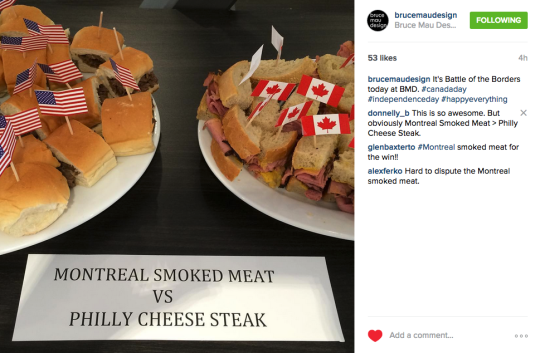
    Yesterday I came across the above Instagram post by Bruce Mau Design, which pitted the Philadelphia Cheese Steak sandwich against the Montreal Smoked Meat sandwich in a “battle of borders.” It was to celebrate both Canada Day and American Independence Day.

    I thought this was an awesome idea, so I tweeted out the photo. Then Daniel Kay Hertz – who is a Senior Fellow at City Observatory and from Chicago – asked me: “Is there a Toronto equivalent?

    And that got me thinking. 

    Montreal has smoked meat, bagels, and poutine. Philly has the cheese steak. Chicago has deep dish pizza. Quebec City has maple sugar and tourtiere (a kind of meat pie). New Orleans has po’boy sandwiches. Boston has clam chowder. Austin has tacos. Seattle has crab. And the list goes on.

    But what is the quintessentially Toronto dish? Asian fusion food? Peameal bacon sandwiches from the St. Lawrence Market? I really don’t know. So I think we should decide on one right now. Think of it as an exercise in city branding.

    Leave your suggestion in the comments below and we’ll have a vote.

  • A new chapter

    Photograph St. Lawrence by Ralph Sobanski on 500px

    St. Lawrence by Ralph Sobanski on 500px

    I have an announcement to make on Architect This City today.

    Next week I’m joining the development team at CAPREIT (TSE: CAR.UN) here in Toronto. CAPREIT is one of Canada’s largest residential landlords. They are a growth-oriented real estate investment trust with over 41,839 residential units in major urban centers across both Canada and Ireland.

    They also happen to be headquartered in the St. Lawrence Market area, which means I now live and work in the same neighborhood. As we discussed here, location matters a lot.

    So here’s to a new chapter. I’m looking forward to diving into the multi-family business. Change is good.

  • Towards more publicness

    Back when the commercial internet first started to take off it was uncommon to use your real name online. Instead people relied on usernames and other pseudynoms to represent themselves. I honestly can’t remember what I used in those days, but I’m sure it was something ridiculous.

    Over time though that started to change. 

    Blogging started to take off in the late 1990s. And we started to become more comfortable sharing personal information online. Perhaps the biggest shift though, came with the introduction of Facebook in 2004 (over 10 years ago!). All of a sudden people – young college students initially – started sharing lots of personal information online, including photos of themsleves and their friends.

    But this wasn’t an overnight change. When Facebook first launched, privacy was an important component. It still is, but I would argue that it has become less central given how public a lot of other social media platforms are today. Twitter, for instance, is what it is today largely because of its publicness. 

    For my own social media accounts, I have made every single one of them completely public. From Twitter to Facebook to Instagram to Snapchat, nothing I post to social media is restricted in any way. And I do that because I believe we are headed towards a world with more – not less – openness, transparency and publicness.

    Of course, I’m not just talking about social media and tech. I’m talking about open data in general.

    Earlier this year, the Toronto Real Estate Board clamped down on real estate brokers who were publishing historical sales data online. Citing privacy concerns, TREB ordered them to stop or lose their access to the MLS system. 

    For those of you not from familiar with the Toronto real estate market, historical sales data for homes is not open and published online. You generally need to go through a realtor to get access to this data. Some think this is the right approach. And others think it is antiquated.

    But as I explained above, our conception of what should be private can, and will, evolve over time.

    Here are the details on my home:

    I purchased it in September 2012 for exactly $400,000 (Canadian). It’s a 650 square foot condo in the St. Lawrence Market neighborhood of Toronto. It has one bedroom, a 400 square foot terrace, one parking spot, and 10′ ceilings.

    Sooner or later, I believe this information will be freely available online. But since that’s not the case today, I figured I would just tell you. Sharing this information is not a big deal for me.