Daily insights for city builders, delivered every morning at 6 AM ET. I’m Brandon Donnelly — a Toronto-based real estate developer and founder of Globizen. I’ve been writing here since 2013.
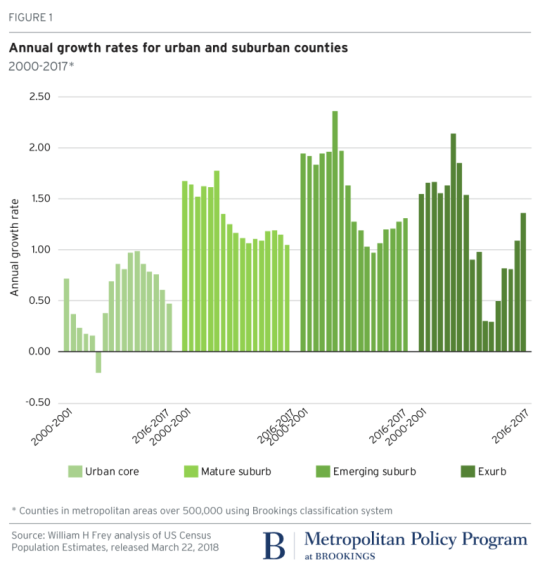
According to newly released US census data for 2010-2017 – which Brookings analyzed here – the “back to the city” movement appears to have peaked in 2012. (This is something that we’ve looked at before on the blog.)
Here is a graph from Brookings showing the annual growth rate for urban and suburban counties. Note how growth in the “urban core” peaked in 2012 and how growth in both the “emerging suburb” and “exurb” have increased since then.
The other finings from Brookings are that growth has slowed in large metropolitan areas (small metro areas and non metro areas, on the other hand are up) and that people are continuing to move from the Snow Belt to the Sun Belt.
If you look at population gains and losses from 2016-2017 for the 100 largest US metro areas, the only Snow Belt gainers within the top 20 are New York (15th), Columbus (19th), and Boston (20th). Dallas, a Sun Belt city, was first with a gain of 146,000 people.
So what’s going on? The narrative is that soon as the US economy and housing market recovered from the Great Recession of 2008, the trend lines simply reverted back to business as usual: sun and sprawl.
Albert Wenger recently published a post on his blog about architecture and basic income. Albert is a venture capitalist and is currently working on a book called World After Capital, which I have mentioned before on this blog. He is also an advocate of basic income as a solution to the growing inequality that the modern economy seems to be producing.
In this latest post he wades into the world of architecture with two assertions that I would like to respond to today. The first is that with basic income the current trend of everyone piling up in large cities will end. We will decentralize in search of cheaper land on the outskirts of cities. And the second is that affordable housing could perhaps be produced with a more open source approach to architectural drawings and new construction.
In terms of his first point, I’m not entirely clear why someone earning a basic income would suddenly decentralize. In the comments there is some discussion about how retirees, on a fixed income, often move outward in search of more affordable housing. I understand that phenomenon, but I am not convinced in this scenario.
There has been lots of talk about the demise of cities because of new technologies and other factors. But agglomeration economies have proved, again and again, to be a powerful centralizing force. Let’s also not forget about the environmental impacts of large scale decentralization, which would only be partially mitigated by the widespread adoption of electric vehicles.
Secondly, you can build a house without an architect. The issue isn’t that good bathroom details are hard to come by. Some of the bigger issues are likely the availability of land (decentralization, I guess, is supposed to solve this); construction costs (it’s a highly inefficient process that generates copious amounts of waste); and the immense regulatory burdens imposed on new construction (process, time, and costs).
All of this stemmed from a visit that Albert did with a group of architecture students who are researching the relationship between architecture and basic income. I would be very curious to see what they produce.
The U.S. Census Bureau recently released it’s 2016 city and town population estimates. The press release can be found here.
The headline isn’t a new one. Southern cities continue to grow quickly. This is not a new trend. Humans seem to like warm weather and the housing supply in southern cities tends to be more elastic. This keeps home prices relatively in check and allows the cities to more easily accommodate growth.
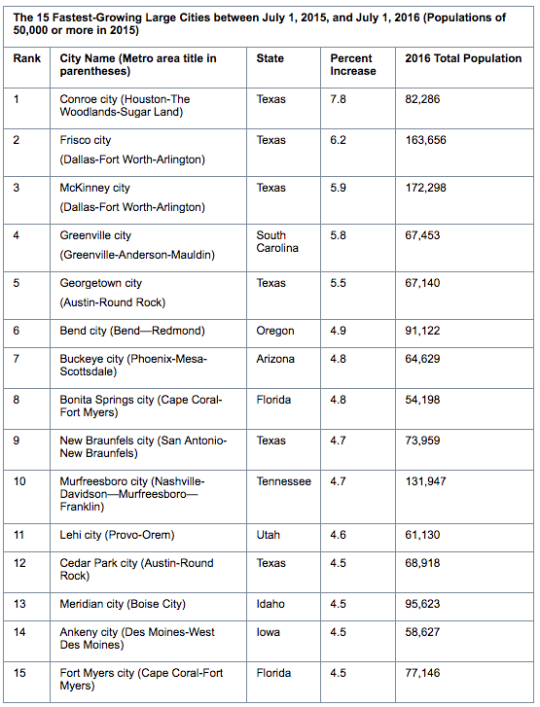
From July 2015 to July 2016, 10 of the 15 fastest growing large U.S. cities were in the south (based on % growth). 4 of the top 5 were in Texas.
From 2010 to 2016, the population in large southern cities grew an average of 9.4%. Cities in the west clocked in at 7.3%. And cities in the northeast and midwest were at 1.8% and 3.0%, respectively.
Two outliers near the top are Seattle and Denver. Since 2010, the population of these two cities grew 15.39% and 14.87%, respectively. I’m going to say it’s because of the skiing and snowboarding. Half-joking. For the top 25 large cities ranked by 2010-2016 growth rate, click here.
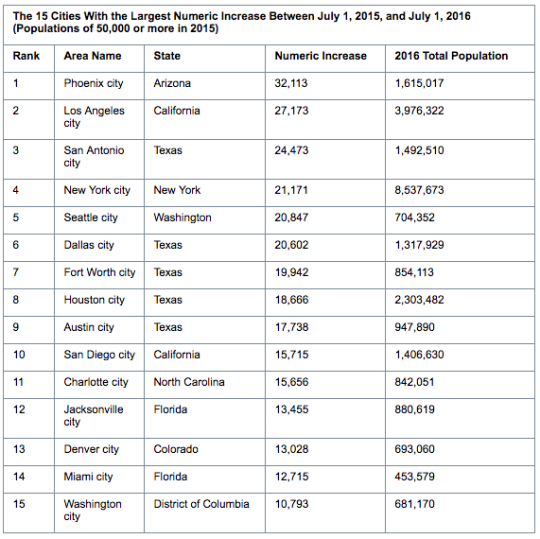
In terms of absolute humans, Phoenix had the largest numeric increase between 2015 and 2016: 32,113 or about 88 people per day. After Phoenix it’s Los Angeles (27,173), San Antonio (24,473), New York (21,171), and Seattle (20,847). These are all city proper figures.
It’s also worth noting which large cities aren’t growing. From 2015 to 2016, Chicago fell -0.32% and Detroit fell -0.52%. Philadelphia was only slightly positive at 0.19%. Going back to 2010, Chicago is still flat at 0.27% and Detroit is even more negative at -5.39%. Philadelphia is 2.5%.
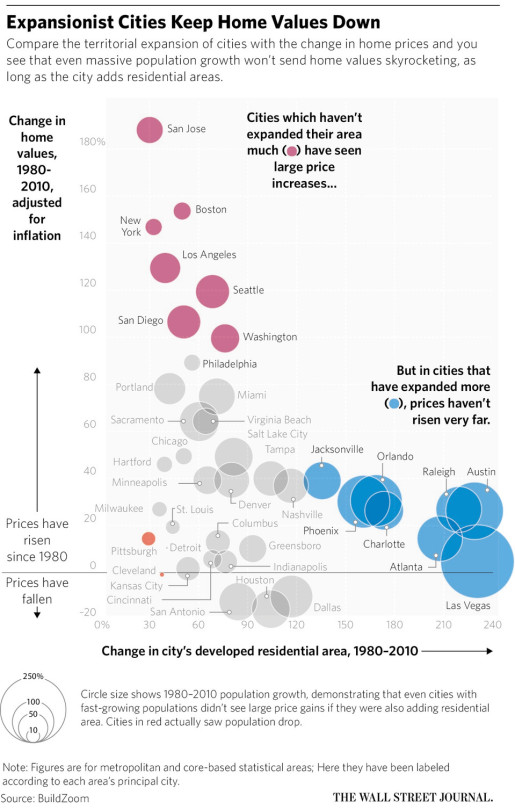
The WSJ article is about the growing divide between affordable and expensive cities in the US. And the argument is that expansionist, or sprawling, cities are better at suppressing home values and maintaining affordability:
“The developed residential area in Atlanta, for example, grew by 208% from 1980 to 2010 and real home values grew by 14%. In contrast, in the San Francisco-San Jose area, developed residential land grew by just 30%, while homes values grew by 188%.”
Now, here’s a chart saying that same thing:
The reality is that greenfield development (suburban sprawl) generally has far fewer barriers to development than urban infill development. So I’m not surprised to see cities like Las Vegas, Atlanta, and Phoenix clustered towards the bottom right.
At the same time though, I’m obviously not convinced that sprawl is an optimal outcome. I think there are other costs not reflected in the chart above. So what’s the best solution here, assuming we want to build inclusive mixed-income cities?
Urbanists generally don’t like to talk about cities like Houston. It sprawls. It’s car oriented. It’s over air-conditioned. In other words, it’s the antithesis of the dense and walkable cities that urbanists today like to tout as being exemplary.
But despite all this, Houston is one of, if not the, fastest growing city in America. According to The Economist, the population of the Houston metro area grew faster than any other city in America between 2000 and 2010. And between 2009 and 2013, its real GDP grew by 22%.
So why is that? Here’s a snippet from that same Economist article (“Life in the sprawl”):
Paradoxically, perhaps the city’s biggest strength is its sprawl. Unlike most other big cities in America, Houston has no zoning code, so it is quick to respond to demand for housing and office space. Last year authorities in the Houston metropolitan area, with a population of 6.2m, issued permits to build 64,000 homes. The entire state of California, with a population of 39m, issued just 83,000. Houston’s reliance on the car and air-conditioning is environmentally destructive and unattractive to well-off singletons. But for families on moderate incomes, it is a place to live well cheaply.
So while Houston may not check off all of Jane Jacobs’ boxes, it does provide one important thing: cheap housing. And that’s clearly valuable for a huge number of people.
But the other interesting thing about the snippet above, is that it starts to illustrate how frequently supply constrained markets operate with housing deficits.
The fact that the entire state of California issued only about 30% more building permits than the Houston metro – which you could easily argue is closer to a “perfect market” – tells me that there’s probably a lot of people bidding for the same housing in California.
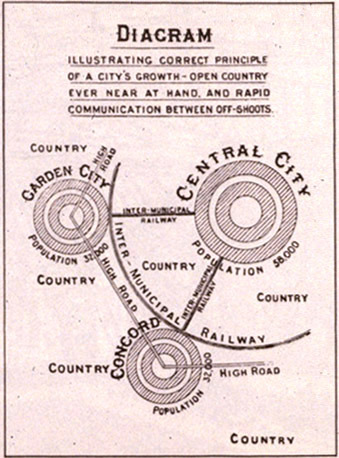
In the book, the authors argue that the solution to our suburban problems is to return to a “tragically interrupted, 150-year-old tradition” known within urban planning and architectural circles as the Garden City movement. Here’s how Arieff describes it:
The garden suburb is — because it still exists in many places — a planned, self-contained village located usually outside a major city. Ideally, it features a variety of housing types, though by variety, we’re talking single-family homes and a few low-rise multifamily buildings.
In contrast to the suburbs we’ve come to be most familiar with, these featured homes are situated in a comfortably dense, highly walkable environment designed around a public center or square.
But in addition to being more dense and walkable, the big difference for me is that the garden city (to use the original terminology) was initially intended to be self sufficient economically–rather than just serve as a bedroom community for the central city.
It was all incredibly rational. As one garden city reached its population and employment projections, the next garden city node would be created and connected to the network via road and rail. And by using land relatively intensely, it meant that more of the countryside could be preserved as undeveloped land.
But while I would agree that the suburbs aren’t going to go away (I’ve said this before) and that we should be making them more dense and walkable, the book (well, the article) got me wondering to what extent the Garden City model applies from an economic standpoint. Should we be trying to create poly-centric cities with tidy little self-sufficient pockets of employment? Or should everything primarily feed a central city?
The irony of the decentralized information economy is that it appears to be encouraging centralization across and within cities. But even before the rise of the internet and other technologies, there have always been real economic benefits to firms clustering in cities. Known as agglomeration economies, it’s one of the reasons cities even exist in the first place.
Certainly, there’s a lot we can learn from the way we used to build and plan our cities and towns (they were designed around people as opposed to cars). But something doesn’t sit right with me in terms of the way the Garden City movement thinks about cities, economically. It seems idealistic.